Hungary to Take Delivery of New Gripen C Fighters in 2026. Technical Analysis, European Positioning, and Budgetary Implications of a Modernized Fleet.
In summary
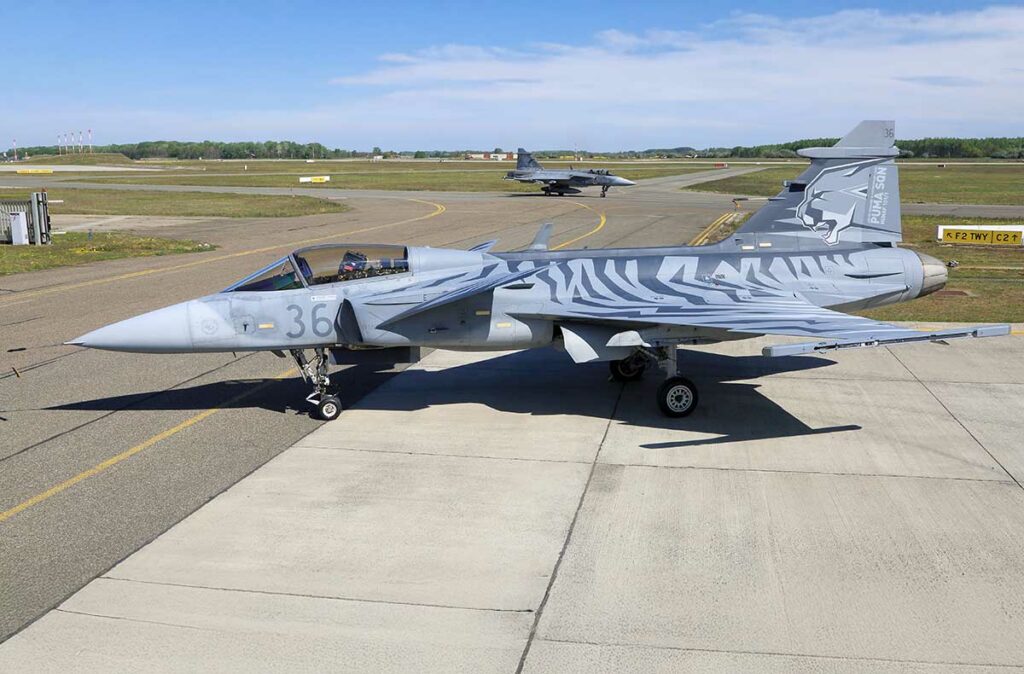
At the end of April 2026, Hungary took delivery of two new JAS 39 Gripen C fighter jets, bringing its operational fleet to sixteen aircraft. This delivery is part of a contract signed in February 2024 for four additional aircraft, two of which are scheduled to arrive this summer. Budapest has been operating the Gripen since 2006 under a lease-to-own agreement, which has gradually been converted into ownership. This expansion remains modest in scale but consistent with the country’s strategy: maintaining a credible air defense capability compatible with NATO standards while keeping costs under control. In a European context marked by the accelerated modernization of combat fleets, Hungary is taking a pragmatic approach: strengthening an existing system rather than switching platforms. The choice of the Gripen thus reflects a balance between operating costs, interoperability, and operational sovereignty.
Delivery of New Gripens as a Continuation of a Proven Model
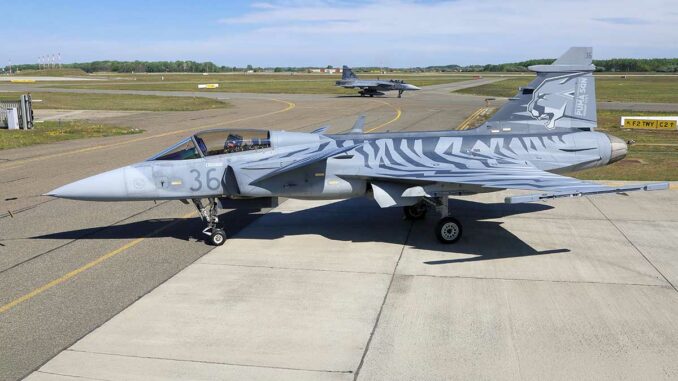
The arrival of two new Gripen C aircraft at the Kecskemét Air Base marks another step in the consolidation of the Hungarian fleet. These single-seat aircraft complement a fleet that previously consisted of 12 Gripen C and 2 two-seat Gripen D aircraft, used for training and certain specific missions.
The contract signed in February 2024 calls for the acquisition of four additional aircraft. Two were therefore delivered in the spring of 2026, while the remaining two are set to join the fleet in the coming months. Once these deliveries are complete, Hungary will have 18 aircraft, the majority of which will be operational C versions.
This decision to stick with a proven version of the Gripen is worth noting. Unlike other European countries investing in next-generation platforms such as the F-35, Budapest prioritizes continuity. The Gripen C remains a versatile aircraft, capable of air-to-air and air-to-ground missions, with modernized avionics and NATO compatibility.
Since entering service in 2006, the Gripen has been the backbone of Hungary’s air defense. The initial arrangement was based on a lease agreement with Sweden, which was subsequently renegotiated and extended through 2026, then converted into a phased acquisition. This approach allows Hungary to spread out its investments while maintaining high operational readiness.
Hungary’s Strategic Position in Central Europe
The expansion of the Gripen fleet is part of a broader strategic framework. Hungary, a NATO member since 1999, plays a specific role in Central Europe. Its geographical position, between the Balkans, Eastern Europe, and the Danube region, makes it a key contributor to collective defense.
The Hungarian Gripen fleet regularly participates in NATO air policing missions. These operations involve monitoring and intercepting unidentified aircraft in allied airspace. Hungary has notably contributed to these missions in the Baltic states and Slovenia.
With a fleet of 16 to 18 aircraft, Hungary does not aim for regional air superiority. The objective is different: to guarantee a credible minimum capability, capable of ensuring the sovereignty of its airspace and contributing to allied missions.
By comparison, countries like Poland have embarked on a more ambitious modernization program, with orders for F-35s and FA-50s. The Czech Republic, which also operates the Gripen, has announced its intention to transition to the F-35 by 2030. In this context, Hungary’s strategy appears more conservative.
This choice can be explained by several factors. First, Hungary does not face a direct threat comparable to that of the Baltic states. Second, its defense budget remains limited. Finally, the Gripen offers a solution that is sufficiently capable for current missions, without requiring a costly technological leap.
Choosing the Gripen Over Western Alternatives
The JAS 39 Gripen C stands out due to its unique positioning in the fighter jet market. It is a lightweight, single-engine aircraft designed to offer a good balance between performance and cost.
Technically, the Gripen C can reach a maximum speed of approximately Mach 2, with a combat range of around 800 to 1,000 kilometers. It is equipped with a PS-05/A radar capable of tracking multiple targets simultaneously. Its armament includes modern air-to-air missiles such as the AIM-120 AMRAAM, as well as guided air-to-ground capabilities.
One of the Gripen’s major selling points remains its operating cost. This is estimated at between 4,000 and 7,000 euros per flight hour, depending on configurations and sources. By comparison, an F-16 often exceeds 15,000 euros, while an F-35 can reach 30,000 to 35,000 euros per hour.
This cost difference partly explains Hungary’s choice. For a country with a limited budget, the Gripen allows for maintaining regular air operations without straining public finances.
Another advantage is simplified logistics. The Gripen is designed to be operated from dispersed bases with a reduced crew. This capability, inherited from Swedish doctrine, offers significant resilience in the event of a crisis.
Finally, NATO compatibility remains a key criterion. The Gripen is fully interoperable with allied systems, allowing Hungary to participate in joint exercises and operations without major difficulty.
The Budgetary Framework and Defense Prioritization
The budgetary issue is central to Hungary’s strategy. In 2024, Hungary crossed the threshold of 2% of GDP allocated to defense, in line with NATO targets. This budget amounts to approximately 4 to 5 billion euros per year, according to estimates.
Within this framework, investments must be carefully prioritized. The purchase of four additional Gripen aircraft is part of a broader program to modernize the armed forces, known as Zrínyi 2026.
This program also includes the acquisition of armored vehicles, artillery systems, and helicopters. The focus is not exclusively on air power. The decision to reinforce the existing fleet rather than acquire a new fighter jet helps limit infrastructure, training, and maintenance costs.
The cost of a new Gripen C is estimated at between 50 and 70 million euros per unit, depending on equipment and associated support. For four aircraft, the total investment could therefore reach approximately 200 to 250 million euros, excluding ancillary costs.
Added to this are expenses related to modernizing existing aircraft, particularly regarding avionics and weapons systems. Hungary is thus seeking to extend the service life of its fleet while enhancing its capabilities.
This approach contrasts with that of certain European countries that have chosen to completely replace their fleets. Hungary is adopting an incremental approach, which is slower but more financially sustainable.
The Industrial and Political Implications of the Partnership with Saab
The choice of the Gripen entails a close partnership with the Swedish manufacturer Saab. This partnership goes beyond the simple acquisition of aircraft. It includes industrial, technological, and political aspects.
Hungary benefits from technology transfers and cooperation programs. In particular, Saab has developed local industrial partnerships, contributing to the Hungarian defense ecosystem.
Politically, this choice strengthens relations between Budapest and Stockholm. It aligns with a European approach, distinct from American programs such as the F-35.
This positioning is not neutral. It reflects a desire to diversify partners and preserve a certain strategic autonomy. Hungary, while remaining a member of NATO, seeks to balance its dependencies.
The Gripen, as a European platform, offers this possibility. It allows Hungary to avoid total dependence on American technologies, while remaining compatible with Western standards.
A measured build-up in the face of a changing environment
The delivery of new Gripen aircraft comes amid a context of rapid transformation of air forces in Europe. The war in Ukraine has accelerated modernization programs, with a build-up of air capabilities in several countries.
Faced with this dynamic, Hungary is adopting a cautious stance. It does not seek to rival the major European military powers. Its objective is more focused: maintaining a credible and reliable operational capability.
This approach has its limitations. A fleet of fewer than twenty aircraft remains vulnerable in the event of a high-intensity conflict. The question of long-term modernization is already arising, particularly in light of the arrival of advanced air defense systems.
However, within the current framework, the Gripen meets the identified needs. It allows Hungary to fulfill its obligations within NATO while keeping costs under control.
Hungary’s strategy illustrates a reality that is often underestimated: in defense, performance is not measured solely in technological terms. It also depends on the alignment between capabilities, objectives, and available resources.
The expansion of the Gripen fleet is consistent with this logic. It does not transform Hungary into a major air power, but it consolidates an essential capability, tailored to its strategic environment and budgetary constraints.
War Wings Daily is an independant magazine.