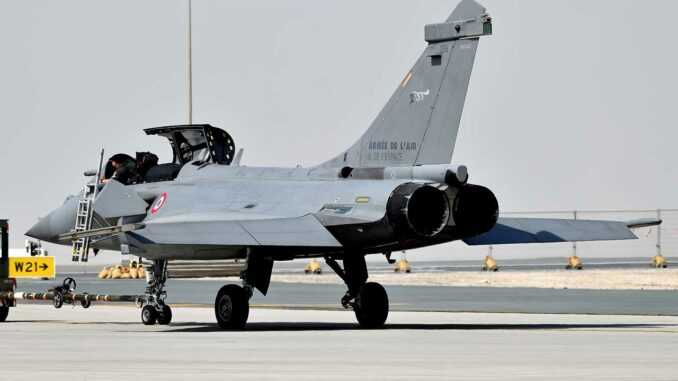
The Rafale F5 is poised to achieve a capabilities breakthrough with the T-REX engine, ASN4G, and collaborative combat to penetrate hardened air defenses.
In summary
Between March 29 and 31, 2026, several revelations brought the Rafale F5 back to the forefront of French strategic debate. The most discussed aspect concerns the T-REX engine, developed by Safran to give the Rafale increased thrust without altering the dimensions of the current M88. The issue is significant because it is not merely about a performance gain. It is about preparing the aircraft to carry more payload, generate more power, maintain its range in a heavy configuration, and integrate the future ASN4G missile, touted as hypersonic. That is the real challenge. The Rafale F5 is not intended to become a hypersonic aircraft itself. It must become a platform capable of penetrating airspace locked down by multi-layered defenses such as the S-400 or S-500, by combining range, speed, electronic warfare, connectivity, stealth drones, and next-generation missiles. It is an industrial, operational, and nuclear ambition.
The Rafale F5 as a response to a sky that has become hostile
The Rafale F5 standard is not a mere upgrade for convenience. It is a direct response to the densification of modern air defenses. For several years now, major powers have been deploying long-range radars, multi-layered surface-to-air missiles, passive detection systems, jamming capabilities, and more advanced interceptors. In this context, the traditional idea of penetration relying solely on speed or radar stealth is no longer sufficient.
France understood this early on. The F5 must combine several components: a modernized manned aircraft, a stealth combat drone derived from the nEUROn program, enhanced connectivity, massive onboard data processing, and the integration of the future ASN4G. In other words, the Rafale is no longer conceived as an isolated aircraft, but as the center of a broader offensive system.
This is where we must be frank. The rhetoric about an aircraft capable of “breaking through the impenetrable” is politically effective, but technically it should not be interpreted as a magical promise. No non-stealth fighter becomes invulnerable when facing an integrated air defense architecture. The French approach is more realistic. It consists of saturating, jamming, and shifting risks; firing from farther away; striking faster; and reducing exposure time within the enemy’s air defense bubble. It is a strategy of operational breakthrough, not invisibility.
The T-REX engine as the cornerstone of the capability leap
The M88 T-REX engine is the building block that gives coherence to this ambition. In 2025, Safran officially announced a version with a thrust of 9 tons with afterburner, which is 20% more than the current M88, while also announcing that the dimensions, modularity, target fuel consumption, and cost of ownership would remain unchanged.
In other words, the goal is to achieve more power without requiring a complete redesign of the Rafale’s airframe.
Why is this point so crucial? Because the Rafale, in its current version, already boasts an external payload of 9.5 tons, a maximum takeoff weight of 24.5 tons, and a maximum speed of Mach 1.8. The problem, therefore, is not to make it a more spectacular aircraft on paper. The problem is to maintain credible performance when the aircraft carries heavier, bulkier, and more drag-intensive loads, while meeting growing demands for cooling, electricity, and mission power.
The T-REX addresses precisely this. More thrust means a less hindered takeoff, better acceleration, a more comfortable margin at high altitude, an increased ability to conserve usable fuel, and better management of heavy configurations. In modern combat, this makes a significant difference. An aircraft that takes off with a strategic missile, fuel tanks, sensors, and—in the future—a collaborative combat environment cannot make do with an engine designed for the previous generation.
The T-REX must also be viewed as an industrial milestone. The 2025 parliamentary debates showed that this engine is seen as a useful stepping stone between the current M88 and the requirements of the future NGF engine. It is therefore not just about boosting the Rafale. It is about maintaining continuity in high-level military propulsion expertise.
The Hypersonic Ambition: A Misunderstood Topic
The word hypersonic captures everyone’s attention. It impresses, it simplifies the narrative, it fuels headlines. But it also clouds understanding of the program. What France is preparing is not a Rafale flying at Mach 5. That would be absurd in the short term, and the aircraft’s airframe is not designed for that. The hypersonic ambition focuses first and foremost on the weapon, not the platform.
The future ASN4G is described in parliamentary documents as a high-speed missile—that is, hypersonic and maneuverable—intended to succeed the upgraded ASMPA by 2035. This detail matters greatly. A missile of this category is not just about speed. It is designed to complicate interception, shorten the enemy’s reaction window, and restore the credibility of the airborne component of deterrence in the face of advancing missile defenses.
The T-REX is therefore not the engine of a hypersonic Rafale. It is the engine of a Rafale capable of deploying a weapons system based on hypervelocity. This is a crucial distinction. The increase in thrust serves the mission, not the myth.
A second point must be added. Hypersonic technology is not a magic wand. A very fast missile also poses challenges in terms of guidance, thermal management, trajectory control, target detection, and cost. France appears to accept this. It is not seeking volume. It is seeking assured penetration using a limited number of delivery vehicles of very high strategic value.
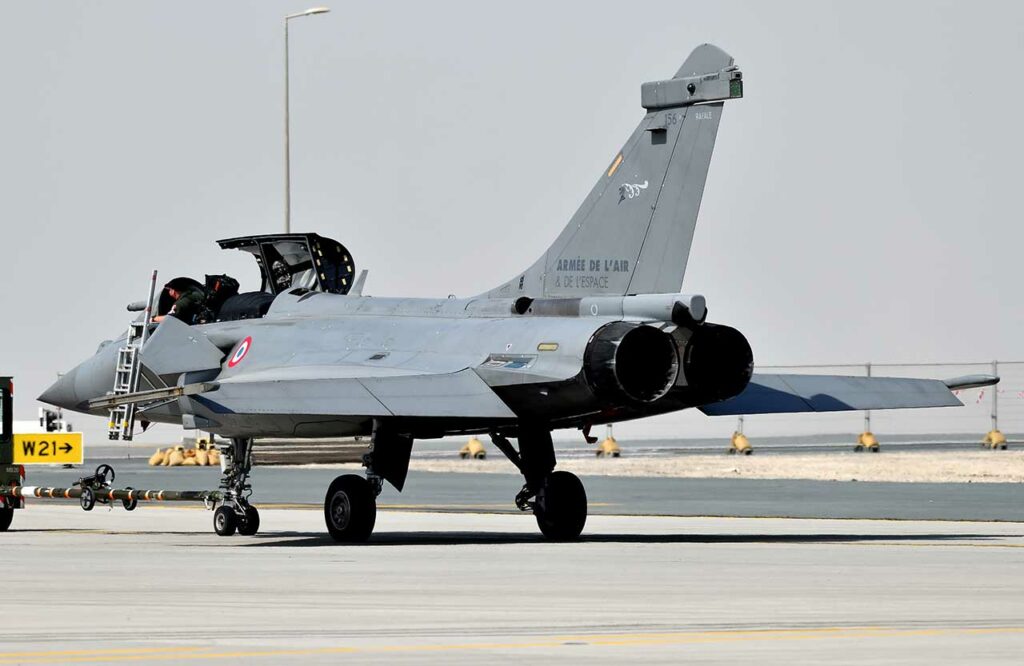
The S-400 and S-500 Systems as a Doctrinal Counterpoint
When discussing the S-400 and S-500, we must avoid slogans. These systems are not impenetrable walls, but they impose a reality: access to airspace is no longer guaranteed. According to public data, the S-400 is generally credited with a range of up to 400 kilometers with certain missiles, while the S-500 is cited by Russian sources and several public analyses as having a range of up to 600 kilometers against certain aerial targets. These figures should be treated with caution, as they depend on the missiles used, the target’s profile, altitude, and the quality of the sensor network.
The key lies elsewhere. These systems are not valued solely for their range. They are valued for their integration into a network: radars, electronic warfare, data links, advanced sensors, and even their complementarity with other ground-to-air layers. This is what complicates the mission of an attack aircraft.
Faced with this type of threat, the Rafale F5 must play on several fronts. First, shoot from further away using next-generation weapons. Next, shift the risk to a stealth drone capable of opening, illuminating, or disrupting. Finally, reduce exposure time through improved performance when entering and exiting the zone. The T-REX doesn’t eliminate the problem. It makes this approach more credible.
The nuclear dimension as the true heart of the program
We can talk about engines, sensors, or the S-500 for hours. Yet the heart of the matter remains deterrence. The F5 is primarily structured to accommodate the Rafale F5 – ASN4G pairing. It is this requirement that largely explains the standard’s level of ambition.
French budget documents show just how much of a priority the issue has become. The ASN4G program has entered a more committed phase, with a sharp increase in commitment authorizations in 2026. This budgetary signal means one simple thing: France no longer views this missile as a distant prospect, but as a program that must be locked in now if the 2035 deadline is to be met.
This is also why debates over the timeline are sensitive. According to official and parliamentary sources, the F5 is sometimes presented as expected in the early 2030s, sometimes with a first delivery targeted for 2033, and full alignment with the ASN4G by 2035. There is no total contradiction. There is a difference between an available standard, an initial delivery, and full strategic capability.
The Communication Aspect and the Reality
Publications from March 29 to 31, 2026, portrayed a Rafale almost transformed into a sanctuary breaker. The image is powerful. It is not entirely false. But it deserves to be put into perspective.
The most solid reality is this: the Rafale F5 is poised to become a heavier, more connected, more nuclear-capable, more collaborative, and better-suited-to-modern-defenses platform.
The T-REX engine is essential to this upgrade. The ASN4G gives the program its strategic depth. The stealth drone must compensate for some of the vulnerabilities of a fighter that, despite its qualities, is not a fifth-generation stealth aircraft.
France’s strategy is therefore very clear. It does not consist of copying the F-35. Nor does it consist of waiting for the SCAF as a distant solution. It consists of pushing the Rafale to the absolute limit of what its airframe, architecture, and industrial base can still offer.
It is an ambitious, costly, and risky gamble. But it is also a coherent one. In a Europe that often speaks of sovereignty without always embodying it, France is choosing a more direct and transparent path: maintaining a credible national fighter aircraft capable of facing the toughest defenses, and preserving its airborne nuclear capability without depending on a future program that remains uncertain. The T-REX, behind its spectacular name, says exactly that: the Rafale F5 does not seek to become another aircraft. It seeks to remain a game-changer in a world where access to the skies is closing in.
War Wings Daily is an independant magazine.