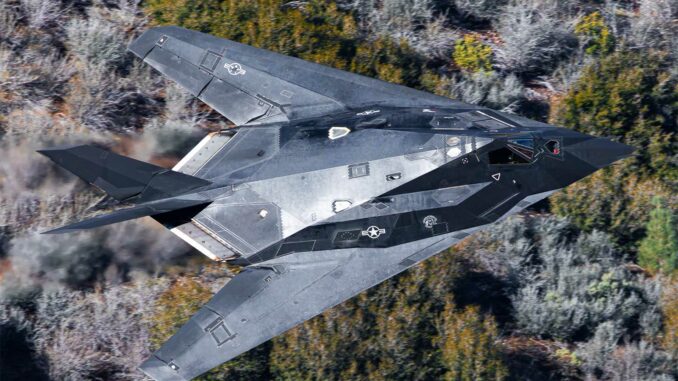
How the work of Pyotr Ufimtsev allowed Lockheed to design the F-117, history’s first operational stealth aircraft.
In Summary
The F-117 Nighthawk was not born from a more powerful engine, a thinner wing, or superior speed. It was born from a calculation. In the 1960s, Soviet physicist Pyotr Ufimtsev published research on the diffraction of electromagnetic waves by surfaces and edges. The USSR saw no immediate military application for it. Lockheed, on the contrary, understood that these equations could be used to calculate an aircraft’s radar signature. The result would be the Echo 1 software, then the Have Blue demonstrator, and finally the F-117. Its strange, faceted, and unstable shape was not an aesthetic choice; it was the physical translation of a simple idea: do not reflect radar energy back to the transmitter. The aircraft later proved its effectiveness in operations, notably during Desert Storm, before its vulnerability was exposed in Serbia in 1999.
The Paradox of an American Jet Inspired by a Soviet Theory
The F-117 Nighthawk occupies a unique place in military history. It is often described as the first operational stealth aircraft. While accurate, this description misses the point. The F-117 did not just introduce a new machine; it imposed a new way of designing combat aircraft.
Before it, military aircraft were primarily designed around lift, speed, range, armament, and manoeuvrability. With the F-117, Lockheed inverted that logic. The priority became the reduction of the radar signature. Aerodynamics took a back seat. Pilot comfort was secondary. Even the aircraft’s beauty disappeared. What mattered was how every surface reflected or dispersed a radar wave.
This breakthrough came in part from a Soviet researcher, Pyotr Yakovlevich Ufimtsev. In the 1960s, he worked on the diffraction of electromagnetic waves. His research focused on a technical subject: how a wave behaves when it encounters a conducting object, particularly its edges and discontinuities.
The USSR authorised the publication of his work because it seemed too theoretical at the time to alter the military balance. This was a major miscalculation. In the United States, Lockheed engineer Denys Overholser realised that these equations could become a design tool. It was no longer just about measuring the radar visibility of an aircraft already drawn; it became possible to draw the aircraft based on its radar visibility.
That is where the story of the F-117 truly began.
Pyotr Ufimtsev’s Central Role in Modern Stealth
Pyotr Ufimtsev did not design the F-117. He did not work for Lockheed, nor did he sketch the aircraft. But he provided a decisive mathematical foundation. His contribution lies in a difficult but essential idea: the radar reflection of an object does not depend solely on its size. It also depends on its shapes, angles, edges, and the way waves diffract at these surface breaks.
This approach was vital because engineers already knew that certain shapes reflected radar waves strongly. Right angles, air intakes, leading edges, vertical stabilisers, and internal cavities can act as reflectors. However, a means of calculating these effects in a usable way was needed.
Ufimtsev’s work on the physical theory of diffraction allowed for the estimation of how waves behave on flat surfaces and edges. For a stealth aircraft, this is fundamental. A radar wave hits the aircraft. If it returns directly to the transmitting antenna, the aircraft appears clearly. If it is deflected in another direction, the radar return becomes much weaker.
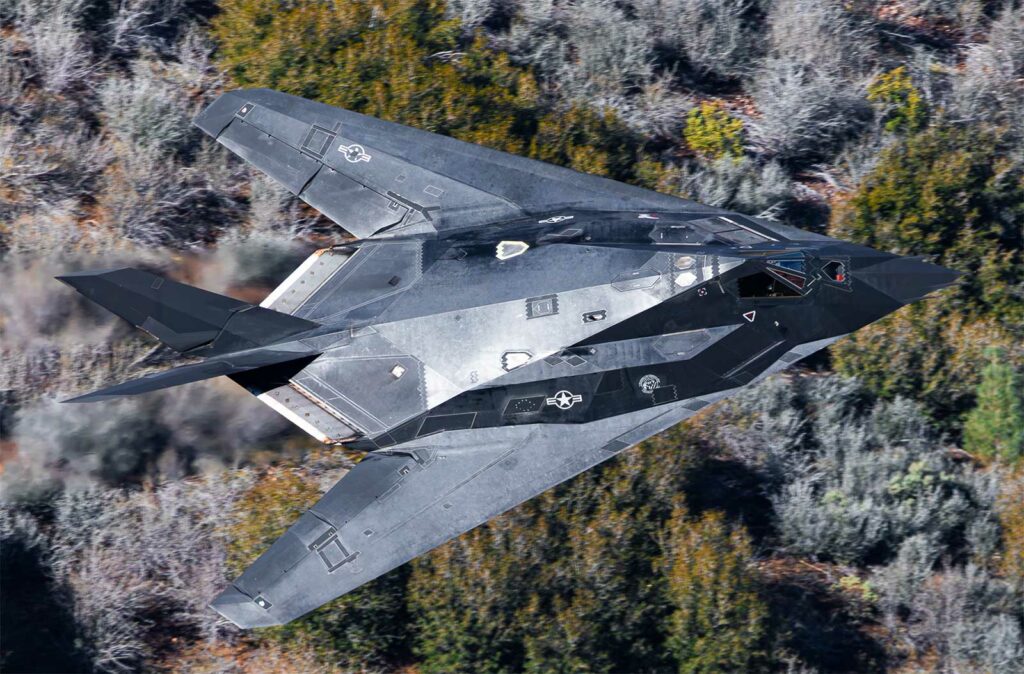
Lockheed transformed this reasoning into a practical tool. The Echo 1 software was used to calculate the radar cross-section of a shape composed of facets. The computers of the era could not yet easily process complex curves. Therefore, engineers chose flat surfaces. This was a technical constraint, and it became the visual identity of the F-117.
The plane is angular because the calculation allowed it. It is faceted because 1970s computers were better at analysing flat panels than continuous shapes. This computing limit gave birth to one of the most recognisable silhouettes in aviation history.
Radar Wave Reflection Explained Simply
A radar works by sending an electromagnetic wave into space. If this wave hits an object, part of the energy returns to the antenna. The radar then measures this return, allowing it to estimate distance, direction, and sometimes speed.
A conventional aircraft produces numerous reflections. The wings, fuselage, air intakes, external payloads, stabilisers, and structural angles all create echoes. The stronger these returns, the easier the aircraft is to detect. Stealth consists of reducing these returns. It does not make the aircraft invisible; it reduces the probability of detection, the detection range, and the quality of radar tracking.
The F-117 uses several principles. The first is geometric deflection. Its facets are oriented to reflect radar energy somewhere other than back to the transmitter. The second is edge alignment. The edges of the aircraft are organised along a few dominant directions to concentrate residual reflections into limited sectors. The third is the use of absorbent materials. These materials do not replace the shape, but they reduce certain returns.
The radar cross-section (RCS) is the indicator often used to express this visibility. It does not correspond to the physical size of the aircraft. Instead, it expresses the amount of radar energy reflected back to the transmitter. A large, well-designed aircraft can therefore sometimes appear smaller to a radar than a more compact aircraft that is poorly profiled electromagnetically.
This is the great lesson of the F-117. Stealth does not depend on a single secret material. It rests on a complete architecture. The shape comes first. The materials come second. Mission procedures complete the package.
The Structure of the F-117: A Brutal Compromise Between Stealth and Flight
The F-117 is not a fighter in the traditional sense. Despite the “F” designation, it is an attack aircraft. It does not possess a conventional offensive fire-control radar. It does not seek aerial combat. It is designed to penetrate defended airspace, strike a high-value target with a guided munition, and exit.
Its dimensions illustrate the scale of the compromise. The F-117A is approximately 20.1 metres long with a wingspan of about 13.2 metres. It is powered by two General Electric F404 engines without afterburners. It remains subsonic, with a maximum speed generally around Mach 0.9. Its military payload is carried in an internal bay to avoid external pylons and weapons, which are detrimental to stealth.
The airframe is built around flat surfaces. The wings are swept back sharply. The tail fins are canted inward. The air intakes are protected by grids intended to mask the compressor faces, which are very powerful radar reflectors. The nozzles are flattened to reduce the infrared signature. The canopies receive a conductive treatment to limit reflections produced by the pilot’s helmet and cockpit elements.
This architecture comes at a price. The F-117 is unstable. It could not fly properly without fly-by-wire controls. The computer constantly corrects deviations. The pilot, therefore, does not fly a naturally docile machine; they command an aircraft that electronics keep within its flight envelope.
The compromise is stark. The F-117 sacrifices aerodynamic performance for low observability. It is neither fast like an interceptor, nor agile like an air superiority fighter, nor versatile like an F-16. Its strength lies elsewhere: arriving at night, through a narrow corridor, with a reduced probability of being detected early enough to be engaged.
From Have Blue to the Operational F-117
Before the F-117, there was Have Blue. This secret demonstrator was developed by Lockheed’s Skunk Works under DARPA supervision. Its first flight took place in late 1977. Two aircraft were built. Both were lost during testing, but the programme proved the essential point: a shape calculated for stealth could fly and present a very low radar visibility.
Have Blue was sometimes nicknamed the “Hopeless Diamond” due to its strange shape. The nickname was cruel but fairly accurate. The aircraft looked less like a traditional combat machine and more like an assembly of inclined planes. However, radar tests validated the predictions made by Echo 1. This was the turning point. The mathematical model worked well enough to justify an operational aircraft.
The programme leading to the F-117 remained “black” (highly classified) for years. The F-117A’s first flight occurred in 1981. The aircraft reached initial operational capability in 1983. Its existence was not publicly acknowledged until 1988. In total, 59 production models were built, in addition to five development aircraft.
This confidentiality followed a clear logic. The F-117 was a strategic advantage. It was designed to attack enemy air defences and command centres at the start of a conflict. Revealing it too early would have given adversaries time to adapt their radars, procedures, and surface-to-air defence networks.
Operational Use of a Plane Built to Strike at the Heart
The F-117 entered operational history during the invasion of Panama in 1989. However, its true demonstration came during the Gulf War in 1991. Iraq possessed a dense air defence network at the time, particularly around Baghdad. The capital was protected by radars, surface-to-air missiles, and numerous anti-aircraft guns.
In this context, the F-117 was used against sensitive targets: command centres, communication nodes, bunkers, military infrastructure, and heavily defended installations. During Desert Storm, F-117s flew approximately 1,300 sorties and struck about 1,600 high-value targets according to American reports. They accumulated over 6,900 hours of combat flight time. No F-117 was lost during this campaign.
These figures built its legend. Above all, they showed that the aircraft met a specific need. It could attack targets that conventional aircraft would have had to approach with much heavier support: massive jamming, SEAD (Suppression of Enemy Air Defences) aircraft, escort fighters, and preparatory missions.
However, one must be rigorous. The results announced after the war were later nuanced. The Government Accountability Office (GAO) notably estimated that the F-117’s hit rate during Desert Storm was lower than some initial claims. According to their analyses, while effectiveness remained high, the communication figures were sometimes overly favourable. This does not destroy the F-117’s reputation; it simply puts it into perspective. The plane was very effective, but not magical.
Successes and Limits Revealed by Serbia
On 27 March 1999, during Operation Allied Force against Yugoslavia, an F-117A was shot down near Buđanovci, Serbia. The aircraft was hit by an S-125 Neva surface-to-air missile, an old but well-utilised Soviet system. The pilot ejected and was later recovered. The event was major: it was the first known destruction of a stealth aircraft in operation.
This case is often misunderstood. It does not prove that stealth doesn’t work; it proves that it has limits. Serbian forces exploited several factors: radar emission discipline, mobility, knowledge of probable flight paths, short detection windows, and the prudent use of older radars. The F-117, for its part, reportedly suffered from repetitive flight paths and an operational environment less favourable than in Iraq.
The lesson is direct. A stealth aircraft can be detected if the adversary is patient, competent, and lucky. It can be engaged if the trajectory, weather, radar frequencies, and procedures create an opportunity. Stealth reduces risks; it does not eliminate them.
This episode has lasting doctrinal importance. It serves as a reminder that stealth is never a standalone protection. It must be combined with intelligence, electronic warfare, planning, the destruction of surface-to-air defences, and variation in mission routes. A discrete aircraft that becomes predictable becomes vulnerable once again.
The Real Effectiveness of an Often Over-Simplified Aircraft
The F-117 was officially retired from combat service in 2008, following the arrival of the F-22 and the rise of other stealth platforms. Yet, several aircraft have continued to fly in testing, training, and “aggressor” roles. This discreet continued use shows that the aircraft still has value. It allows pilots, radars, and defence systems to be exposed to a specific signature.
Its legacy is immense. The B-2, F-22, F-35, and other programmes carry forward some of its lessons, albeit with more curved shapes. Advances in computing have made it possible to calculate complex surfaces that are less aerodynamically brutal than the F-117’s facets. In short, the Nighthawk is a transitional aircraft. It represents the moment when we knew how to calculate stealth, but not yet how to make it elegant.
Its effectiveness comes from this brutality. The F-117 did not seek versatility. It had one mission: to strike strategic targets in hostile airspace. It did so with significant success, particularly in 1991. But it also showed the limits of a first generation of stealth: dependence on mission conditions, low versatility, limited payload, moderate speed, and possible vulnerability to a disciplined adversary.
The Industrial Lesson Left by the F-117
The F-117 tells a story larger than that of a black plane. It shows how a military power can transform foreign theoretical research into an operational advantage. The USSR allowed Ufimtsev’s work to be published because they did not perceive an immediate application. Lockheed saw something else: a method to calculate radar visibility before even building the plane.
This is a harsh lesson for states and industries. A scientific discovery does not always have obvious value the moment it appears. Its impact depends on the ecosystem that receives it. In the 1970s, the United States had the right elements at the right time: engineers capable of reading the theory, computers powerful enough to exploit it, an agency like DARPA to finance the risk, and Skunk Works to build quickly in secret.
The F-117 is thus the product of a convergence of mathematics, computing, unstable aerodynamics, and strategic need. Its faceted shape is not a curiosity; it is the visible trace of an equation turned into an aircraft. This is what makes the Nighthawk so important. It did not just hit targets; it proved that aerial warfare was entering a new era, where detection mattered as much as speed, and where the shape of a plane could be worth as much as its engine.
Sources
- U.S. Air Force, F-117A Nighthawk Fact Sheet, via National Security Archive.
- National Museum of the U.S. Air Force, Lockheed F-117A Nighthawk.
- DARPA, Have Blue and stealth technology.
- DARPA, Stealth aircraft.
- Lockheed Martin, F-117 Nighthawk Fast Facts.
- P. Ya. Ufimtsev, Method of Edge Waves in the Physical Theory of Diffraction, U.S. technical translation.
- Government Accountability Office, Operation Desert Storm: Evaluation of the Air Campaign.
- U.S. Air Force Office of Special Investigations, Nighthawk helps shape PJ legacy.
War Wings Daily is an independant magazine.