
In 2009, an EA-18G Growler reportedly simulated a victory against an F-22. Here is a technical analysis of a duel where electronic warfare and tactics change everything.
When an Electronic Warfare Aircraft Surprises the F-22
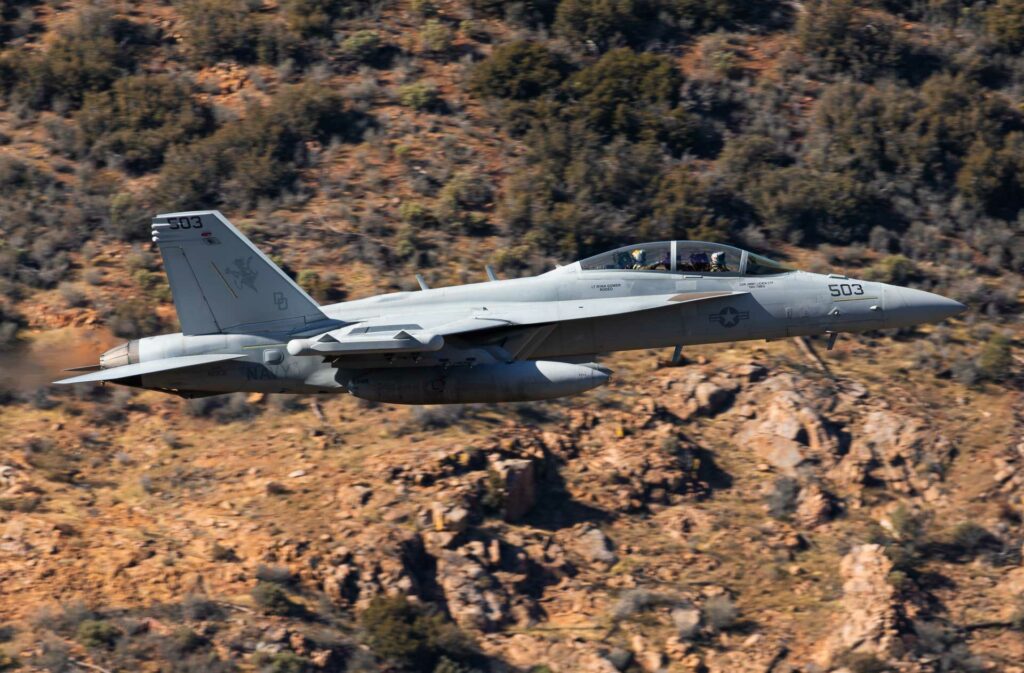
The story has become famous in military aviation circles. During an exercise held at Nellis Air Force Base in 2009, a US Navy EA-18G Growler reportedly achieved a simulated victory against an F-22 Raptor, the US Air Force’s most advanced air superiority fighter. According to several specialised accounts, the Growler managed to lock a simulated AIM-120 AMRAAM shot against the American stealth fighter, later displaying a Raptor kill mark on its fuselage. The episode is reported as an exercise fact, not as proof of the Growler’s operational superiority over the F-22.
This detail is important. In a real conflict, the F-22 retains major advantages: stealth, speed, altitude, data fusion, manoeuvrability, and the ability to engage the adversary before being detected. However, the incident demonstrates a frequently overlooked reality: no aircraft is invulnerable. Even a fifth-generation platform can be placed in difficulty if the scenario diminishes its advantages or if the opponent better exploits the geometry of the combat.
Two Aircraft Designed for Very Different Missions
The F-22 Raptor is designed for air superiority. The US Air Force describes it as a combination of stealth, supercruise, manoeuvrability, and integrated avionics. Its role is to dominate airspace, particularly through its ability to detect, identify, and engage a threat before the latter can react.
The EA-18G Growler, meanwhile, belongs to a different logic. It is derived from the two-seat F/A-18F Super Hornet, but its primary mission is electronic attack. The Navy presents it as an aircraft capable of integrating advanced electronic warfare systems, including ALQ-218 receivers, ALQ-99 jamming pods, communication countermeasure systems, and data transmission tools.
On paper, the duel seems unbalanced. The F-22 is a stealthy air dominance fighter. The Growler is an electronic support aircraft, designed to disrupt radars, protect a raid, jam communications, and participate in the suppression of enemy air defences. Yet, in an exercise, an aircraft’s pure performance is not enough. Rules of engagement, imposed distances, sensor limitations, and the tactical situation can all alter the outcome.
Combat Geometry: A Decisive Factor
The key to this episode likely lies in engagement geometry. In aerial combat, it is not enough to have the best aircraft; one must also be in the right place at the right time with the right information. A pilot can exploit a relative blind spot, a trajectory constraint, a lack of anticipation, or a very narrow firing window.
The F-22 is optimised for beyond-visual-range (BVR) combat. It seeks to see first, shoot first, and disappear before the opponent clearly understands the threat. But if an exercise forces the aircraft to close in, limits certain radar modes, or imposes an artificial tactical situation, the F-22’s initial advantage can be eroded.
It is likely in this type of context that the Growler secured its simulated kill. This does not mean it would easily down an F-22 in a real war. Rather, it means that modern aerial combat depends as much on the situation as it does on the technical specifications. Poor positioning, an incomplete reading of the scene, or a momentary loss of tactical awareness can be enough to create an opportunity.
Why Electronic Warfare Changes the Balance of Power
Electronic warfare has become central to modern aerial combat. It does not necessarily destroy the enemy directly; rather, it first seeks to blind, slow down, deceive, or degrade their decision-making capacity.
The ALQ-99 system, used on the EA-18G, is described by NAVAIR as an external electronic attack capability intended for jamming radars and communications, particularly for the suppression of integrated air defences. The Growler can therefore disrupt the electromagnetic environment in which other aircraft operate.
In a sky saturated with signals, the situation becomes more confused. Radars can see less far, and data links can be degraded. Pilots sometimes receive partial, delayed, or contradictory information. Situational awareness is no longer stable; it becomes fluid.
This is where the Growler brings considerable tactical value. It does not seek to beat an F-22 in a classic duel; it seeks to complicate the reading of the battlefield. In certain cases, this disruption is enough to create a breach. Even the stealthiest aircraft remains dependent on its sensors, its network, and its ability to maintain a clear image of the threat.
The F-22 Remains a Formidable Platform
It would be incorrect to conclude that the Growler is superior to the F-22. The Raptor remains an aircraft designed to impose air dominance in highly contested environments. Its combination of stealth, supercruise, integrated avionics, and manoeuvrability makes it an exceptional platform. The US Air Force insists on this global combination, rather than any single isolated quality.
The F-22’s stealth reduces its radar signature. Its supercruise allows it to fly at supersonic speeds without afterburners in certain conditions. Its manoeuvrability, enhanced by thrust vectoring, gives it a significant advantage in close-quarters combat. However, none of these elements functions as an absolute shield.
The F-22’s superiority rests on a complete system: aircraft, pilot, sensors, doctrine, ground support, refuelling, network, intelligence, and coordination with other platforms. If any part of this system is constrained by an exercise or degraded by electronic warfare, the margins narrow.
Exercises are Not Real Wars
Military exercises serve to test scenarios, not to establish a definitive ranking of fighter jets. Rules can be deliberately restrictive. An aircraft may be deprived of some of its usual assets, or a pilot may be given a disadvantaged mission. A scenario might force a proximity that would not occur in the same way during a real operation.
This is why simulated “victories” against fifth-generation aircraft must be interpreted with caution. Rafale, Eurofighter, F-16, or Super Hornet pilots have all claimed or achieved interesting results against stealth platforms in training contexts. These episodes are instructive, but they do not prove that a fourth-generation fighter structurally dominates a fifth-generation aircraft.
They prove something else: training is precisely for creating surprises. It exposes weaknesses, tests doctrines, and forces crews to learn. A simulated victory is therefore less a verdict and more a signal. It shows that a tactical flaw exists under certain conditions.
A Lesson for All Air Forces
The episode involving the Growler and the Raptor highlights a major trend: aerial combat is no longer just a matter of speed, range, or missiles. It increasingly depends on electromagnetic dominance. He who controls the electromagnetic spectrum controls a portion of the battle.
Modern aircraft must be capable of operating in a degraded environment. This means flying with less data, disrupted communications, jammed radars, and uncertain information. Crews must be able to decide quickly despite an incomplete picture. Air forces must also protect their networks, multiply their sensors, and avoid depending on a single source of information.
This is why electronic attack aircraft remain essential. The Growler is not just a support aircraft; it is a power multiplier. It can open an attack corridor, protect an air group, weaken surface-to-air defences, or complicate the mission of a better-equipped adversary.

What This Episode Says About the Future of Aerial Combat
Future high-intensity conflicts will likely see a combination of stealth, jamming, drones, long-range missiles, cyber warfare, passive sensors, and distributed networks. In this context, the question will no longer be: which aircraft is the best? The real question will be: which combat system best retains useful information under pressure?
The F-22 holds a special place in military aviation history. But the Nellis incident serves as a reminder of a simple truth: radar stealth is not total invisibility. It reduces the probability of detection and provides a major advantage, but it does not eliminate risk.
The EA-18G Growler, for its part, shows that a specialised aircraft can influence the outcome of a confrontation without possessing the kinematic performance of an air superiority fighter. Its primary weapon is not just the missile; it is the capacity to alter the informational environment in which the combat takes place.
A Symbolic Victory, Not a Doctrinal Revolution
The Growler’s simulated victory over the F-22 remains primarily a tactical anecdote. It is spectacular, useful for squadron culture, and interesting for analysts. However, it does not overturn the hierarchy of platforms. It does not mean the Growler would be better than the F-22 in aerial combat, nor does it call into question the logic of fifth-generation aircraft.
Instead, it confirms a more subtle rule: in the modern sky, the best aircraft can lose if it loses information, timing, or position. Aerial combat is not an abstract duel between technical spec sheets. It is a dynamic confrontation between sensors, crews, jamming, doctrine, and opportunities.
The main takeaway is therefore clear. The F-22 remains an exceptional fighter. The EA-18G Growler remains a specialised electronic attack aircraft. But in an environment saturated by jamming, radar emissions, data links, and tactical constraints, even a stealth aircraft can be surprised. This is precisely what makes modern aerial warfare so complex: victory no longer depends solely on the aircraft, but on the ability to understand, disrupt, and exploit the entire battlefield.
War Wings Daily is an independant magazine.