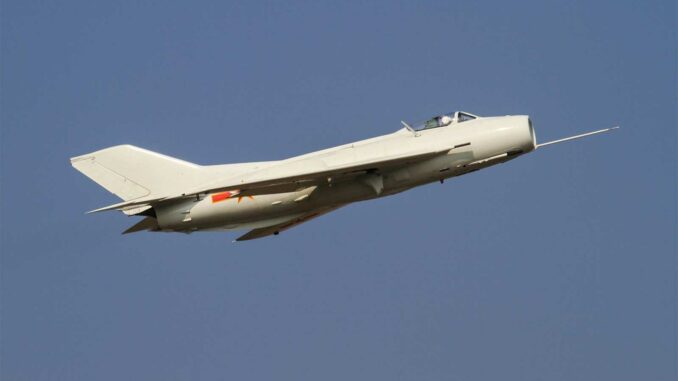
Beijing is recycling its old J-6 fighters into J-6W attack drones to saturate Taiwan, wear down its defenses, and prepare for mass warfare.
In Summary
China is transforming a portion of its old Shenyang J-6 fighters—derivatives of the Soviet MiG-19—into J-6W attack drones. This information is strategic. According to data published by the Mitchell Institute and reported by Reuters, at least 200 converted aircraft are visible across six bases near the Taiwan Strait, primarily in Fujian and Guangdong. These aircraft are not modern stealth drones. They are old, noisy, visible, and likely vulnerable. However, their value lies elsewhere. Used en masse, they can force Taiwan to fire expensive missiles, saturate radars, complicate threat identification, and pave the way for more dangerous strikes. This follows a logic of aerial war of attrition. Beijing is not just seeking sophistication; it is seeking mass, low cost, and psychological pressure.
The recycling of J-6s reveals a highly calculated mass strategy
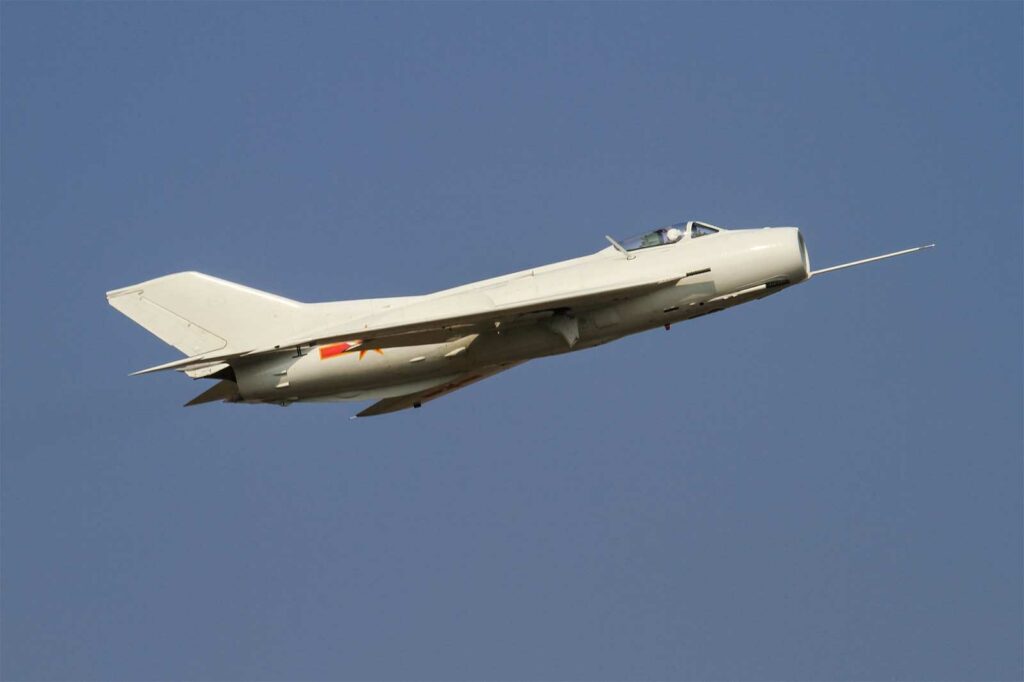
The conversion of old Chinese fighters into attack drones is not a technical curiosity; it is a military signal. The Shenyang J-6 is a 1960s-era aircraft. Derived from the Soviet MiG-19, it served for a long time as a pillar of the People’s Liberation Army Air Force before being retired from front-line service. On paper, this aircraft belongs to another age: old engines, outdated avionics, a high radar signature, and limited survivability against modern defenses.
Yet, that is precisely what makes it useful. China possesses a large inventory of old airframes. A portion of these aircraft is worth very little as manned fighters. Conversely, transformed into drones, they become expendable vectors. They can fly fast, carry a limited military payload, appear as a real threat on radar, and force the adversary to react.
According to Reuters, drawing on the Mitchell Institute for Aerospace Studies, China has positioned at least 200 converted J-6s at six bases near the Taiwan Strait. Satellite imagery cited shows aircraft lined up at five bases in Fujian and one in Guangdong. J. Michael Dahm, a former US Navy intelligence officer and analyst at the Mitchell Institute, estimates that over 500 J-6s may have been converted into drones. The drone version is designated J-6W.
This logic fits into a brutal geographical reality. Fujian is located directly across from Taiwan. The distance between the Chinese coast and the island is short—about 130 kilometers at the narrowest part of the strait. A fast aircraft launched from a coastal base can therefore reach the airspace near Taiwan very quickly. In the opening hours of a conflict, this proximity would have major tactical value.
China is not transforming these planes to win an aerial duel. It is transforming them to complicate the adversary’s defense. The J-6W attack drone is not a replacement for the J-20, the J-16, or ballistic missiles. It is an additional piece in a much broader architecture: missiles, manned aviation, modern drones, electronic warfare, cyberattacks, precision strikes, and psychological operations.
The J-6W functions as a “poor man’s” cruise missile
The term “drone” can be misleading. The J-6W should not be imagined as a small tactical UAV piloted remotely from a tablet. It is a modified former jet aircraft. According to information displayed by China during the Changchun Air Show and reported by Reuters, the cannons and certain equipment have been removed. The aircraft has reportedly received an autopilot system and terrain-following navigation. Its first flight as an unmanned version reportedly dates back to 1995.
The Mitchell Institute presents the J-6W as an aircraft converted into an attack drone. Its public technical data gives a maximum speed of 805 knots (approx. 1,491 km/h), a maximum range of 913 nautical miles (approx. 1,691 km), and a combat radius of 367 nautical miles (approx. 680 km). Its payload is listed at 1,102 pounds (approx. 500 kg). These figures should be read with caution, as they vary according to configuration, airframe condition, and mission. But they provide a clear order of magnitude: the J-6W is not a toy.
In an attack scenario, it could be used as an improvised cruise missile. It flies toward a pre-programmed zone or target. It forces radars to track it. It can carry an explosive charge or serve as a decoy. Its purpose is not to survive. Its purpose is to be launched in numbers.
This is where the conversion makes complete sense. A modern cruise missile is expensive. It requires a specialized industrial chain, sensors, propulsion, guidance, and complex integration. An old J-6 already produced, already stored, and already amortized represents a different marginal cost. The conversion is not free—one must maintain the airframe, refurbish the engines, install an autopilot, modify controls, integrate navigation, and prepare for employment—but the investment likely remains lower than that of a new vector with comparable speed and mass performance.
China is thus transforming an obsolete asset into a large-scale aerial munition. It is a cold, rational, and economically efficient approach.
Saturation primarily targets Taiwanese air defense
The primary objective is saturation. Taiwan possesses a dense air defense. It combines fighter jets, radars, Patriot batteries, Tien Kung systems, short- and medium-range surface-to-air missiles, anti-aircraft guns, and electronic warfare capabilities. But no defense has infinite munitions. No chain of command can process hundreds of simultaneously arriving tracks without friction.
The value of the J-6W is to create a dilemma. If Taiwan does not fire, some drones may reach radars, runways, depots, ports, or command centers. If Taiwan does fire, it consumes modern missiles against old, expendable aircraft. In both cases, Beijing achieves an effect.
Reuters quotes a Taiwanese official explaining that these drones could serve to exhaust air defense systems in a first wave. This remark is central. The goal is not only to destroy; the goal is to wear down. A massive attack can force Taiwan to reveal the locations of its radars, launchers, and procedures. It can also create confusion between real threats, decoys, fast drones, slow drones, cruise missiles, and manned aircraft.
The cost of interception is a major problem. According to The Defense Post, Taiwan purchased 102 Patriot PAC-3 MSE missiles for approximately 20 billion Taiwan dollars, or 637 million US dollars. This represents about 6.2 million dollars per missile. Firing a Patriot at an old converted J-6 would therefore be economically unfavorable, even if it might be militarily necessary. This is the entire logic of cost-effectiveness imbalance: forcing the adversary to employ a very expensive munition against a much less costly target.
Taiwan is specifically seeking to correct this problem. The government has proposed an additional defense budget of 40 billion dollars, including integrated air defense systems, drones, and locally produced weapons. The T-Dome program aims to strengthen a multi-layered defense. But this transition takes time. Missiles, radars, and interceptor drones are not produced in a few weeks.
China seeks an opening before high-value strikes
The J-6W is likely not the decisive weapon of a war around Taiwan. It would be most useful as an opening tool. A first wave could include J-6Ws, more modern drones, ballistic missiles, cruise missiles, electronic warfare aircraft, and cyberattacks. The goal would be to disorganize the defense before the arrival of the most dangerous assets.
In this scenario, the converted old fighters can fulfill several functions. They can serve as decoys to divert radars. They can test Taiwanese reactions. They can force surface-to-air batteries to turn on their radars, thereby revealing themselves. They can strike secondary objectives. They can also saturate operators’ screens and complicate the discrimination between real threats and false leads.
This method is not new in principle. Armies have long used decoys, target aircraft, and saturation means. What has changed is the scale. China possesses an industrial and military inventory that allows for mass to be envisioned. SIPRI estimates that Chinese military spending reached 336 billion dollars in 2025, the second-highest in the world. Taiwan, in the same report, is credited with 18.2 billion dollars in military spending in 2025. The budget gap gives Beijing an attrition capacity that Taipei cannot simply match.
This imbalance does not mean Taiwan is doomed. A well-designed defense can inflict significant losses. But it forces Taipei to choose its priorities. Firing a high-end missile at every J-6W is not sustainable. Therefore, it must combine detection, jamming, anti-aircraft artillery, lower-cost missiles, interceptor drones, and passive infrastructure protection.
The Chinese budget transforms old equipment into military capital
The conversion of the J-6s demonstrates a frequently underestimated quality of Chinese military modernization: Beijing does not throw everything old away. It reuses it when it serves the doctrine. This approach is less elegant than a latest-generation stealth program, but it is budget-efficient.
The J-6 was produced in very large numbers. Figures vary by source, but the total production of Chinese versions and derivatives counts in the thousands. Even if only a small portion remains recoverable, it provides a reserve of aircraft. For an army preparing for a high-intensity conflict, every reusable airframe can become an expendable asset.
The exact cost of a J-6W is not public. It would be unwise to invent a price. However, one can break down the actual budget: funding the refurbishment of Wopen-6A engines, replacing components, integrating an autopilot system, navigation, control or programming links, payload, testing, storage, unit training, and maintenance. One must also maintain runways, shelters, fuel, and ground personnel.
It is therefore not a “free” weapon. But it is a weapon less costly than the mass production of a new heavy drone or a modern cruise missile. The Chinese calculation is likely this: even if a large portion of J-6Ws are shot down, the attrition and saturation effect can justify their use.
This logic recalls a lesson observed in Ukraine and the Middle East: mass matters again. Highly sophisticated weapons remain decisive, but simple, numerous, and replaceable systems can exhaust adversary defenses. China seems to be integrating this lesson into its own theater, with means adapted to the geography of the Taiwan Strait.
Military effectiveness remains real but limited
One must remain sober in the evaluation. The J-6W is not a miracle weapon. It is an old converted aircraft. It is likely visible on radar. It emits a significant thermal signature. It depends on vulnerable forward bases. It needs fuel, maintenance, and preparation. In the event of an open crisis, bases in Fujian and Guangdong could be targeted by Taiwan or Taipei’s allies if the conflict were to widen.
Reuters also reports that J. Michael Dahm considers these airfields vulnerable to counter-attack. This is an obvious weakness. Dozens of aircraft lined up near runways are useful for launching a quick wave, but they are also exposed to preemptive or retaliatory strikes—if Taiwan has the intelligence, the political decision-making, and the means to act.
The other limitation concerns navigation and precision. A J-6W can follow a flight plan and strike a zone. But one should not attribute to it the capabilities of a modern drone equipped with advanced AI, high-end electro-optical sensors, and jam-resistant links. Its effectiveness will depend on the quality of the programmed mission, resistance to jamming, weather, flight profile, and the Chinese capacity to coordinate complex waves.
Its effectiveness will therefore be maximal in three roles: saturation, decoying, and attacks against fixed or low-mobility targets. It will be weaker against mobile targets, well-camouflaged assets, or those protected by a multi-layered defense.
The Taiwanese response must be cheaper and more distributed
The correct response to a J-6W is not solely a multi-million dollar missile. Taiwan must develop a more refined defense. It must save its high-end missiles for the most dangerous threats: modern aircraft, ballistic missiles, precise cruise missiles, electronic warfare aircraft, and command platforms.
Against the J-6Ws, the island will need a more economical mix. This may include short-range surface-to-air systems, modernized cannons, passive radars, electro-optical sensors, jamming, interceptor drones, and defensive decoys. The goal is not to play the Chinese game. If Beijing sends a cheap target and Taipei systematically responds with a very expensive munition, China wins part of the economic ratio.
Passive defense also counts. Repairable runways, hardened shelters, dispersed stockpiles, redundant command centers, and mobile radars reduce the effect of the first waves. Survival does not only depend on interception; it also depends on the capacity to take a hit, repair, and continue fighting.
This is why the budget debate in Taiwan is crucial. The additional 40 billion dollar plan covers the period 2026-2033, according to USNI News, and includes the T-Dome, air defense capabilities, access-denial means, and drones. This type of investment directly addresses the problem posed by the J-6Ws: building a multi-layered defense capable of handling numerous, varied, and simultaneous threats.
The transformation of J-6Ws heralds a “dirtier” air war
The conversion of J-6s into attack drones is not as spectacular as a new stealth aircraft. It is almost rustic. But it is militarily serious. It says something about the coming air war around Taiwan: it would not only be a battle of modern fighters. It would also be a battle of stockpiles, runways, decoys, missiles, radars, cheap munitions, and expendable systems.
China is showing that it is preparing an opening sequence where mass could precede precision. The old J-6Ws would serve to absorb fire, blur the reading of the battlefield, and create windows of opportunity for more modern weapons. This is not proof of invincibility; it is proof of method.
For Taiwan, the message is clear. The island cannot only buy prestigious systems. It must build a durable, distributed, and economically sustainable defense. The real danger of the J-6Ws is not their sophistication. It is their number. In a narrow strait, with close Chinese bases and permanent political pressure, an old fighter from the 1960s can still become a modern weapon. Not because it flies better than before, but because it forces the adversary to spend, decide, and react faster than they would like.
War Wings Daily is an independant magazine.