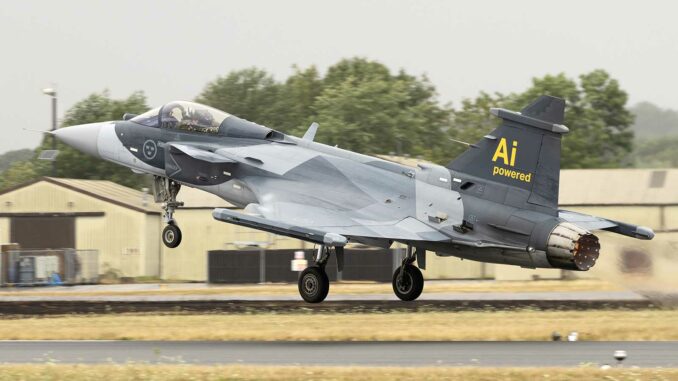
Sixteen Gripen C/D aircraft could be delivered to Ukraine as early as 2027, ahead of the new Gripen E models. This marks a major industrial and strategic shift in the face of Russia.
In summary
The Saab JAS 39 Gripen deal for Ukraine has just passed a decisive political and industrial milestone. However, two separate operations must be distinguished. Sweden plans to provide up to 16 second-hand Gripen C/D aircraft, with the first deliveries expected to begin in early 2027. Meanwhile, Saab has received an order for 16 brand-new Gripen E aircraft, valued at 24.6 billion Swedish kronor, with deliveries scheduled for 2029 and 2030.
This decision does not replace Ukraine’s F-16s. It establishes a second Western supply chain, better suited to dispersed operations and degraded infrastructure. Above all, the Meteor missile could force the Russian Su-34s to drop their glide bombs further from the front line.
This decision also reflects a shift in US focus. Washington is asking the Europeans to provide more funding for Ukraine’s defence, whilst its own stocks and priorities are being absorbed by other theatres of operation. Europe is therefore beginning to supply systems that it would previously have expected from the United States.
The 2027 delivery concerns the Gripen C/D and not the Gripen E
The announcement requires careful reading. Sixteen aircraft are indeed expected from 2027, but these are the JAS 39 Gripen C/D currently in service with the Flygvapnet, the Swedish Air Force.
These aircraft are to be drawn from the national fleet and transferred to Ukraine as part of bilateral aid. The Swedish government refers to a full squadron, comprising up to 16 aircraft. Their transfer remains contingent upon Kyiv’s acquisition of a new fleet of Gripen E aircraft and budgetary authorisation from the Riksdag.
A second operation was formalised on 30 June 2026. Saab signed a contract with the Swedish Defence Materiel Administration for 16 Gripen E aircraft destined for Ukraine. The announced value amounts to 24.6 billion Swedish kronor, equivalent to approximately 2.54 billion dollars and nearly 2.3 billion euros at current exchange rates.
These aircraft will not be delivered in 2027. Saab plans to hand them over to the Swedish authorities between 2029 and 2030, prior to their transfer to Ukraine in accordance with the agreed terms.
The timetable therefore consists of two phases. The Gripen C/D aircraft are intended to provide rapid operational capability. The Gripen E aircraft are then intended to form the core of a modernised Ukrainian air force in the long term.
This distinction is important. It avoids presenting the delivery of new fighter aircraft – which will still require several years of production – as imminent.
The project had been put on hold so as not to disrupt the F-16 programme
Sweden had already laid the groundwork in 2023 and 2024. Ukrainian pilots had familiarised themselves with the Gripen. Technical assessments had been launched. Stockholm had also studied the implications of a transfer for its own security.
However, the project was put on hold in September 2024. The reason was operational, not political. The allies wanted to prioritise the integration of the F-16s.
Ukraine was already having to cope with a considerable upheaval. Pilots, mechanics, armourers and air traffic controllers needed to be trained. Airbases needed to be converted, spare parts networks established and Western missiles integrated. Adding the Gripen straight away would have created a second supply chain at the most vulnerable moment.
A fighter aircraft is never delivered on its own. It arrives with its simulators, test equipment, maintenance tools, software, ground support equipment and safety procedures. Each new type increases the complexity of the fleet.
Kyiv still operates Soviet-era aircraft. It introduced the F-16, followed by the Mirage 2000. Adding the Gripen creates a new family of aircraft. The risk of fragmentation is real.
However, the situation has changed. The F-16s are now fully integrated. Ukrainian teams have gained initial experience with Western maintenance procedures. Training on the Gripen can therefore begin without jeopardising the American programme.
Sweden also needs time to prepare the aircraft, build up stocks of spare parts and replace the aircraft it will be transferring. The initial delay did not scupper the project. It simply postponed the timetable until Ukraine is ready to take it on.
The Gripen C/D directly addresses Ukraine’s requirements
The Gripen is not stealthy. It lacks the range and penetration capabilities of an F-35. Its value to Ukraine lies elsewhere.
Sweden designed it during the Cold War to enable combat operations to continue after the destruction of major air bases. The aircraft were intended to be dispersed along road sections, camouflaged, refuelled quickly and returned to service by small crews.
This philosophy aligns closely with conditions in Ukraine. Airfields are regularly struck by ballistic missiles, cruise missiles and drones. The aircraft must move between locations, avoid prolonged parking and limit their reliance on heavy infrastructure.
According to a Ukrainian defence cooperation official interviewed by Reuters, a team of six people – comprising one qualified technician and five less specialised personnel – can refuel and rearm a Gripen in under ten minutes. Engine replacement can also be carried out quickly in the field.
These characteristics are by no means incidental. In a war of attrition, day-to-day operational readiness often counts for more than the peak performance figures listed on a technical specification sheet.
The Gripen C/D uses the RM12 turbofan engine, derived from the General Electric F404. Its maximum speed is close to Mach 2. It can carry European and American weaponry. It is compatible with the AMRAAM, the IRIS-T and, above all, the Meteor.
The two-seater Gripen D variant can be used for operational conversion, complex missions and advanced training. The single-seater Gripen C will carry out the bulk of combat sorties.
The Meteor missile represents a genuine operational breakthrough
The aircraft alone will not alter the balance of power in the air. The Gripen-Meteor combination, however, can impose new constraints on the Russian air force.
The Meteor is a long-range, radar-guided air-to-air missile. It uses a ramjet engine with variable thrust. Unlike a missile whose engine burns out quickly after launch, it retains a significant portion of its energy right up to the final phase.
This characteristic increases its effective interception range against a target that is manoeuvring or attempting to evade. The theoretical range is not sufficient to measure this effectiveness. The key factor is the amount of energy still available as the missile approaches its target.
Russian Su-34s frequently drop their glide bombs several tens of kilometres from the front line. These munitions enable them to strike Ukrainian positions without penetrating deeply into the area covered by ground-to-air defences.
A Gripen C equipped with the Meteor could threaten these aircraft whilst they are preparing to fire. Experts estimate that this combination offers a better chance of engaging a Su-34 situated 60 to 70 kilometres behind Russian lines than a Ukrainian F-16 fitted with the currently available versions of the AMRAAM.
The intended effect is not necessarily to increase the number of aircraft shot down. It is to alter the Russians’ flight paths. If the Su-34s are forced to fly lower, remain further away or halt their preparations, the range and accuracy of their bombs are reduced.
The Meteor can also put pressure on the Su-35s tasked with escorting the tactical bombers. Russia will have to deploy more electronic warfare, surveillance and air defence assets.
This pressure will not eliminate the threat. The Gripens themselves will have to avoid the S-300s, the S-400s, Russian fighters and long-range missiles. They will also depend on the quality of the intelligence received from ground-based radars and allied networks.
The Gripen therefore provides a strategic advantage. It does not automatically create air superiority.
The Gripen E paves the way for a different Ukrainian air force
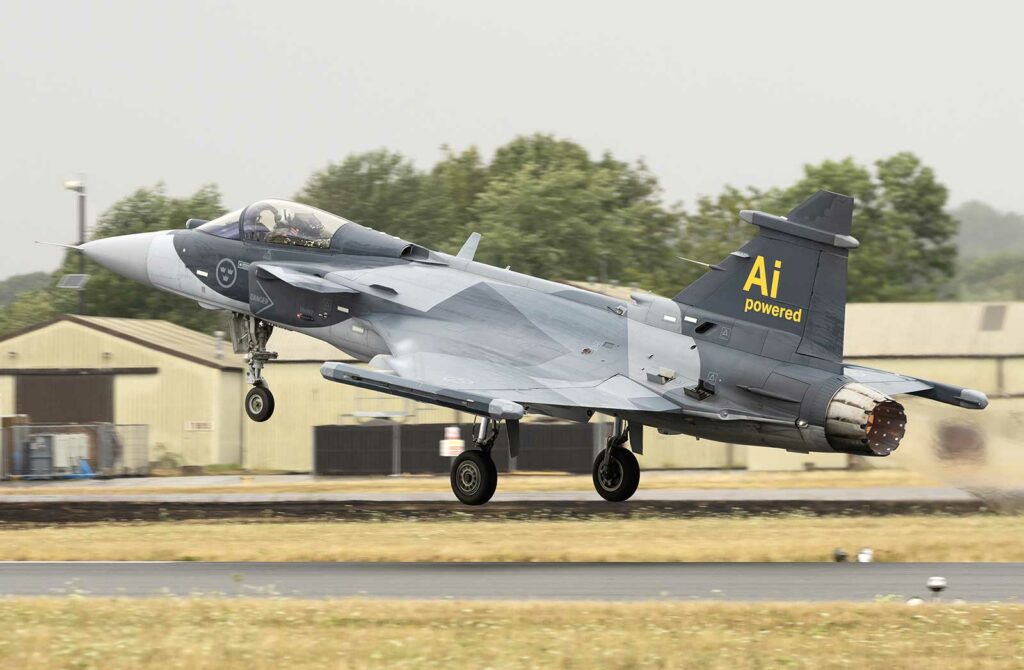
The Gripen E belongs to a thoroughly modernised generation. It is not merely an evolution of the Gripen C.
Its airframe carries more fuel. Its General Electric F414G engine delivers greater thrust. The aircraft has ten hardpoints and can carry a heavier payload over a greater distance.
Its Raven ES-05 radar uses an active electronically scanned array (AESA) antenna. This can be mechanically steered to widen the search area. The aircraft also features an IRST (Infrared Search and Track) system, a more powerful electronic warfare suite and a computer architecture designed to receive rapid updates.
These capabilities enhance passive detection. They enable the pilot to search for certain targets without having to use the radar continuously. They also improve the fusion of information provided by other aircraft, ground-based radars and command centres.
The Gripen E is, however, more expensive and more complex. Saab already has to fulfil orders from Sweden, Brazil and other customers. Ukrainian production cannot therefore be improvised.
The contract signed on 30 June no longer covers the 20 aircraft mentioned at the end of May, but 16 Gripen E aircraft. The change may reflect a redefinition of the first batch, its funding and the associated equipment.
The contract value amounts to approximately 1.54 billion Swedish kronor per aircraft if divided simply by 16. However, this calculation – equivalent to nearly 159 million dollars per aircraft – does not correspond to the price of the airframe alone. The contract includes spare parts, materials, equipment and technical support.
Comparing this figure with the list price of another fighter aircraft would therefore be misleading.
The budgets reveal two different approaches
The programme’s funding is structured on several levels.
The contract for the 16 Gripen E aircraft amounts to 24.6 billion Swedish kronor. Ukraine is to use part of the European loan earmarked for its military needs. A budget of 2.5 billion euros had initially been announced for the acquisition of 20 Gripen E/F aircraft.
The donation of the Gripen C/D aircraft falls under a separate budget. The Swedish government has estimated the cost of the package – comprising the aircraft, advanced munitions, training, support and the replacement of the transferred capability – at 22.2 billion kronor.
This figure does not represent the commercial value of 16 second-hand aircraft. It notably includes the purchase of additional Gripen E/F aircraft for the Flygvapnet. Sweden does not wish to assist Ukraine by creating a lasting gap in its own air defence.
An additional budget of 1.5 billion kronor covers munitions, electronic warfare capabilities and long-range strike capabilities.
Operating costs are another advantage of the Gripen. A Ukrainian official has estimated its operating cost at around 8,000 dollars per hour. This figure should be treated with caution, as accounting methods vary from country to country. It remains significantly lower than the full costs generally associated with heavy fighters and stealth aircraft.
In a war where aircraft must remain in service for several years, fuel consumption, spare parts, the number of maintenance personnel and the duration of ground operations become critical factors.
A fighter that is cheaper to operate can carry out more missions within the same budget. This reality partly explains why Kyiv is not solely seeking the most high-performance system. It is looking for an aircraft that it can keep operational whilst under bombardment.
The US’s refocusing is forcing Europe to step up
The Gripen issue cannot be separated from political developments in the US.
Washington remains a key supplier of missiles, intelligence and air defence systems. However, its aid to Ukraine has slowed significantly. The US administration is prioritising the protection of its own territory, the replenishment of stocks and burden-sharing with its allies.
The National Security Strategy published in 2025 explicitly criticises international commitments deemed to have insufficient links to the direct interests of the United States. The federal budget for 2026 also emphasises national defence, border security and the reduction of certain forms of foreign aid.
This shift reflects the influence of several domestic political forces. A section of the Republican electorate rejects prolonged commitments abroad. Some elected representatives are calling for Europeans to pay more for a war being waged on their continent. Federal deficits and domestic spending are also fuelling the backlash.
Congress remains more supportive of Ukraine than certain elements of the executive. In June 2026, a Senate committee proposed $750 million for the Ukraine Security Assistance Initiative. The House backed a package comprising over $1 billion in aid and up to $8 billion in loans.
These figures demonstrate continued support. However, they remain far below the substantial sums approved at the start of the war.
There are also industrial challenges. The United States must supply its own forces, its NATO allies, Israel and its Pacific partners. Global demand for Patriot missiles exceeds production rates. Tensions in the Middle East have further intensified this competition.
The US slowdown does not, therefore, signify a complete withdrawal. It reflects a combination of political choices, industrial constraints and strategic priorities.
The Gripen contract illustrates the European response. Sweden is supplying the aircraft. The European Union is funding the purchase. Kyiv is training personnel and integrating the system. Europe is taking on a role that would previously have relied more heavily on Washington.
Ukraine’s need for armaments remains insatiable
Ukraine is not just asking for fighter jets. It simultaneously lacks anti-aircraft missiles, artillery shells, drones, radars, spare parts and electronic warfare capabilities.
In the spring of 2026, Ukrainian air defence units were reportedly using launchers that were only half-loaded. Kyiv was sometimes reduced to requesting batches of five or ten missiles for its NASAMS and IRIS-T systems.
The Czech ammunition procurement programme aimed to raise 5 billion euros. By February, only 1.4 billion had been committed. This discrepancy sums up Ukraine’s problem. Weapons are sometimes available on the market, but funding is arriving too slowly.
The European Union has therefore approved a loan of €90 billion for 2026 and 2027. An indicative budget of €60 billion is intended to support the defence industry and military procurement. For 2026, €28.3 billion is earmarked for Ukrainian industrial capabilities. An initial tranche of €3.9 billion has been allocated to drones.
These sums seem immense. They are swallowed up by a war being fought every day along a front stretching over 1,000 kilometres, under waves of drones and missiles.
Needs are constantly being replenished. A missile fired disappears from stock. A worn-out gun must be replaced. A radar switched on reveals its position. An aircraft requires hours of maintenance after each series of missions.
The term ‘insatiable’ therefore describes a material dynamic. It is not a matter of Kyiv’s political preference. It is the consequence of a protracted industrial war against an adversary with a massive production base.
Ukrainian weaponry is beginning to take a heavy toll on Russia
The arrival of the Gripen aircraft will not have its first effects until 2027. But the overall increase in Ukrainian capabilities is already hitting Russia far beyond the front line.
Ukrainian drones have struck refineries, depots, ports and pumping stations across several thousand kilometres. In August 2025, strikes on ten refineries had disrupted at least 17 per cent of Russian capacity, amounting to approximately 1.1 million barrels per day.
In March 2026, attacks on ports, oil pipelines and terminals are reported to have temporarily disrupted nearly 40 per cent of Russia’s oil export capacity. In June, some regions experienced shortages, queues and prices exceeding 100 roubles per litre at independent petrol stations.
Russia has had to increase its fuel imports and step up the protection of its facilities. Every air defence system redeployed to a refinery or port is no longer available to defend a military base or support ground forces.
The economic cost adds to the strain on the budget. According to an analysis by Reuters Breakingviews, Russian military spending reached a rate equivalent to around 12 per cent of gross domestic product in the first quarter of 2026. This estimate is not definitive budget data, but it reflects the growing burden of the war on the economy.
This impact does not mean that Russia is on the brink of collapse. It continues to produce missiles, drones, tanks and glide bombs. It still has significant human and energy resources at its disposal.
But the cost is rising. Infrastructure needs repairing. Refineries need protecting. Crews have to operate further afield. Anti-aircraft missiles are being used up fighting far cheaper drones.
The Gripen aircraft fit into this strategy. Their aim is not merely to shoot down aircraft. They must force Russia to alter its operations and spend more to achieve the same result.
The sixteen aircraft will not be a miracle weapon
A fleet of 16 Gripen C/D aircraft remains limited. Some of the aircraft will be needed for training. Others will be grounded for maintenance. The aircraft will not be able to cover the whole of Ukrainian territory on their own.
Their effectiveness will depend on stocks of Meteor, AMRAAM and IRIS-T missiles. It will also depend on the survivability of the dispersed bases, the availability of radar systems and the quality of intelligence.
Russia will seek out the Gripens whilst they are on the ground. It will attempt to jam their communications, strike their depots and target maintenance crews. It will adjust the flight paths of its Su-34s and reinforce their escorts.
The Gripen will therefore not eliminate ballistic missiles, drones or Russian artillery. It will not give Ukraine overall air superiority.
Its contribution may nevertheless be significant. It adds a mobile capability that requires little infrastructure and is equipped with a particularly dangerous air-to-air missile. It forces the adversary to factor a new threat into every mission plan.
This is precisely where the strategic value lies. Sixteen aircraft can alter Russia’s calculations, even if they cannot win the war on their own.
The Gripen deal heralds a lasting Europeanisation of the war
The first delivery, scheduled for 2027, is not merely a new form of military aid. It marks the development of a Ukrainian air force that is less dependent on a single supplier.
The F-16s remain essential. The Gripen C/D variants will provide a more dispersible capability and access to the Meteor missile. The Gripen E will pave the way for the fleet of the coming decade. European air defence systems, Ukrainian drones and EU funding will complete this architecture.
This diversification comes at a cost. It increases the number of maintenance chains and training programmes. But it also reduces Kyiv’s political vulnerability. A decision taken in Washington will no longer be able, on its own, to cut off all Western air support.
Russia is facing a similar shift in other areas. Ukraine no longer depends solely on stocks held by its allies. It is purchasing, producing and co-developing systems designed for a protracted war.
The Gripen is therefore arriving at a time when the nature of the conflict is changing. The debate is no longer solely about the next delivery. It centres on Europe’s ability to sustain a modern Ukrainian air force over several years.
The real test will begin when the first aircraft have to take off from a Ukrainian airfield, evade Russian strikes, fire a Meteor missile and be back in the air a few minutes later. It is in this routine, and not in political announcements, that the value of Sweden’s decision will be measured.
Sources
Swedish Government, ‘Sweden to sell Gripen E/F fighter aircraft to Ukraine’, 28 May 2026. Donation of 16 Gripen C/D aircraft, timetable, ammunition, training and a budget of 22.2 billion kronor.
Swedish Government, ‘Ukraine to procure Swedish fighter jets’, 28 May 2026. European funding of 2.5 billion euros and an initial project covering 20 Gripen E/F aircraft.
Saab, “Saab signs contract for Gripen E for Ukraine”, 30 June 2026. Order for 16 Gripen E aircraft worth 24.6 billion kronor, with deliveries scheduled for 2029 and 2030.
Reuters, “Saab signs $2.54 billion Gripen fighter jet deal with Ukraine”, 30 June 2026. Distinction between the Gripen C/D aircraft expected in 2027 and the new Gripen E aircraft.
Swedish Government, ‘New military support package to strengthen Ukraine’s defence capabilities’, 9 September 2024. Temporary suspension of the Gripen programme to prioritise the integration of the F-16s.
Reuters, “Sweden’s Gripen faces moment of truth in Ukraine’s air war with Russia”, 4 June 2026. Announced operating costs, dispersed operations and the effectiveness of the Meteor missile against glide bomb carriers.
Saab, “Gripen E-series”. F414G engine, AESA radar, IRST system, electronic warfare and ten weapon pylons.
Ukrainian Ministry of Defence, “Gripen fighter aircraft armed with Meteor missiles will strengthen Ukraine’s Air Force”, May 2026. Planned deployment against Russian Su-34s.
Council of the European Union, “Council finalises €90 billion support loan to Ukraine”, 23 April 2026. Funding for Ukraine’s budgetary and military requirements in 2026 and 2027.
European Commission, ‘Commission disburses €3.9 billion for drones’, 30 June 2026. Breakdown between budgetary support, defence and Ukrainian industry.
Reuters, “Ukraine says it is running short of air defence missiles”, 8 May 2026. Depletion of Ukrainian air defence missile stocks.
White House, “National Security Strategy”, December 2025. Priority given to the direct interests of the United States and burden-sharing with allies.
Reuters, ‘US lawmakers seek $750 million for Ukraine’, 11 June 2026. Differences between Congress and the administration over continued military aid.
Reuters, ‘At least 40% of Russia’s oil export capacity halted’, 25 March 2026. Impact of Ukrainian strikes on Russian energy capacity.
Reuters, ‘Russian fuel crisis pushes some pump prices past 100 roubles’, 30 June 2026. Shortages and price rises caused by disruptions to refining.
Reuters Breakingviews, ‘Defence spending chokes Russia to stagnation’, 25 June 2026. The growing burden of military spending on the Russian economy.
War Wings Daily is an independant magazine.