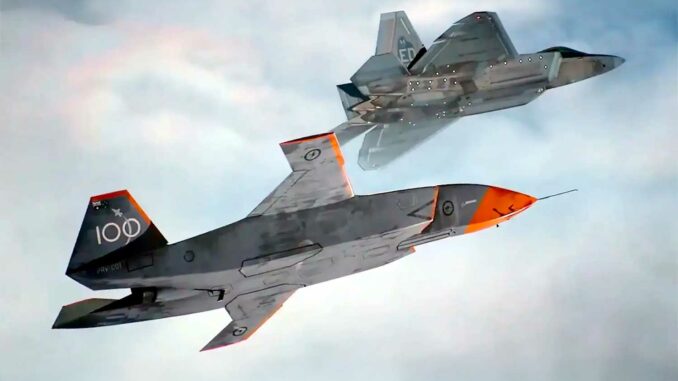
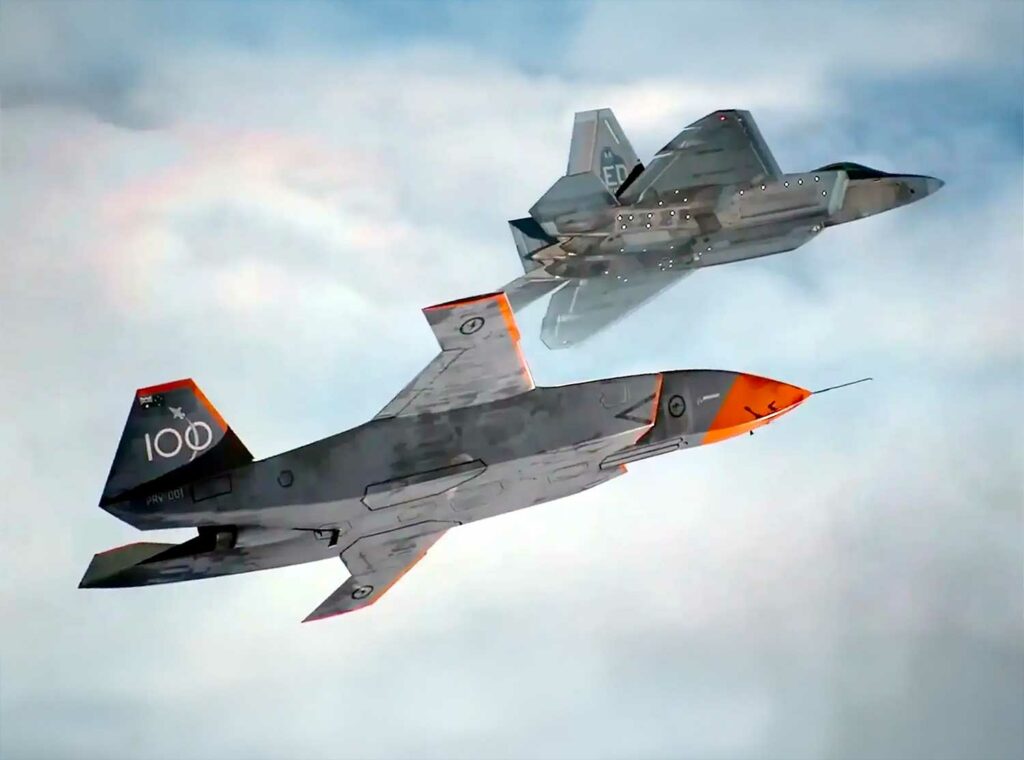
With the FQ-42A and FQ-44A, the USAF aims to build affordable combat mass. Yet stealth, autonomy, and survivability are already threatening the cost equation.
Executive Summary
The U.S. Collaborative Combat Aircraft program has just crossed a threshold. The USAF is no longer weighing an industrial decision: it has made it. On June 17, 2026, it awarded development and production contracts to General Atomics and Anduril for the FQ-42 and FQ-44, aiming to field more than 150 operational CCAs before 2030. A month later, Anduril’s YFQ-44A fired an AIM-120 AMRAAM over the Mojave Desert. Behind these tests lies a fundamental transformation of air combat. Pilots are no longer expected to manually control each individual aircraft, but rather to command a team of semi-autonomous aircraft capable of sensing, protecting, or striking. The goal is “affordable mass,” targeted at roughly $30 million per CCA. Yet that equation remains fragile. The more these drones are required to penetrate modern defenses and survive, the more their systems risk pushing their cost and complexity closer to that of the manned fighters they are meant to complement.
CCA Production Has Already Passed a Decisive Milestone
Developments within the Collaborative Combat Aircraft (CCA) program are moving at a rapid pace. The competition between General Atomics’ YFQ-42A Dark Merlin and Anduril’s YFQ-44A Fury is no longer waiting for a production decision: the USAF has chosen to produce both.
On June 17, 2026, the Department of the Air Force awarded Engineering and Manufacturing Development and production contracts to both manufacturers for Increment 1. The decision came four months earlier than planned. The USAF now explicitly aims to acquire more than 150 combat-ready CCAs before the end of the decade.
This step also updates their designations. In U.S. military nomenclature, the “Y” prefix indicates a pre-series or developmental aircraft. The “F” stands for fighter capability, and the “Q” signifies an uncrewed system. The YFQ-42A becomes the FQ-42A as it enters production; the same rule applies to the YFQ-44A.
General Atomics conducted the maiden flight of the YFQ-42A in August 2025, just 15 months after receiving the prototype contract. The aircraft is a direct evolution of work conducted on the XQ-67A and the Gambit family. Its modular architecture is designed to allow a shared airframe to be adapted for multiple mission sets: air-to-air combat, persistent surveillance, or air-to-ground strike.
Anduril is pursuing a different philosophy with Fury. The aircraft prioritizes a relatively simple, modular design engineered from the outset for rapid mass production.
This distinction matters. The CCA program is not designed to pick a single winner in the traditional sense. Washington wants to maintain multiple industrial avenues and avoid recreating a single-source monopoly similar to those seen in past major military aviation programs.
Firing an AIM-120 Turns the Wingman into a True Combatant
The second milestone occurred in July.
A YFQ-44A Fury conducted a live-fire test of an AIM-120 AMRAAM over a test range in the Mojave Desert. The missile was launched at a digital target. The test followed months of captive-carry trials using inert munitions to validate data link integration between the drone and its weapon system.
This technical detail is critical.
Carrying a missile under a wing is relatively straightforward. Launching it from an autonomous aircraft requires validating a complex sequence: power distribution, digital handshakes between weapon and airframe, missile pre-launch priming, targeting parameter transfers, launch authorization, and clean aerodynamic separation without collision.
The USAF notes that the YFQ-44A can execute this sequence autonomously within pilot-defined parameters. Crucially, the authority to employ weapons remains human. The drone does not make independent decisions to engage targets.
The FQ-42A is also scheduled to undergo air-to-air live-fire testing. However, a structural difference separates the two designs. According to the USAF, General Atomics’ entry features an internal weapons bay, whereas Anduril’s Fury currently carries its missiles on external hardpoints.
This design divergence highlights a core debate within the CCA initiative.
An internal weapons bay reduces drag and lowers the aircraft’s radar cross-section. However, it requires internal volume, doors, ejection mechanisms, structural reinforcement, and far more complex integration.
External carriage is cheaper and simpler, but the missile and its pylon increase radar signature and degrade aerodynamic efficiency.
In short: stealth comes with a price tag.
The Pilot as Quarterback of an Autonomous Team
The term “loyal wingman” can give a misleading impression of the concept.
A CCA is not merely a remote-controlled drone trailing a F-35 or the future F-47. If a pilot had to manually manage heading, altitude, sensors, and weapons for multiple offboard platforms, the cognitive workload would quickly become unsustainable.
The goal is to transition from platform control to command by intent.
A pilot might direct several CCAs to sweep a sector, search for threats, hold a defensive position, protect a formation, or engage designated targets. The mission autonomy software then handles the low-level navigation, formation keeping, and tactical positioning.
The parallel VENOM program, managed jointly by DARPA and the USAF, illustrates this direction. Modified F-16s are currently serving as testbeds for artificial intelligence agents capable of performing flight operations. DARPA explicitly aims to enable human pilots to command and orchestrate teams of autonomous aircraft.
This model alters the economics of air combat.
A high-cost manned fighter can serve as the command node for a distributed formation. CCAs positioned tens or hundreds of kilometers ahead can extend radar coverage, carry additional missiles, force enemy air defenses to illuminate, or enter high-threat envelopes where risks to human crews would be unacceptable.
The pilot becomes less of a stick-and-rudder aviator and more of a quarterback.
Decoupling the Airframe from the AI Shifts the Industrial Model
Another shift is less visible, but potentially as significant as the airframe itself.
The USAF is decoupling mission autonomy software from the physical aircraft.
General Atomics or Anduril can build the airframe, while a separate defense contractor supplies the “digital pilot.” Six companies were selected for the initial software vendor pool: Anduril, General Atomics, Lockheed Martin, Northrop Grumman, RTX Collins Aerospace, and Shield AI.
Anduril, RTX Collins Aerospace, and Shield AI subsequently secured the first production option contracts for mission autonomy software. A follow-on competition is set to select the primary software provider for Increment 1 by the summer of 2027.
This open architecture is designed to mitigate a persistent military procurement risk: vendor lock-in.
Under this model, an FQ-44 could receive a next-generation software upgrade without requiring structural changes to the airframe. The software stack can theoretically evolve every few months, even while the physical airframe remains in service for years.
The YFQ-42A has already flown using third-party mission autonomy code, and the Fury has similarly served as a testbed for multiple software suites.
This represents a departure from traditional fighter procurement, where airframe, avionics, sensors, and software have historically been tightly coupled for decades.
Affordable Mass as a Response to USAF Fleet Realities
The CCA strategy is primarily driven by fiscal realities.
Modern combat aircraft have become too expensive to allow one-for-one replacements of retiring legacy fleets.
Consequently, the USAF is seeking to decouple its total number of pilots from its total number of effectors.
The target unit cost for Increment 1 is pegged at $30 million or less per CCA—a fraction of the flyaway cost of a modern crewed fighter. In late July, Col. Timothy Helfrich, senior materiel leader for Advanced Aircraft and Fighters, stated that both CCA designs were coming in below the Air Force’s target price point.
Budgetary requests show Washington moving toward industrial scaling.
The FY2027 budget request includes $996.528 million for the initial procurement phase of Collaborative Combat Aircraft, alongside $150.5 million in advance procurement funding, bringing total authorized funding to $1.147 billion.
However, the exact number of airframes associated with this request remains classified. Budget documents note that specific contractual details are protected. As a result, dividing $1.147 billion by a projected airframe quantity does not yield an accurate unit cost.
Survivability Threatens the Core Economic Value Proposition
This is where the program confronts its central tension.
A $30 million CCA offers a compelling value proposition as long as military planners accept that it will offer lower performance than an F-35 or an F-47.
However, challenges arise when considering operations inside contested airspace against advanced radars, modern fighters, long-range surface-to-air missiles, and heavy electronic attack.
Surviving in that environment demands a reduced radar signature, secure communications, anti-jamming data links, passive sensor suites, potential AESA radar integration, electronic countermeasures, system redundancy, extended range, and hardened cybersecurity.
Each requirement is individually logical from a tactical perspective.
Taken together, however, they threaten to undermine the program’s cost model.
Achieving low-observable performance requires specialized shaping, embedded antenna integration, strict engine intake and exhaust management, radar-absorbent materials, and tight manufacturing tolerances. Internal weapons bays improve stealth, but add volume, structural weight, and complexity.
The risk is straightforward: gradually creeping the scope of a low-cost drone until it becomes a small stealth fighter.
The “Attritable” Label Is Being Refined
The USAF itself is shifting away from describing these drones as disposable.
The preferred terminology has evolved to “optionally attritable.” This means commanders can choose to expose a CCA to high risk if mission value warrants it, without treating the platform as a single-use weapon.
Col. Helfrich clarified this position in July, emphasizing that the Air Force never viewed CCAs as disposable assets. An individual airframe is expected to fly numerous sorties and remain operational for years, while still being available for missions where the risk profile would be unacceptable for a crewed platform.
This distinction is financially significant.
At $30 million per unit, an FQ-42A or FQ-44A represents a substantial asset. Losing ten airframes equates to roughly $300 million in baseline hardware costs alone.
However, losing those platforms remains far preferable to losing ten crewed fighters, their trained pilots, and their substantially higher replacement costs.
This capability-risk trade-off forms the core logic of the CCA program.
Logistics Are as Critical as Autonomy
The USAF is already testing these platforms outside traditional flight-test environments.
In July, the Experimental Operations Unit deployed FQ-42 and FQ-44 airframes to Creech Air Force Base, Nevada, as part of an Agile Combat Employment exercise. Teams conducted multiple sorties, integrated airframes with crewed platforms, loaded inert AIM-120s, refueled the drones, and tested turn times for rapid re-flight.
While less high-profile than artificial intelligence flight demonstrations, these operational trials are critical.
A fleet of hundreds of uncrewed aircraft offers limited operational value if each airframe requires extensive ground crews, specialized support equipment, climate-controlled facilities, and lengthy turn times between missions.
For “affordable mass” to work, it must extend beyond acquisition unit cost to field maintenance and operational logistics.
This explains why Anduril’s FQ-44 emphasizes simplified maintenance and external weapon carriage, while General Atomics focuses on modularity across a shared airframe family.
The Real Test: Resisting the Push for an Uncrewed Fighter
The FQ-42A and FQ-44A represent more than just two new uncrewed platforms joining the inventory. They reflect a broader shift in how the USAF views airpower.
For decades, expanding force capacity meant buying more crewed fighters or engineering higher-performing platforms. The CCA concept offers an alternative approach: distributing sensors and weapons across a larger number of autonomous platforms operating around a smaller core of crewed aircraft.
This structure could significantly impact operational calculations in the Pacific, where range, missile inventory capacity, and acceptable attrition rates are key planning factors.
Yet the success of the initiative will not depend solely on a Fury launching an AMRAAM or a Dark Merlin flying autonomously.
Ultimately, it will depend on the USAF’s willingness to accept a platform that cannot perform every mission.
If a CCA is required to match the stealth of an F-35, carry fifth-generation sensor suites, execute complex electronic warfare, house multiple internal weapons, run highly sophisticated software, and maintain a 30-year service life, its unit cost will inevitably climb toward the crewed aircraft it was designed to supplement.
The success of the Collaborative Combat Aircraft program depends on operational discipline: accepting an imperfect platform in order to field meaningful mass.
The central question is no longer whether autonomous wingmen can fly or fire weapons—those capabilities are already being demonstrated.
The key question is whether the USAF can contain capability creep long enough to preserve the core rationale of the program: operational mass.
War Wings Daily is an independant magazine.