The Sino-Russian patrol on 27 June reveals genuine military cooperation, but also a growing imbalance in Beijing’s favour.
In summary
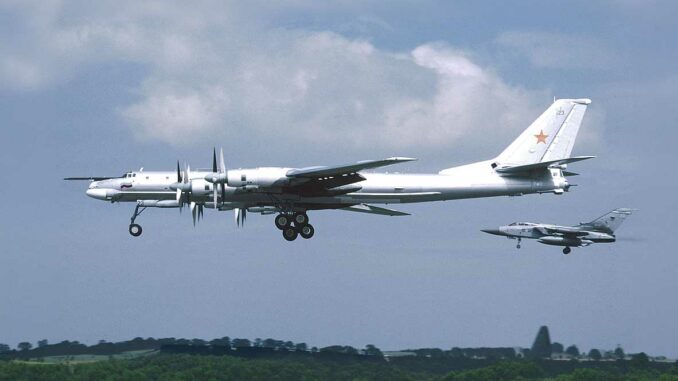
The strategic air patrol conducted by China and Russia on 27 June 2026 goes beyond the scope of a routine exercise. Russian Tu-95MS and Chinese H-6 bombers flew over the Sea of Japan, the East China Sea and the western Pacific, under the protection of Su-35 and J-16 fighter jets. Russian Tu-142 aircraft, specialised in maritime surveillance, also took part in the operation.
For Moscow, this mission serves first and foremost to demonstrate that the war in Ukraine has not confined it to the role of a regional power. Russia wishes to maintain a visible presence in Asia and retain a place in the global balance of power. For Beijing, the interest lies elsewhere. Russia is an experienced military partner, geographically well-positioned and capable of complicating US planning.
This strategy serves as a demonstration of coordination. However, it does not place Russia on an equal footing with China. On the contrary, it reveals an increasingly asymmetrical relationship.
The 27 June patrol involved a much larger deployment than just two bombers
The mission on 27 June 2026 was the 11th joint strategic patrol organised by the Chinese and Russian air forces since this format was launched in 2019. It lasted around six hours. Its route covered the Sea of Japan, the East China Sea and part of the western Pacific.
Data published and subsequently corrected by the Japanese General Staff show two distinct phases. Two Chinese H-6 bombers first joined two Russian Tu-95s and two Tu-142 maritime patrol aircraft over the Sea of Japan. Two Chinese J-16 fighters and a Russian Su-35 accompanied this initial formation.
Later, two further H-6s rejoined the Russian Tu-95s. The group continued its flight from the East China Sea into the Pacific, south of the Japanese island of Shikoku. Four J-16s and the two Tu-142s took part in this second phase. The Japanese map thus shows four H-6s, two Tu-95s, two Tu-142s, several pairs of J-16s and one Su-35 throughout the entire operation.
The Russian Ministry of Defence, for its part, announced the participation of Su-30SM and Su-35S fighters. This discrepancy does not necessarily constitute a contradiction. Japanese systems only reported aircraft identified within the monitored areas around the archipelago. Some Russian fighters may have operated further north, outside the sector detailed by Tokyo.
The Japan Air Self-Defence Force scrambled its fighters to track the formation. South Korea also deployed aircraft when nine Chinese and Russian aircraft entered its air defence identification zone. There is no available evidence to suggest a violation of Japanese or South Korean airspace. An air defence identification zone is not sovereign airspace. It serves to detect, at an earlier stage, aircraft that may be approaching national territory.
The Tu-95 remains as much a political tool as a strategic bomber
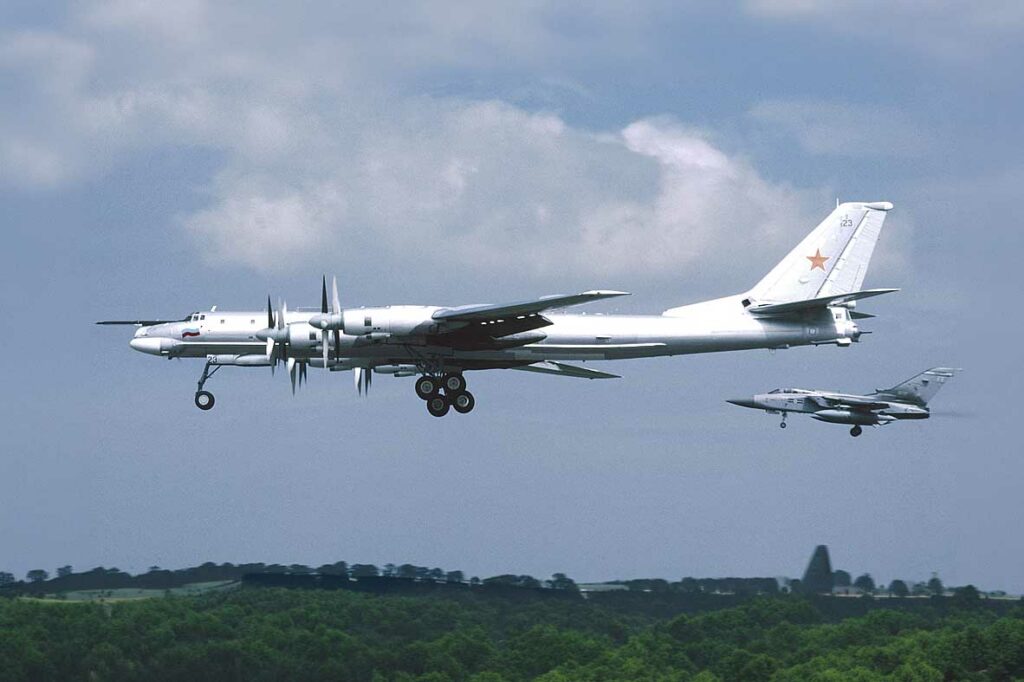
The Tupolev Tu-95 is often portrayed as a relic of the Cold War. The first prototype flew in 1952. Whilst this is indeed a long history, it can be misleading. The Tu-95MS aircraft in service today are not the same as those from the 1950s. This version was designed as a cruise missile platform and has been in production since the early 1980s.
Its role is no longer to penetrate deep into modern airspace to drop bombs. Instead, it consists of remaining at a distance from enemy defences and launching long-range cruise missiles. Its long range, internal volume and the relative fuel efficiency of its four NK-12 turboprop engines enable it to carry out long missions.
The Tu-95MS is neither stealthy nor inconspicuous, nor is it difficult for modern radar to track. But that is not what Moscow expects of it during a strategic patrol. The aircraft must be seen. Its presence indicates that the air component of Russia’s deterrent remains active and capable of reaching a distant theatre.
The mission on 27 June was therefore a demonstration of readiness. It showed that Russian crews, bombers and escort units could still be mobilised in the Russian Far East despite the constraints imposed by the war against Ukraine.
The presence of the Tu-142s reinforces this interpretation. Derived from the Tu-95 family, the Tu-142 specialises in maritime patrol, submarine detection and oceanic surveillance. Its inclusion suggests a more complex scenario than a simple air parade. The mission combined strategic bombing, fighter protection and maritime reconnaissance.
The Su-35 provides credible protection but does not transform the formation into an integrated combat force
The Su-35S is a heavy fighter derived from the Su-27. It can reach Mach 2.25, carry up to 8,000 kilograms of payload and operate at a maximum declared altitude of 18,000 metres. Its 12 hardpoints allow it to carry a wide range of air-to-air and air-to-ground missiles.
During a bomber patrol, its role is to detect aircraft approaching to identify the formation, to protect the slowest aircraft and to maintain a security bubble. It can also gather intelligence on enemy radars, interception procedures and communications.
The presence of a Su-35 remains limited, however. It does not prove that Russia and China have a joint air command, integrated rules of engagement or a shared target designation system. No details of the weapons carried have been officially disclosed. There is therefore no evidence to suggest that the aircraft simulated a coordinated strike against a specific target.
The sophistication of the mission is better gauged by the synchronisation of flight paths, timings and formations. Bringing together bombers from different bases, escorting them with several types of fighter aircraft and maintaining the formation for six hours requires serious preparation. This remains below the level of integration seen in NATO operations, but is more than a mere symbolic encounter in the skies.
Russia wants to prove that the war in Ukraine has not reduced it to a European power
For Russia, the main purpose of the China-Russia strategic air patrol is political. Moscow wants to show that its horizons are not limited to Ukraine, the Black Sea or NATO’s borders.
A global power must be able to operate across multiple theatres. It must possess long-range military capabilities. It must also have partners capable of opening up diplomatic and operational spaces for it. China provides all three of these advantages.
By flying alongside Chinese forces near Japan and the Korean Peninsula, Russia is reminding the world that it remains a Pacific power. It has over 4,000 kilometres of coastline in this region, air bases in the Far East and a fleet deployed in Vladivostok. Its territory enables it to exert simultaneous pressure on the European, Arctic and Asian flanks of US alliances.
The staging is crucial. The image of Tu-95s flying alongside Chinese H-6s formally places Moscow on an equal footing with Beijing. The two countries appear as two centres of power jointly challenging the US-dominated strategic order.
This image has become a geopolitical multiplier for the Kremlin. It contradicts the Western narrative of an isolated Russia. It allows Vladimir Putin to assert that sanctions have not deprived his country of major partners. Finally, it forces Washington to maintain surveillance and interception capabilities in the Pacific, whilst US forces are already having to manage Europe, the Middle East and the Indo-Pacific.
China uses Russia as a low-cost strategic insurance policy
Beijing is not seeking exactly the same outcome. China does not need Russia to appear as a major power. Its economy, industry and armed forces are already sufficient to grant it that status.
On the other hand, Moscow provides it with low-cost strategic assurance. Russia secures a shared land border stretching over 4,000 kilometres. It forces the United States and its allies to monitor a vast area stretching from Northern Europe to Alaska. It also has extensive experience of strategic air operations, Arctic flights and long-range bomber missions.
For the People’s Liberation Army Air Force, joint patrols provide an opportunity to train H-6 and J-16 crews to operate far from Chinese bases. They offer access to Russian expertise in bomber coordination, long-range mission planning and responding to foreign interceptions.
Russia also serves to complicate Japan’s military calculations. Tokyo cannot focus all its attention on the East China Sea and Taiwan. Russian aircraft can approach from the north, from the regions of Vladivostok, Khabarovsk or Kamchatka. Chinese aircraft advance from the west and south-west. Even without an attack, this convergence necessitates multi-directional surveillance.
The operation on 27 June specifically exploited this geography. Part of the formation operated in the Sea of Japan. Another part entered the Pacific via the straits to the south-west of the archipelago. The patrol thus linked several sensitive areas within a single operational sequence.
The military partnership is progressing without becoming a formal alliance
China and Russia officially refer to a comprehensive strategic partnership. Beijing, however, continues to frame this relationship according to three principles: no alliance, no confrontation and no targeting of a third country.
This formulation is deliberately ambiguous. It allows the two governments to cooperate militarily without signing a mutual defence treaty comparable to Article 5 of NATO.
China is not legally obliged to defend Russia. Nor would Moscow be obliged to intervene in a war over Taiwan.
It is therefore cooperation without mutual guarantees. This model offers flexibility. The two countries can organise patrols, naval exercises, anti-missile drills and strategic consultations. They can exchange technology and intelligence. However, they retain the option of keeping their distance when their interests diverge.
This limitation is particularly important for China. Beijing wants to weaken US dominance, but does not wish to sacrifice its global economic relations for the sake of Russian objectives. Russia, for its part, seeks to avoid the image of a state dependent on its Chinese neighbour.
Official statements in May and June 2026, however, continue to emphasise increased strategic coordination and the building of a multipolar world. The patrol on 27 June embodies this direction in the military sphere.
Economic and military asymmetry undermines the Russian narrative of a relationship between equals
The figures clearly show the limits of this posturing. According to the Stockholm International Peace Research Institute, China spent around $336 billion on its armed forces in 2025. Russia spent around $190 billion, or 7.5 per cent of its gross domestic product.
China therefore spends nearly 77 per cent more than Russia whilst bearing a proportionally much lighter budgetary burden. It also benefits from a far more extensive industrial, electronic and naval base.
Bilateral trade reached around $227.6 billion in 2025. This figure was down by nearly 7 per cent year-on-year, but remained 55 per cent higher than the 2021 level. Russia is now heavily dependent on Chinese machinery, electronic components, vehicles and energy markets.
This dependence creates a paradox. The more Russia relies on China to demonstrate that it remains a global power, the more it reveals that it can no longer defend this claim on its own.
Beijing can maintain trade relations with Europe, the United States, Japan and the Gulf economies whilst working with Moscow. Russia no longer has this room for manoeuvre. Its trade with Western economies has been severely curtailed by sanctions and the war.
The relationship is therefore not balanced. China regards Russia as a useful military partner, an energy supplier and a source of diplomatic support. It does not necessarily treat it as an equivalent second centre of power. Moscow is gradually becoming a subordinate partner, even if ceremonies and press releases strive to mask this development.
The geopolitical outcome is real but falls short of stated ambitions
The Sino-Russian strategy serves as a signal. It forces Japan and South Korea to scramble fighter jets. It compels the United States to monitor Russian and Chinese activities simultaneously. It demonstrates a capacity for coordination that did not exist at this level ten years ago.
It is also effective on a political level. Both governments are producing simple yet powerful imagery. Bombers capable of carrying nuclear or conventional weapons are flying together over strategic areas. The message is understood without any borders being crossed.
But this strategy also has unintended consequences.
The joint patrols strengthen Japan’s case for rearmament. They are pushing Tokyo, Seoul and Washington to improve their early-warning systems and joint procedures. They are helping to transform what is still limited military cooperation into a lasting threat in regional perceptions.
Nor does the 27 June patrol prove that the two armies could wage a joint war. It reveals neither an integrated general staff, nor a unified doctrine, nor a shared logistics chain. It does not show that Beijing would be prepared to bear the consequences of a war triggered by Moscow.
The operation therefore achieves a specific objective. It makes Sino-Russian cooperation visible, credible and costly to ignore. It does not restore parity between the two partners.
Russia can still fly alongside China, deploy strategic bombers and force several countries to react. It thus retains a capacity for global disruption and deterrence. But the centre of gravity of the relationship has shifted. In the skies over the Pacific, the Tu-95s project the image of a superpower. The economic and military structure of the partnership already tells a different story.
Sources
Japanese Ministry of Defence, Joint Staff Office, ‘Chinese and Russian aircraft activity around Japan’, revised publication dated 1 July 2026.
Japanese Ministry of Defence, correction to the press release on the Sino-Russian joint flight, 28 June 2026.
Ministry of Defence of the People’s Republic of China, press release on the 11th joint strategic air patrol, 27 June 2026.
USNI News, ‘Russia, China Fly Joint Bomber Missions Near Japan, South Korea’, 30 June 2026.
United Aircraft Corporation, technical and historical documentation on the Tu-95MS.
Rosoboronexport, technical specifications of the Su-35.
Stockholm International Peace Research Institute, ‘Trends in World Military Expenditure, 2025’, April 2026.
Chinese Ministry of Foreign Affairs, statements on the Sino-Russian strategic partnership, March to June 2026.
Chatham House, analyses of the asymmetry in the partnership between China and Russia, May and June 2026.
War Wings Daily is an independant magazine.