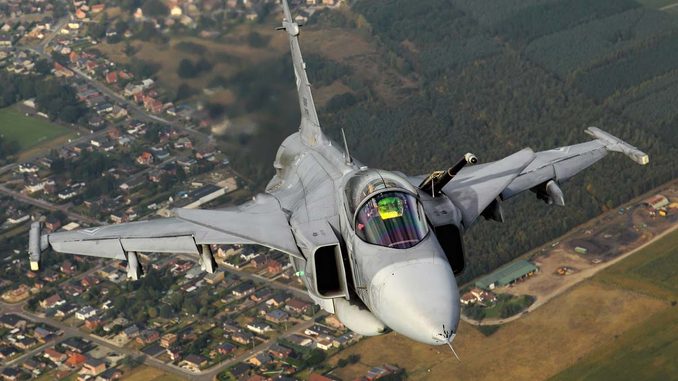
The Saab JAS 39 Gripen can be refueled and rearmed in a matter of minutes. Its engine can be replaced in the field in less than an hour.
Executive Summary
The Saab JAS 39 Gripen illustrates a philosophy rarely pushed so far on a modern combat aircraft: maintainability is a military capability. Inherited from the Swedish dispersion doctrine born during the Cold War, the fighter was designed to leave major air bases, utilize public roads, and be serviced by small teams. Saab states that a Gripen C can be refueled, inspected, and rearmed for an air-to-air mission in under ten minutes by a single professional technician and five conscripts with specialized training. Even more striking, the manufacturer claims that the same team can swap the engine in under an hour in field conditions. These performance metrics are far from incidental. They stem directly from the aircraft’s architecture, quick-access panels, ground autonomy, and intentionally reduced logistical footprint. In 2026, Sweden is still looking to shorten these turnaround times in response to the acceleration of adversary targeting cycles.
Swedish Doctrine Imposed an Aircraft Capable of Surviving Without a Base
To understand the Gripen, one must abandon the traditional image of a modern air base. Sweden long operated under the assumption that in a war against the Soviet Union, its military airfields would be among the very first targets.
The response was dispersion.
The Bas 60 system, followed by Bas 90 during the Cold War, was designed to spread aircraft, fuel, munitions, and ground crews across numerous sites. Portions of public highways and secondary airstrips could serve as temporary bases. Within a single sector, aircraft were also dispersed to prevent a single strike from neutralizing an entire squadron on the ground.
This doctrine directly dictated the design of the JAS 39 Gripen, whose development began in 1982.
The aircraft had to take off short, land short, be refueled quickly, and return to the air. Crucially, it could not rely on a hangar full of specialists and heavy equipment.
The Gripen C/D measures just 14.9 meters in length with an 8.4-meter wingspan, and has a maximum takeoff weight of 14 metric tons. According to FMV, the Swedish Defence Materiel Administration, it requires roughly 400 meters to take off and 500 meters to land under standard baseline conditions. Saab notes that it can operate from a highway strip measuring roughly 800 meters long by 16 meters wide.
The aircraft’s compact size is therefore more than just an aerodynamic choice. It is integral to its tactical mobility.
Maintenance Was Built Into the Gripen’s Architecture
The essential difference becomes clear as soon as the aircraft stops rolling.
On many fighter jets, maintenance is an afterthought of the design process. On the Gripen, it was a primary constraint from day one.
Frequently accessed panels are within easy reach. Several can be opened quickly without complex tools. Components requiring field replacement are positioned to minimize the need to remove adjacent hardware. Onboard systems handle much of their own fault diagnostics.
The Auxiliary Power Unit (APU) also plays a critical role. This small turbine provides power to the aircraft while on the ground, reducing its dependence on external electrical support equipment.
The principle is simple: every truck, generator, specialized mechanic, or test bench eliminated from the supply chain is one less element that needs to be moved, defended, and resupplied.
Saab thus asserts that the equipment required to support two Gripens for two weeks can fit inside a single standard 20-foot shipping container, or approximately 6.1 meters in length.
The sophistication is contained within the aircraft itself, allowing its operational environment to remain simple.
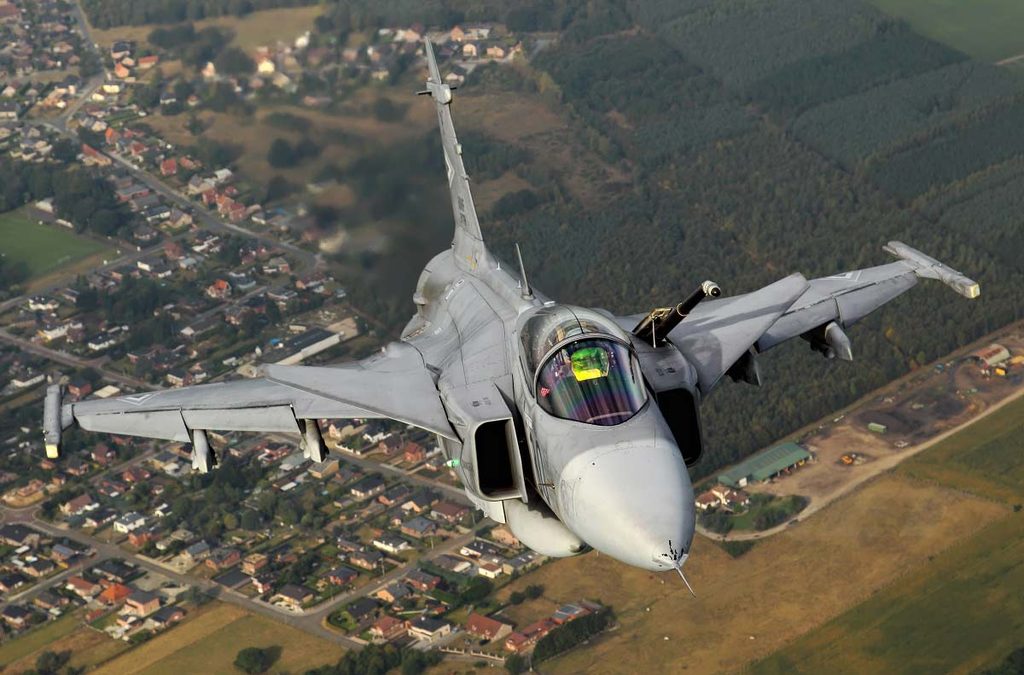
An Engine Swap in Under an Hour Is the Result of Architectural Intent
The engine replacement is the most dramatic example of this design philosophy.
On the Gripen C/D, the RM12 engine is derived from the General Electric F404. The Gripen E utilizes the RM16—the Swedish designation for the General Electric F414-GE-39E—delivering roughly 98 kN of thrust.
Saab states that an engine swap can be completed in under an hour, testing included, with one technician and five conscripts on the Gripen C. The manufacturer has also reported a replacement time of approximately 45 minutes on the latest generation.
The secret is obviously not that the turbofan is mechanically simple. A modern fighter engine remains an extremely complex machine.
Rather, it is its interface with the aircraft that was streamlined.
On the Gripen E, Saab notes that the engine is secured at three mounting points, with connectors designed for rapid access. Opening the engine bay does not require specialized, heavy infrastructure. The goal is not to overhaul a turbine on the roadside, but to quickly swap out a faulty module and send the aircraft back into combat. Deep engine repairs are deferred to a dedicated facility.
This is a fundamental distinction. Sweden did not simplify the engine’s technology. It simplified its replacement.
Five Conscripts Turn Logistics Into a Force Multiplier
The same logic applies between sorties.
For the Gripen C, Saab provides a baseline benchmark of under ten minutes for an air-to-air turnaround, including refueling, rearming, and pre-flight checks, carried out by one qualified technician and five conscripts. The manufacturer notes that these conscripted mechanics could be prepared for these procedures after roughly ten weeks of training.
However, a distinction must be drawn between the manufacturer’s nominal performance figures and current operational realities.
In July 2026, the Chief of the Flygvapnet, Major General Jonas Wikman, noted that crews comprising one supervisor and five conscripts were currently achieving certain refueling and rearming sequences in 15 to 20 minutes. The Swedish Air Force is now striving to push below the ten-minute mark, notably experimenting with hot-pit refueling operations (with the engine running).
The nuance is important: ten minutes represents a demonstrated capability and a design target, not necessarily the timing systematically achieved under all operational conditions.
The Gripen’s Simplicity Meets Modern High-Intensity Warfare
The value of this concept is highlighted by the war in Ukraine. Ballistic missiles, cruise missiles, drones, and satellite reconnaissance make major air bases extremely vulnerable.
Moving aircraft is no longer enough. Mechanics, ammunition, fuel, spare parts, and support gear must all move with them to sustain operations.
This is where the Gripen demonstrates a strategic advantage that is often less visible than its radar or missiles: its intentionally small logistical footprint.
Sweden continues to train its units for this dispersed style of warfare. During exercise Aurora 26 in April 2026, Gripens operated out of Hagshult Air Base, a legacy site of the Bas 90 system. Conscripts were evaluated on their capability to turn aircraft around under field conditions.
Ultimately, the Gripen presents a telling paradox. It is a digital, aerodynamically unstable aircraft guided by fly-by-wire controls and equipped with advanced combat systems. Yet part of its effectiveness relies on an almost rustic principle: the ability to land far from a main base, take on fuel and missiles, quickly swap a malfunctioning component, and return to the sky.
In a war where an airfield can be detected and struck from hundreds of kilometers away, this simplicity is no longer just a cost-saving measure. It becomes a method of survival.
War Wings Daily is an independant magazine.
Sources
Saab — Gripen Support, data on turnaround times, conscript teams, and engine replacement.
Saab — Gripen C-series, technical specifications, turnaround times, and engine replacement.
Saab — Gripen’s Smart Support Solution, support doctrine, and logistical footprint.
Saab — Gripen E: Always Ready for Flight, maintenance architecture, and engine replacement.
Saab — A Future-Proof Fighter Jet, data on engine replacement in approximately 45 minutes.
Försvarets materielverk, FMV — JAS 39 Gripen, Gripen C/D specifications and engine support organization.
Försvarsmakten — Aurora 26, JAS 39 Gripen short-runway operations at Hagshult, April 30, 2026.
Försvarsmakten — Documentation on maintenance units and JAS 39 Gripen turnaround procedures.
Aviation Week — Swedish Air Force To Shorten Turnaround Times For Dispersed Basing, July 20, 2026.