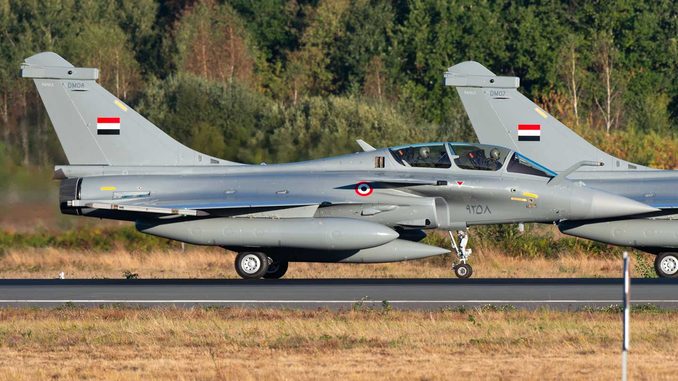
Egypt is requesting a proposal from Dassault Aviation for 24 additional Rafale aircraft, with the potential goal of expanding its fleet to 78 fighters.
In Summary
Egypt is potentially preparing a third Rafale order. According to information published in early September 2026, Cairo sent a Request for Proposal to Dassault Aviation for 24 additional Rafales. An RFP requests a detailed technical and commercial offer but does not yet constitute an order. If negotiations succeed, the Egyptian Air Force would eventually operate 78 Rafales, following the 24 aircraft ordered in 2015 and the 30 additional units acquired in 2021. The move addresses a structural problem: Egypt still operates more than 200 F-16s, several dozen of which were delivered in the 1980s and 1990s. The Rafale brings more modern avionics, superior electronic warfare, and access to a suite of French weaponry. This request also comes as Cairo deepens its military cooperation with Beijing. Egypt is seeking less a single supplier and more greater autonomy in its procurement choices.
The Egyptian Request Paves the Way for a Third Order
The news is significant, but its current status must be properly understood.
According to La Tribune, Egypt sent a Request for Proposal (RFP) to Dassault Aviation for 24 new Rafales. Several specialized publications subsequently reported the story on September 1, 2, and 3, 2026.
An RFP is not an order.
It invites a manufacturer to submit a formal offer detailing technical specifications, pricing, financing, support, delivery schedules, and potentially associated weapons systems. Formal negotiations can then begin.
Dassault Aviation has not publicly confirmed the existence of a future contract and declined to comment on reports in the French press. At this stage, no price, delivery schedule, or breakdown between single-seat and two-seat variants has been announced.
The precise standard of the aircraft is also not officially known. It would therefore be premature to state that the 24 aircraft would necessarily be Rafale F4s, even if that standard currently serves as the baseline for new production runs.
The Rafale Has Become a Pillar of Egyptian Aviation
The relationship between Cairo and the Dassault Rafale dates back to 2015.
That year, Egypt became the Rafale’s first export customer with an order for 24 aircraft. The contract was part of a package that also included a FREMM frigate and advanced weaponry.
Egypt returned to Dassault Aviation in 2021 with a second order for 30 additional aircraft.
That brought the total ordered to 54 jets.
Dassault Aviation noted at the time that the Egyptian Air Force would become the world’s second-largest Rafale operator after the French Air and Space Force.
The 30 aircraft from the second contract are scheduled to progressively join the fleet through the end of 2026.
A new acquisition of 24 fighters would thus bring the theoretical total to 78 Rafales.
78 Rafales Would Not Be the Largest Export Contract
A nuance is necessary here.
At 78 aircraft, Egypt would not become the largest foreign customer for the Rafale in terms of total airframes ordered. The United Arab Emirates signed a contract in December 2021 for 80 Rafales to the F4 standard.
Cairo would nonetheless possess one of the largest Rafale fleets outside of France, along with far more operational experience on the type than future operators.
This operational continuity matters. Adding 24 Rafales to an existing fleet costs less in terms of training, infrastructure, and logistics than introducing an entirely new fighter model.
Aging F-16s Create a Massive Replacement Challenge
Industrial logic alone does not fully explain this third tranche.
The real challenge for the Egyptian Air Force is the F-16 Fighting Falcon.
Egypt received roughly 240 F-16s under various phases of the Peace Vector program. According to available inventories, more than 200 remain in service.
A significant portion of this fleet is aging.
The initial batch included 42 F-16 Block 15s delivered starting in 1982. Forty Block 32s followed beginning in 1986, and 47 Block 40s were delivered in the early 1990s.
These first three tranches represent 129 aircraft delivered between 1982 and 1995.
Even after modernization, airframe age becomes a critical constraint. In 2026, the earliest Egyptian F-16s are over forty years old.
A potential fleet of 78 Rafales would not numerically replace all of these legacy aircraft. It would represent only about 60% of the 129 F-16s belonging to the first three batches.
Egypt’s recapitalization challenge is therefore far broader than a single order of 24 fighters.
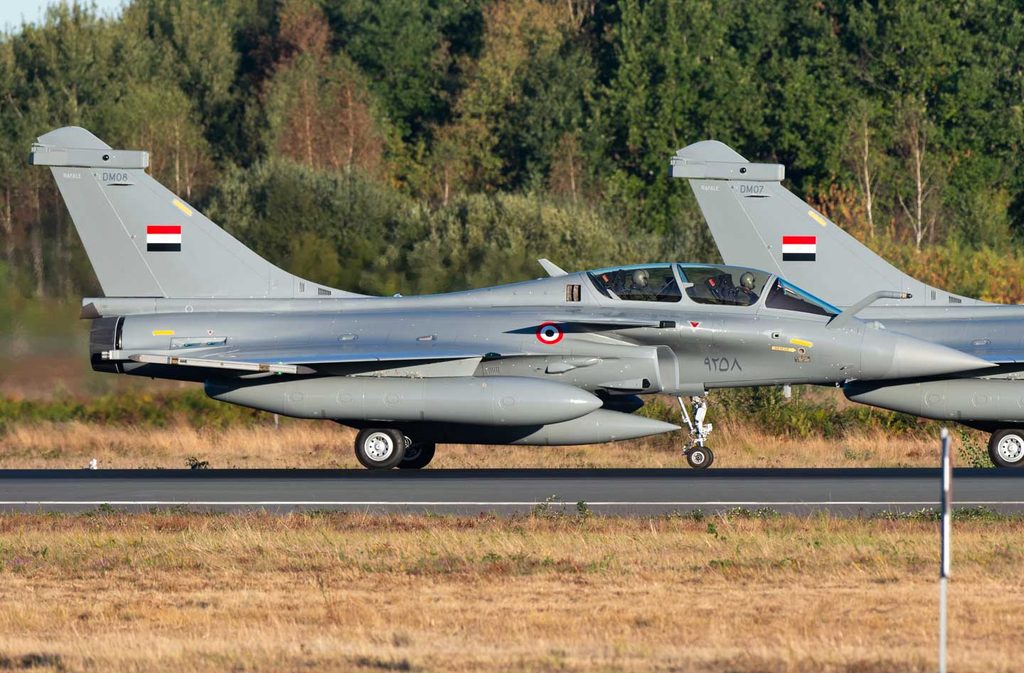
The Rafale Brings Capabilities the Egyptian F-16 Lacks
The Rafale is not simply newer.
Its core value lies in its combat architecture.
The French fighter pairs an RBE2 AESA active electronically scanned array radar with a front-sector optronics system, data links, the SPECTRA electronic warfare suite, and sensor fusion combining data from across its suite.
SPECTRA represents a major operational leap. The system detects and geolocates hostile electromagnetic emissions, contributing directly to warning, jamming, and aircraft protection.
The Rafale can also employ a wide array of French ordnance.
MICA handles air-to-air engagements, while Meteor provides long-range interception capabilities. The AASM Hammer delivers precision air-to-ground strikes, and the SCALP-EG cruise missile offers long-range standoff capabilities against hardened land targets.
However, the exact configuration accessible to Egypt depends on French export approvals. It should not be automatically assumed that every export Rafale includes the full spectrum of French weapons and equipment.
Deepening Ties with China Complicate Egypt’s Choices
The Egyptian request arrives in a particularly notable diplomatic context.
The Egyptian Air Force recently conducted the Eagles of Civilization 2026 exercise alongside China. Chinese J-16s operated directly alongside Egyptian Rafales.
This joint training highlights Cairo’s desire to avoid relying exclusively on Washington or Paris.
China is concurrently pushing its own combat aircraft on the export market. The Chengdu J-10 represents a credible option for countries seeking modern fighters without committing entirely to the American defense ecosystem.
Xi Jinping’s visit to Egypt in early September 2026 further underscored this trend, with Beijing and Cairo signaling their intent to deepen economic, diplomatic, and military ties.
This does not imply that Egypt is abandoning its Western partners. The reality is precisely the opposite: Cairo is multiplying its options.
The Rafale Allows Egypt to Reduce US Dependence
The history of Egypt’s F-16 fleet explains this strategy.
Egypt has been one of the primary beneficiaries of US military aid for decades. However, the operation and modernization of its F-16s remain subject to political decisions in Washington.
Deliveries of American equipment and upgrades were notably disrupted following the overthrow of Mohamed Morsi in 2013.
For Cairo, diversifying its suppliers acts as a form of strategic insurance.
The Egyptian fleet currently operates an eclectic mix of American F-16s, French Rafales, Mirage 2000s, and Russian MiG-29Ms. This diversity increases logistical overhead and complicates training, but it prevents any single foreign supplier from holding complete leverage over the nation’s air power.
A third Rafale order would firmly solidify the French pillar of this force structure.
The Final Outcome Will Reveal More Than Just Aircraft Numbers
The headline figure of 24 additional Rafales naturally commands attention. However, the specific details of any eventual contract will prove far more telling than the sheer volume of airframes.
Key factors to monitor will include the requested aircraft standard, authorized weapons suites, financing terms, delivery schedules, and the split between single-seat and two-seat airframes.
The Rafale represents a pragmatic choice for Egypt. The aircraft is already integrated into its operational structure, pilots are trained, and supporting infrastructure exists. Adding a new tranche would allow rapid capability expansion without introducing a brand-new supply chain.
Yet 24 fighters alone will not solve the systemic aging of a fleet that once inducted F-16s by the hundreds.
Above all, Egypt’s decision highlights a broader transformation: Cairo intends to maintain its defense partnership with the United States, strengthen its military ties with France, and expand its strategic relationship with China. In the Middle East of 2026, the key question is no longer just which fighter has the superior radar, but which supplier will grant its customer the greatest political autonomy.
War Wings Daily is an independant magazine.