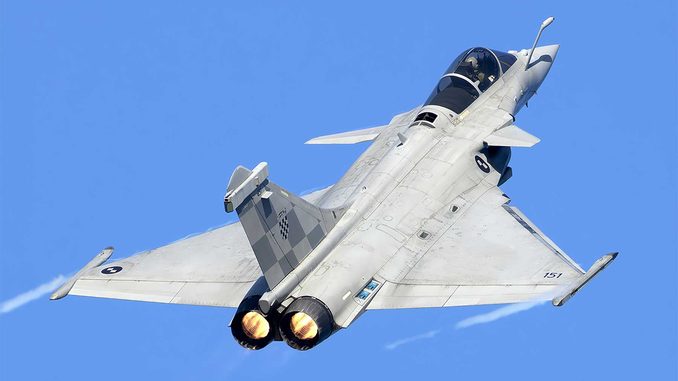
French pilots highlight the growing difficulties faced by the Rafale when countering stealth fighters, making the upcoming F5 standard a critical evolution planned for the 2035 horizon.
In Summary
A French strategic study brought back into the spotlight in early September 2026 highlights a significant limitation of the Rafale in high-intensity aerial warfare. French pilots accustomed to joint exercises with fifth-generation fighters estimate that a mission against a stealth platform remains “very difficult to win” using current sensors. The assessment originates from an IFRI study published in January 2025 rather than a new operational incident occurring on September 3. The issue primarily concerns the capability to detect, track, and provide a fire-control solution sufficiently early against low-observable aircraft. While the RBE2 AESA radar, OSF optronics, and SPECTRA electronic warfare suite remain highly capable, no single sensor can neutralize the inherent advantages of stealth. The upcoming Rafale F5 standard aims to bridge this gap through a upgraded radar, advanced infrared detection, directional data links, enhanced sensor fusion, and a stealthy combat drone operating alongside the aircraft.
A Harsher Assessment Than a Simple Technical Comparison
The information reported on September 2 and 3, 2026, requires context.
This is not a newly published warning issued by the French Air and Space Force. The findings stem primarily from a study published in January 2025 by the French Institute of International Relations (IFRI) and authored by Adrien Gorremans—a former fighter pilot with 2,500 flight hours and 120 combat missions—with contributions from Jean-Christophe Noël, also a former military pilot.
The paper is based on interviews conducted with active-duty French officers.
Its conclusion is remarkably direct: pilots who regularly participate in allied exercises against fifth-generation fighters report that aerial combat remains very difficult to win with the Rafale in its current sensor configuration.
This does not mean the Dassault Rafale is incapable of detecting a stealth aircraft. The challenge is more nuanced: detecting a target is insufficient. A pilot must generate a track that is precise enough to achieve and maintain target lock, providing a fire-control solution to the missile before the adversary can launch its own weapons.
Stealth Drastically Reduces Effective Radar Range
The Rafale’s RBE2 AESA radar operates primarily in the X-band, similar to most modern fire-control radars.
While this frequency offers exceptional resolution for tracking and targeting, it encounters fundamental physical limitations when facing aircraft engineered to minimize their radar cross-section (RCS).
Radar detection range is proportional to the fourth root of the target’s radar cross-section. Mathematically, reducing an aircraft’s RCS by a factor of ten reduces the radar detection distance by roughly 44%, all other parameters remaining equal.
When RCS is reduced by several orders of magnitude, the tactical range drop becomes severe.
For analytical purposes, the IFRI study categorizes a conventional fighter target at around 1 m², a Low Observable (LO) target at roughly 0.1 m², and a Very Low Observable (VLO) target below 0.01 m².
The actual radar signatures of the F-35 Lightning II, F-22, or J-20 remain strictly classified, meaning specific figures published online should be evaluated with caution.
AESA Technology Cannot Overrule Physics
Increasing radar power, refining signal processing, and utilizing active electronically scanned array (AESA) antennas restore some lost detection margin.
However, there is no magic radar system.
The French study indicates that an AESA radar pushed to its design limits can help counter an LO target, but it becomes far less effective as a standalone sensor against a true VLO platform.
This reality drives the design logic for the RBE2X radar planned for the Rafale F5: increasing raw detection performance without claiming to negate the physical laws of stealth.
Infrared Bypasses Radar, but Comes with Its Own Limits
One solution involves looking beyond radar detection.
Radar stealth does not eliminate thermal output generated by jet engines, atmospheric airframe friction, or exhaust gases. Infrared Search and Track (IRST) systems detect these heat signatures passively without emitting radio waves.
The Rafale relies on its Front Sector Optronics system (OSF, Optronique Secteur Frontal). Dassault Aviation highlights that this system enables passive detection and tracking of stealth threats.
This provides a vital tactical advantage: the target receives no radar warning system alerts.
However, an IRST system’s operational range varies depending on atmospheric moisture, altitude, aspect angle, weather conditions, and target skin temperature.
The IFRI study maintains a cautious tone, noting that as of 2025, no infrared system had publicly demonstrated an ability to reliably detect VLO platforms at tactically useful ranges under all weather conditions.
Heavy cloud cover can degrade optronic performance. Infrared tracking serves as a valuable complement to radar, but it cannot fully replace it.
The J-20 Demonstrates the Evolving Threat Landscape
The case of the Chengdu J-20 highlights the evolving nature of the threat.
It would be unwise to assign a definitive radar cross-section to the aircraft, as China does not publish such data and Western estimates vary.
Nevertheless, the J-20 incorporates airframe shaping designed to minimize its frontal signature, alongside internal weapon bays and increasingly modern avionics. Modern variants continue to evolve rapidly.
For France, the core issue extends beyond encountering allied F-35s in training exercises. It requires preparing for future adversaries capable of combining low radar observability with long-range air-to-air missiles and distributed sensor networks.
In high-intensity engagements, whichever platform builds a fire-control track first can launch its weapons without ever being clearly identified by the enemy.
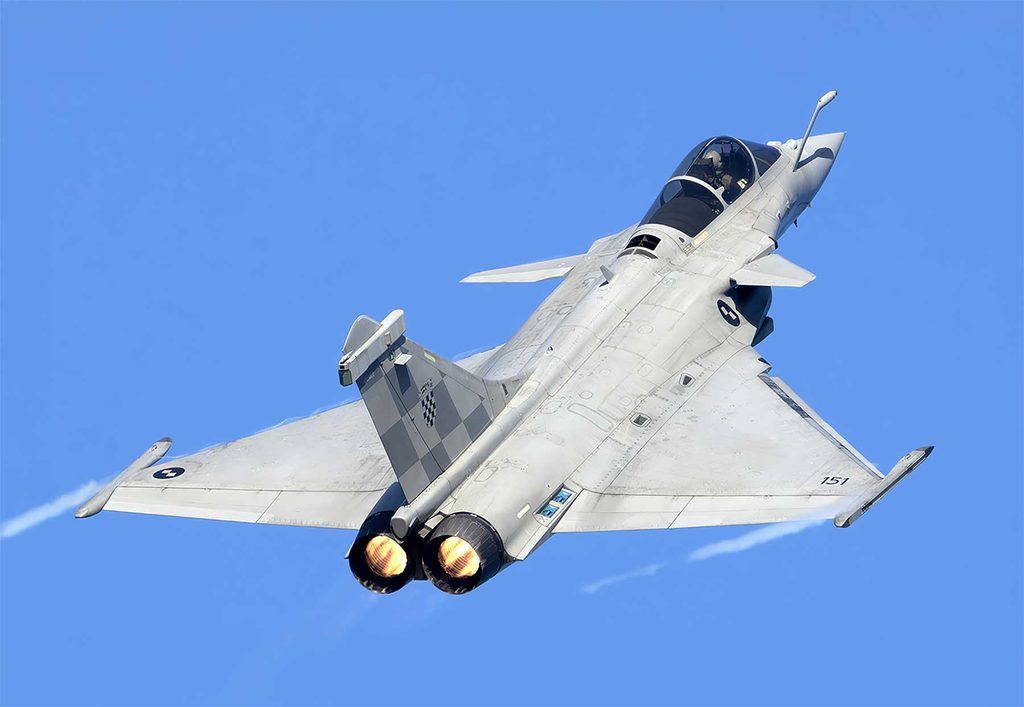
The F5 Standard Shifts from Single-Sensor Duels to Networked Warfare
This is where the Rafale F5 standard becomes critical.
It would be inaccurate to view the F5 simply as a Rafale F4 equipped with a better radar.
The IFRI study describes a comprehensive upgrade package featuring the new RBE2X radar, a significantly enhanced IRST capable of targeting LO and VLO threats, upgraded data fusion, and directional tactical data links designed to resist electronic jamming.
This architecture aims to reframe the problem.
A Rafale will no longer need to detect targets entirely on its own. Off-board platforms—including other fighters, drones, ground-based radars, or airborne early warning aircraft—can feed targeting data into the network. Correlating data from multiple offset sensors creates a clearer tactical picture.
This enables a multistatic and collaborative combat framework.
An aircraft shape optimized to reflect minimal radar energy back to a transmitter directly ahead of it will present a different radar reflection when viewed from another angle. Multiplying transmitters and receivers significantly complicates the tactical environment for stealth aircraft.
Stealth Drones Will Act as Advanced Sensors for the Rafale
The cornerstone of the French response involves the future combat drone developed by Dassault Aviation, drawing on lessons learned from the nEUROn technology demonstrator.
Dassault indicates that the Rafale F5 will be accompanied by a combat drone controlled directly from the aircraft.
This implementation brings the loyal wingman concept to life.
The drone can be deployed into contested airspace ahead of the manned fighter. Its own low-observable airframe allows it to penetrate deeper into adversary air defense zones, operating as a forward sensor node, electronic warfare platform, or weapons carrier depending on mission requirements.
The IFRI study summarizes the concept directly: the stealth drone must pave the way through advanced defense networks for a manned fighter that remains less discreet.
Artificial intelligence will also play an increasing role. Dassault is developing a sovereign, supervised AI designed to accelerate sensor fusion and assist pilot decision-making. The goal is not merely to automate flight controls, but to process multi-platform data quickly enough to display an actionable tactical picture to the pilot.
The Rafale F5 Will Not Become a Stealth Aircraft
This distinction remains essential.
The F5 standard will not transform the Rafale into a VLO aircraft comparable to the F-35. The airframe’s basic geometry will remain anchored in its original 1980s design.
The French air combat doctrine prioritizes offsetting stealth limitations through collaborative warfare.
The development roadmap spans several years. Initial work on the F5 standard is underway, with IFRI anticipating major development milestones around 2033, while the new airborne nuclear capability featuring the ASN4G missile is scheduled for operational service around 2035.
This timeline means the Rafale F4 will continue to form the backbone of French air power for several years.
The observations shared by French pilots do not invalidate the core strengths of the Rafale platform. Instead, they reflect a broader transformation in modern aerial warfare. Having an advanced radar, exceptional missiles, and highly trained pilots is no longer enough when an adversary can reduce its radar footprint, operate passively, and leverage distributed sensor networks.
The air battles of tomorrow will shift away from single-radar duels toward sensor networks competing against other sensor networks. This is precisely the domain where the Rafale F5 is designed to break away from previous generations.
War Wings Daily is an independant magazine.