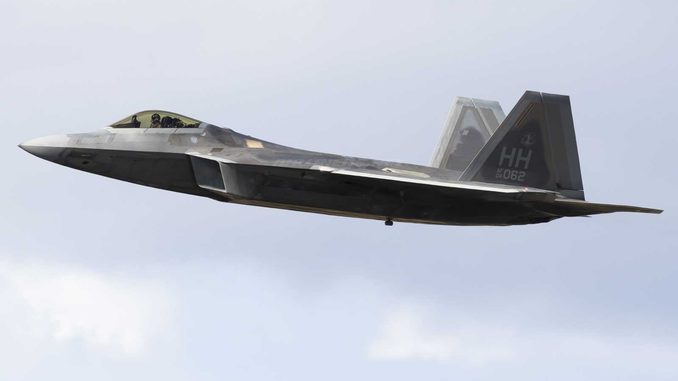
Stealth IRST pods, low-drag fuel tanks, embedded infrared sensors: The US Air Force is upgrading the F-22 to counter the J-20 and Su-57.
Executive Summary
The F-22 Raptor is receiving its most significant visible transformation since entering service in 2005. Lockheed Martin and the US Air Force are adding three key components. First is a stealth infrared search and track pod, the Advanced Sensor Pod, which finally gives the Raptor a passive detection capability against adversary stealth aircraft. Second is a faceted, low-drag external fuel tank capable of supersonic flight. Third is an array of infrared sensors embedded into the airframe to detect incoming missile launches. The US Air Force has already ordered 30 pods, with initial deliveries targeted for the second quarter of fiscal year 2028. The modernization program encompasses 142 aircraft. The objective is clear: maintain the first-look, first-shot advantage against a Chinese J-20 fleet estimated in the hundreds. The trade-off is a minor increase in radar cross-section, deemed an acceptable compromise by military planners.
The F-22 Raptor has dominated aerial combat for two decades thanks to its stealth, supercruise capabilities, and AN/APG-77 radar. However, the operational environment has evolved. China now fields hundreds of stealth fighters. Russia flies the Su-57. Long-range air-to-air missiles are proliferating. In response to these emerging threats, the US Air Force chose to mount new equipment under the Raptor’s wings. Displayed as a mock-up at the Air & Space Forces Association’s Warfare Symposium in February 2026, this configuration is dubbed “Raptor 2.0” by Lockheed Martin.
The Raptor: An Aircraft Blind in the Infrared Spectrum
This paradox is well known among defense experts. The F-22 Raptor never featured an infrared search and track sensor. Although included in the original program, it was cut due to budget constraints. In contrast, the F-35 features the EOTS and DAS systems, the Su-57 carries a 101KS-V sensor forward of the canopy, and the J-20 integrates an electro-optical targeting system under its nose. Until now, the Raptor relied solely on its radar and passive radar warning receivers.
This gap becomes critical when facing stealthy opponents. An X-band radar struggles to acquire a target with a significantly reduced radar cross-section. Furthermore, every active radar transmission risks revealing the operator’s position.
IRST Pods: Passive Detection Tailored Against Stealth
The Physical Principles of Infrared Search and Track
An Infrared Search and Track (IRST) system detects the thermal radiation emitted by a target. Because it emits no signal, it remains completely indetectable and immune to electronic jamming. While radar stealth relies on airframe shaping and radar-absorbent materials, it cannot eliminate heat signatures. Air friction heats leading edges and skin surfaces, particularly at supersonic speeds, while jet engines leave hot exhaust plumes. These thermal signatures remain visible to an infrared sensor regardless of radar stealth quality.
Range Estimation: The Achilles’ Heel of IRST
IRST systems possess an inherent limitation: they instantly measure a target’s bearing and elevation, but not its distance. A single aircraft must maneuver to estimate range via kinematic calculation, which consumes critical time. The solution lies in triangulation. Two networked aircraft exchange data to calculate target distance instantly by cross-referencing angles. According to reports, an IRST-equipped Raptor will also be capable of sharing target tracks with F-22s flying in a clean configuration. This networked capability matters more than raw sensor performance alone.
Advanced Sensor Pods: A Calculated Compromise
Lockheed Martin designates this hardware as the Advanced Sensor Pod. It features a slender, faceted pod mounted under the external hardpoints of each wing. Its chined edges mirror the airframe’s geometry to minimize radar reflections. Early mock-ups were photographed in February 2022 at Palmdale, California. The sensor, recognizable by its gold-coated window, subsequently underwent flight testing under a Sabreliner 65 testbed at Nellis Air Force Base, followed by testing on the F-22 program’s Boeing 757 “Catfish” testbed in June 2026.
The FY2026 budget confirmed the podded format. The US Air Force has placed two orders of 15 units each, totaling 30 pods. Initial deliveries are slated for the second quarter of fiscal year 2028. The Sensor Enhancement program aims to preserve the “first look, first shot, first kill” advantage across 142 Block 30/35 aircraft. While an external pod inevitably impacts the aircraft’s radar cross-section, the US Air Force considers this a necessary trade-off for the massive gain in passive detection capability.
LDTP Fuel Tanks: Extended Range Without Sacrificing Stealth
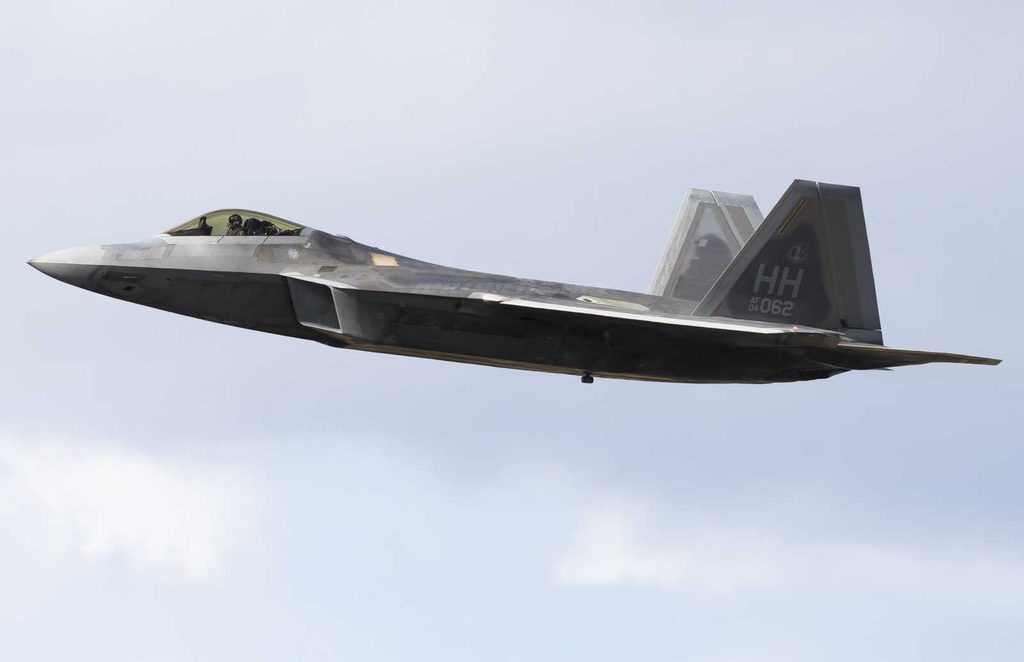
The Raptor’s second limitation is its combat radius, internal fuel range being estimated at roughly 850 km (460 nautical miles)—a significant constraint in the Indo-Pacific theater. Existing 2,271-liter (600-gallon) fuel tanks are non-stealthy, serving primarily for ferry flights and Alaskan interception sorties.
The Low Drag Tank and Pylon (LDTP) program resolves this issue. The new tanks feature faceted, streamlined contours to minimize drag and permit supersonic flight. Budget documentation outlines testing up to Mach 0.95, targeting an operational envelope of Mach 1.2 (approximately 1,275 km/h / 790 mph at high altitude). The pylons incorporate pneumatic controlled jettison technology, known as a “smart rack,” which ensures precise release and leaves a smooth outer surface once discarded. Lockheed Martin indicates that in specific combat scenarios, the F-22 will be able to enter contested airspace with these tanks attached—a distinct doctrine shift for an airframe designed to fight clean.
The timeline has experienced minor adjustments. While the 2025 budget targeted squadron deliveries before March 2026, an F-22 was photographed during test flights carrying both tanks and pods over Edwards Air Force Base in March 2026.
IRDS: An Airframe-Integrated Infrared Defensive Bubble
The third upgrade component is concealed within the airframe. In January 2025, Lockheed Martin secured a $270 million contract for the Infrared Defensive System (IRDS). This architecture distributes multiple flush-mounted TacIRST sensors around the airframe, replacing the legacy AN/AAR-56 missile launch detector. Its primary mission is detecting incoming long-range air-to-air and surface-to-air missiles. A low-rate initial production decision was scheduled for the fourth quarter of fiscal year 2026.
Urgency stems directly from recent tactical developments. The Chinese PL-15 missile saw operational use during the Indo-Pakistani air engagements in May 2025. This accelerated development of the American AIM-260 JATM, which official renderings show launched from modernized Raptors. These initiatives form part of a $7.8 billion overall allocation for the F-22 program running through fiscal year 2029.
The Race Against the J-20 and Su-57
The primary threat driver remains China. Fleet size for the Chengdu J-20 surpassed 300 aircraft in 2025, with some projections reaching up to 500 units in 2026. Meanwhile, the Shenyang J-35 achieved initial carrier qualification on the Fujian in 2025. By contrast, the US Air Force maintains approximately 185 total F-22s, of which 143 are combat-coded. The Raptor cannot rely on numbers alone.
The Sukhoi Su-57 presents a distinct set of tactical challenges. Though produced in smaller quantities, it incorporates a built-in nose-mounted IRST. To counter both rivals, the modernized Raptor relies on superior passive sensor integration and high-speed data networking. An F-22 that detects targets without emitting radar energy retains the tactical initiative; one forced to illuminate its active radar forfeits it.
The Legacy of a Fighter Turned Technology Testbed
Today, the F-22 serves as a test platform for technologies destined for Boeing’s upcoming F-47 sixth-generation fighter, as evidenced by mirror-like skin coatings tested at Nellis. The integration of stealth pods also creates new possibilities: two certified stealth hardpoints could eventually carry additional payloads, such as electronic warfare jammers or specialized sensor suites. Yet one fundamental question remains unaddressed publicly by the US Air Force: at what point does numerical inferiority outweigh qualitative technological edge against an adversary fielding mass stealth assets? The answer will depend less on the pods themselves than on the number of operational Raptors remaining in service when full deliveries arrive.