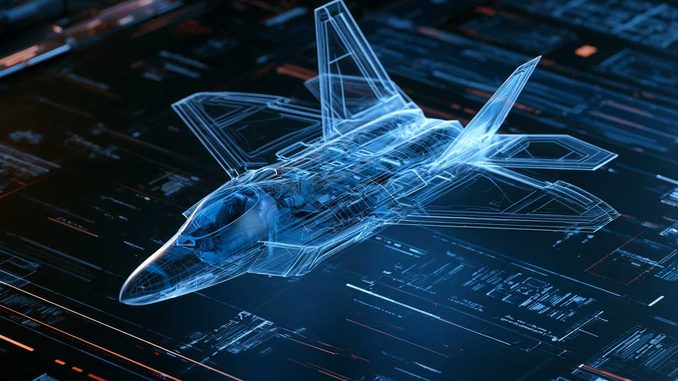
740-variable optimization, AI pilots trained in 24 hours, mass-produced combat drones: Washington, Beijing, and Europe are betting on AI. Who is leading?
Executive Summary
Artificial intelligence does not yet design a combat aircraft entirely on its own, but it is transforming every stage of engineering. Neural networks are replacing multi-hour aerodynamic simulations with near-instantaneous predictions. Optimization algorithms explore hundreds of variables simultaneously. Reinforcement-learned agents are already piloting real aircraft. The United States has taken an industrial lead: two autonomous combat drones entered production in June 2026, targeting a fleet of over 1,000 aircraft. China claims algorithmic breakthroughs, such as optimizing a stealth drone across 740 variables, and uses DeepSeek within its design bureaus. Europe excels in software with Helsing, but remains fragmented following the collapse of the FCAS fighter pillar in June 2026. The real competition now centers on iteration speed, computing power, and the ability to certify machines that make decisions autonomously.
Designing a combat jet used to take fifteen to twenty years. Engineering offices went through endless scale models, wind-tunnel tests, and prototypes. AI is upending this cycle. It does not replace the engineer; it multiplies the number of solutions they can test before cutting the first sheet of titanium. It also provides the “brain” for uncrewed platforms flying alongside crewed fighters.
AI Intervenes at Three Design Levels
The Surrogate Model: Aerodynamic Accelerator
A computational fluid dynamics (CFD) simulation can take hours or even days for a single configuration. The surrogate model bypasses this bottleneck. It consists of a neural network trained on a few hundred high-fidelity simulations. Once trained, it predicts lift, drag, or structural loads for a new shape in seconds. Software developers like nTop and Luminary Cloud are demonstrating the evaluation of hundreds of configurations in hours rather than weeks.
The next generation goes further. Conditional diffusion models—cousins of the AI systems that generate images—perform inverse design. The engineer specifies the desired performance parameters, and the algorithm proposes aerodynamic shapes that achieve them. Physics-Informed Neural Networks (PINNs) incorporate fluid flow dynamics directly into their equations to prevent non-physical anomalies.
Multidisciplinary Optimization and the Curse of Dimensionality
A stealth aircraft is a series of permanent trade-offs. An air intake designed to reduce radar cross-section often degrades airflow to the engine. A wing optimized for low drag may reflect radar waves more strongly. Every additional design variable causes calculation times to skyrocket—a challenge specialists refer to as the curse of dimensionality.
The Autonomous Agent: A Brain Trained by Reinforcement
The third tier governs flight behavior. Reinforcement learning involves having an AI agent play against itself millions of times in simulation. Every victory is rewarded, allowing the agent to discover tactical maneuvers on its own. This method enabled DARPA’s ACE program to fly the X-62A VISTA against a human pilot in a real-world dogfight as early as 2023. In turn, it dictates airframe requirements: a drone whose software maneuvers aggressively requires a structure and flight controls tailored to match.
The United States Industrializes Autonomy
Washington has built a clear lead in scaling autonomous production. The General Atomics YFQ-42A first flew on August 27, 2025, roughly fifteen months after contract award, followed by the Anduril YFQ-44A in October 2025. On June 18, 2026, the US Air Force launched production for both models, designated the FQ-42A Dark Merlin and FQ-44A Fury. The stated goal exceeds more than 1,000 CCA combat drones. The 2027 budget request allocates $1 billion for procurement and $1.4 billion for research and development.
Architectural choices have proven decisive. The government-owned Autonomy Government Reference Architecture (A-GRA) decouples autonomy software from the aircraft itself. In February 2026, a YFQ-44A switched mid-flight between Shield AI’s Hivemind software and Anduril’s Lattice platform. This enables the Pentagon to swap software providers without replacing the physical airframe. Selection of the primary autonomy vendor is expected by mid-2027. Meanwhile, Northrop Grumman is developing the YFQ-48A Talon Blue, set for a first flight by late 2026, and Shield AI unveiled the X-BAT in October 2025—a vertical takeoff autonomous fighter boasting a combat radius of over 3,700 km (2,000 nautical miles).
China Focuses on Speed and Mass
Beijing focuses its public communications on algorithmic milestones. In July 2025, a team at the China Aerodynamics Research and Development Center, led by Huang Jiangtao, published an optimization tool in Acta Aeronautica et Astronautica Sinica capable of processing 740 variables without exponentially increasing calculation times. The selected test case was notable: the American X-47B, abandoned in 2015 after failing to balance stealth, aerodynamics, and propulsion. The researchers simultaneously improved drag, radar cross-section, and thrust metrics.
The Shenyang Aircraft Design Institute, creator of the J-35, uses the DeepSeek large language model to automate routine tasks and engineering reviews. Operationally, a GJ-11 stealth drone was filmed in November 2025 flying in formation with a Chengdu J-20 and a J-16D. The twin-seat J-20S is explicitly designed to command these uncrewed wingmen. However, analysts note that operational coordination remains heavily scripted rather than truly autonomous. Furthermore, China remains dependent on Western electronic design software and high-end semiconductors.
Europe: Brilliant Software, Fragmented Programs
Europe possesses a major software asset. On May 28 and June 3, 2025, Helsing’s Centaur agent took control of a Gripen E over the Baltic Sea. It conducted beyond-visual-range (BVR) combat engagements against a human-piloted Gripen and executed firing commands. Centaur’s reinforcement learning factory accumulates decades of virtual combat experience in just 24 hours, requiring less than six months between scenario definition and first flight.
Hardware platforms are following. Helsing’s CA-1 Europa—a 4-tonne (8,800 lb) drone—is scheduled to fly in 2027, with an 11-meter (36 ft) electronic warfare variant, the CA-1EA, designed to operate up to 100 km (62 miles) ahead of a Typhoon by around 2031. Airbus is proposing the 6-tonne U760 Ravenstorm for around 2032, preceded by a Europeanized variant of the Kratos XQ-58A by 2029.
However, political challenges persist. The Franco-German-Spanish FCAS program, estimated at €100 billion, saw its fighter pillar collapse on June 8, 2026, without producing a prototype. The trilateral GCAP program involving the UK, Italy, and Japan moves forward independently. The Tempest received a £4.6 billion contract awarded to Edgewing in July 2026. BAE Systems employs digital twins and automated safety-critical code generation, cutting production time from weeks to days. Ten test pilots have already accumulated over 170 synthetic flight hours on the demonstrator.
The Limits Recognized by Engineers
The enthusiasm surrounding AI has notable blind spots. Zhang Xianzhe, an engineer at the Chengdu Aircraft Design Institute, publicly warned against hallucinations in large language models, noting they can generate plausible yet incorrect figures for airframe lengths, payload capacities, or radar ranges. Similarly, surrogate models are only as reliable as their training datasets; outside their training domain, they extrapolate poorly.
Certification remains the primary bottleneck. Neural networks cannot be deterministically verified like traditional software code. Manufacturers are implementing real-time safety monitors that override autonomous agents if they breach flight envelope constraints. Shield AI is developing a certification framework aligned with the ASTM F3269-21 standard.
The Aircraft Built Around Its Algorithm
The design paradigm has inverted. Previously, airframes were constructed first and software was installed later. In future developments, interchangeable autonomy software updated continuously will dictate airframe requirements. This shift favors developers capable of rapid iteration and mass manufacturing. It also introduces an unresolved ethical question: who bears responsibility for a engagement decision executed by an algorithm trained on simulated dogfights that never occurred in the real world?