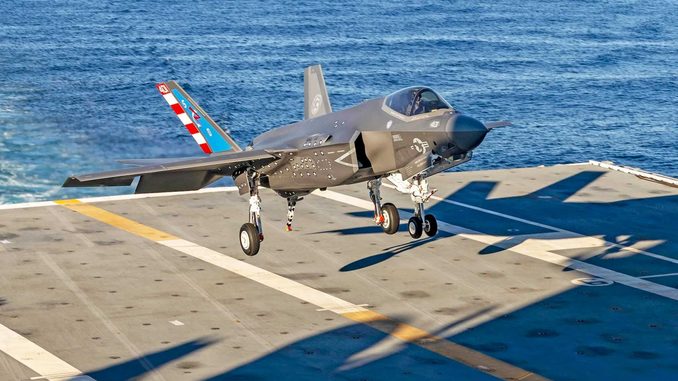
The F-35C successfully accomplishes its first arrested landing on the John F. Kennedy, inaugurating flight testing for the new American Ford-class aircraft carrier.
In Summary
On October 13, 2026, a US Navy F-35C Lightning II completed the first trap of an F-35C on a Gerald R. Ford-class aircraft carrier, aboard the future USS John F. Kennedy (CVN-79). The operation took place in the Western Atlantic with an aircraft from Air Test and Evaluation Squadron 23 (VX-23), based at Patuxent River, Maryland.
This test marks a major milestone in the integration of fifth-generation stealth fighters into the new American nuclear-powered aircraft carriers. In particular, it enables the evaluation of the Advanced Arresting Gear (AAG) system, paired with EMALS electromagnetic catapults.
The John F. Kennedy, the second ship in the Ford class, received its preliminary acceptance on September 29, 2026. Its final delivery remains scheduled for spring 2027. Behind this landing lies a major industrial and military challenge: demonstrating that new American naval aviation technologies can operate together reliably and at a high operational tempo.
The first F-35C landing on the John F. Kennedy
On October 13, 2026, a Lockheed Martin F-35C Lightning II touched down on the flight deck of the future USS John F. Kennedy (CVN-79) while sailing in the Western Atlantic.
The aircraft belonged to Air Test and Evaluation Squadron 23 (VX-23), nicknamed the “Salty Dogs.” This US Navy unit specializes in flight testing and evaluation of military aviation equipment.
Two F-35Cs participated in the flight activities documented that day. One performed a arrested landing using an arresting cable, a maneuver during which the aircraft’s tailhook catches a transverse wire installed on the flight deck.
The operation is part of an Aircraft Compatibility Testing (ACT) campaign designed to verify the compatibility of aircraft with the ship’s launch and recovery systems.
Teams from the F-35 Integrated Test Force at Patuxent River are using instrumented aircraft for these trials. Their sensors record mechanical stress and performance parameters during maneuvers.
This is therefore not a mere demonstration. These data points serve to progressively validate the operational conditions of the F-35 Lightning II from this new generation of aircraft carriers.
The AAG system transforms the demands of carrier recovery
Arrested landing is one of the most demanding maneuvers in naval aviation. A fighter jet must stop several tens of tons in a matter of seconds, over a very short distance.
On Nimitz-class aircraft carriers, this function relies on conventional hydraulic arresting gear.
The John F. Kennedy uses a different system: the Advanced Arresting Gear (AAG), developed by General Atomics.
Digital control of arresting energy
When an aircraft catches an arresting wire, its kinetic energy is transferred to the recovery system.
The AAG combines energy absorption mechanisms, electromechanical conversion equipment, and digital controls. Unlike conventional systems, it provides finer control of the braking force.
The goal is to tailor recovery to varying aircraft weights while reducing stress on airframes.
This capability is particularly vital for a carrier air wing that combines heavy fighters, airborne early warning aircraft, and eventually more uncrewed platforms.
The October 13 landing confirms that an F-35C can be recovered by the John F. Kennedy’s system. However, it does not by itself constitute a validation of its reliability during high-intensity operations.
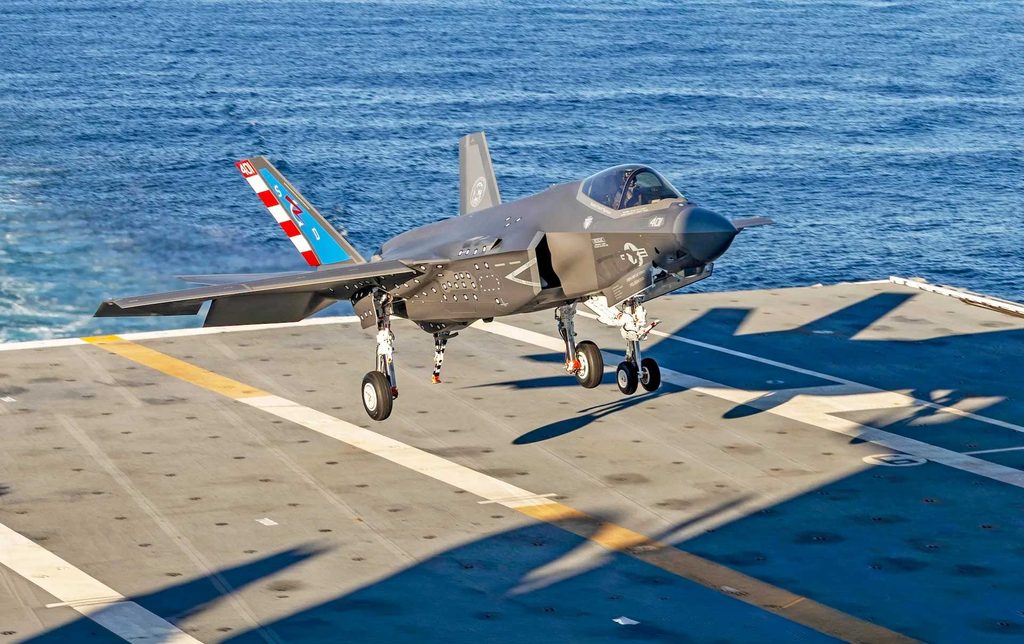
The F-35C features a carrier-specific design
The F-35C is not simply an F-35A fitted with a tailhook.
This naval variant features a larger wing, reinforced landing gear, and a airframe tailored to endure the forces of catapult launches and arrested landings.
Its wingspan reaches 13.1 meters (43 feet), compared to 10.7 meters (35 feet) for the F-35A. Its wingtips fold to facilitate parking on the flight deck and in hangar bays.
The F-35C also boasts an internal fuel capacity of approximately 8.7 metric tons (19,200 pounds), according to figures published by Lockheed Martin. Its combat radius exceeds 1,100 kilometers (600 nautical miles), depending on the selected mission profile.
These characteristics allow the stealth fighter to carry out deep penetration, reconnaissance, and strike missions from a carrier strike group.
Its stealth, integrated sensors, and data-sharing capabilities complement those of the Boeing F/A-18 Super Hornet, which remains a cornerstone of US naval aviation.
The John F. Kennedy must demonstrate the capabilities of the Ford class
CVN-79 is the second nuclear-powered aircraft carrier of the Gerald R. Ford class. It measures approximately 333 meters (1,092 feet) with a displacement of around 100,000 long tons.
This class introduces several innovations aimed at increasing sortie generation rates.
The most notable is the Electromagnetic Aircraft Launch System (EMALS), which replaces steam catapults with an electromagnetic system. This allows for more precise control of aircraft acceleration during takeoff.
The design also incorporates Advanced Weapons Elevators, increased electrical power generation, and a reconfigured flight deck layout designed to speed up rearming and aircraft turnaround times.
The US Navy set a target for the Ford class of 160 sustained daily sorties, compared to roughly 120 for the Nimitz class—a theoretical increase of 33%.
However, this ambition must be distinguished from actually demonstrated performance. The EMALS, AAG, and weapons elevators experienced technical difficulties and reliability issues during their development.
The John F. Kennedy benefits from lessons learned on the lead ship, USS Gerald R. Ford (CVN-78), but must still validate its own installations.
Delivery of the aircraft carrier remains scheduled for 2027
On September 29, 2026, the US Navy granted the John F. Kennedy its preliminary acceptance following acceptance trials conducted in August.
At that time, the vessel was roughly 99% complete. Major systems were installed, though checks remained necessary, notably on four weapons elevators.
Final delivery is announced for spring 2027.
This milestone comes after several delays, primarily related to the certification of arresting gear equipment and the completion of onboard systems.
The American goal extends beyond taking delivery of a new ship. It aims to field an aircraft carrier capable of operating fifth-generation aircraft from the moment it enters service, whereas USS Gerald R. Ford was initially delivered without all the necessary modifications for the F-35C.
This modernization fits into a broader transformation of naval air forces, also reflected in French deliberations regarding the next-generation aircraft carrier PA-NG.
The true test will be sustaining high-tempo flight operations
The October 13 landing represents a technical success, but the military value of an aircraft carrier is not measured by a single isolated maneuver.
It depends on its ability to execute continuous catapult launches, recoveries, maintenance ops, and aircraft rearming over several consecutive weeks.
The John F. Kennedy will still need to demonstrate the reliability of its systems, the availability of its facilities, and the efficiency of its flight deck organization.
For the US Navy, the real challenge now is turning this initial success into a lasting operational capability. The technology is promising. Its credibility will hinge on the tempo it can sustain at sea, far from the controlled conditions of test trials.