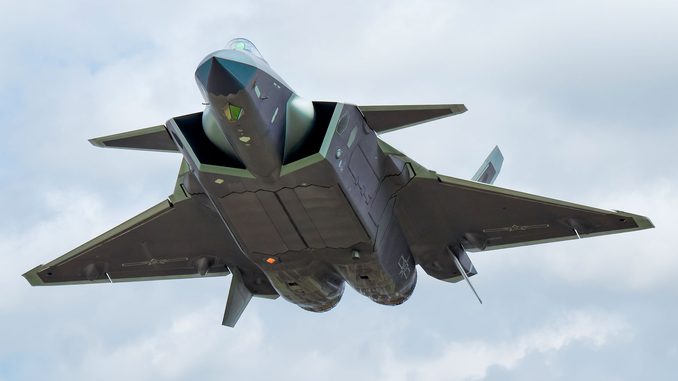
The Chengdu J-20’s AESA radar relies on advanced detection technologies. How it works, GaN modules, radar stealth, and electronic warfare.
In Brief
The Chengdu J-20, the Chinese Air Force’s fifth-generation stealth fighter, features an active electronically scanned array (AESA) radar designed to detect and track multiple targets at long range. Often associated with the Type 1475 (KLJ-5), the system is estimated in unconfirmed public analyses to use an array of between 1,856 and 2,200 transmit/receive modules. Gallium nitride (GaN) technology, under consideration for upgraded variants, could increase transmission power without enlarging the array. Electronic beam steering, low probability of intercept emissions, and potential electronic warfare capabilities represent additional advantages of this architecture. However, exact specifications of the J-20’s radar remain classified, and its real-world effectiveness depends as much on digital signal processing and cooling as on raw power. These technologies reflect the evolving demands of air combat against stealth aircraft.
The J-20’s Type 1475 Radar Remains Shrouded in Secrecy
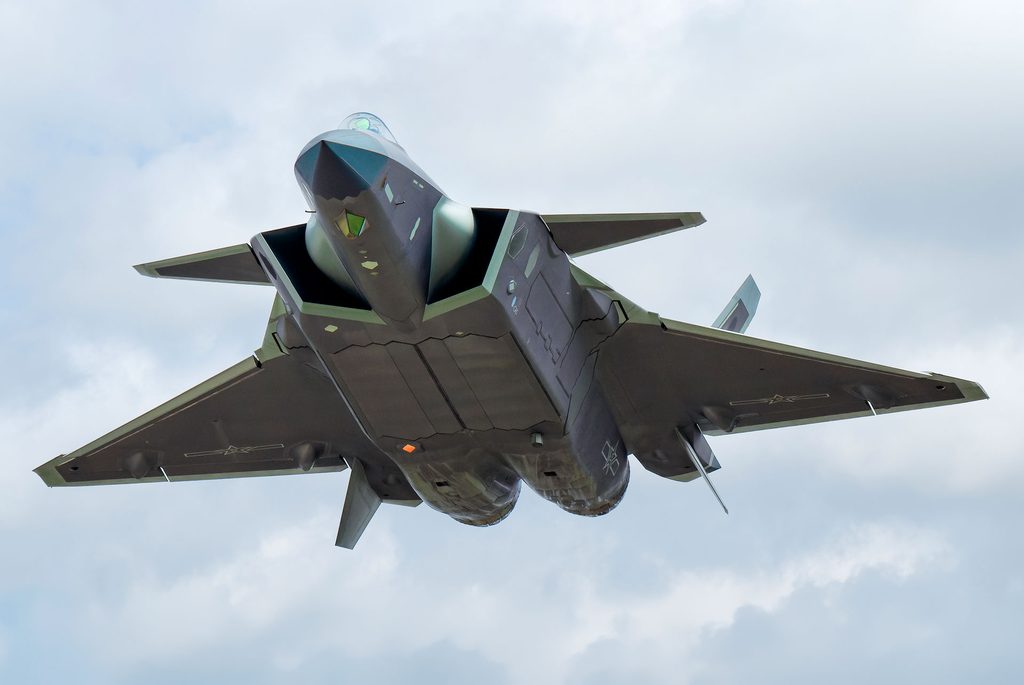
Having entered service in 2017, the Chengdu J-20 was designed to engage aerial targets at long range, including stealth fighters. Its radar is one of the core components of this capability.
Several assessments link it to the Type 1475, also designated KLJ-5, an AESA radar developed in China. The Nanjing Research Institute of Electronics Technology (NRIET), also known as Institute 14, is among the organizations commonly associated with this technology.
In July 2025, a report by the China Aerospace Studies Institute, affiliated with the U.S. Air University, referenced a radar with 1,856 transmit/receive modules, a configuration originally linked to the J-11D.
Other estimates put the J-20’s module count between 2,000 and 2,200, based on the dimensions of its radome.
These figures do not come from an official specification sheet. The exact designation of the installed radar, its module count, and its operational performance have not been publicly confirmed.
An AESA Radar Steers Its Beam Without Moving the Antenna
A conventional radar uses a mechanically steered antenna to scan the sky. An AESA radar—Active Electronically Scanned Array—shifts the direction of its emissions electronically.
Its array consists of numerous radiating elements paired with transmit and receive circuitry.
Each radio-frequency channel controls several signal parameters: power, phase, and, depending on the architecture, amplitude. By adjusting the phase shift between elements, the radar focuses electromagnetic waves in a specific direction.
The beam can change direction in microseconds, without mechanical movement of the antenna.
This speed allows the radar to scan different sectors of the sky, revisit a target frequently, and tailor dwell times to threat levels.
The J-20’s radar is generally described as operating in the X-band, roughly between 8 and 12 GHz, corresponding to wavelengths of 2.5 to 3.75 centimeters (1 to 1.5 inches).
This frequency band offers a practical balance between antenna size, directivity, and measurement precision.
However, it does not guarantee effective detection of all stealth aircraft.
Echo Processing Determines Detection Accuracy
Operation relies on transmitting electromagnetic pulses and analyzing their returning echoes.
When a pulse strikes an aircraft, a fraction of its energy reflects back toward the antenna. The radar measures the elapsed time to calculate range.
At 93 miles (150 kilometers), the signal travels 186 miles (300 kilometers) round-trip, returning in roughly one millisecond.
Radial velocity is determined largely through the Doppler effect, which shifts the echo’s frequency as the target closes in or moves away.
Processors then use successive measurements to establish a flight path, estimate speed, and separate valid returns from electronic noise or clutter.
Using Track While Scan (TWS) mode, an AESA radar can maintain tracks on multiple targets while continuing to search.
The beam does not need to remain locked on a single aircraft continuously; the system periodically updates each track and predicts its position between scans.
Accuracy still depends on update rates, echo quality, and digital signal processing performance.
Gallium Nitride Could Increase Radar Power
One potential upgrade path for newer J-20 variants involves radio-frequency modules made with gallium nitride, or GaN.
AESA radars have historically used gallium arsenide (GaAs) components. GaN has a wider bandgap of roughly 3.4 electronvolts, compared with 1.4 electronvolts for GaAs.
This property enables transistors that can withstand higher electric fields and deliver greater radio-frequency power within a compact footprint.
A concrete example illustrates this trend. In 2020, Qorvo unveiled a hybrid GaN/GaAs module for X-band radars capable of producing 10 watts in a 7 × 5 millimeter (0.28 × 0.20 inch) package, with power-added efficiency around 30 to 40 percent.
These specifications do not describe the J-20; they illustrate what the technology can achieve.
GaN potentially allows higher transmit power without expanding the antenna aperture. At the same time, higher power requires effective thermal management.
An array containing thousands of modules concentrates substantial heat inside the aircraft’s nose, making electrical power supply and heat dissipation critical constraints.
No public evidence currently confirms the widespread integration of GaN modules in J-20A aircraft.
Radar Power Alone Is Not Enough to Detect Stealth Fighters
Radar range depends on several factors: transmit power, antenna gain, receiver sensitivity, system losses, and the target’s radar cross section.
The radar range equation shows that, holding other parameters constant, maximum detection range scales with the fourth root of transmit power.
Doubling transmit power theoretically increases detection range by roughly 19 percent.
Stealth works in the opposite direction.
If a target’s radar cross section is one hundred times smaller, its theoretical detection range drops to roughly 31.6 percent of the baseline value, all else being equal.
A radar that detects a conventional target at 124 miles (200 kilometers) might detect a target one hundred times less reflective at only 39 miles (63 kilometers) under this simplified model.
This calculation does not reflect the J-20’s actual performance, but it shows why increasing power alone does not defeat stealth.
The challenge also affects Western radars, as seen in analyses of the sensor limitations of the Rafale against stealth aircraft.
LPI Emissions Aim to Make the Radar Harder to Spot
An active radar has a fundamental vulnerability: it radiates energy that adversary systems can intercept.
Low Probability of Intercept (LPI) techniques seek to reduce that exposure.
An AESA radar can use several methods, including frequency agility between pulses, complex waveforms, power management, and sidelobe suppression.
The goal is to make emissions harder to distinguish from background electromagnetic noise and complicate identification by radar warning receivers (RWRs).
Varying the pulse repetition frequency (PRF) can further diversify the waveforms used.
These techniques help track a target without repeating the predictable emissions of older radars.
Still, they do not make an aircraft invisible; an advanced passive receiver can intercept and analyze LPI signals.
The specific modes used by the J-20’s radar are not publicly known.
Electronic Warfare Turns the Radar Into a Multifunction System
An AESA array can theoretically perform functions beyond detection.
By allocating its radio-frequency resources, it can generate directional emissions for electronic jamming, data links, or electronic support.
Advanced architectures can partition elements into subarrays or switch rapidly between tasks, and some can form multiple simultaneous beams.
Directional jamming concentrates energy toward an adversary receiver to disrupt its ability to detect or measure a target.
This capability has limits, however: devoting resources to jamming reduces capacity available for other roles, such as radar search.
While combining functions is technically established for certain AESA designs, how it applies specifically to the J-20 remains to be demonstrated.
The J-20’s Radar Fits Into a Networked Combat Strategy
A stealth fighter’s effectiveness no longer depends solely on its standalone sensors.
The J-20 is equipped with electro-optical sensors and is reported to fuse data from them with its radar and external platforms, such as KJ-500 airborne early warning aircraft.
This architecture could allow it to acquire targeting data without constantly radiating from its own radar.
It becomes especially relevant during air-superiority missions and J-20 deployments near the Indian border.
In those scenarios, the radar must help identify a threat, maintain a sufficiently accurate track, and provide the data needed to cue a PL-15 air-to-air missile.
In January 2026, Chinese state-linked media pointed to future radar upgrades, jam-resistance improvements, and artificial intelligence integration.
Yet the decisive question remains the real-world performance of the complete system.
A high-power radar that struggles against jamming, overheats, or passes insufficiently accurate tracks loses much of its operational value.
China now possesses an industrial base capable of developing modern AESA radars, but whether the J-20 holds an edge over U.S. AN/APG-77 and AN/APG-81 radars cannot be publicly verified.
The next technological frontier will not simply be the number of modules packed into an array, but the ability to detect, identify, and engage a stealth target while limiting the aircraft’s own electromagnetic signature.