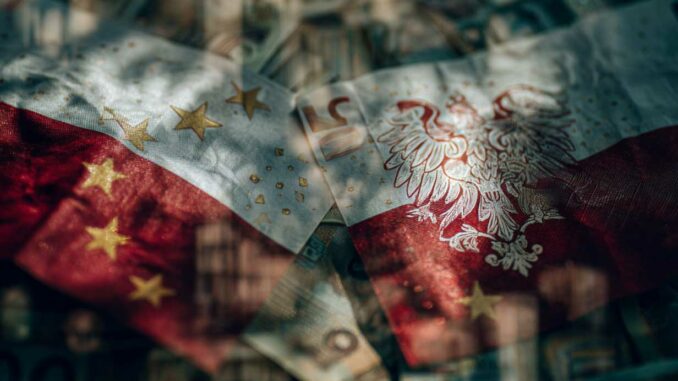
Warsaw becomes the first beneficiary of SAFE loans, securing €43.7 billion to accelerate its rearmament in the face of Russia.
In Summary
Poland has just become the first European Union member state to sign a loan agreement under SAFE, the new European instrument designed to finance defense efforts. The amount is massive: up to €43.7 billion, or approximately $51.6 billion. Warsaw is set to receive an initial advance of about €6.56 billion. This mechanism does not function as a grant. The European Union borrows on the markets, leveraging its financial credit, and then lends to member states under long-term, competitive conditions. Poland will therefore have to repay the funds. The benefit lies elsewhere: it quickly obtains considerable financing to purchase equipment, strengthen its industry, and develop air defense, anti-drone systems, artillery, and military mobility. This decision confirms a major shift: in response to Russia, Europe is now willing to finance defense using common budgetary tools.
Poland Becomes the First Full-Scale Test of the SAFE Mechanism
Poland’s signature marks a significant political milestone. Warsaw becomes the first EU country to finalize a loan agreement under Security Action for Europe, better known by the acronym SAFE. The authorized amount reaches €43.734 billion, which corresponds to roughly $51.6 billion based on recent exchange rates. On a European scale, this is the largest loan package ever allocated to a single member state under this mechanism.
The decision is not merely financial; it is strategic. Today, Poland is one of the European countries most exposed to the Russian threat due to its geographical location, its border with Belarus, and its role as a logistical hub for Ukraine. Since the Russian invasion in February 2022, Warsaw has sharply accelerated its military acquisitions, ordering tanks, artillery, aircraft, air defense systems, and equipment from South Korea, the United States, and Europe.
With SAFE, Poland is not receiving a free check. It gains access to massive, structured, long-term European financing. This changes everything. The question is not just how much Warsaw will receive; it is essential to understand who is borrowing, who is lending, under what conditions, for which equipment, and with what industrial constraints.
The subject is sensitive. Some Polish officials have criticized the mechanism in the name of budgetary sovereignty and debt. Conversely, Donald Tusk’s government views it as a national security tool. The reality is quite clear: for a country seeking to rearm quickly while avoiding immediate excessive pressure on its budget, a long-term European loan is a powerful instrument. However, it remains a debt that must be serviced.
The SAFE Mechanism Relies on European Debt, Not Subsidies
SAFE is a financial instrument created to accelerate member states’ defense spending. Its total envelope can reach €150 billion. The principle is simple: the European Union issues bonds on the financial markets, raising money in its own name. It then lends these funds to member states that request them and whose investment plans are approved.
This model has an obvious advantage. The European Union enjoys a strong financial rating, allowing it to borrow on terms that are often more favorable than those available to individual states. It pools market access capacity without automatically transforming these loans into permanent common debt. Beneficiary states then repay the amounts received.
SAFE is therefore not a grant fund or a military Marshall Plan. It is a European line of credit. The word “loan” is central: Poland must repay the money received, along with the interest stipulated in the agreement. Warsaw’s gain lies in the cost, maturity, predictability, and speed of the financing. While a state can always borrow on its own, borrowing through a European instrument can offer longer durations, a more favorable structure, and a stronger political signal.
The other benefit is industrial. SAFE does not only finance national purchases; it aims to strengthen the European Defense Technological and Industrial Base. The Union wants to prevent each country from buying separately and urgently without coherence. It seeks to encourage joint procurement, European supply chains, interoperability, and the scaling up of factory production.
This is where the mechanism becomes political. Europe is no longer just looking to spend more; it wants to better direct that spending.
Repayment Terms Provide Budgetary Breathing Room for Warsaw
SAFE loans are designed as long-maturity loans. European documents describe them as competitive-rate, long-term financing. European press and institutional communications mention preferential conditions with a staggered repayment logic. The goal is to prevent beneficiary countries from suffering the full budgetary shock of military purchases all at once.
For Poland, the interest is obvious. The country plans to dedicate a very high share of its gross domestic product to defense. Recent estimates place the Polish effort among the highest in NATO, reaching levels between 4.7% and 4.8% of GDP according to budget announcements. At this pace, defense becomes a major item in public finances.
The SAFE loan allows this burden to be smoothed out. Warsaw can accelerate orders now and spread the repayment over time. This aligns with the very nature of military equipment. An air defense system, a missile battery, armored vehicles, drones, or military infrastructure do not produce an effect over a single year; they are long-term investments. It is therefore logical to finance them over a long period.
However, this choice has a trade-off. The loan increases debt and creates a future repayment obligation. The argument of Polish opponents is not groundless on this point: the money is not free. The real question is whether the financial cost is lower than the strategic cost of rearming too slowly. For Warsaw, the answer is clearly yes. The perceived threat is immediate, and time is worth more than bank interest.
Initial Disbursement Signals Speed
The agreement provides for a significant advance. The European Commission is set to make approximately €6.56 billion in pre-financing available to Poland. This amount represents 15% of the total envelope, allowing programs to start quickly without waiting for the full series of disbursements.
This is an important point. Military purchases often suffer from long delays—defining needs, signing contracts, reserving industrial slots, financing down payments, organizing deliveries, and training personnel. An advance facilitates the first orders and provides visibility to industrial players.
Timing plays a strategic role here. Europe knows its stockpiles are low. Deliveries to Ukraine have emptied part of the reserves. European armies must replenish their arsenals while preparing a credible conventional deterrence. In this context, waiting several years would negate the benefits of the mechanism.
Poland is a special case. It has already engaged in massive rearmament. SAFE does not start from a blank slate; it complements an ongoing national effort. The European loan can therefore finance priority capabilities, consolidate orders, and support programs related to the eastern border.
Targeted Purchases Cover the Most Urgent Gaps
SAFE finances specific categories. The mechanism notably covers ammunition, missiles, artillery, land systems, drones, anti-drone capabilities, cyber defense, military mobility, air and missile defense, naval capabilities, C4ISTAR systems, space, artificial intelligence, and electronic warfare.
For Poland, the most visible needs are well-known. Warsaw seeks to strengthen air defense, anti-drone systems, artillery, the protection of critical infrastructure, and military transport capabilities. The “Eastern Shield” program, intended to harden the eastern border, is among the most politically sensitive projects. It aims to improve defenses, obstacles, sensors, and infrastructure in the face of risks coming from Belarus and Russia.
Air defense is a major challenge. The war in Ukraine has demonstrated the importance of surface-to-air missiles, radars, short- and medium-range systems, and protection against Shahed drones, cruise missiles, and ballistic strikes. A frontline country like Poland cannot settle for symbolic air defense; it requires multiple layers capable of protecting bases, cities, logistical hubs, and military sites.
Artillery is the other direct lesson from Ukraine. Ammunition stocks, range, precision, and production capacity have returned to center stage. European armies had long planned for limited conflicts, but high-intensity warfare has brought volume back to the forefront. SAFE serves precisely to finance this capacity buildup.
Industrial Rules Aim to Avoid a “Blank Check” to Foreign Suppliers
SAFE includes eligibility conditions. The European Union wants the money to serve the purpose of strengthening the European, Ukrainian, and certain associated partners’ defense industries. The Council of the European Union indicates that contracts must respect an important rule: no more than 35% of the component costs may originate from countries outside the European Union, Ukraine, or states in the European Economic Area and the European Free Trade Association.
This rule is strategic. It aims to prevent European loans from being used primarily to purchase non-European equipment. It does not completely close the door to foreign suppliers, but it imposes a logic of local or partner industrial content. For the most sensitive equipment—notably in the categories of missile defense, large drones, space, or electronic warfare—the conditions are even stricter. Contractors must notably maintain the capacity to modify equipment without restrictions imposed by third countries.
This point is crucial for sovereignty. Buying a weapon is not enough; one must be able to modify it, maintain it, integrate it into their systems, and employ it without depending on external authorizations. Europe has learned this lesson with ammunition, missiles, software, components, and logistical chains.
For Poland, this constraint creates a trade-off. Warsaw buys heavily from the United States and South Korea. SAFE may encourage it to strengthen the European share of its acquisitions or to structure industrial arrangements with local production, European components, and partnerships compatible with the mechanism’s rules.
Polish Political Obstacles Show the Loan is Not Neutral
The signing of the agreement was not a smooth process. Polish President Karol Nawrocki had vetoed text allowing the use of SAFE loans, denouncing heavy foreign debt and risks of dependency. Donald Tusk’s government chose to bypass the impasse by using a mechanism linked to the armed forces fund and the state-owned bank, Bank Gospodarstwa Krajowego.
This sequence shows that SAFE is a financial tool, but also a political object. In a polarized country like Poland, there is a consensus on the need for defense, but not always on the means. Should they borrow from the European Union? Should they prioritize national financing? Should they accept European industrial conditions? These questions touch on sovereignty, debt, and the relationship with Brussels.
The Polish government stands by its choice, believing the security urgency justifies the tool. Its argument is direct: in the face of Russia, postponing purchases for budgetary procedural reasons would be more dangerous than borrowing. This line is consistent with Polish strategy since 2022. Warsaw wants to become the primary conventional land power in the European Union, and SAFE provides it with additional leverage.

The Role of the European Union is Changing in Nature
With SAFE, the European Union is crossing a threshold. It is no longer limited to financing research programs, industrial cooperation, or indirect support mechanisms. It is borrowing to finance large-scale defense purchases. This is a major political shift.
For a long time, defense remained primarily a national competence. NATO provided the military backbone, while the European Union handled industrial, regulatory, or diplomatic issues. The war in Ukraine has blurred this separation. Europeans have realized that industry, stockpiles, ammunition, military mobility, and mass production are matters of collective security.
SAFE is part of “Readiness 2030,” the European strategy intended to mobilize up to €800 billion in defense efforts in the broadest sense. The €150 billion in loans is just one pillar, but it gives a very concrete signal. Europe is now using its borrowing capacity to accelerate defense.
However, one must remain realistic. A loan does not automatically manufacture a missile. It does not create a factory in a few weeks. It does not resolve shortages of gunpowder, electronic components, engines, or skilled labor. SAFE provides money and visibility; the industry will have to follow.
The Benefit for Warsaw Will Depend on Industrial Execution
Poland can derive considerable benefit from this loan, but everything will depend on execution. The €43.7 billion is only valuable if programs are well-chosen, delivered on time, and correctly integrated into the armed forces. Buying quickly can lead to errors; buying slowly can lead to vulnerability. Warsaw must find the right balance.
The main risk is fragmentation. Polish forces are already absorbing a wide variety of equipment: American, South Korean, European, and national hardware. This diversity increases available power but complicates maintenance, training, spare parts inventories, and logistical chains. The SAFE loan must therefore finance coherence, not just accumulation.
The priority should be clear: air defense, ammunition, command, drones, anti-drone systems, military mobility, infrastructure, and local industrial capacities. These are the areas that matter in a long war. Visible platforms attract political attention, but stockpiles, radars, support vehicles, and repair capabilities often make the difference on the ground.
Poland also wants the money to benefit its economy. According to several national statements, a large portion of the funds must flow into the Polish industry or locally based production. This is logical: a sustainable rearmament must create internal capabilities, not just import finished systems.
The Polish Loan Heralds a More Financial than Declaratory European Defense
The Polish case is revealing. Europe has spoken much about strategic sovereignty, and SAFE provides a financial translation of that ambition. It is not yet a European army, nor is it a fully integrated defense. But it is a step toward a more operational logic: raising money together, directing purchases, strengthening industrial players, and filling urgent gaps.
Poland is the first beneficiary because it combines three elements: a perceived direct threat, a strong political will for rearmament, and massive budgetary needs. Other countries will follow, but Warsaw will serve as a test. If the funds are used effectively, SAFE will gain credibility. If projects stall, the instrument will be accused of adding debt without producing enough security.
The stakes therefore go beyond Poland; they concern the European Union’s ability to transform a strategic crisis into concrete industrial decisions. Russia has forced Europe to rediscover an obvious truth: a defense policy without heavy financing remains a statement of intent. With SAFE, Brussels and Warsaw are moving to a more serious stage. Success will be measured less in press releases than in the radars installed, the missiles delivered, the stockpiles replenished, and the units that are truly ready.
War Wings Daily is an independant magazine.