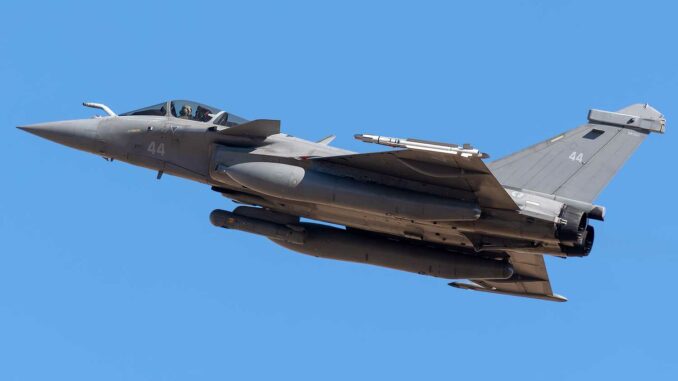
India is moving forward with plans to acquire 114 Rafale jets for its Air Force, with local production representing both an industrial challenge and a strategic signal in the face of China.
In summary
India has taken a new step forward in the matter of the 114 Rafale aircraft intended for the Indian Air Force. As of May 25, 2026, New Delhi has finalized, according to the Indian press, its Letter of Request addressed to France as part of the MRFA program, for Multi-Role Fighter Aircraft. The project calls for an initial delivery of aircraft manufactured in France, followed by large-scale local production, with approximately 92 aircraft assembled in India. Tata Advanced Systems, Mahindra Aerospace, and Adani Defence are among the Indian companies positioned to host this production line, with the final decision resting with Dassault Aviation. This project goes far beyond the purchase of a fighter jet. It concerns the urgent modernization of the Indian Air Force, the reduction in the number of squadrons, the replacement of aging aircraft, the strategic balance with China and Pakistan, as well as New Delhi’s desire to build a more self-reliant military aviation industry.
The contract for 114 Rafale jets enters a decisive phase
The case of the 114 Rafale jets for India is no longer just a hypothetical discussion at an air show. It is entering a much more concrete political and industrial phase. According to information published in India on May 25, 2026, the Indian government has finalized its Letter of Request, or LoR, addressed to France. This letter constitutes a formal step in an intergovernmental procurement process. It does not constitute a final signature, but it paves the way for structured negotiations on price, schedule, equipment, armaments, maintenance, and the share of local production.
The need has been known for years. The Indian Air Force seeks to address its shortage of fighter aircraft through the MRFA program, designed to procure 114 multi-role aircraft. This program was initially intended to pit several Western and Russian aircraft against one another. In reality, the Rafale has taken a considerable lead. India already possesses 36 Rafales ordered in 2016. In April 2025, the Indian Navy signed a contract for 26 Rafale Marines. The decision to procure a third batch, this time for the Air Force, would therefore make clear operational sense.
The amount mentioned is massive. The Indian press is reporting approximately 3.25 lakh crore rupees, or nearly $39 billion according to published estimates. This figure should be treated with caution, as it will depend on the final scope: aircraft, engines, weapons, simulators, infrastructure, maintenance, training, spare parts, and technology transfer. But it gives an idea of the scale. It would be one of the largest fighter jet contracts in Indian history.
This is not just an additional order. It is a structural choice for the Indian Air Force.
The shortage of squadrons explains India’s urgency
The Indian Air Force faces a simple problem: it lacks aircraft. The officially targeted force structure is around 42 fighter squadrons to simultaneously cover requirements against Pakistan, China, and domestic missions.
However, recent figures indicate an operational fleet below this level, with approximately 29 to 31 squadrons depending on the sources and the retirement dates of older aircraft.
The situation has deteriorated with the gradual phasing out of the MiG-21, MiG-23, and MiG-27. The Jaguars, MiG-29s, and Mirage 2000s will also need to be replaced or modernized in the coming years. The Tejas Mk1A and Tejas Mk2 are essential for the Indian industry, but their timelines remain subject to production constraints, particularly regarding engines and ramping up production capacity.
This is where the Rafale becomes strategic. The aircraft exists. It is already in service in India. Indian pilots are familiar with it. Support infrastructure already exists at Ambala and Hasimara. Integrating a new batch would therefore be faster than fully introducing a new foreign aircraft.
The Rafale also offers a qualitative solution. India is not merely seeking to increase the number of aircraft. It wants to replace older aircraft with platforms capable of ensuring air superiority, long-range strike, maritime attack, reconnaissance, and the carriage of advanced weaponry. The Rafale fits precisely into this logic of a multi-role aircraft, capable of switching from one mission to another without changing platforms.
The real challenge is budgetary and industrial. Purchasing 114 aircraft is not enough. Their availability must be guaranteed for thirty or forty years.
Local production becomes the crux of the matter
The most sensitive aspect of the project concerns production in India. The plan currently under discussion calls for an initial batch of aircraft to be delivered from France, while approximately 92 aircraft would be produced locally. This breakdown serves two objectives. First, the Indian Air Force wants to receive operational aircraft quickly. Second, the Indian government wants to strengthen the Make in India program in a sector considered critical.
On May 23, 2026, industry reports indicated that Tata Advanced Systems, Mahindra Aerospace, and Adani Defence had submitted formal industrial proposals to participate in this local production. Dassault Aviation is expected to conduct capability audits before selecting its partner(s). This is a critical point. Building a modern fighter jet involves more than just assembling parts. It requires mastery of tolerances, quality control, traceability, composite processes, systems integration, cybersecurity, and long-term maintenance.
Tata Advanced Systems already has a clear advantage. In June 2025, Dassault Aviation and Tata signed production transfer agreements to manufacture Rafale fuselage sections in Hyderabad. Production is set to begin with a ramp-up target of approximately two fuselages per month starting in fiscal year 2028. This is a major milestone: for the first time, structural components of the Rafale are to be produced outside France for the Indian and international markets.
Mahindra Aerospace and Adani Defence are also seeking to establish themselves in India’s aerospace and defense ecosystem. The final decision will not be purely industrial. It will be political, financial, and strategic. New Delhi wants to avoid being merely a “screwdriver factory.” It seeks a genuine increase in capabilities. Dassault, for its part, will need to safeguard the quality, timelines, and intellectual property of its aircraft.
The risk is clear. The more ambitious the industrial transfer, the more fragile the schedule becomes. India wants to produce locally. The Indian Air Force wants to receive the aircraft quickly. These two objectives are not always compatible.

The Rafale provides a credible technical response to regional threats
The Rafale is not a fifth-generation stealth aircraft. It does not claim to play the role of the American F-35. Its strength lies elsewhere. It combines a compact airframe, great versatility, advanced avionics, excellent electronic warfare capabilities, and a wide range of armaments.
The aircraft is approximately 15.3 meters long, with a wingspan of 10.9 meters. Its maximum takeoff weight is approximately 24,500 kg. It is powered by two Snecma M88 engines, each delivering approximately 75 kN of thrust with afterburner. It can reach Mach 1.8, or approximately 2,200 km/h at altitude depending on conditions, and carry up to 9,500 kg of external payloads.
Its RBE2 AESA radar, developed by Thales, allows it to track multiple targets and employ long-range missiles such as the Meteor. The SPECTRA system, developed by Thales and MBDA, provides detection, identification, tracking, and jamming of radar, infrared, and laser threats. This system is one of the Rafale’s key technical features. It does not make the aircraft invisible, but it significantly improves its survivability.
For India, the benefit is tangible. Against Pakistan, the Rafale provides precision strike capability, qualitative superiority, and conventional deterrence. Against China, the situation is more complex. The People’s Liberation Army Air Force possesses a much larger fleet, including J-10C, J-16, and J-20 aircraft. India cannot match China’s numerical superiority on a one-to-one basis. It must therefore focus on quality, missiles, sensors, electronic warfare, and networking.
The Rafale fits into this strategy. It can carry Meteor air-to-air missiles, MICA missiles, AASM Hammer guided bombs, precision-guided munitions, and, depending on the French configurations, cruise missiles such as the SCALP. India already has Rafales adapted to its needs, with specific equipment and integrated weaponry.
The choice of the Rafale does not eliminate the need for indigenous aircraft. Above all, it provides the IAF with an immediately credible combat solution while the Tejas Mk2 and AMCA programs mature.
The Rafale Marine Strengthens Franco-Indian Coherence
The project for 114 Rafales for the Indian Air Force is proceeding in parallel with the Rafale Marine contract signed in April 2025. This contract covers 26 aircraft for the Indian Navy, comprising 22 single-seaters and 4 two-seaters. Deliveries are expected between 2028 and 2030, according to public sources. The goal is to gradually replace the MiG-29Ks currently deployed on Indian aircraft carriers.
This naval order changes the overall strategy. India is no longer content to simply purchase a French aircraft for its air force. It is building a Rafale family across its air and naval forces. This enables synergies: training, maintenance, armaments, simulators, doctrine, lessons learned, and the supply chain.
The Indian Navy needs a robust aircraft for carrier-based operations. The Rafale Marine has already been in service with the French Navy aboard the aircraft carrier Charles de Gaulle. It is designed for carrier landings, catapult launches, and operations in a maritime environment.
For India, whose aircraft carriers INS Vikramaditya and INS Vikrant are tasked with projecting power in the Indian Ocean, the arrival of the Rafale Marine represents a qualitative leap.
Consistency thus becomes a matter of policy. The more Rafales India purchases, the more it reduces the marginal cost of the ecosystem. The more it produces locally, the more it strengthens its relationship with Dassault, Safran, Thales, and MBDA. The more it standardizes part of its fleet, the more it reduces the complications of an inventory historically scattered across Russia, France, the United Kingdom, the United States, and the domestic industry.
The Rafale thus becomes a tool for relative simplification in a military long accustomed to heterogeneous fleets.
The geopolitical dimension goes beyond the mere purchase of aircraft
The Rafale mega-contract must be viewed within a tense regional context. India faces two nuclear-armed adversaries: Pakistan to the west, and China to the north and east. Since the 2020 clashes in the Himalayas, Sino-Indian relations have become more strained. In the Indian Ocean, China’s growing presence, its dual-use research vessels, and its base in Djibouti are fueling Indian concerns.
The Rafale is not just a fighter jet. It is a signal. In Islamabad, it serves as a reminder that India wants to maintain a technological edge. In Beijing, it signals that New Delhi is not content with slow modernization. In Washington and Moscow, it demonstrates that India is diversifying its partners without becoming overly dependent on any single one.
This last aspect is significant. India has long relied heavily on Russia for its aircraft, tanks, missiles, and submarines. The war in Ukraine has exposed the limits of this dependence: Western pressure, parts availability, Russian industrial priorities, exposure to sanctions, and logistical uncertainties. Buying French allows New Delhi to diversify its strategic portfolio.
For France, the stakes are just as high. A contract for 114 Rafale jets would secure Dassault Aviation’s future for several years. It would strengthen the French industrial chain, from Mérignac to Safran, Thales, and MBDA. It would also confirm Paris’s position as India’s strategic partner in the Indo-Pacific.
France does not have the military might of the United States. But it possesses territories, forces, a navy, a comprehensive defense industry, and an independent diplomatic service. For India, this French autonomy holds value. It reduces the risk of political dependence on Washington, while avoiding being trapped in the Russian legacy.
India’s industrial choice remains the true test of the program
The main challenge may not be signing the deal. It will be production. India has already experienced long, complex aerospace programs slowed by technology transfers, supply chains, engines, testing, and administrative decisions. The Rafale will be no exception.
Locally producing 92 aircraft requires an assembly line, qualified suppliers, trained technicians, a stable relationship with Dassault, strict quality controls, and the ability to absorb sensitive technologies. Expectations will also need to be managed. Local assembly does not equate to complete autonomy. Access to source codes, the independent integration of national weapons, and full control over the engine remain sensitive issues.
Safran has declared itself ready to move forward on an engine assembly line in India as part of the discussions. This point is strategic. The M88 engine is at the heart of the Rafale’s technical sovereignty. Local engine capacity, even partial, would be a significant industrial gain for New Delhi. But such a transfer requires careful negotiation. No manufacturer hands over its core technology without guarantees.
India will therefore have to balance ambition with realism. Aiming for 60% local content, extensive technology transfers, short timelines, and a contained price is politically appealing. Industrially, it is much more difficult.
There is a risk of a sliding timeline. If the first locally assembled aircraft do not arrive until the early 2030s, the IAF’s squadron shortfall will remain critical for several years. The Rafale can help, but it does not solve India’s equation on its own.
The Battle for the Rafale Heralds a New Phase of Indian Power
The 114-Rafale project reveals an India that is more ambitious, yet also grappling with its own constraints. New Delhi wants a powerful air force, a navy capable of operating far from home, a credible domestic industry, and an independent foreign policy. These objectives are consistent. They are also costly, time-consuming, and technically demanding.
The Rafale offers a solid solution in the short and medium term. It provides proven performance, compatibility with Indian requirements, and an existing Franco-Indian industrial base. It strengthens conventional deterrence against Pakistan. It improves India’s posture vis-à-vis China. It gives the Indian Air Force a reliable platform while domestic programs progress.
But we must not gloss over the issue. Purchasing 114 Rafales will not automatically make India an air power on par with China. The numerical ratio will remain unfavorable. Infrastructure, refueling aircraft, early warning aircraft, drones, missiles, and command networks will matter just as much as the fighters themselves. A modern aircraft is decisive only if it is integrated into a coherent combat system.
India’s gamble is therefore twofold. It consists of quickly purchasing a high-performance foreign aircraft while demanding that this purchase serve as a lever for national industrial development. It is an ambitious strategy. If it works, India could become one of the major hubs for the Rafale outside of France. If it stalls, the contract will add a new chapter to the long history of major Indian programs slowed down by their own requirements.
The Indian Rafale is no longer just an aircraft. It is becoming a test of power for New Delhi: the ability to purchase, produce, integrate, finance, and transform a military order into a lasting strategic advantage.
War Wings Daily is an independant magazine.