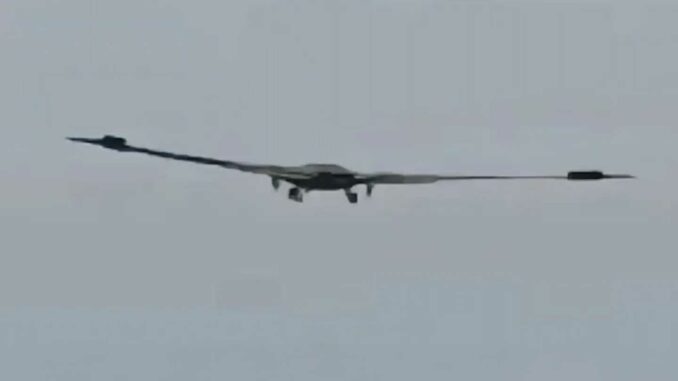
The PLAAF is stepping up production of modern fighter jets and large stealth drones. The challenge is industrial, logistical and strategic.
In summary
China is no longer content merely to modernise its military aviation. It is now seeking to produce rapidly, in large volumes, and across multiple production lines simultaneously. Estimates based on satellite analysis suggest an industrial capacity of up to 300 to 400 modern fighters per year from 2027 onwards, centred on the J-20, J-16 and J-35A. This figure should be treated with caution. It represents potential capacity, not necessarily a guaranteed annual production rate. But the signal is significant. At the same time, the emergence of large stealth drones such as the GJ-X and the WZ-X shows that the PLAAF is developing a combat aviation capability that is more autonomous, has a longer range and is better suited to the Pacific. The challenge is no longer merely technological. It concerns indigenous engines, supply chains, mobile electromagnetic catapults, exports and Beijing’s actual ability to transform its manufacturing base into a credible military power.
The ramp-up is changing the scale of the PLAAF
The modernisation of the Chinese air force is no longer simply a matter of new prototypes. It is becoming a question of industrial production rates. This is the most significant change. Over the past twenty years, China has gradually replaced a fleet characterised by older derivatives of the MiG-21 and Su-27 with a more modern, more connected and more domestically produced air force. The J-10C, J-16 and J-20 have already altered the Western perception of the PLAAF. The J-35A now adds a second family of land-based stealth fighters.
The most striking data comes from satellite observations of AVIC sites, the major Chinese aerospace conglomerate. Massive expansions have been spotted in Chengdu, Shenyang and at other sites linked to military aircraft production. According to an analysis attributed to J. Michael Dahm of the Mitchell Institute for Aerospace Studies, China’s industrial capacity could reach 300 to 400 fourth- and fifth-generation fighters per year for the People’s Liberation Army. A conservative estimate of around 250 aircraft per year is also put forward.
Let us be clear. Factory capacity is not the same as actual deliveries. It depends on budgets, engines, radars, computers, stealth coatings, weapons, pilots and maintenance. But the scale of the operation changes the discussion. The United States and its allies are no longer looking solely at the quality of Chinese aircraft. They must also consider the rate of replacement, ramp-up and acceptable attrition.
The J-20 remains the symbol of this shift. Western estimates had already suggested more than 200 operational or produced aircraft by the end of 2024. More recent assessments put the fleet at over 300 aircraft. Even using the most conservative figures, the trend is clear: the J-20 is no longer a showpiece. It is a production aircraft, integrated into several brigades, and used to establish Chinese air superiority.
The J-20, J-16 and J-35A trio provides new depth
The core of Chinese production is based on complementarity. The J-20 occupies the top end of the stealth spectrum. The J-16 provides heavy firepower, payload capacity and long-range strike capability. The J-35A is expected to offer a more compact stealth option, potentially less expensive and more versatile.
The J-20 is a large twin-engine stealth fighter. Its primary mission remains long-range air superiority. Its size provides it with fuel capacity, range and internal space for weapons and avionics. It is suited to the distances of the Western Pacific, where bases, refuelling aircraft and early warning aircraft become priority targets. The two-seater J-20S variant, observed with PLAAF markings, reinforces the idea of an aircraft capable of coordinating combat drones or managing complex tactical command missions.
The J-16 plays a different role. It is not stealthy. But it can carry a large payload of weapons, sensors and long-range missiles. Derived from the Flanker family, it provides the PLAAF with a heavy, robust aircraft suitable for air superiority, ground strike, electronic warfare and maritime attack. In a conflict around Taiwan or in the South China Sea, a J-16 can serve as a missile carrier, whilst stealth platforms or advanced drones provide targeting data.
The J-35A is the most politically significant element. It was publicly unveiled in Zhuhai as a new-generation stealth fighter intended for the PLAAF, whilst the naval J-35 is designed for Chinese aircraft carriers. Details remain highly opaque. Its actual stealth capabilities, radar, data links and engine performance are not publicly documented. But its appearance is already changing the market. China is becoming the only country, alongside the United States, to have two families of stealth fighters in service or nearing service.
Indigenous engines remain the most serious bottleneck
China has made significant progress in airframes, radars, missiles and drones. But the engine remains the weak point of its combat aviation. Beijing is well aware of this. This is precisely why the WS-10, WS-15 and WS-19 families are so strategic.
The J-20 has long relied on Russian engines or interim Chinese solutions. The WS-10C has helped reduce this dependence. The WS-15 must go further, offering greater thrust, more electrical power reserves, better high-altitude performance and a more credible supercruise capability. For a stealth aircraft, this is no minor detail. A high-performance engine increases range, improves acceleration, reduces reliance on afterburners and supports more powerful sensors.
The J-35A poses another challenge. Several analyses suggest the possible use of the WS-19, a Chinese engine more advanced than the older WS-13 series. Here too, caution is warranted. Beijing does not publish data on thrust, service life, fuel consumption or reliability. Yet the mass production of a fighter does not depend solely on the maiden flight. It depends on the number of engines available for delivery, their time between overhauls, the stock of hot parts and the ability to train maintenance teams.
Engine logistics could become the bottleneck in ramping up production.
Producing 400 airframes a year makes no sense if the turbofans, turbine blades, high-temperature coatings and digital control systems cannot keep up. Industrial sovereignty cannot be decreed. It is measured by the regularity of deliveries, the availability rate and the life-cycle cost.
Large stealth drones are shifting the centre of gravity
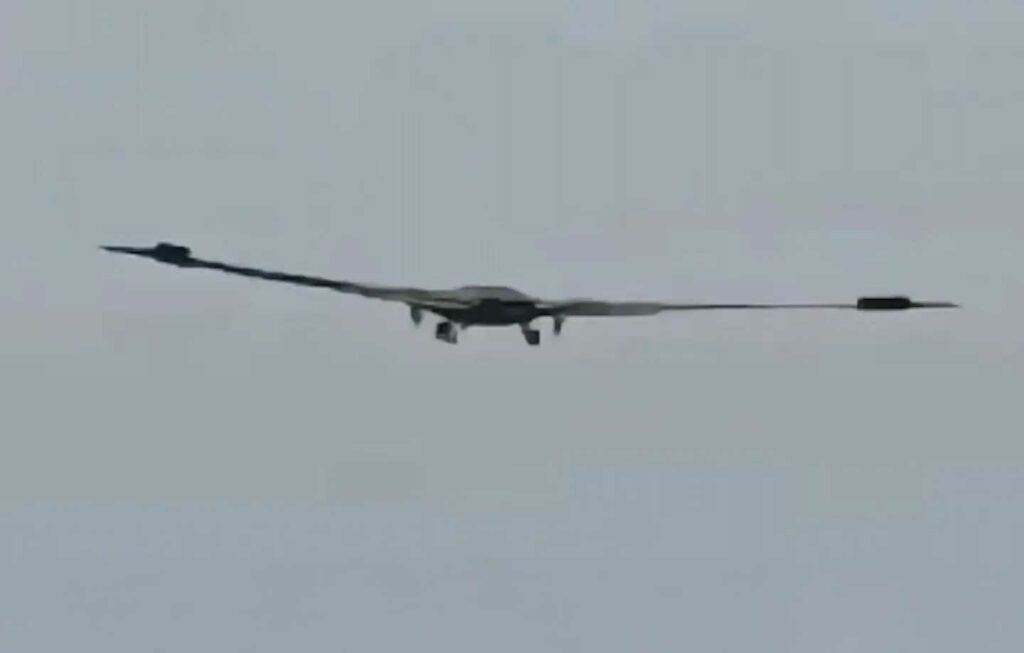
The other major change comes from drones. Satellite images taken at the Malan base in Xinjiang show two very large stealth flying wings capable of high-altitude flight and long endurance. Their public designations remain unofficial. Observers often refer to them as the WZ-X and GJ-X. We must therefore speak of probable programmes, not officially named systems.
The larger aircraft, dubbed the ‘Monster of Malan’ by some analysts, is said to have a wingspan of approximately 53 metres (173 feet). This is close to the order of magnitude of a B-2 stealth bomber. Its flying wing design suggests a long-endurance surveillance mission, with a low radar signature. In this role, a stealth HALE drone can remain at a distance for long periods, detect radar emissions, map naval movements and provide targeting data.
The second aircraft, often associated with the GJ-X, is said to have a wingspan of approximately 42 metres (137 feet). Its so-called ‘cranked kite’ shape is reminiscent of several American stealth designs, though this does not allow us to deduce its actual performance. It could carry out intelligence, electronic warfare or long-range strike missions. If it has internal bays, it could carry guided munitions whilst maintaining a degree of radar stealth.
The important point is not the exact name. The important point is the category. China appears to be developing combat drones that are much larger than conventional tactical drones. They resemble neither simple armed MALE drones nor loitering munitions. They are designed for long-range air combat, with endurance, stealth, sensors and possibly internal weaponry.
The fighter-killer duo could have an impact on the Pacific
The most likely concept is that of a fighter-killer duo. The WZ-X or a comparable HALE drone monitors, detects and tracks. The GJ-X or a heavier flying wing strikes, jammers or approaches the defended area. This combination could prove formidable in the Pacific, where distances are vast and targets highly mobile.
In a crisis involving Taiwan, these drones could help track US carrier strike groups, refuelling aircraft, forward bases, amphibious ships or anti-missile batteries. They could also support anti-ship ballistic missiles, cruise missiles and air strikes. The effectiveness of a DF-26 missile, a YJ-21 or a cruise missile depends heavily on the quality of the detection and targeting chain. A long-endurance stealth drone can fulfil part of this requirement.
This architecture indirectly competes with certain missions expected of the future H-20 bomber. The H-20 remains the most symbolic programme, as it would give China a manned stealth strategic bomber. But a network of stealth drones can fulfil some of the penetration, surveillance and strike missions without exposing a crew.
It can also enter service more quickly, in successive batches, with fewer political constraints.
We must not exaggerate. A large stealth drone does not automatically replace a strategic bomber. It may be limited by payload, communications, decision-making autonomy, resilience to jamming and rules of engagement. But it gives China an additional option. This is exactly what matters in a high-intensity confrontation: multiplying the adversary’s dilemmas.
Mobile electromagnetic catapults open up another avenue
Images of mobile electromagnetic catapults observed in China add an interesting layer. Modular, truck-mounted systems have been spotted near low-signature drones and naval platforms under construction. Some images suggest a launch track assembled in sections, with several vehicles lined up. Available estimates suggest a run-up of around 60 metres, but the details remain unconfirmed.
The military benefit is clear. A land-based electromagnetic catapult would allow heavier fixed-wing drones to be launched from sites without a conventional runway. It would offer a solution for dispersed bases, islands, coastal areas or temporary installations. It could also reduce reliance on large runways, which are easy targets for missiles.
China is already developing this capability at sea. The Fujian aircraft carrier uses electromagnetic catapults. The Type 076 Sichuan, a new-generation amphibious vessel, is also associated with the capability to launch fixed-wing drones. The logic is therefore consistent. Beijing is seeking to separate air power from conventional runways. Carrier-based aircraft, catapult-launched drones, hybrid vessels, modified merchant platforms and mobile land-based systems are all part of the same trend.
But here too, caution is warranted. A truck-mounted demonstrator is not an operational capability deployed at regimental level. It requires energy, procedures, maintenance, security, trained crews and compatible drones. The mobile catapult is a powerful concept. Its true maturity remains to be demonstrated.
The supply chain becomes the true test of Chinese power
The Chinese aerospace industry enjoys a clear advantage: it can mobilise the state, public banks, universities, industrial groups and civilian supply chains around a strategic priority. This centralisation makes it possible to expand factories, coordinate suppliers and support programmes that are not very profitable in the short term.
But it also has its weaknesses. Not all critical components are easy to produce. Engines, AESA radars, ruggedised computers, absorbent materials, infrared sensors, precision actuators and specialised semiconductors impose significant constraints. Modern air warfare is not just a matter of sheet metal and composites. It is a matter of microelectronics, software, materials and quality control.
Anti-corruption crackdowns are adding to the uncertainty. Data from SIPRI and analyses reported by Reuters have indicated a decline in revenue for major Chinese military groups in 2024, linked to contract delays or cancellations in the context of the anti-corruption drive. This does not halt China’s modernisation. But it may slow down procurement, tighten controls and complicate certain decision-making processes.
China does, however, have an official defence budget that is rising sharply. For 2026, Beijing has announced approximately 1.9 trillion yuan, or nearly $275–282 billion, representing an increase of around 7%.
This official figure remains lower than broader Western estimates, which sometimes take indirect expenditure into account. But even the published figure already gives the PLAAF a significant financial base to absorb an increase in production.
The international market may shift first through drones
International market gains are unlikely to come from the J-20. China has no obvious interest in exporting its most strategic stealth fighter. The J-35A or an export variant could be a different matter, especially if Beijing wishes to offer an alternative to customers who do not have access to the F-35 or who reject dependence on the US. But exporting a stealth fighter involves technological, diplomatic and industrial risks.
The real commercial leverage lies elsewhere: drones. China has already established a strong presence with the Wing Loong, CH and other armed MALE systems. Its customers are found in the Middle East, Africa, Central Asia and certain regions where US or European restrictions leave room for Chinese manufacturers. SIPRI figures indicate that China accounted for 5.6% of global arms exports over the 2021–2025 period, with a strong concentration in Asia, Oceania and Africa.
The arrival of large stealth drones could reshape the high end of the market. A country unable to purchase a stealth bomber, an F-35 or an American HALE drone might be tempted by a Chinese solution that is cheaper, more politically accessible and less restrictive in terms of use. Even if Beijing retains the most sensitive versions, less advanced derivatives could supply a market already in demand for maritime surveillance, long-range strike and electronic warfare.
The risk for Western manufacturers is real. The United States retains a technological advantage, but its offerings are often expensive and heavily controlled. Europe is making slow progress on heavy combat drones. Turkey occupies a dynamic segment with Baykar. China can compete on price, volume and speed of delivery. In some markets, that is enough.
The real challenge remains converting the factory into a combat force
China knows how to build factories. It knows how to produce in volume. It knows how to showcase prototypes. But military power is measured differently. It is measured by the number of aircraft actually available, the quality of the crews, maintenance, missile stocks, refuelling aircraft, hardened bases, secure communications and the ability to fight under jamming.
The PLAAF is making rapid progress. The Pentagon already believes that the J-16 and J-20 give the People’s Liberation Army an increasing capacity for long-range strikes and for challenging US and allied forces. Exercises around Taiwan demonstrate an air force that is more present, more numerous and better able to operate without refuelling in its immediate regional environment.
The real question, therefore, is not whether China will produce good aircraft. It already does. The question is whether it can transform a massive industrial base into a flexible, sustainable air force capable of absorbing losses. That is more difficult. It requires trained pilots, numerous mechanics, a clear doctrine and robust logistics.
China’s strategy is brutally rational. Faced with a technologically advanced American adversary, Beijing is seeking to combine quantity, range, stealth, missiles and drones. If this combination works, the Western Pacific will become a much more costly theatre for American and allied forces. If it fails, China will have built a massive air force that is difficult to sustain at the pace of a modern conflict.
The message sent by the PLAAF is already clear. China is not merely preparing the next fighter aircraft. It is preparing a comprehensive industrial system, capable of delivering fighters, drones, sensors and launch platforms at a rate that Western industrial democracies currently struggle to match. It is perhaps here that the true balance of power is being decided.
War Wings Daily is an independant magazine.