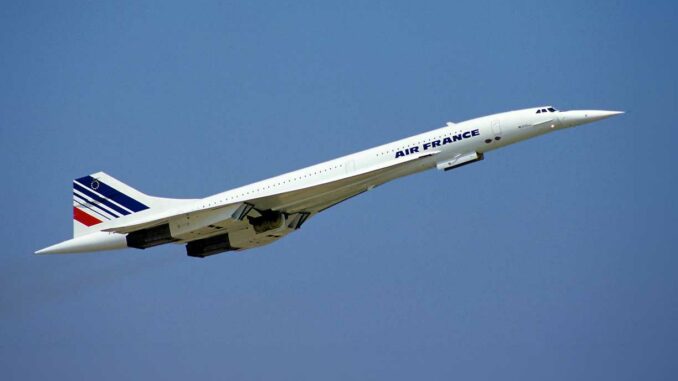
Originally designed for British bombers, the Olympus 593 propelled Concorde to Mach 2 and paved the way for Snecma’s expansion into the civil aviation sector.
In summary
The Rolls-Royce/Snecma Olympus 593 was not designed from scratch. Its lineage traces back to the Bristol Olympus, which was first developed in 1946 for British high-altitude bombers. The engine first entered service on the Avro Vulcan, a mainstay of the UK’s nuclear deterrent. A significantly reinforced version, the Olympus 22R, was subsequently developed for the BAC TSR-2 supersonic bomber. It was from this line that the Concorde’s Olympus 593 was derived. The transition from military to civil use was, however, not a simple adaptation. It was necessary to design an engine capable of sustaining Mach 2 for several hours, meeting civil reliability requirements and operating with highly sophisticated air intakes and nozzles. For Snecma, the programme provided a crucial learning experience in international cooperation, certification and civil industrialisation. But it is important to be precise: the CFM56 is not a descendant of the Olympus. Concorde prepared Snecma to become a major civil engine manufacturer. It did not provide the core of the future CFM56.
The military origins of an engine designed for deterrence
The story begins in April 1946. At that time, Bristol Aero Engines was developing a turbojet for a high-speed bomber, capable of operating at high altitude and reaching around 960 km/h (600 mph). The first B.Ol.1 was test-run on a test bench in May 1950. This design became the first British twin-shaft turbojet.
In a two-shaft engine, two concentric rotating assemblies operate at different speeds. The low-pressure compressor is connected to its own turbine. The high-pressure compressor also has its own turbine and shaft. This design allows each part of the engine to operate within a more favourable speed range. It improves compressor stability, acceleration and efficiency across a wide operating range.
The choice of this architecture was no accident. At the time, the United Kingdom was building its strategic bomber force around the ‘V-bombers’: the Vickers Valiant, Handley Page Victor and Avro Vulcan. These aircraft were intended to form the air arm of Britain’s nuclear deterrent.
The Olympus was fitted to the Vulcan B.1 from 1956 onwards. The first production versions developed approximately 49 kN (11,000 lbf). The family then progressed rapidly. The Mk 102 and Mk 104 powered various variants of the Vulcan B.1. The Mk 201, designed for the Vulcan B.2, produced around 76 kN (17,000 lbf). The Mk 301 eventually increased the thrust to around 89 kN (20,000 lbf).
This progression provided Bristol with a robust technological foundation. The engine accumulated thousands of flight hours within RAF Bomber Command. It built a reputation for reliability and stability under varying engine speeds. This operational experience was more valuable than its thrust output alone; it paved the way for supersonic programmes.
The TSR-2 transforms the Olympus into a high-speed engine
In January 1959, the United Kingdom selected the Olympus for the BAC TSR-2.
This aircraft was designed to penetrate at very low altitude, accelerate to supersonic speed and carry a tactical nuclear weapon. It also had to be capable of carrying out high-speed reconnaissance missions.
The requirements were radically different from those of the Vulcan. The engine had to withstand rapid accelerations, very high inlet temperatures and long periods of high power output. It also had to be fitted with an adjustable afterburner system.
The Olympus B.Ol.22R Mk 320 was developed for this mission. It is a direct derivative of the B.Ol.21 used on the Vulcan B.2. However, this was no longer simply a matter of increasing thrust. The engineers had to redesign a large part of the engine.
Certain bearings were moved away from the hottest areas. The shafts, materials and lubrication systems were modified. The oil and fuel circuits had to function despite temperatures significantly higher than those encountered on the Vulcan.
At high speed, the air entering the engine is not cold. It is already compressed and heated by its deceleration in the air intake. The TSR-2 imposes a total inlet temperature that can approach 146 °C. The subsonic Vulcan had never subjected the Olympus to such a severe environment.
The afterburner system of the 22R represents another major development. Fuel is injected behind the turbine, into a flow that still contains sufficient oxygen. A new combustion process increases the temperature and velocity of the gases. Thrust increases significantly, at the cost of considerable fuel consumption.
A variable nozzle must then adjust its cross-sectional area to the gas flow rate and pressure. Without this adjustment, the ignition of the afterburner would disrupt the engine’s operation and could cause compressor instability.
This work on reheat, materials and high temperatures provided the direct basis for the Olympus 593. Historical documentation from the Royal Air Force is unequivocal: the Concorde engine is an evolution of the 22R.
The TSR-2 made its maiden flight in September 1964. The programme was cancelled by the British government in April 1965. Its engine, however, did not disappear. Much of the work carried out found a new purpose in the Concorde programme.
The link with the supersonic bomber is therefore direct. The link with the Avro Vulcan is older, but just as real, since the 22R is descended from the Olympus family tried and tested on the strategic bomber.
Concorde required a far more profound transformation than a simple conversion
It would be incorrect to say that Concorde was fitted with a slightly ‘civilised’ bomber engine. The lineage is military, but the Olympus 593 became a specialised engine. The demands of a commercial airliner flying continuously at Mach 2 bear no resemblance to supersonic acceleration limited to a few minutes.
The Franco-British treaty launching the Concorde programme was signed on 29 November 1962. The British Aircraft Corporation and Sud Aviation were tasked with the airframe. Bristol Siddeley and Snecma shared responsibility for the development of the propulsion system. Snecma was involved in the financing, design, testing and industrialisation. Rolls-Royce took over Bristol Siddeley in 1966.
The first prototype of the Olympus 593 was tested on the test bench at Villaroche in November 1965. Flight tests began the following year beneath the fuselage of an Avro Vulcan converted into a flying test bed. This configuration allowed the engine to be tested under real-world conditions before Concorde was available.
Concorde 001 made its maiden flight in Toulouse on 2 March 1969. Full certification of the engine was granted in 1975, ahead of the launch of the first commercial services in January 1976.
The production model, the Olympus 593 Mk 610, is a twin-core turbofan engine fitted with an afterburner. It comprises two axial compressors, each with seven stages. The low-pressure compressor and the high-pressure compressor each have their own shaft and turbine.
Its maximum take-off thrust reaches approximately 169 kN with afterburner (38,050 lbf). The four engines can thus provide nearly 676 kN, or approximately 69 metric tonnes of thrust.
However, afterburner use is restricted to certain phases. It is used during take-off, then during transonic acceleration, approximately between Mach 0.95 and Mach 1.7.
The afterburner is switched off during cruise. This detail is essential. Concorde did not cross the Atlantic with all four afterburners engaged. Such usage would have made its range impossible.
Afterburner provides around 20 per cent additional thrust when required. Once the aircraft has accelerated, the low drag of the airframe and the efficiency of the propulsion system allow Mach 2 to be maintained without afterburner. Concorde thus achieved a form of supercruise, long before the term was popularised by modern fighter aircraft.
The propulsion system goes far beyond a simple turbojet
At Mach 2, the engine cannot directly handle a supersonic airflow. Its compressors are designed to receive a stable, properly distributed subsonic flow. Concorde’s air intakes must therefore slow the flow down before it reaches the first stage of the compressor.
They use movable ramps and auxiliary doors. The ramps generate a succession of shock waves. These waves slow the air down and increase its pressure. The system must operate with great precision. Incorrect positioning of the ramps can lead to a sudden loss of pressure, flow distortion or compressor surge.
This external compression is considerable. At around 15,500 m (51,000 ft) and Mach 2, the total pressure ratio of the propulsion system can reach approximately 82 to 1. The air intake provides a significant proportion of this compression even before the engine’s fourteen stages begin their work.
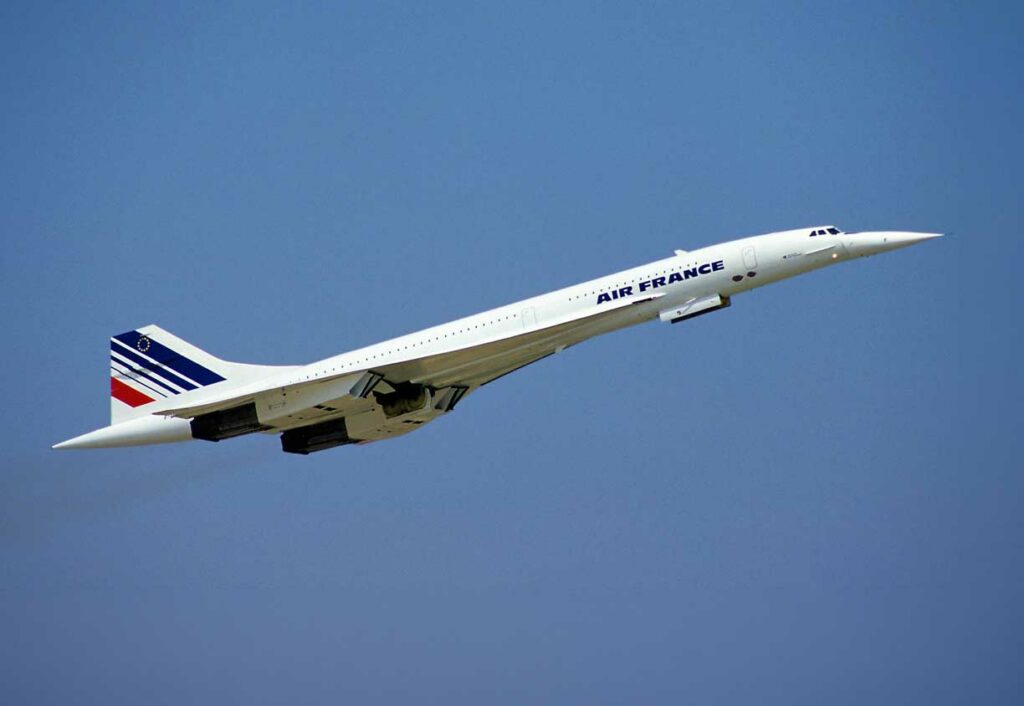
The Concorde’s engine must therefore be understood as a complete propulsion system. The air intake, the turbojet and the nozzle form an inseparable unit. Assessing the Olympus 593 on its own is not sufficient to understand the aircraft’s performance.
Estimates of cruise thrust illustrate this reality. Around 63 per cent of the propulsive force results from the pressures exerted within the air intake. Nearly 8 per cent comes directly from the thrust transmitted by the engine to its mountings. The remainder comes mainly from the ejection system and the nozzle.
These proportions depend on the calculation conventions used. Nevertheless, they reveal a physical reality: at Mach 2, the internal aerodynamics of the nacelle are almost as significant as the turbojet engine itself.
The Concorde’s nozzle also features movable flaps. These adjust the ejection geometry to suit the different phases of flight. They can also function as thrust reversers after landing.
Heat becomes the Olympus 593’s constant enemy
The air entering the propulsion system exceeds 120 °C during supersonic cruise. This temperature is not yet that of combustion; it corresponds to the outside air already heated by its deceleration.
The first stages of the compressor make extensive use of titanium, chosen for its strength and low mass. The final stages of the high-pressure compressor, however, require nickel-based alloys. These materials are normally reserved for the much hotter parts of turbojet engines.
After compression, the temperature rises further. The fuel burnt in the combustion chamber heats the gases to a level that metallic materials could not withstand over the long term without protection.
The distributors and certain turbine blades are therefore cooled by air drawn from the compressor. Small internal passages direct this air towards the most exposed areas. The principle seems simple. Its implementation requires extreme precision.
A variation of a few tens of degrees in the metal’s temperature can significantly reduce a component’s service life. Studies carried out during development have, in particular, highlighted the importance of manufacturing tolerances in the cooling of the blades.
Fuel also plays a part in thermal management. Before being burnt, it absorbs heat from several of the aircraft’s systems. This role as a heat-transfer fluid becomes essential in an aircraft whose airframe itself heats up during cruise.
Exceptional performance masks brutal fuel consumption
The Olympus 593 is remarkably well-suited to supersonic cruise. Concorde flies at around 2,160 km/h (1,350 mph), at an altitude of up to approximately 18,300 m (60,000 ft).
At this speed, the pure turbojet offers several advantages. Its frontal area remains relatively small. It can accelerate a limited mass of air to very high speeds. It fits into a narrow nacelle and is better suited to the supersonic flight regime than a high-bypass engine.
A modern turbofan engine designed for an Airbus A320 or a Boeing 737 operates on a different principle. Its large fan accelerates a large mass of air, but with a smaller variation in speed. This design is highly efficient in subsonic flight. It becomes bulky and difficult to integrate at Mach 2.
The Olympus’s performance, however, remains very limited. At low speeds, the engine consumes a great deal of fuel and produces a level of noise that is difficult to accept. British Airways reported an overall fuel consumption of around 25,600 litres per hour for the aircraft. Its total fuel capacity was nearly 119,500 litres.
These figures do not precisely describe each phase of flight. Fuel consumption varies significantly between taxiing, take-off, acceleration and cruise. They do, however, give an indication of the scale of the problem.
The military engine, now adapted for civilian use, retained a weakness inherent to its original mission. Priority was given to thrust and speed, not to subsonic fuel economy.
Concorde could be efficient within its niche. But that niche was extremely limited.
The oil crisis, restrictions linked to the sonic boom, take-off noise and maintenance costs prevented this design from becoming widespread. The Olympus excelled where almost no other airliner flew. It performed poorly under the conditions in which commercial aviation spent the bulk of its time.
Snecma’s contribution goes beyond licence production
For Snecma, the Olympus 593 represented a strategic shift. The French company already had a strong military heritage, notably thanks to the Atar family. It was therefore no stranger to gas turbines, high temperatures or the demands of high-speed aircraft.
However, Concorde imposed upon it the demands of an international civil programme. Responsibilities had to be shared with a foreign partner, two industrial organisations had to be coordinated, every modification had to be documented, and civil certification authorities had to be satisfied.
Operational availability also became a key consideration. A military engine can be maintained in a controlled environment, with specialist teams and a limited number of aircraft. A civil engine, however, must be capable of daily operation by an airline. Maintenance work must be predictable. Parts must be tracked. Procedures must be repeatable.
In 1962, Snecma and Bristol Aero Engines decided to co-finance the development on an equal basis. The first prototype ran at Villaroche in 1965. Snecma was involved in the engine’s design and development. French companies also worked on the nozzle components, the brakes, the landing gear and several critical systems.
Safran now regards the Concorde’s maiden flight as the start of Snecma’s civil development. This is a significant statement. The Olympus 593 was not merely a prestigious contract. It enabled the company to grapple directly with the demands of commercial air transport.
It would, however, be an exaggeration to claim that Concorde alone created this expertise. Snecma already had a powerful industrial base. It subsequently collaborated with General Electric and MTU on the CF6-50 intended for the Airbus A300. Concorde was a major milestone, not the sole origin.
The link with CFM International must be recounted without myth
The creation of CFM International in 1974 marked a continuation of Snecma’s rise in the civil aviation sector. But the CFM56 is not a modernised version of the Olympus. Its architecture, purpose and technical lineage are different.
The high-pressure core of the CFM56 derives largely from General Electric’s work on the F101. This military engine had been developed for the Rockwell B-1 supersonic bomber.
Snecma was responsible for the low-pressure system. Its contribution included, in particular, the fan, the low-pressure compressor and the low-pressure turbine. The French company also played a major role in the engine’s installation and the design of the nacelles.
General Electric retains responsibility for the high-pressure core, the combustion chamber and the high-pressure turbine. This division of responsibilities brings together two complementary sets of expertise.
The continuity with Concorde is therefore industrial, human and strategic. Snecma has learnt to participate in a transnational programme, to manage complex interfaces and to meet the constraints of commercial aviation. It also possesses valuable military expertise in aerodynamics, materials and turbomachinery.
The parallel is more interesting than the simplified narrative. The Olympus 593 transformed a lineage of British bomber engines into a supersonic civil propulsion system.
A few years later, the CFM56 combined a core derived from another bomber, the B-1, with a French low-pressure system to conquer the global subsonic aviation market.
In both cases, the military-to-civilian transfer is highly selective. It is not enough simply to remove the afterburner or change the nacelle. The targets for fuel consumption, noise levels, service life and maintenance require a complete redesign.
The success of the CFM56 is on a completely different scale to that of Concorde. CFM International now claims to have delivered over 39,000 engines and recorded more than one billion cumulative flight hours for the CFM56 and LEAP families.
The CFM56 and subsequently the LEAP have powered thousands of Airbus A320s and Boeing 737s. Concorde remained a very low-volume programme. Yet this small supersonic programme helped shape one of the partners behind the greatest industrial success in civil aviation engine manufacturing.
The Olympus’s legacy lies as much in its limitations as in its records
The Olympus 593 demonstrates that military technology can succeed in the civil sector when it fulfils a specific mission. It also proves the reverse: an exceptional design at Mach 2 can be mediocre across the rest of the flight envelope.
Its thrust, thermal resistance and reheat system made Concorde possible. Its fuel consumption, noise levels and specialisation prevented any direct successors.
Its true legacy is therefore not a modern engine that resembles it. It lies in methods, teams and a culture of cooperation. Through Concorde, Snecma learnt to become a leading player in the civil sector. It then moved up a gear with General Electric.
To say that the Olympus gave rise to CFM International would be historically inaccurate. To say that it prepared Snecma for this venture is much more accurate.
This nuance makes the story all the more compelling. The Concorde’s engine was not merely a relic of the Cold War fitted to a commercial airliner. It was a bridge between two industrial worlds. A costly, noisy and technically brilliant bridge, but one strong enough to help French propulsion establish a lasting presence in global commercial aviation.
War Wings Daily is an independant magazine.