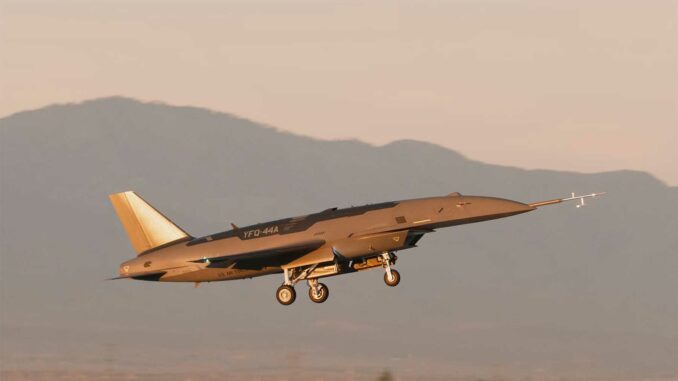
With the FQ-42A and FQ-44A, the US Air Force is separating the airframes from the software to speed up production of its future combat support aircraft.
In summary
The US Air Force reached a decisive milestone on 17 June 2026. It awarded industrial development and production contracts to General Atomics and Anduril Industries for the FQ-42A Dark Merlin and FQ-44A Fury. These Collaborative Combat Aircraft are designed to accompany piloted fighter jets, carry sensors or weapons, and carry out certain tasks with supervised autonomy. The contracts were awarded four months ahead of schedule. Washington is now aiming for more than 150 operational aircraft by 2030, followed by a fleet of around 1,000 CCAs. However, the real breakthrough does not concern aircraft alone. The US Air Force is procuring autonomy software separately. Anduril, Shield AI and RTX Collins Aerospace are taking part in a competition to select a prime contractor in 2027. At the same time, Anduril is preparing for series production of the Fury at its Arsenal-1 complex in Ohio. The programme is progressing rapidly. It remains, however, exposed to the technical risks of industrialisation commencing before testing is fully complete.
The June contract marks the transition of the CCA to production
On 17 June 2026, the US Air Force awarded Engineering and Manufacturing Development and production contracts to General Atomics Aeronautical Systems and Anduril Industries.
General Atomics will produce the FQ-42A Dark Merlin. Anduril will manufacture the FQ-44A Fury. The two aircraft constitute Increment 1 of the Collaborative Combat Aircraft programme.
This decision goes beyond the initial order for a few experimental demonstrators. It paves the way for the preparation and launch of large-scale production. The US Air Force states that both models meet its mission requirements and offer the best balance between capability and cost amongst the solutions evaluated.
The contracts were awarded four months ahead of schedule. The contract value and the exact number of aircraft in the first batch have not been made public. This lack of figures means we must remain cautious. The start of production has been confirmed, but the initial production volume has not.
The stated objective is nevertheless clear. The US Air Force aims to acquire more than 150 CCAs capable of combat before the end of the decade. Its longer-term ambition is to reach around 1,000 aircraft.
This scale explains the urgency. Even a fleet of 150 aircraft requires several years of production, the building up of stocks of engines and spare parts, the training of maintenance personnel, the development of ground control systems and the organisation of operational support.
The two aircraft pursue the same mission using different approaches
The FQ-42A and FQ-44A are sometimes described as wingman drones. This term is an oversimplification.
A Collaborative Combat Aircraft is not designed as a simple remote-controlled aircraft. It must receive objectives, analyse the local situation, maintain formation, manage its sensors and propose or execute certain actions within the limits set by a human operator.
It must be capable of collaborating with an F-35, an F-22, the future F-47 or other command platforms. Its role may vary depending on the sensors, weapons and software installed.
It can extend the area monitored by a piloted fighter. It can carry additional missiles. It can approach an air defence system without immediately exposing a pilot.
It can also complicate the adversary’s calculations by increasing the number of flight paths and lines of attack.
The precise missions and detailed performance specifications of both aircraft remain largely classified. No comprehensive official data has been published on their range, service ceiling, maximum speed, radar cross-section or payload.
The FQ-42A builds on General Atomics’ experience
The FQ-42A Dark Merlin is derived from General Atomics’ work on the Gambit family. This approach is based on a common core that can be adapted to multiple missions.
General Atomics is considering variants dedicated to long-endurance surveillance, air-to-air combat, strike missions or sensor carriage. The manufacturer is thus seeking to retain the same core components whilst changing the mission equipment.
This philosophy theoretically reduces development costs. It can also simplify maintenance by sharing certain sub-assemblies across several versions.
The programme draws on nearly two decades of experience in unmanned jet aircraft. General Atomics first flew the MQ-20 Avenger back in 2008. The company subsequently developed the XQ-67A, a remote-sensor demonstrator, in collaboration with the Air Force Research Laboratory; this served as a precursor to the FQ-42A.
General Atomics was selected in April 2024. The YFQ-42A’s maiden flight took place in August 2025. The manufacturer claims to have gone from contract to flight in 15 months. Several pre-production aircraft subsequently carried out automated take-offs and landings.
The FQ-44A embodies Anduril’s industrial model
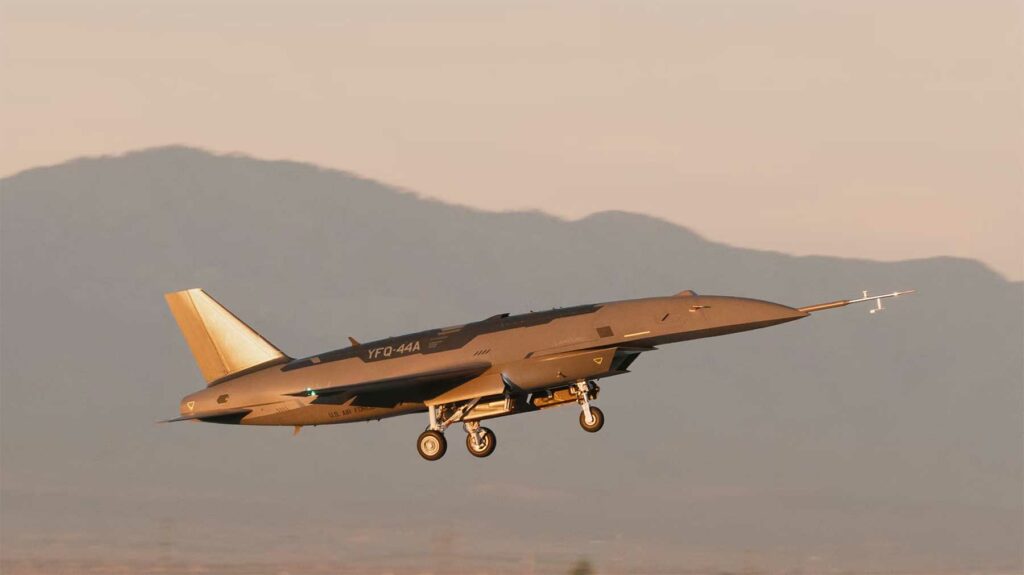
The FQ-44A Fury embodies a different approach. Anduril aims to apply a method similar to software development to the military aviation sector.
The company funds a significant proportion of its upstream capabilities. It builds prototypes rapidly. It then refines the product through short development cycles, whilst preparing the production infrastructure ahead of securing large-scale production orders.
The Fury is presented as an autonomous aircraft offering performance comparable to that of a fighter, with modular payloads. It uses Anduril’s Lattice software suite for control, mission management and data exchange.
The first pre-production model was developed in around a year. Flight tests began in October 2025. By February 2026, the YFQ-44A had already flown using several mission autonomy software packages.
The separation of the software from the aircraft is the real game-changer
The US Air Force does not wish to replicate the traditional model in which a manufacturer controls the aircraft, the computers, the interfaces and the software for several decades.
It is applying a policy to the CCA described as software sold separately.
The aircraft contract covers the airframe, propulsion, flight controls, electrical systems and the physical integration of equipment. The mission autonomy software is the subject of a separate tender.
This separation could allow software developed by Shield AI to be installed in an Anduril aircraft. It could also lead to an RTX Collins Aerospace solution being integrated into a General Atomics aircraft.
The airframe manufacturer therefore does not automatically enjoy a monopoly over the tactical intelligence of its own aircraft.
The A-GRA is designed to prevent industrial lock-in
This policy is based on the Autonomy Government Reference Architecture, or A-GRA.
This is a software architecture owned by the US government. It defines the interfaces enabling autonomy software to communicate with the aircraft, sensors, mission systems and control systems.
The idea is comparable to that of a common operating system. The software must be able to request a flight path, read information provided by sensors, receive a mission objective and transmit its status without being entirely dependent on a proprietary architecture.
The policy is clear: no single supplier should control the whole system.
By February 2026, the US Air Force had already tested the A-GRA on both platforms. RTX Collins Aerospace was working with General Atomics on the YFQ-42A. Shield AI was collaborating with Anduril on the YFQ-44A. The aim was to prove that a third-party algorithm could pilot a mission on an aircraft built by another company.
This portability will never be fully automatic. The two aircraft do not have the same flight characteristics, the same fuel reserves, the same flight computers or the same sensors.
The software must therefore be provided with a precise description of the platform. It must know its speed limits, flight envelope, manoeuvring performance, fuel consumption and safety margins.
The open architecture reduces the integration workload. It does not eliminate it.
The autonomous mission competition keeps six companies in the running
The general autonomous mission contract covers a six-year period. Six companies have been admitted to the supplier pool:
Anduril, General Atomics, Lockheed Martin, Northrop Grumman, RTX Collins Aerospace and Shield AI.
The US Air Force thus retains the option to purchase licences from each of these companies throughout the contract period.
However, three companies have been awarded the initial production options: Anduril, Shield AI and RTX Collins Aerospace.
They are taking part in an initial six-month competitive phase. A second six-month period will then determine which solutions perform best. The US Air Force plans to select its primary mission autonomy supplier for Increment 1 during the summer of 2027.
The algorithms will need to demonstrate tactical autonomy
Mission autonomy goes far beyond autopilot.
An autopilot maintains altitude, speed or a flight path. A mission autonomy system must decide how to reach an objective despite threats, loss of communication and the movements of other aircraft.
It may need to change formation, avoid an area covered by a surface-to-air missile, manage its energy, allocate targets amongst several aircraft and decide which sensor to use.
It must also know when to abort. An aircraft that is damaged, running low on fuel or has lost communication must adopt safe and predictable behaviour.
The main challenge is not simply getting the aircraft to fly. It lies in achieving tactical behaviour that human pilots can understand.
An unmanned combat aerial vehicle (UCAV) that is too cautious would become useless. One that is too aggressive could jeopardise the mission or endanger allied aircraft.
The US Air Force therefore plans to link part of the payments to actual performance and operator feedback. The supplier will only receive the full amount of its licence fees if its software provides a capability deemed relevant by users.
Arsenal-1 transforms the factory into a key component of the programme
Anduril is not content merely to design the FQ-44A. The company is building an industrial complex in Ohio designed to manufacture several families of autonomous weapons.
Arsenal-1 is set to eventually cover approximately 464,500 square metres (5 million square feet) on a site of over 202 hectares (500 acres), near Columbus. The announced investment amounts to approximately $1 billion. The project is expected to create more than 4,000 direct jobs.
The Fury is the first major aerospace programme set to enter this production line. Anduril had initially announced that production would begin in July 2026. The company finally began installing the assembly stations and preparing for production during the first half of the year.
The June contract now provides an official military basis for this ramp-up. It also sets out a framework enabling the US Air Force to order additional batches over the coming years.
Anduril’s aim is to make the factory more flexible than traditional aerospace production lines. Workstations, digital instructions and controls must be adaptable to multiple products.
This approach is consistent with the CCA. The aircraft is not intended to remain unchanged for thirty years. Its airframe, computers and payloads are to evolve in successive blocks.
The production line must therefore be capable of accommodating these modifications without requiring a complete overhaul of the production line.
The AIM-120 firing demonstrates that the Fury has moved beyond the demonstrator stage
On 15 July 2026, a YFQ-44A fired an AIM-120 air-to-air missile at a test site in the Mojave Desert.
The missile was used against a digital target. The test therefore did not involve the destruction of an actual target aircraft. It did, however, allow the entire launch sequence to be tested.
The tests had begun with the carriage of inert munitions. Engineers had verified the structural loads, vibrations, the aircraft’s behaviour and the potential separation of the weapon.
Subsequent stages validated the link between the FQ-44A and the missile. The July test included the actual launch of the AIM-120 and a comparison between the numerical models and the measurements obtained in flight.
The US Air Force was keen to emphasise that the authority to fire remains with a human operator.
The CCA can automatically execute the engagement sequence within defined parameters. It can manage its own flight path and technical communications with the missile. However, the decision to release the weapon remains under the control of an operator.
This distinction is crucial. The programme involves semi-autonomous aircraft. In its announced configuration, it does not constitute a programme of weapons that select their own targets.
The return of the FQ-42A highlights the risks of an accelerated timetable
The General Atomics programme experienced a serious incident on 6 April 2026.
An YFQ-42A crashed shortly after take-off in the Californian desert. No one was injured, but the aircraft was completely destroyed.
The joint investigation identified a calculation error in the autopilot concerning the aircraft’s mass and centre of gravity. The software was using incorrect data to control the flight phase.
General Atomics and the US Air Force modified the software, carried out safety checks and then authorised the resumption of trials on 21 May. Other ground-based activities had continued during the hiatus.
The incident does not spell the end for the FQ-42A. Test programmes are specifically designed to uncover this type of fault.
It does, however, demonstrate that speed does not eliminate risk. It simply shifts that risk to the testing phase, the software and the first production batches.
The US Air Force accepts a form of concurrent development. Aircraft are still being evaluated whilst production lines begin to operate. This method reduces the time needed to field a fleet. It may also necessitate modifications to aircraft that have already been assembled when a fault is discovered at a late stage.
The CCA programme is changing the economics of air combat
The US approach is not to replace all manned fighters.
An F-35 or a future F-47 will retain superior sensors, computing power and versatility. A human pilot also remains indispensable when the situation becomes ambiguous or politically sensitive.
UCAVs are instead intended to increase the range of capabilities available around these costly platforms.
A fighter can remain at a distance whilst dispatching several aircraft to monitor a sector. One UCAV can carry additional missiles. Another can transmit data or draw the attention of an enemy radar.
The potential loss of an unmanned aircraft remains a serious matter. It is, however, more acceptable than the loss of a manned fighter and its crew.
The real deciding factor will be the total cost. An UCAV that is cheap to purchase but requires heavy maintenance, complex infrastructure or constant upgrades will not deliver the expected volume.
Availability will also be a key factor. A thousand aircraft on the books do not equate to a thousand aircraft capable of taking off. Engines, spare parts, computers and communication links will need to keep pace.
The US Air Force is therefore experimenting with a new approach to air combat. It separates airframes, software and suppliers. It accepts several competing models. It retains the option of replacing an algorithm without replacing the entire fleet.
It is an ambitious gamble. It is also a clear-sighted one. Faced with a power that possesses numerous missiles, vast distances and dense air defences, a few dozen highly sophisticated fighter aircraft are no longer enough.
The success of the FQ-42A and FQ-44A will not be measured by their futuristic appearance. It will depend on their ability to be produced in large numbers, maintained simply, controlled safely and constantly improved without recreating the industrial dependencies that the open architecture is specifically seeking to eliminate.
War Wings Daily is an independant magazine.