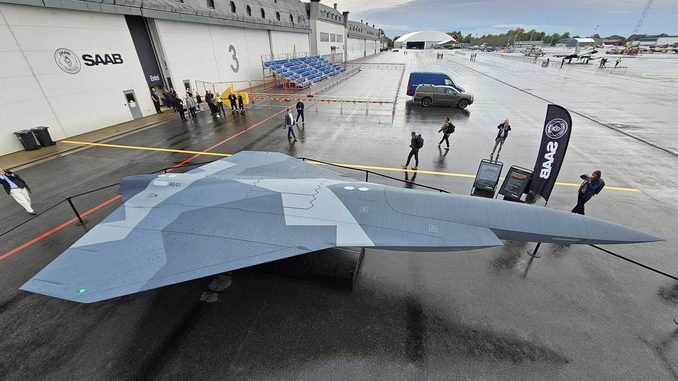
Saab unveils the A3-001, a stealthy and supersonic combat drone designed to operate alongside the Gripen in highly contested airspace.
Executive Summary
On August 21 and 22, 2026, in Linköping, Saab unveiled a full-scale mockup of the A3-001, its collaborative combat aircraft concept of the future. The aircraft is intended to complement the Gripen E and future Swedish fighters rather than replace them. Tailless, featuring a stealth-shaped airframe, and designed for supersonic flight, the A3 targets missions where exposing a pilot becomes exceptionally risky: electronic warfare, suppression of enemy air defenses, advanced reconnaissance, and precision strikes. No definitive engine or armament has yet been selected. As such, the A3-001 remains an industrial concept rather than a flying prototype. However, Saab is concurrently developing the A1 and A2 technology demonstrators as part of work funded by the Defense Materiel Administration (FMV). Uncrewed aircraft with fighter-like performance are expected to fly before 2030. An operational capability derived from the A3 could eventually emerge in the mid-2030s.
The Unveiling of the A3-001 Shapes the Future of Swedish Air Combat
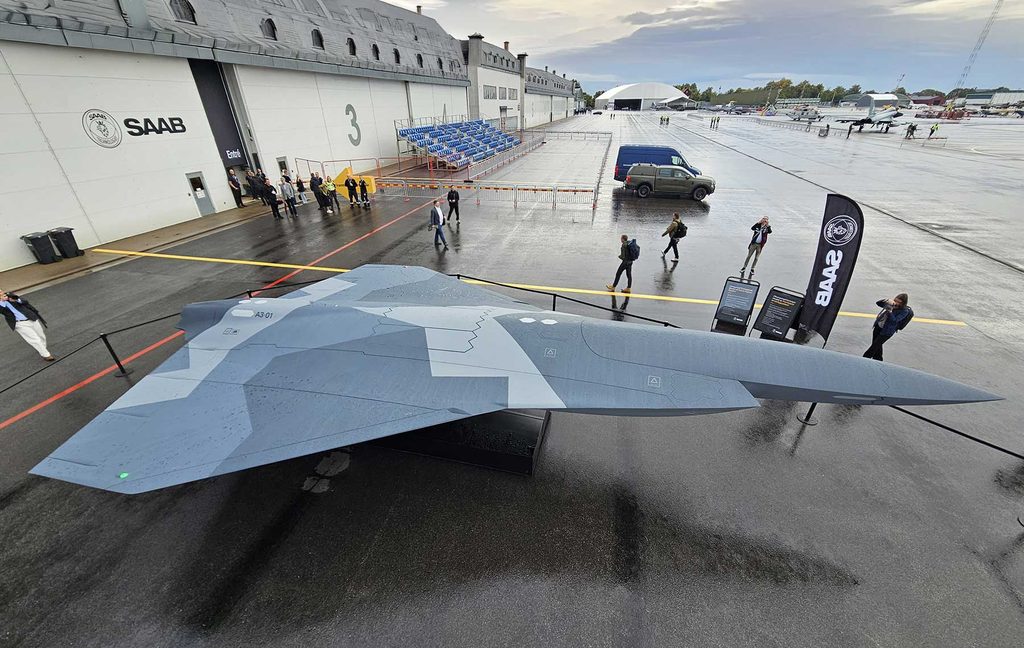
The photographs are deceptive. The aircraft displayed at Malmen Air Base near Linköping resembles an operational plane ready for flight. Yet, it is a full-scale 1:1 mockup.
Saab presented it to the press on August 21, prior to its public exhibition during the August 22–23 airshow celebrating the centenary of the Swedish Air Force (Flygvapnet).
The A3-001 gives physical form to several years of strategic planning. In March 2024, the Defense Materiel Administration (FMV) tasked Saab with studying various architectures for a future air combat system. The Swedish program deliberately avoids focusing on a single aircraft, examining instead a combination of crewed and uncrewed solutions organized into a system-of-systems.
In October 2025, Stockholm accelerated the project with a contract worth approximately 2.6 billion Swedish kronor covering the 2025–2027 period to fund studies, technologies, and flight demonstrators.
The A3 itself is not directly funded as a production aircraft. Saab presents it as its own vision of a capability that could enter service in the mid-2030s if Sweden chooses to pursue this path.
The Tailless Airframe Places Stealth at the Core of the Concept
The most defining feature of the A3-001 is its lack of vertical stabilizers.
This design choice is not aesthetic. Vertical tails create reflective surfaces for radar waves. Removing them allows for superior control of the radar cross-section, though it adds significant complexity to the aircraft’s stability and flight control systems.
setup features a highly integrated airframe. The fuselage blends seamlessly into a complex delta wing. The leading and trailing edges follow precisely calculated alignments. Several apertures feature serrated, sawtooth edges to scatter or direct electromagnetic reflections away from the transmitting radar rather than returning energy directly to it.
The engine nozzle is also deeply recessed into the aft section and flanked by serrated shapes. This layout helps reduce both radar and infrared signatures, although Saab naturally has not published specific performance metrics.
The concept heavily prioritizes internal payload carriage. This is crucial: missiles or bombs suspended under the wings severely degrade radar stealth.
Concurrently, Saab is targeting supersonic capability. The manufacturer is thus pursuing a far more demanding balance than that of a standard subsonic drone: stealth, speed, range, payload capacity, and survivability must coexist.
Penetrating Where Sending a Gripen Becomes Too Dangerous
The military utility of the A3 is clearly seen in its risk allocation.
A Gripen E is costly, but its pilot is even harder to replace. In airspace protected by modern radars, long-range surface-to-air missile systems, and adversary fighters, Sweden wants the ability to project an uncrewed platform dozens or hundreds of kilometers ahead of the manned aircraft.
The A3 could thus hunt for radar stations, locate electromagnetic emissions, and transmit target coordinates back to the Gripen. It could also provide electronic jamming, launch ordnance, or deliberately provoke the activation of enemy air defenses to expose their positions.
This is the core principle of Suppression of Enemy Air Defenses (SEAD). The objective is not necessarily to destroy every radar site immediately; forcing a system to shut down or disrupting its operation is often enough to open a temporary corridor for other strike assets.
Saab also notes precision strike and air-to-air combat missions as potential roles.
In this context, the A3 becomes far more than a simple “loyal wingman.” It acts as a remote sensor and forward effector, exchanging real-time data with the Gripen, GlobalEye airborne early warning platforms, and other assets.
Open Engine and Dimension Choices Highlight an Evolving Program
Ambition, however, must be distinguished from proven operational capability.
Saab has not yet selected an engine. Peter Nilsson, head of Advanced Programs, indicated that using a propulsion system related to that of the Gripen E remains one of the options under evaluation.
The Gripen E is powered by the RM16, a Swedish variant of the General Electric F414-GE-39E, producing roughly 98 kN of thrust with afterburner. Reusing this engine family would mitigate industrial risks and yield logistics synergies.
Yet no final decision has been made.
In 2024, Saab presented several potential aircraft architectures, including a supersonic drone weighing over five metric tons that clearly presaged the A3 design. The manufacturer has not yet released final figures regarding the A3-001’s maximum takeoff weight, operational radius, service ceiling, top speed, or payload capacity.
Assigning precise performance figures to the aircraft at this stage would be premature.
A1 and A2 Demonstrators Aim to Turn Concept into Real-World Data
The program transitions into concrete development through its demonstrator flight path.
Saab is planning a phased technological progression moving through A1, A2, and ultimately A3. The initial subscale aircraft will evaluate distinct airframe architectures, specifically comparing tailed versus tailless configurations.
The timeline is aggressive. Saab aims to fly uncrewed demonstrators featuring fighter-like performance before 2030. Peter Nilsson suggested a target of roughly 18 months for the initial demonstrator, putting a first flight on track for late 2027 or early 2028 if schedules hold.
This phased methodology lets Sweden refrain from locking in its future system architecture prematurely.
A tailless aircraft may offer exceptional stealth characteristics while proving more complex to control. Alternative configurations might offer better overall aerodynamic compromises. The flight demonstrators are designed specifically to quantify these trade-offs rather than relying solely on computer simulations.
The A3 Prepares a New Air Warfare Architecture Rather Than a Direct Gripen Replacement
Ultimately, the most compelling aspect of the program lies in what Saab is not doing. The manufacturer does not present the A3-001 as a direct successor to the Gripen.
Instead, it aims to distribute operational capabilities across multiple platforms.
The Gripen retains the human pilot, core processing power, primary command decision-making, and heavy weapons carriage. The GlobalEye platform provides long-range air and surface surveillance. Advanced stealth drones can penetrate deeper into defended airspace to jam, detect, or strike. Lower-cost attritable platforms can round out the fleet for missions where extreme stealth is unnecessary.
This approach directly addresses a profound evolution in air combat. Against layered integrated air defense networks, concentrating sensors, weapons, and a human pilot into a single airframe creates an extraordinarily capable platform—but an immensely valuable and vulnerable one.
The A3-001 offers an alternate operational logic: shifting a portion of that capability and risk onto uncrewed assets.
Saab explicitly stresses that the future drone must cost significantly less than a Gripen. Striking this financial balance will be critical. A stealthy, supersonic aircraft equipped with sophisticated sensors and long range can quickly become nearly as complex and expensive as a crewed fighter.
The A3’s entire viability hinges on this equilibrium. Sweden is not simply building an uncrewed aircraft. It is defining which operational functions still require a cockpit and which can be safely entrusted to a machine. That boundary, far more than the striking lines of the A3-001, will define the next generation of air warfare.
War Wings Daily is an independant magazine.
Sources
Saab — Saab showcases full-scale uncrewed aircraft concept, August 22, 2026.
Saab — Saab receives order from FMV for continued future fighter concept studies, October 14, 2025.
Saab — Saab receives order for Swedish future fighter concept studies, March 22, 2024.
Saab — Saab achieves AI milestone with Gripen E, June 11, 2025.
The Aviationist — Saab Unveils A3-001 Collaborative Combat Aircraft Concept, August 22, 2026.
The War Zone — Saab Unveils Stealthy Supersonic “Fighter Drone” Concept, August 21, 2026.
FlightGlobal — Saab takes wraps off new “loyal wingman” concept, August 2026.
AeroTime — Saab unveils new uncrewed combat air system concept, August 22, 2026.
Lentoposti — Saab esitteli Linköpingissä uuden hävittäjän kokoisen miehittämättömän A3-ilma-aluskonseptin, August 22, 2026.