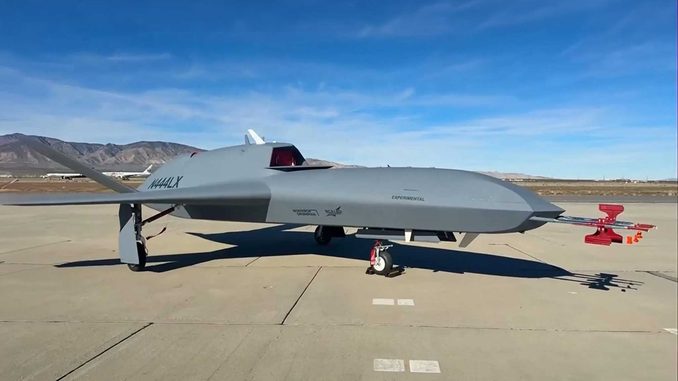
The US Air Force is accelerating its CCA and MMA drone programs, targeting 1,000 aircraft as early as 2032 to build an affordable, autonomous combat mass to counter China.
In Summary
The US Air Force no longer views autonomous combat drones as an experimental capability. It is now preparing for their large-scale deployment. Its goal is to field at least 500 Collaborative Combat Aircraft and 500 Massed Modular Aircraft by 2032, representing approximately 1,000 new semi-autonomous combat drones. The General Atomics FQ-42 Vengeance and the Anduril FQ-44 Fury represent the first generation of CCAs. They are beginning to join experimental units and will participate in Emerald Flag this December, marking their first large-scale operational exercise. Concurrently, seven defense manufacturers are competing in the MMA program, designed around an aircraft costing approximately $10 million that is capable of assuming missions currently carried out by the MQ-9 Reaper. The maiden flight of Northrop Grumman’s YFQ-48A Talon Blue on October 3 demonstrates that the competition remains open. Washington is thus constructing an air force founded on affordable mass, autonomy, and rapid production.
CCAs Transition from Prototypes to a True Combat Force
The speed of this transformation is striking. In June 2026, the US Air Force awarded production contracts for the first generation of Collaborative Combat Aircraft (CCA) to General Atomics Aeronautical Systems and Anduril Industries. Increment 1 is slated to cover approximately 150 aircraft, split between the FQ-42A Vengeance and the FQ-44A Fury.
Washington is now targeting at least 500 operational CCAs by 2032. Over the longer term, the planned fleet size remains around 1,000 aircraft.
CCAs are neither simple remotely piloted drones nor fully autonomous fighters. They are semi-autonomous aircraft capable of receiving mission intent, executing navigation, formation flying, and target search functions, and subsequently cooperating with crewed platforms. Pilots are thus relieved of the need to continuously control every maneuver of the drone.
This collaborative combat philosophy lies at the core of American CCA drones. They will be capable of carrying missiles, operating forward of a formation, offloading sensors, jamming enemy air defenses, or expanding available magazine depth without exposing additional human pilots to risk.
Nevertheless, human oversight remains central to weapons release. During a live-fire test in July, the YFQ-44A launched an AIM-120 AMRAAM at a digital target following human fire authorization.
First Fury and Vengeance Aircraft Reach Operational Units
The decisive milestone lies not merely in prototype flight testing, but in placing these platforms directly into the hands of the operators who will deploy them operationally.
The US Air Force’s Experimental Operations Unit previously operated YFQ-42A and YFQ-44A platforms during trials at Creech Air Force Base, Nevada, in July. Anduril formally delivered a YFQ-44A to the unit in August, followed by General Atomics with a YFQ-42A in September.
Creech is currently utilized to establish maintenance, arming, refueling, and sortie generation procedures. One early finding is particularly significant: the experimental unit reported operating with approximately one technician per CCA during certain exercise scenarios.
This is critical. An aircraft marketed as “affordable” rapidly loses its value proposition if it demands support infrastructure comparable to that of a conventional fighter jet.
General Atomics states it can produce up to six FQ-42s per month. For its part, Anduril aims for a production capacity of 150 FQ-44s annually at its Arsenal-1 facility in Ohio. The American objective has thus expanded from technological demonstration to industrial scaling.
Exercise Emerald Flag to Test the Kill Chain for the First Time
An additional milestone is scheduled for December 2026 at Eglin Air Force Base, Florida. CCAs will participate for the first time in a Large Force Employment exercise as part of Emerald Flag.
The scope extends well beyond simple formation flight.
The US Air Force plans to integrate the drones into a large-scale strike package alongside fourth- and fifth-generation fighters. The exercise is specifically structured to test a complete kill chain under realistic operational conditions, spanning from initial detection and data transmission to target engagement.
This is where the concept will face its definitive test. Flying an autonomous drone is now relatively well-mastered. Coordinating that drone alongside dozens of aircraft, radars, data links, and electronic warfare assets within contested airspace presents a far higher order of complexity.
This architecture directly prepares the operational environment for Boeing’s F-47 program. The future fighter will not be designed merely to fight in isolation; it must serve as a key command node within a network of crewed and uncrewed platforms.
Talon Blue Keeps Northrop Grumman in the Competition
The selection of General Atomics and Anduril has not closed off the market.
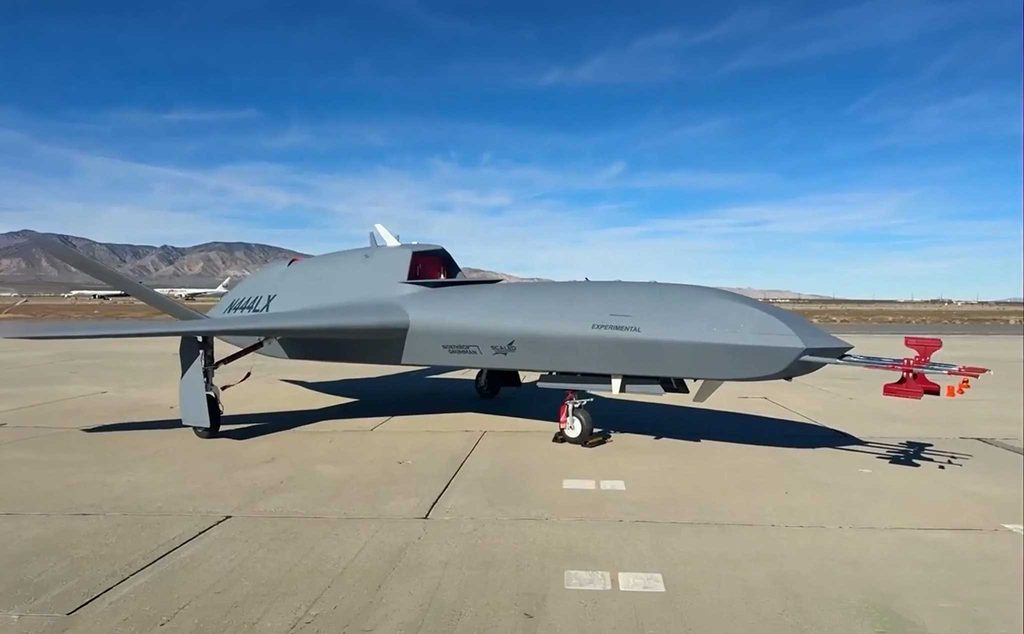
On October 3, 2026, Northrop Grumman completed the maiden flight of its YFQ-48A Talon Blue at Mojave. The aircraft autonomously conducted taxiing, takeoff, in-flight maneuvers, and landing.
Talon Blue is not part of the Increment 1 contract currently in production. However, Northrop Grumman is self-funding its development, positioning the platform directly for upcoming increments of the CCA program.
This continuous competition is by design. The US Air Force seeks to avoid locking itself into a single model for three decades. Instead, it intends to regularly re-compete airframes, engines, autonomy software, and mission systems.
Software is notably managed independently from the airframe. Six industrial partners have been integrated into the mission autonomy contract. This decoupling allows algorithms to be upgraded or replaced without necessitating a complete redesign of the underlying physical platform.
MMAs Push the Attritable Drone Concept Even Further
The second pillar of this strategy is less publicized but potentially even more disruptive. The Massed Modular Aircraft (MMA) program is designed to assume a portion of the intelligence, surveillance, reconnaissance, and strike missions currently performed by the MQ-9A Reaper.
Air Force Secretary Troy Meink stated the goal of fielding 100 MMAs by 2029 and 500 aircraft by 2032.
The target unit cost for the bare airframe—excluding sensors and mission systems—is approximately $10 million, compared to the roughly $20 million target cost for a mass-produced CCA.
The performance specifications issued to industry are ambitious, citing a combat radius of approximately 4,260 km (2,300 nm), a ferry range approaching 14,800 km (8,000 nm), and a payload capacity of at least 1,270 kg (2,800 lb).
Seven companies passed the initial selection phase: Anduril, Chaos Industries, General Atomics, Grid Aero, Otto Aerospace, Shield AI, and Swarm Aero.
The term “attritable” is key here. It does not mean disposable. It describes an aircraft capable enough to deliver military utility, yet inexpensive enough that its loss can be accepted when mission parameters demand it.
Heavy MQ-9 losses during US operations against Iran in 2026 underscored this calculus. Public estimates indicate several dozen Reapers were lost. Systematically replacing such losses with platforms costing tens of millions of dollars per unit becomes financially unsustainable when facing adversary air defense networks capable of shooting them down.
China Forces a New Economic Equation in Air Combat
The underlying strategic imperative is centered in the Indo-Pacific. Facing China, the United States must prepare for operations thousands of kilometers from major forward bases, operating under the threat of ballistic missiles, advanced fighter fleets, dense electronic jamming, and multi-layered air defense grids.
In this environment, quality alone is no longer sufficient.
Deploying exclusively high-cost F-35s or sixth-generation fighters introduces a severe economic asymmetry. An adversary could force Washington to expend platforms valued in the tens or hundreds of millions of dollars against far less costly threats.
The CCA and MMA programs aim to reverse this cost exchange. A crewed aircraft remains protected at a distance while multiple drones distribute sensors, weapons, and operational risk across the battlespace.
It represents the economics of mass applied to modern air warfare.
Boeing’s Dual Win Reshapes US Defense Industry Landscape
This evolution unfolds as Boeing dramatically solidifies its hold on next-generation US combat aviation.
On September 29, the US Navy awarded Boeing a contract valued at over $20 billion for the full-scale development of the F/A-XX. The contract encompasses multiple flight-test aircraft dedicated to ground testing, airworthiness verification, systems validation, and weapons integration.
The F/A-XX is projected to progressively complement and ultimately replace the Boeing F/A-18E/F Super Hornet and EA-18G Growler beginning in the 2030s.
Boeing had previously secured the US Air Force’s F-47 development contract in March 2025, establishing the company as prime contractor for both American sixth-generation fighter programs.
While this concentration prime contract awards is notable, it also explains why the Pentagon is intentionally fostering broader competition in uncrewed systems. General Atomics, Anduril, Northrop Grumman, Shield AI, and several emerging defense startups are counted on to ensure future US air power architecture does not depend entirely on a small number of monolithic programs.
Mass Re-emerges as an Operational Capability in Its Own Right
The CCA and MMA programs represent a shift deeper than the introduction of a new generation of uncrewed aircraft. The United States is attempting to dismantle an acquisition model where each successive aircraft generation becomes capability-richer, more complex, more expensive, and consequently scarcer.
The core American experiment focuses as much on procurement reform as on autonomous technology itself.
The CCA program progressed from initial development to production contracts in slightly over two years. The US Air Force reported a timeline of just nine months between first flight and a live-fire weapons test. By decoupling software from airframes, maintaining continuous vendor competition, and integrating operational units before freezing final platform configurations, the service is actively altering its fielding model.
The strategy carries inherent risks. A low-cost drone that lacks sufficient survivability could result in unsustainable attrition rates. Conversely, a platform engineered with excessive sophistication risks replicating the very cost growth the initiative was designed to eliminate.
Managing this balance will dictate the ultimate operational value of Collaborative Combat Aircraft. With 1,000 CCAs and MMAs targeted by 2032, Washington is no longer attempting merely to build better aircraft. It is working to convert scale itself into a strategic advantage.