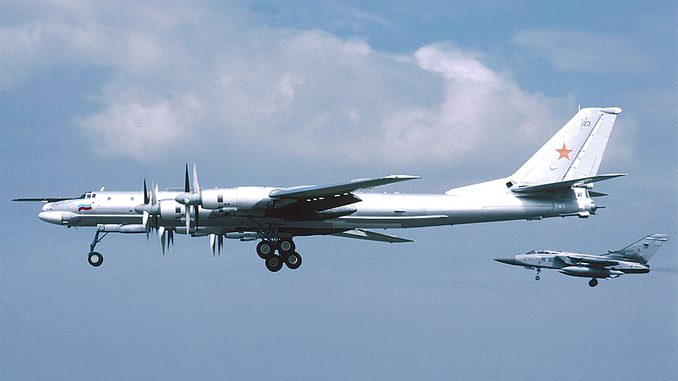
Two Russian Tu-95 bombers were intercepted by Taiwanese F-16s. Why is Moscow deploying its strategic aviation near Taiwan?
In Brief
On November 19, 2026, two Russian Tu-95 strategic bombers entered Taiwan’s air defense identification zone, prompting F-16 fighter jets to scramble. The aircraft flew along the island’s eastern coast before continuing northward. This marked their second transit through the region in three days, following a stopover in Da Nang, Vietnam. These movements coincide with the APEC summit in China and meetings between the American, Chinese, and Russian leaders. For Moscow, the operation serves to demonstrate its military power projection capabilities in Asia despite the ongoing war in Ukraine, while also underscoring its strategic alignment with Beijing. However, there is no evidence of a coordinated military operation with China. Japan also scrambled fighter jets to monitor the Russian aircraft, highlighting the broader regional dimension of this show of force.
Russian Bombers Trigger an Interception Off Taiwan
On November 19, 2026, two Russian Tupolev Tu-95 bombers entered Taiwan’s air defense identification zone (ADIZ). Approaching from the south, they tracked north along the island’s eastern coastline before exiting northeast of Keelung.
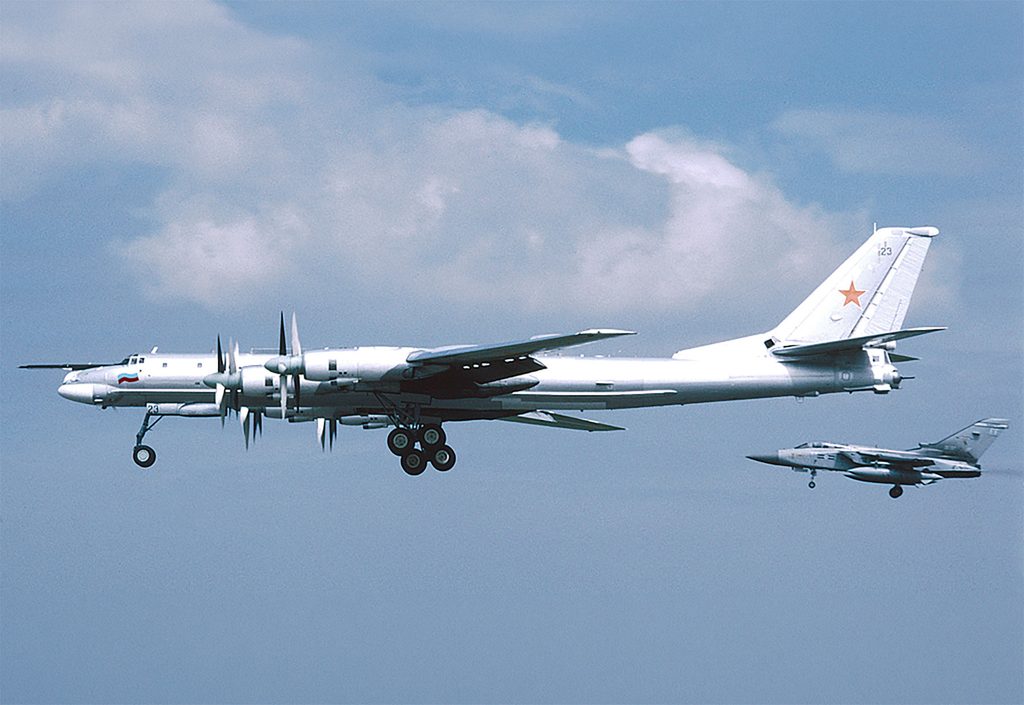
Taiwan’s Ministry of National Defense released a photograph of one of the bombers taken from an F-16 Fighting Falcon tasked with monitoring the flight. Authorities did not specify the number of fighters scrambled or the duration of the interception.
The incident was not isolated. On November 17, Taipei had already reported two Russian military aircraft flying the reverse route, from north to south. The bombers subsequently landed in Da Nang, Vietnam, before departing again on November 19.
Reuters confirmed that a registration number visible in the Taiwanese photograph matched that of a Tu-95 spotted in Vietnam. The news agency also authenticated footage of the aircraft taking off from Da Nang.
This was therefore a regional air deployment, rather than a mission launched directly against Taiwan.
An ADIZ Does Not Constitute Sovereign Airspace
An air defense identification zone is a surveillance area in which authorities seek to identify aircraft approaching their territory. It can extend well over international waters, and crossing into it does not, in itself, constitute a violation of sovereignty.
Territorial airspace extends over land and territorial waters up to 12 nautical miles (22.2 kilometers) from the coast. No intrusion by the Tu-95s into Taiwanese sovereign airspace was reported.
Fighter interceptions involve visually identifying the aircraft, confirming their flight path, and gathering intelligence. Taiwan’s modernized F-16Vs are notably equipped with the AN/APG-83 AESA radar, capable of tracking multiple targets simultaneously and enhancing aerial situational awareness.
No confrontation was reported.
The Tu-95MS Remains an Instrument of Russian Strategic Power
Designed in the Soviet Union, the Tupolev Tu-95 has been flying since 1952. Its Tu-95MS variant remains a frontline strategic bomber despite the age of its airframe design.
Four Kuznetsov NK-12 turboprop engines drive contra-rotating propellers. The aircraft has a wingspan of approximately 164 feet (50 meters) and a cruising speed approaching 441 mph (710 km/h).
The bomber has an unrefueled range of roughly 6,524 miles (10,500 kilometers), depending on its payload configuration. Its value lies not in stealth or supersonic speed, but in its long endurance and ability to carry long-range cruise missiles.
Tu-95MS bombers can launch conventional Kh-101 cruise missiles or, depending on their configuration, nuclear-armed variants. However, a bomber’s nuclear capability does not mean it is carrying nuclear weapons, and no information confirms the presence of nuclear warheads during this mission.
For Moscow, committing two aircraft of this class projects long-range air power without requiring the deployment of large combat formations.
Russia Seeks to Reassert Its Military Presence in Asia
The war in Ukraine ties down a substantial portion of Russia’s military resources. Nevertheless, these flights serve as a reminder that Moscow still retains the capability to project force in the Pacific.
The timing is significant. The aircraft transited the region during the APEC summit in Shenzhen and high-level meetings between Vladimir Putin, Xi Jinping, and Donald Trump.
The likely message is that Russia refuses to be confined to the European theater. For Moscow, Asia remains an arena in which to defend its status as a global power and maintain leverage in its strategic rivalry with Washington.
However, portraying this operation as preparation for an attack on Taiwan would be an overstatement. No public evidence indicates a targeting mission, a Chinese directive, or operational coordination with Beijing.
The bombers’ transit also allows Russian forces to observe regional responses—including detection times, radar tracking, interceptor scramble speeds, and interagency coordination. While these intelligence-gathering benefits are plausible, no dedicated reconnaissance mission has been confirmed.
Closer Ties Between Moscow and Beijing Amplify the Flight’s Impact
Russia backs China’s position on Taiwan. Consequently, a Russian aerial presence near the island fits into a broader pattern of regular Chinese military pressure, even in the absence of a declared joint operation.
Military cooperation between the two nations has tangible precedents. On December 9, 2025, two Russian Tu-95s and two Chinese H-6 bombers conducted a joint patrol near Japan, escorted for part of the route by four Chinese J-16 fighters, according to Japan’s Joint Staff.
The November 19, 2026 flight differed in that authorities reported no Chinese fighter escort.
Above all, the sortie demonstrates that Moscow can introduce an additional layer of uncertainty into the defense calculations of Taipei and its partners.
Still, this pressure remains limited. Two bombers clearly visible on radar do not, by themselves, alter the military balance across the Taiwan Strait.
The Stopover in Vietnam Points to a Broader Objective
The detour through Da Nang may be the most revealing detail of the operation. Russia sent two Tu-95s accompanied by two support aircraft to the Vietnamese coastal city. According to Reuters, this represents one of Moscow’s largest aerial deployments in East Asia in more than a decade.
In 2014, Russian aerial refueling tankers stationed in Vietnam supported bomber patrols near Guam, home to major U.S. military installations.
Regular access to Da Nang would provide Moscow with greater logistical flexibility, enabling it to stage future missions across the western Pacific.
For Hanoi, hosting these aircraft may also serve to maintain historic defense ties with Russia while preserving strategic room to maneuver vis-à-vis China. Vietnam and Beijing remain locked in competing maritime claims in the South China Sea.
Japan Also Scrambles Fighters to Track Russian Aircraft
The operation’s impact extended well beyond Taiwan.
On November 17, Japan reported an incursion by two suspected Russian aircraft into its sovereign airspace near Okinoshima, lasting roughly three minutes each. Tokyo lodged a formal diplomatic protest and scrambled fighter jets, though the exact aircraft types were not publicly confirmed.
On November 19, Japan’s Joint Staff tracked the two Tu-95s flying northward toward the Tsushima Strait. Two Russian Tu-142 maritime patrol aircraft joined them over the East China Sea, prompting the Japan Air Self-Defense Force to scramble interceptors once again.
These responses illustrate how Russian flight paths simultaneously test multiple national air defense networks across the region.
The Frequency of Future Flights Will Determine Their True Significance
The immediate consequence is likely to be heightened surveillance of Russian movements rather than direct confrontation. Taipei, Tokyo, and their allies will focus on determining whether Da Nang is becoming a recurring staging point.
Renewed joint Russian-Chinese patrols would send a far stronger signal than a standalone transit. Conversely, if the flights are not repeated, the episode will remain primarily diplomatic in scope.
The decisive question, therefore, is not whether two Tu-95s posed a direct military threat to Taiwan on November 19, but whether Moscow intends to establish a sustained strategic aviation presence in the western Pacific, adding further strain to regional air forces already stretched by Chinese military activity.