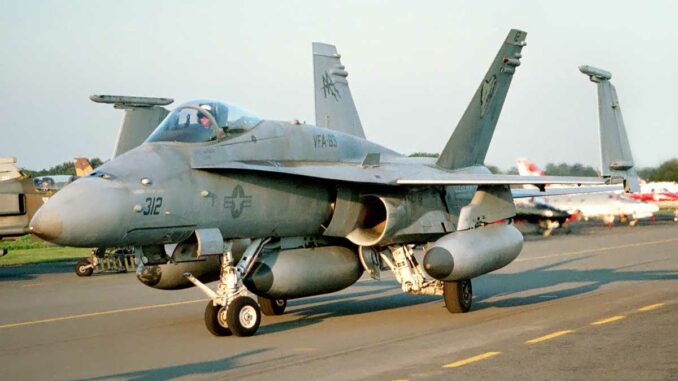
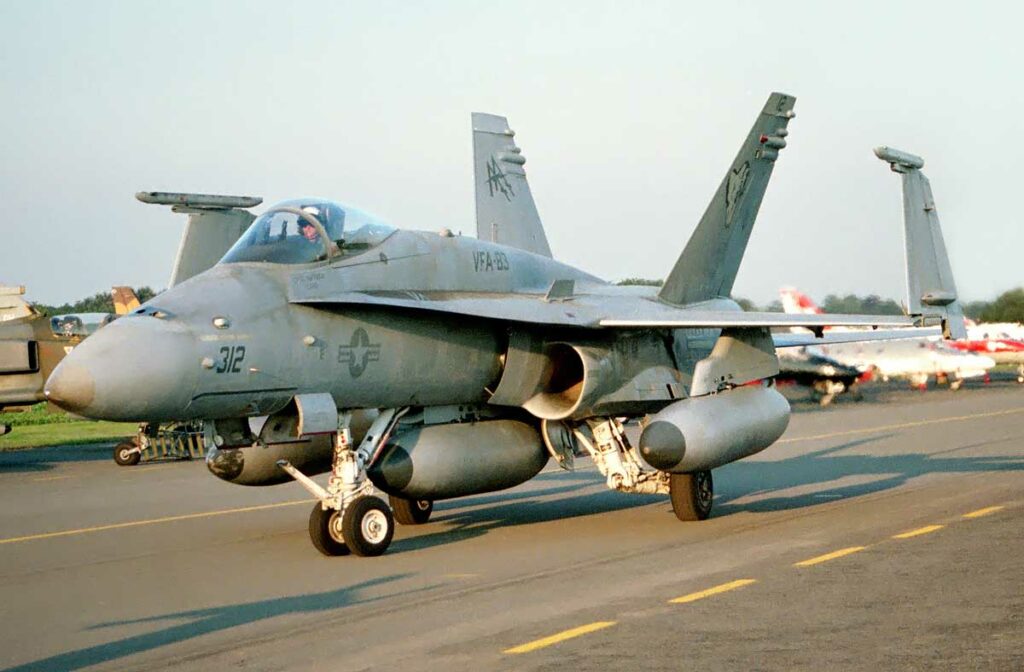
The Marine Corps is retiring its F/A-18C/Ds by 2030 to transition to a fleet of F-35s that are more stealthy, networked, and suited to modern combat.
In summary
The U.S. Marine Corps is accelerating the phase-out of its remaining F/A-18C/D Hornets, with a complete decommissioning of the units still in service targeted for 2030. This decision is not merely administrative. It marks the end of a fighter aircraft that has been central to the Marines’ tactical aviation since the 1980s. The Hornet has served long and well, but it belongs to a generation designed before the era of systematic stealth, data fusion, and highly networked combat. Its replacement relies on the F-35B and the F-35C, two versions of the Lightning II already integrated into the Marine Corps’ air strategy. The goal is clear: to have a fleet with fewer aircraft types but greater performance in contested environments. This transition is costly, but it addresses a stark military reality: in the face of China, modern surface-to-air missiles, and electronic warfare, the aging Hornet no longer offers the same margin for survival.
The retirement of the F/A-18C/D marks the end of an operational cycle
The F/A-18 Hornet has long been one of the pillars of the Marine Corps’ tactical aviation. Entering service in the 1980s, it carried out missions ranging from fighter operations, ground attack, interdiction, close air support, reconnaissance, and forward air control. Its strength lay in its versatility. The same aircraft could carry air-to-air missiles, guided bombs, anti-radar missiles, or maritime attack payloads.
This versatility explains its longevity. The single-seat F/A-18C and the two-seat F/A-18D served with the Marines for several decades, from the end of the Cold War through operations in the Middle East. The aircraft demonstrated its robustness during the Gulf War. It could take off, strike, fight, and return even when damaged. It thus represented a modern response to the dual demands of air combat and attack.
But the airframe is aging. Production of the C/D versions ceased in 2000. The last F/A-18D destined for the Marine Corps was delivered that same year. By 2026, the aircraft still in service will therefore belong to a fleet whose industrial architecture dates back more than twenty-five years. This does not mean they are useless. It means they are becoming more expensive, more demanding to maintain, and less suited to modern threats.
The Marine Corps is not retiring the Hornet because it was a bad aircraft. It is retiring it because the strategic landscape has changed. Contemporary air combat is no longer limited to flying fast, firing from a distance, and carrying bombs. It requires surviving within air defense bubbles, detecting before being detected, sharing data with other platforms, and striking from safer distances.
The F/A-18C/D remains a fourth-generation fighter. The F-35 Lightning II operates under a different logic.
The decommissioning schedule reflects a transition already underway
The Hornet’s retirement will not happen with a single decision. It follows a phased schedule, tied to bases, units, mechanics, pilots, and parts inventories. In May 2026, the Marine Corps issued a directive on the transition of F/A-18-related maintenance specialties. This document confirms that the phased deactivation of F/A-18C/D operations is a central element of the tactical aviation transformation plan.
The timeline is specific. F/A-18 operations at MCAS Beaufort, South Carolina, must cease no later than August 1, 2028. After that date, no F/A-18 maintenance positions are to remain at that base. The western region, centered around MCAS Miramar in California, must follow suit no later than August 1, 2029. The Reserve component, particularly around NAS JRB Fort Worth, must also be included in this phased closure process prior to the fleet’s final decommissioning.
The ultimate goal is clear: to no longer maintain Hornet operational capability beyond fiscal year 2030. This timeline also applies to maintenance specialties. Airframe mechanics, engine technicians, radar technicians, electricians, and specialists in F/A-18 safety equipment must be reassigned to other specialties, with priority given to the F-35 community when skills are transferable.
This human dimension is often underestimated. Retiring an aircraft involves more than just grounding flights. It requires shutting down supply chains, relocating inventory, reassigning personnel, adapting training programs, converting squadrons, and maintaining sufficient operational readiness until the very last day. The final phase of an aging fleet is often the most difficult. The fewer aircraft there are, the more critical each spare part becomes. The fewer squadrons there are, the more technical expertise is concentrated.
The retirement of the F/A-18C/D is therefore as much an act of industrial planning as it is an operational decision.
The choice of the F-35 is driven by the need for survival in a contested environment
Replacing the Hornet with the F-35 is not merely a step up in class. It is a paradigm shift. The F/A-18C/D was designed as a versatile, robust aircraft that is relatively easy to integrate into conventional air operations. The F-35 is designed as a stealthy, connected, and data-centric platform.
The Marine Corps plans to field a fleet of 420 F-35s, comprising 280 F-35Bs and 140 F-35Cs. The F-35B is the short takeoff and vertical landing (STOVL) variant. It allows operations from amphibious ships, rudimentary runways, or forward operating bases. The F-35C is the carrier-based variant, featuring a larger wingspan, reinforced landing gear, and capabilities tailored for carrier-based operations.
This duality aligns with the Marine Corps’ mission. The Corps must be able to support expeditionary forces, operate from the sea, deploy across the Indo-Pacific, and strike from forward bases. In this context, the F-35B is particularly important. It reduces dependence on large air bases, which are easier targets for ballistic or cruise missiles.
The difference from the Hornet is profound. The F-35 is not just a fighter jet. It is a flying sensor. Its AESA radar, infrared systems, passive sensors, and data fusion allow the pilot to receive a more comprehensive tactical picture. The aircraft can detect, classify, share, and exploit information in real time.
This capability changes the aircraft’s value. An F-35 can contribute to a mission even without firing a shot. It can spot a threat, designate a target, relay an air situation, or guide other effectors. In modern warfare, this role as a network node is just as important as its military payload.
The Marine Corps is therefore seeking to replace a combat aircraft with a connected combat platform.
The F-35’s performance goes beyond a simple speed comparison
Comparing the F/A-18C/D and the F-35 solely on speed would be misleading. The Hornet can exceed Mach 1.7. The F-35 reaches approximately Mach 1.6. On paper, the older Hornet is therefore not out of the running. But military performance is no longer measured solely by maximum speed.
The F/A-18C/D is approximately 16.8 meters long, with a wingspan of 13.5 meters. Its maximum takeoff weight is approximately 23,537 kg. It is powered by two General Electric F404-GE-402 turbofan engines, each producing approximately 7,711 kgf of static thrust. It can carry a 20 mm M61 Vulcan cannon, AIM-9 Sidewinder, AIM-7 Sparrow, AIM-120 AMRAAM, Harpoon, HARM, and Maverick missiles, as well as JDAM or JSOW guided bombs.
The F-35 introduces other priorities. Its stealth capabilities reduce the probability of radar detection. Its internal weapon bays allow it to carry weapons while maintaining a low radar signature. Its F135 engine provides high thrust, while its integrated sensors transform the pilot’s workload. The logic is no longer simply to maneuver faster. It consists of seeing before the adversary, engaging before being engaged, and surviving in radar-saturated environments.
The F-35B also provides STOVL capability, which is essential for expeditionary operations. This capability comes at a cost. The vertical takeoff and landing system takes up space and reduces certain performance margins compared to the A and C versions. But for the Marines, the operational advantage is considerable. An aircraft capable of operating from an amphibious ship or a short runway offers a flexibility that the F/A-18C/D cannot provide.
The F-35C, on the other hand, offers superior endurance and is better suited for aircraft carrier decks. Its larger wing improves approach capabilities and fuel capacity. For the Marine Corps, this version allows it to remain integrated with the US Navy’s carrier strike groups.
The real difference therefore lies in stealth, data fusion, and tactical connectivity. On these three points, the Hornet cannot compete.
The Rejection of the Super Hornet Reveals a Strategy Unique to the Marines
A question often arises: why hasn’t the Marine Corps adopted the F/A-18E/F Super Hornet, while the U.S. Navy continues to use it? The answer lies in doctrine, budget, and the desire to avoid an intermediate fleet.
The Super Hornet is not simply a modernized version of the Hornet. It is a larger, newer, and more capable aircraft, with greater range, increased payload capacity, and modernized electronics. For the U.S. Navy, it remains a pillar of carrier strike groups, particularly in missions where the F-35C’s stealth is not essential or when payload capacity is paramount.
For the Marines, the equation is different. Introducing the Super Hornet would have created a new fleet to finance, train, support, and modernize. This would have delayed the transition to the F-35. The Marine Corps therefore preferred to focus its resources on a direct transition to the fifth generation.
This choice is drastic, but logical. A mixed fleet of Hornets, Super Hornets, Harriers, F-35Bs, and F-35Cs would have increased the burden of maintenance, training, and logistics. Yet the Marine Corps seeks the opposite: to reduce the number of aircraft types and enhance interoperability.
The U.S. Navy can afford to extend the Super Hornet’s service life because it has a massive naval aviation structure, nuclear-powered aircraft carriers, and specific missions. The Marines, on the other hand, must adapt their aviation to dispersed operations, forward bases, and warfare in the Pacific. In this context, the Super Hornet would have been an effective but temporary solution. The F-35 is more expensive, but it better aligns with future doctrine.
Budgets reflect a costly but accepted modernization
The transition to the F-35 is not cost-neutral. The F-35 program remains one of the most expensive in U.S. military history. Costs vary depending on batches, engines, equipment, infrastructure, and support contracts. Recent public estimates put the unit cost excluding the engine at around $109 million for the F-35B and around $102 million for the F-35C, with an F135 engine costing approximately $20 million depending on the batch.
The acquisition cost is only part of the story. Maintaining operational readiness is a major burden. The F-35 has faced recurring criticism regarding availability, spare parts, repair times, and support costs. The Government Accountability Office has regularly noted that the three versions of the F-35 do not always meet the availability targets set by the Pentagon.
Let’s be frank: the F-35 is not a cheap solution. It is a solution based on technological superiority. The Marine Corps accepts this cost because it believes that maintaining older aircraft would, in the long run, be less rational. An F/A-18C/D costs less to purchase, since it is already depreciated, but it becomes more expensive to maintain. Spare parts inventories are aging. Structural repairs are increasing. Upgrades are becoming less cost-effective.
The budget trade-off therefore lies between two expenditures: extending a fourth-generation fleet or funding a more modern—but more expensive—fleet. The Marine Corps is choosing the second option.
The budget debate remains open in Washington. For fiscal year 2026, the Pentagon has requested a reduced number of F-35s compared to previous years, while Congress has considered increasing purchases. This tension shows that the F-35 is both indispensable and controversial. Indispensable because it underpins U.S. air power. Controversial because it consumes enormous budgets in an environment where missiles, drones, loitering munitions, and autonomous systems also demand funding.
The Hornet’s retirement accompanies the Marine Corps’ transformation
The phasing out of the F/A-18C/D is part of a broader transformation of the Marine Corps. For several years, the Corps has been reorganizing its forces around competition with China, the Indo-Pacific, distributed warfare, and advanced expeditionary operations.
This transformation is not limited to aircraft. It affects armored vehicles, artillery, drones, anti-ship missiles, communications, and logistics. The Marines want to be able to deploy small, mobile units that are difficult to target and capable of detecting, striking, and moving quickly.
In this strategy, aviation must be more than just conventional air support. It must become a network of sensors and effectors. The F-35 can observe, link forces, transmit data, and strike land or sea targets. This versatility is better suited to future warfare than the more traditional Hornet model.
The integration of new weapons reinforces this logic. The Marine Corps is working to integrate long-range weapons, particularly for maritime strikes. The objective is clear: to enable the F-35B and F-35C to contribute to anti-ship warfare in the Pacific, where distances are immense and large platforms are exposed.
The phasing out of the Hornet is therefore less a reduction than a shift in military strategy. The Marine Corps no longer wants merely aircraft capable of bombing. It wants platforms capable of operating within a distributed combat system.
The old Hornet remains a success, but is no longer a sufficient solution
It would be unfair to portray the F/A-18C/D as an obsolete, worthless aircraft. The Hornet was one of the most useful fighter jets of its generation. Its twin-engine design, ruggedness, versatility, and ability to operate in a variety of environments made it a valuable asset for the Marines.
But an aircraft must be judged against the threats it faces, not just by its historical record. Faced with modern surface-to-air systems, more sensitive radars, long-range missiles, electronic warfare, and space-based surveillance, the Hornet becomes vulnerable. It can still serve in permissive environments. It can still train, deter, and provide support. But it no longer offers the same penetration capability into a defended area.
This is the crux of the matter. The retirement of the F/A-18C/D is not sentimental. It responds to an operational reality. In a high-intensity conflict, the cost of a non-stealth aircraft can be measured in human casualties, canceled missions, and unmet objectives.
The F-35 is not perfect. It is expensive, relies on complex logistics, and remains in the midst of a lengthy modernization process, notably with Technical Refresh 3, Block 4, the APG-85 radar, and the integration of new weapons. But it gives the Marines a far more credible chance to operate in the environments the Pentagon deems the most dangerous.
The Shift to the F-35 Redefines Marine Aviation
The planned retirement of the F/A-18C/D Hornet marks the end of a major chapter in U.S. aviation. It also confirms a clear direction: the Marine Corps no longer wishes to maintain a legacy fleet to preserve historical continuity. It aims to build a tactical aviation force entirely based on fifth-generation aircraft.
This choice carries risks. A fleet centered on the F-35 concentrates dependencies. If the program experiences issues with availability, costs, or software, the impact affects the entire Marine Corps tactical aviation force. The diversity of platforms once offered a form of resilience. Standardization offers power, but it also creates systemic vulnerability.
The Marine Corps is betting that the advantages will outweigh the risks. An F-35B/C fleet promises better interoperability, more consistent logistics, pilots trained on a common system, and increased capability in high-intensity conflicts. It also allows the Marines to better integrate with the networks of the U.S. Navy, the U.S. Air Force, and allies.
The Hornet was the aircraft of an era when mechanical versatility reigned supreme. The F-35 is the aircraft of an era where information, stealth, and networking determine survival. The transition from one to the other reflects a broader transformation: combat aviation is no longer defined solely by what an aircraft can carry, but by what it can see, understand, and share before the adversary.
War Wings Daily is an independant magazine.