The SCAF is entering a critical crisis involving Dassault, Airbus, Paris and Berlin. Can the European fighter jet still survive?
In summary
The Future Combat Air System was meant to embody European military sovereignty. It has instead become a barometer of its contradictions. Launched by France and Germany in 2017, with Spain joining in 2019, the SCAF programme was intended to produce a 6th-generation fighter aircraft, accompanying drones, a combat cloud and a common digital architecture. In May 2026, the project remains officially alive, but its industrial core is at a standstill. Dassault Aviation wants to retain control of the New Generation Fighter, the piloted aircraft. Airbus Defence and Space refuses to be reduced to the role of a subcontractor. Behind this standoff, doctrines diverge. France wants a multi-role aircraft, capable of operating from ships and compatible with its deterrent. Germany wants to keep costs down and no longer needs a nuclear-capable aircraft since opting for the F-35. The crisis is therefore deeper than a governance conflict.
The SCAF programme has become a political test for European defence
The SCAF is not just a fighter aircraft programme. It is a political promise. It was intended to prove that France, Germany and Spain could jointly build a top-tier air capability without being entirely dependent on the United States. It was also meant to provide a European response to the American F-35, the British, Italian and Japanese GCAP, and China’s rapid progress in combat aviation.
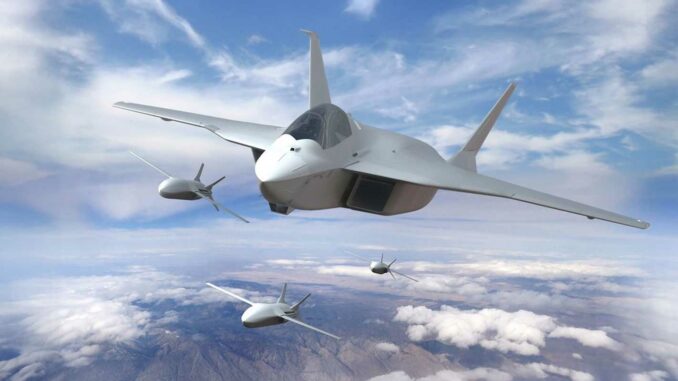
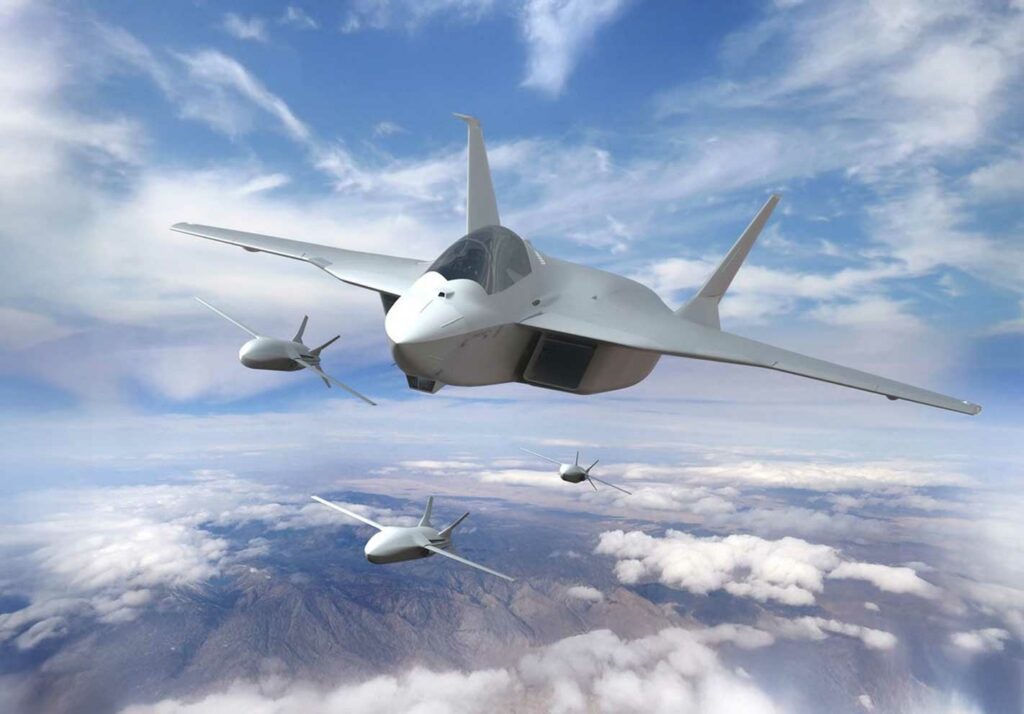
The concept remains ambitious. The SCAF is based on a comprehensive system. At its heart lies the New Generation Fighter, or NGF, a 6th-generation fighter aircraft intended to succeed the French Rafale and the Eurofighter used by Germany and Spain. Operating alongside it will be support drones, known as remote carriers. The whole system must be linked by a combat cloud capable of fusing data, coordinating sensors and sharing the tactical situation between aircraft, drones, satellites, ships and ground forces.
On paper, this architecture meets future needs. Air warfare is no longer fought solely between two aircraft. It is fought between networks. Whoever sees further, transmits faster, jammers better and fires before the other gains the advantage. The SCAF was therefore intended to prepare for the post-Rafale and post-Eurofighter era, with a long-announced entry into service around 2040.
But the current crisis shows that the programme has underestimated a simple reality. A fighter aircraft is not a bureaucratic compromise. It is a doctrine embodied in metal, software and engines. Yet Paris and Berlin do not want exactly the same aircraft.
The industrial disagreement masks a conflict over sovereignty
The most visible deadlock pits Dassault Aviation against Airbus Defence and Space. Dassault is the designated prime contractor for the NGF pillar. The French manufacturer believes that this responsibility must give it effective control over the aircraft’s architecture, technical choices and the selection of subcontractors. Its position is clear: a fighter aircraft is not piloted by a committee.
This demand is not merely a posturing. Dassault designed the Mirage III, the Mirage 2000, the Rafale and their successive variants.
The company knows that the coherence of a fighter aircraft depends on rapid trade-offs between aerodynamics, stealth, propulsion, avionics, payload, maintenance, naval performance and costs. In this field, overly shared governance can kill efficiency.
Airbus sees things differently. The group represents Germany and part of the Spanish interests. It refuses to join a three-way funded programme as a mere contractor. Airbus wants to preserve the industrial balance, the benefits for the German and Spanish ecosystems, and access to critical skills. Its argument is as much political as it is industrial: if Berlin pays a major share of the programme, German industry must have a say in decisions.
This standoff has already caused delays. Phase 1B, announced in December 2022, represents €3.2 billion over approximately three and a half years. It is intended to prepare the demonstrators and mature the key technological building blocks. The next phase was supposed to pave the way for flight demonstrations. Yet decisions are being delayed, deadlines are passing, and confidence is eroding.
France wants an aircraft that Germany does not want to pay for
The most fundamental disagreement is not merely industrial. It is operational. France wants an aircraft capable of doing everything. The future aircraft must replace the Rafale in a wide range of missions: air superiority, conventional strike, long-range penetration, drone command, airborne nuclear deterrence and carrier-based aviation.
This last requirement is crucial. France has confirmed the construction of a new-generation aircraft carrier, often referred to as the PANG, with a target commissioning date of 2038. The vessel is expected to measure approximately 310 metres and displace nearly 80,000 tonnes. It will use electromagnetic catapults and will need to carry Rafale Marine aircraft, followed by a successor capable of operating from a flight deck. A naval aircraft must withstand catapult launch, landing on the deck, salt corrosion and very specific structural stresses. This is expensive. It adds weight. It alters the aircraft’s design.
France also has a nuclear requirement. The Rafale F5 must facilitate the transition to the future ASN4G missile. Ultimately, Paris will need to maintain a sovereign air deterrent capability. This requires highly secure mission systems, communications, penetration profiles, certifications and industrial supply chains. For France, this aspect is non-negotiable.
Germany does not face the same constraint. Berlin has ordered 35 F-35As to replace part of its Tornado fleet and to fulfil NATO’s nuclear sharing mission with American B61 bombs. This decision has changed the equation. For the Luftwaffe, the future European aircraft no longer needs to be designed around the nuclear mission. It can be conceived as an interceptor, a means of achieving air superiority and a networked platform. Germany therefore wishes to avoid funding requirements that primarily serve France.
The problem is stark. France needs a more complex aircraft. Germany needs a more cost-effective aircraft. Spain, for its part, is seeking to preserve its industrial standing without taking the political lead on the issue. This triangle does not produce a clear architecture. It produces a deadlock.
The Rafale-Eurofighter precedent returns to haunt the issue
History is repeating itself almost too well.
In the 1980s, France left the Eurofighter programme to develop the Rafale on its own. Even back then, Paris wanted a lighter, more versatile aircraft, capable of operating from an aircraft carrier and suited to its sovereignty needs. Germany and the United Kingdom favoured a different approach, more geared towards continental air superiority.
Forty years on, the same tensions are resurfacing. The Rafale has ultimately proved the French approach right on one key point: an aircraft designed in line with a coherent national doctrine can endure, evolve and be exported. The Rafale’s recent commercial success has, moreover, put Dassault in a position of strength. The manufacturer is in no rush. It can extend the Rafale F4, develop the Rafale F5 and work on an associated combat drone.
Airbus, for its part, cannot accept seeing Germany fund a programme whose core would largely elude its industry. The group also knows that the post-Eurofighter era will determine its future in combat aviation. If it loses the NGF, it risks becoming primarily a player in systems, drones and cloud computing. This is important, but it is not the same strategic position.
The current crisis is therefore not merely a battle of egos. It is a battle for control of the European fighter aircraft for the next fifty years.
The reconciliation mission resembles a last-ditch mediation effort
Faced with the deadlock, Emmanuel Macron and Friedrich Merz launched a mission in March 2026 to bring Airbus and Dassault closer together. The stated aim was to find common ground and revive an industrial dialogue that had become too contentious. This approach was necessary. But it has come too late.
Public positions have hardened. Dassault is demanding clear direction on the NGF. Airbus is insisting on a balanced partnership. Governments want to save the European symbol, but do not want to pay for an unmanageable programme. The reconciliation mission may produce diplomatic language. It cannot erase the fundamental differences.
The timetable is exacerbating the problem. The SCAF was already due to move towards a more concrete demonstration phase. Every year lost pushes back technological maturity and increases the risk of missing the 2040 deadline. In military aviation, a delay is never just a delay. It drives up costs, demotivates teams, weakens suppliers and pushes the armed forces to seek temporary solutions.
Germany is already looking at the F-35. Airbus is discussing alternative solutions, including a two-aircraft scheme. Dassault knows that a national solution or one extended to other partners could become credible again if the SCAF falls apart. Spain, finally, risks finding itself caught between a more sovereignist France and a more transatlantic Germany.
The German budget could tip the balance of the programme
The SCAF is often presented as a €100 billion programme. This figure encompasses decades of development, production, support and potential upgrades. It provides an order of magnitude, but it does not specify who pays for what, at what pace, or for which configuration.
Germany has entered a phase of accelerated rearmament since the war in Ukraine. But this momentum does not mean that Berlin will sign any old cheque. The Bundestag retains very strong oversight powers. Regional industrial benefits matter. Operating costs matter. Political risks matter too.
Yet the SCAF concentrates several budgetary risks. Naval capabilities primarily serve France. Airborne nuclear deterrence primarily serves France. The Luftwaffe’s requirements for very long-range penetration are not the same. In contrast, the F-35 offers Germany a solution that is already in production, already integrated into NATO and already certified for the missions Berlin must carry out.
This does not mean that the F-35 replaces the SCAF. The F-35 remains an American aircraft, with significant software, industrial and political dependencies. But it reduces the urgency for Germany. This is a decisive point. France has a vital need for a successor to the Rafale for its sovereign missions. Germany has more time and more options.
The two-aircraft scenario would save the system but kill the symbol
Airbus is increasingly advocating the idea that the system must be saved, even if the core aircraft were to be split off. This approach would amount to retaining the drones, the combat cloud, the sensors and certain interoperability standards, whilst accepting two different piloted aircraft.
Technically, this option is not absurd. France could develop a more naval and more sovereign aircraft. Germany and Spain could support a more continental aircraft, possibly closer to Eurofighter requirements or an Airbus architecture. The two aircraft could share communication, mission, simulation and drone modules.
But politically, this would be a major step backwards. The SCAF was intended to embody a common European aircraft. Two aircraft would mean that the countries are cooperating on the ecosystem, but abandoning the central component. This would reduce economies of scale. It would complicate maintenance. It would weaken the message of European sovereignty. It would also create competition between two European products on export markets.
This solution could, however, become the least bad option. In a defence programme, it is sometimes better to salvage a partial architecture than to fund an industrial fiction for ten years. The real danger would be to prolong the deadlock in order to preserve the appearance of unity.
European manufacturers risk falling behind their competitors
The SCAF deadlock has come at the worst possible time. The United States has awarded Boeing the contract to develop the F-47, the centrepiece of the US Air Force’s NGAD programme. The United Kingdom, Italy and Japan are pressing ahead with the Global Combat Air Programme, whose stated objective remains entry into service around 2035. China is accelerating work on the J-20, the J-35A, large stealth drones and mass production. Russia remains weakened, but retains expertise in missiles, air defence and certain areas of electronic warfare.
Continental Europe cannot afford a decade of paralysis. The Rafale and the Eurofighter will remain useful thanks to their upgrades. The Rafale F5 will be a very robust platform. The Eurofighter will continue to evolve with AESA radars, electronic warfare capabilities and new weaponry. But these aircraft will remain platforms designed at the end of the 20th century.
Future air combat will require a distributed architecture. Drones will need to accompany piloted aircraft. Sensors will need to fuse massive amounts of data. Engines will need to provide more electrical power. Aircraft will need to survive in environments saturated with surface-to-air missiles, jammers, cyberattacks and space constellations.
The SCAF was intended to address this transformation.
Today, it risks becoming the opposite example: a strategic ambition that Europe has failed to translate into industrial discipline.
The SCAF may still survive, but not in its current form
The programme is not officially dead. It would even be unwise to write it off too quickly. Governments have already invested, manufacturers have started work, and certain components can move forward. The combat cloud, remote carriers, sensors, simulation and digital architectures retain real value, even if the piloted aircraft is redesigned.
But we must look at the situation frankly. The SCAF as it was originally conceived, with a single common aircraft capable of fully satisfying Paris, Berlin and Madrid, is close to a dead end. Too many requirements diverge. Too much mistrust has built up. Too many players are defending incompatible industrial interests.
Three outcomes are emerging. The first would be a tough political agreement, imposing clear governance, with Dassault as prime contractor for the NGF and Airbus heavily compensated on the other pillars. This option would save the programme, but it would be difficult to sell in Germany. The second would be a redesign involving two aircraft, with a common base of drones, cloud technology and sensors. It would be less symbolic, but more realistic. The third would be a split, with a French project centred on Dassault and a German-Spanish project centred on Airbus or other partners.
The choice is no longer merely technical. It will reveal what European defence is truly capable of. Cooperating on components, yes. Joint procurement, sometimes. Building a single fighter aircraft, with differing national doctrines, is another matter entirely.
The SCAF is therefore entering a make-or-break phase. The coming months will reveal whether Paris, Berlin and Madrid agree to clarify their requirements, budgets and red lines. Without this, Europe will continue to talk about air sovereignty whilst others fly their demonstrators.
Sources
Reuters, Airbus Defence chief rules out total failure of FCAS fighter jet project, 27 May 2026.
Reuters, Airbus reports progress on systems despite FCAS fighter row, 20 May 2026.
Reuters, Fighters can be carved out of FCAS, CEO of Airbus military division says, 21 April 2026.
Reuters, Germany sets mid-April deadline for troubled fighter project with France, 19 March 2026.
Reuters, Dassault CEO says FCAS fighter project “dead” if Airbus refuses to cooperate, 4 March 2026.
Le Monde, French-German fighter jet programme stalls as industrial reality outpaces political ambition, 19 March 2026.
Le Monde, French-German future combat aircraft project on the brink of collapse, 3 October 2025.
Dassault Aviation, Future Combat Air System for Europe: on track for maiden flight, 16 December 2022.
Indra, The launch of Phase 1B of the Future Combat Air System consolidates the largest European defence programme under Indra’s leadership in Spain, 15 December 2022.
Reuters, France to build new aircraft carrier, Macron tells troops based in the Gulf, 21 December 2025.
Le Monde, For the future French aircraft carrier, Macron announces new ship “in an era of predators”, 23 December 2025.
Reuters, Germany seeks more F-35 jets as European fighter programme falters, 19 February 2026.
Reuters, Germany plans to order 15 more US-made F-35 jets, 20 October 2025.
Reuters, Germany looking into buying eight additional F-35 jets, 7 June 2024.
Ministry of the Armed Forces, documents and communications on the Rafale F5, the SCAF and the next-generation aircraft carrier.
War Wings Daily is an independant magazine.