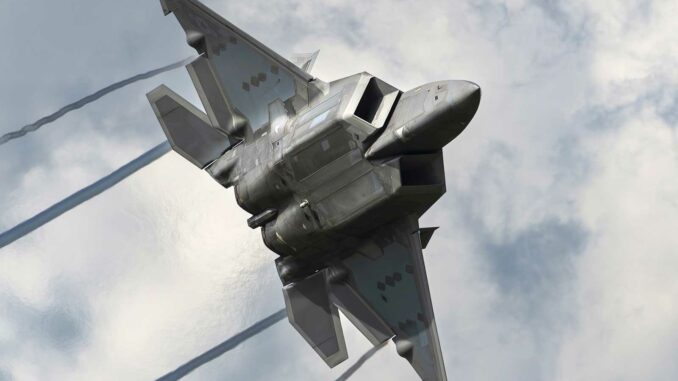
Supercruise allows fighter jets to fly at supersonic speeds without using afterburners, providing a major tactical advantage in range and stealth.
Summary
Supercruise refers to a fighter jet’s ability to maintain supersonic flight without using afterburners. This technology is not just about going fast. It allows aircraft to fly fast for longer periods, using less fuel, generating a lower infrared signature, and offering greater tactical range. The F-22 Raptor is the most accomplished example, capable of speeds exceeding Mach 1.5 without afterburners. The Rafale, Eurofighter Typhoon, and Gripen E also possess partial or operational supercruise capabilities depending on their payload configuration, altitude, and mission. Supercruise relies on a demanding balance between the engine, aerodynamics, air intakes, weight, drag, and thermal management. It enables faster interceptions, more offensive patrols, and better survivability. However, it remains rare because it forces heavy trade-offs right from the aircraft’s design stage.
Supercruise Redefines Useful Speed
The word supercruise is often misunderstood. Many fighter jets can exceed Mach 1, but most do so using afterburners. Supercruise refers to something else: maintaining supersonic speed on dry thrust—meaning without injecting extra fuel into the exhaust nozzle behind the turbine.
The difference is major. An afterburner provides massive thrust by burning fuel in the exhaust flow. It allows for short takeoffs, rapid acceleration, steep climbs, or quick escapes. However, it consumes an enormous amount of fuel. It also significantly increases the aircraft’s infrared signature, turning it into a highly visible target for thermal sensors and certain air-to-air missiles.
Supercruise therefore targets useful speed, not just maximum speed. An aircraft capable of supercruise can reach an area faster, intercept targets further away, fire weapons with more initial kinetic energy, or reposition itself without emptying its tanks. It retains a portion of its thermal stealth and reduces its dependence on refueling tankers. In modern warfare, this is a decisive advantage.
The nuance is important. An aircraft can sometimes remain briefly above Mach 1 without afterburners after initially accelerating with them. This is not necessarily supercruise in the strictest sense. The true capability consists of maintaining sustained, stabilized supersonic flight with a credible combat payload for an operationally useful duration. For this reason, the F-22 remains the benchmark. It was designed from the very beginning around this requirement.
Afterburners Explain Why Supercruise Is So Highly Sought After
To understand supercruise, one must understand afterburners. In a military turbojet or turbofan engine, air is compressed, mixed with fuel, burned, and then expelled at high speed. An afterburner adds a second fuel injection into the nozzle, behind the turbine. The exhaust flow there still contains enough oxygen to support combustion, causing thrust to increase rapidly.
The problem is efficiency. The engine’s core combustion process is highly optimized, but the afterburner is far less so. It produces high thrust, but at the cost of disproportionate fuel consumption. In air combat, just a few minutes of afterburner use can drastically reduce an aircraft’s remaining range. For a pilot, this forces a brutal trade-off: accelerate now or save fuel to fight, return to base, bypass threats, or loiter.
Supercruise bypasses part of this constraint. It requires an engine capable of providing enough dry thrust to break through and then maintain supersonic speeds. It also requires an airframe that generates very low drag at high speeds. Both conditions are indispensable. A powerful engine is not enough if the aircraft creates too much drag, and a sleek airframe is useless if it lacks sufficient dry thrust.
This technology also reduces the aircraft’s infrared signature. An engine running on dry thrust still gets hot, but it does not produce the intense flame of an afterburner. In an airspace saturated with infrared sensors, this difference matters. Supercruise does not make the aircraft invisible, but it makes its acceleration less costly and far less obvious.
The Engine Must Produce Exceptional Dry Thrust
The core of supercruise lies in the relationship between thrust, weight, and drag. A fighter must produce enough thrust without afterburners to overcome air resistance above Mach 1. This resistance increases sharply with speed, especially in the transonic zone, around Mach 0.8 to Mach 1.2. This is where shockwaves appear and drag spikes.
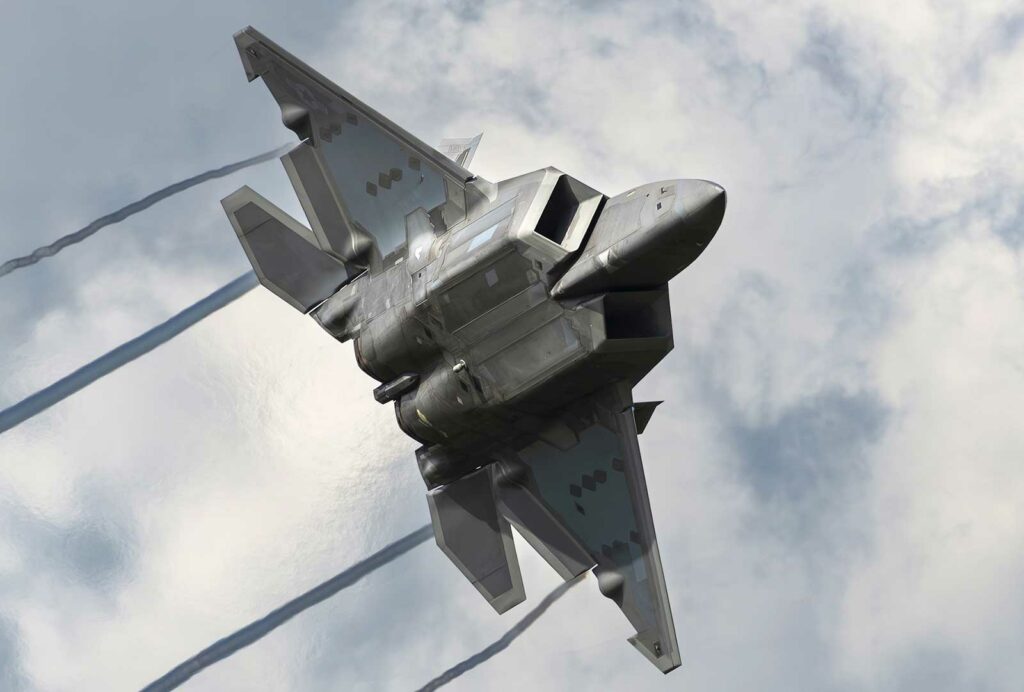
The F-22 Raptor was designed with two Pratt & Whitney F119 engines. Each engine belongs to the 156 kN (approximately 35,000 pounds) thrust class with afterburners. However, its primary value is its high dry thrust, which allows the F-22 to fly above Mach 1.5 without using afterburners. The U.S. Air Force notes that the combination of aerodynamics and thrust allows the Raptor to cruise at speeds exceeding Mach 1.5 without afterburners.
The F119 engine also integrates a two-dimensional thrust-vectoring nozzle. This nozzle improves maneuverability, but it also contributes to the aircraft’s overall control at high speeds and high angles of attack. The F-22 is not just fast; it combines speed, altitude, stealth, and maneuverability.
The Rafale operates with two Safran M88 engines. Each engine delivers about 50 kN of dry thrust and 75 kN with afterburners. The M88 is more compact than the F119 because the Rafale is a lighter aircraft. Dassault lists an empty weight of approximately 10 tonnes, a maximum takeoff weight of 24.5 tonnes, and an external payload capacity of up to 9.5 tonnes. The Rafale can achieve supercruise in certain air-to-air configurations, but its performance depends heavily on external stores.
The Eurofighter Typhoon uses two Eurojet EJ200 engines. Its highly optimized aerodynamic architecture and high thrust-to-weight ratio also allow it to fly at supersonic speeds without reheat for extended periods. The Eurofighter consortium highlights this capability as a key asset of the aircraft. Meanwhile, the Gripen E uses a single General Electric F414G engine. Saab demonstrated a supercruise capability as early as 2009 on the Gripen Demo, reaching speeds exceeding Mach 1.2 at an altitude of 8,540 meters.
Aerodynamics Play as Big a Role as Power
Supercruise is not just a matter of engine power; aerodynamics are equally decisive. At supersonic speeds, shockwaves, form drag, wave drag, and airflow disruptions around the air intakes become central issues. A poorly designed aircraft can have massive thrust and still be incapable of efficiently maintaining supersonic flight without afterburners.
The air intakes are a critical point. A jet engine cannot directly swallow supersonic airflow into its compressor. The air must be slowed down before entering the engine. On a supersonic aircraft, the air intakes must therefore manage shockwaves to slow the airflow with the least possible loss of energy. A poorly adapted intake can cause pressure drops, airflow instabilities, and a loss of engine thrust.
The F-22 illustrates this integration. Its air intakes are fixed, stealthy, and shaped to feed the engines efficiently at high speeds while minimizing the aircraft’s radar cross-section. The trade-off is delicate: an air intake highly optimized for supersonic flight is not always the most radar-discreet. The F-22 manages to combine both better than previous generations of aircraft.
The Rafale and Eurofighter follow a different logic. They are not all-aspect stealth aircraft like the F-22. However, their airframes are very sleek, compact, and optimized for combat. Their delta-canard formula provides excellent lift, high maneuverability, and rapid acceleration. On the other hand, external payloads severely penalize supercruise. Every missile, fuel tank, pod, or bomb creates drag. The more external stores the aircraft carries, the more it loses its ability to maintain supersonic speed without afterburners.
This is one of the reasons why stealth and supercruise complement each other so well. A stealth aircraft carries its weapons internally, keeping its airframe clean, minimizing drag, and protecting its low radar signature. The F-22 benefits fully from this logic. A Rafale or an Eurofighter can supercruise in certain configurations, but they lose this advantage when loaded with heavy external payloads.
Development Required Several Decades of Work
Modern supercruise did not appear overnight. It is the result of several decades of research into engines, materials, flight controls, and supersonic airframes.
Supersonic aircraft of the 1950s and 1960s depended heavily on afterburners. The Mirage III, F-104 Starfighter, MiG-21, and F-4 Phantom II could all go fast, but their supersonic speed was highly expensive in terms of fuel. They were designed for interception, rapid climbs, or short dogfights, not for economical supersonic cruise.
The real American turning point came with the Advanced Tactical Fighter program launched in the 1980s. The U.S. Air Force wanted to replace the F-15 with an aircraft capable of stealth, supercruise, high maneuverability, and sensor fusion. The YF-22 and YF-23 demonstrators flew in 1990, the F-22 made its first flight in 1997, and it entered operational service in 2005. It therefore took about twenty-five years from the initial core requirements to the arrival of a fully operational fighter.
In Europe, development followed a parallel trajectory. The Rafale A first flew in 1986, and the M88 engine was qualified in 1996, with the first operational standards arriving in the early 2000s. The Eurofighter Typhoon stemmed from work begun in the 1980s with the EAP demonstrator, followed by a first flight of the Typhoon in 1994 and its entry into service in the 2000s. The Gripen E is newer; the Gripen Demo flew in 2008 and demonstrated its supercruise capability in 2009.
This lengthy timeline demonstrates a simple reality: supercruise cannot just be added at the end of a program. It must be integrated from the very start. It dictates the choice of engine, the shape of the airframe, the weight distribution, fuel management, air intake design, and weapons integration. An aircraft can be modernized, but it cannot become a true supercruiser through a simple software update.
Supercruise Capabilities Differ Across Platforms
The F-22 remains the clearest example. It exceeds Mach 1.5 without afterburners while carrying an internal air-to-air payload, preserving its stealth, speed, and relative range. This is the strictest definition of modern military supercruise.
The Eurofighter Typhoon can also fly supersonic without reheat. Depending on the configuration, altitude, and payload, its reported supercruise speeds usually hover around Mach 1.3 to Mach 1.5. Its advantage stems from its lightweight airframe, its twin EJ200 engines, and its excellent thrust-to-weight ratio. It is not stealthy like an F-22, but it retains exceptionally high kinematic performance.
The Rafale possesses a more conditional supercruise capability. The M88 engine allows for supersonic cruise in an optimized air-to-air configuration, with open-source data generally citing speeds around Mach 1.4 with a limited payload. However, accuracy requires a distinction: when loaded with heavy fuel tanks, bombs, pods, or configured for penetration missions, supercruise is no longer feasible. The Rafale remains highly capable, but its multirole architecture prioritizes a balance between air-to-air, air-to-ground, deep penetration, nuclear strike, and carrier-based operations.
The Gripen E falls into a lighter category. The Gripen Demo’s performance above Mach 1.2 without afterburners proved that Saab mastered this capability. However, the Gripen is not a miniature F-22. Its value lies elsewhere: lower operating costs, simpler maintenance, the ability to disperse and operate from highways, modern sensors, and seamless integration into a robust national network.
Other aircraft are occasionally mentioned. The F-35 can maintain certain supersonic speeds briefly without afterburners after initial acceleration, but it is not generally considered a true supercruise aircraft. The Russian Su-57 and the Chinese J-20 are associated with supercruise ambitions, but public data remains more uncertain. Caution is necessary; performance announcements do not always equate to a confirmed operational capability with a realistic mission profile, fuel load, and weaponry.
Supercruise Primarily Serves Interception and Air Superiority Missions
The most obvious use of supercruise is interception. A fighter that can fly fast without afterburners covers a given distance more quickly while preserving its fuel. It can reach a bomber, a reconnaissance aircraft, a cruise missile, or an opposing patrol with more tactical margin.
In air superiority missions, supercruise also provides a major kinetic energy advantage. An air-to-air missile fired from a fast, high-altitude platform starts with higher initial energy, which increases its effective range and creates a more favorable firing envelope. The firing fighter can remain further away or force the adversary to react much sooner.
The F-22 was designed exactly for this. It can penetrate airspace discretely, fly fast, detect targets, fire, and reposition before the adversary fully understands the situation. Its supersonic cruise speed reduces its exposure time and allows it to rapidly shift its axis of attack.
Supercruise also serves the air defense of vast territories. For a Nordic nation, a Gulf state, or a Pacific power, distances matter. Reaching an interception zone without burning through all available fuel is a real asset. Refueling tankers are not always available, and in high-intensity conflicts, they are highly vulnerable. Anything that reduces dependence on aerial refueling increases freedom of action.
Aerial Strategy Gains in Tempo and Depth
The true value of supercruise lies in tempo. An aircraft that is faster without afterburners imposes a higher operational rhythm. It can arrive sooner, leave faster, and return from further away. In an air campaign, these saved minutes can decide the outcome of an interception, a missile strike, or a tactical withdrawal.
Supercruise also supports penetration missions. A stealth aircraft flying slowly can remain exposed for a long time, but a stealth aircraft utilizing supercruise drastically reduces that window. It transits through zones covered by radars and missile batteries much faster, all while maintaining a low radar cross-section and a far lower infrared signature than it would using afterburners. This is a rare and powerful combination.
This capability also benefits counter-A2/AD operations. Facing an air defense bubble requires striking fast, shifting attack axes, avoiding dense defensive zones, and coordinating missile launches. Supercruise allows forces to add operational mobility without paying the full fuel penalty of afterburner use.
However, it does not solve every problem. An aircraft in supercruise still consumes more fuel than it would in an economical subsonic cruise. It also generates a sonic boom, which limits its use over certain areas in peacetime. It requires expensive engines, an optimized airframe, and demanding maintenance. It is not indispensable for every mission; for long-endurance patrols, close air support, or heavy strike missions, sustained supersonic speed can be secondary.
Supercruise is therefore a technology designed for air dominance, not a universal utility. It delivers the most value in missions where speed, range, and thermal stealth must combine: interception, air-to-air combat, deep penetration, the protection of strategic assets, and the opening phases of an air campaign.
Supercruise Will Remain Rare but Central to Future Fighters
Future 6th-generation combat aircraft will likely place supercruise at the very heart of their architecture. The American NGAD, the British-Italian-Japanese GCAP, and the European FCAS will all need to fly far and fast while operating alongside accompanying drones. They will also need to produce massive amounts of energy for their sensors, electronic warfare suites, and data links. The engine will no longer just be a provider of thrust; it will become a power generator, a thermal management tool, and a core element of the aircraft’s stealth design.
The next step will be more difficult than what was achieved with the F-22. It will not be enough to simply fly at Mach 1.5 without afterburners. Aircraft will have to do so while running active sensors, coordinating drones, maintaining discrete data links, carrying large internal payloads, and remaining maintainable at an acceptable cost. The bar will be set much higher.
China is also working along this path with its next-generation programs. The J-20 has already shown the importance of range and long-distance missiles. Prototypes attributed to Chengdu and Shenyang appear to go further, featuring tailless airframes and a heavy focus on stealth and network-centric warfare. Supercruise will likely hold an important place in these designs, even if true performance metrics remain unconfirmed.
The reality is clear. Air forces are no longer just looking for the fastest plane. They are looking for an aircraft capable of going fast without giving itself away, without emptying its fuel tanks, and without depending on vulnerable support assets. This is exactly what supercruise promises. It will not win a war on its own, but it gives the world’s best fighter jets a rare and vital asset: a head start.
War Wings Daily is an independant magazine.