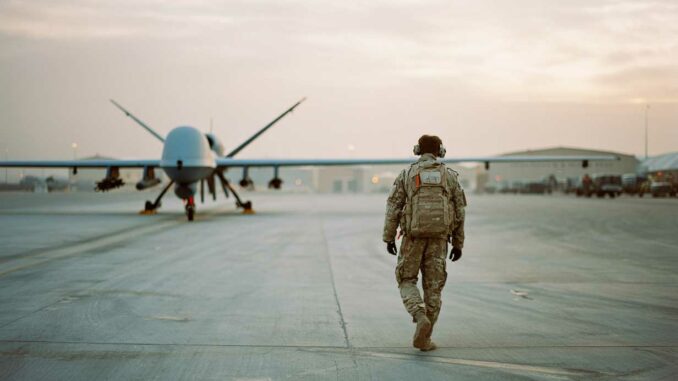
Faced with a lack of pilots, air forces are accelerating AI autonomy and drone integration to preserve their combat mass.
Summary
The pilot shortage is becoming one of the most serious vulnerabilities in military aviation. It affects the United States, several European countries, and regional powers that must sustain more missions with fewer qualified personnel. Training a fighter jet pilot is expensive, takes several years, and requires a volume of flight training that many militaries struggle to guarantee. In parallel, fleets are aging, maintenance costs are rising, and the Chinese threat demands greater mass. Armed drones, MALE systems, loitering munitions, and Collaborative Combat Aircraft are therefore becoming a structural answer. They do not replace the pilot. Instead, they shift a portion of the risk, endurance, and saturation requirements to unmanned platforms. The United States, the United Kingdom, Australia, Israel, Turkey, India, and France are each moving forward with their own priorities, budgets, and constraints.
The Pilot Shortage Weakens Modern Air Power
Military aviation relies on a simple truth: a combat aircraft only has value if a qualified crew can operate it. Yet this resource is becoming scarce. The pilot shortage is no longer just a human resources difficulty; it is becoming an operational problem.
In the United States, the U.S. Air Force has suffered from a chronic deficit for over a decade. In 2024, the shortage was estimated at around 1,850 pilots, including more than 1,100 fighter pilot positions. This is a heavy deficit. It means the most powerful air force in the world struggles to fill its units with the expected level of experience. The situation is aggravated by aging fleets, squadron closures, maintenance backlogs, and competition from commercial aviation.
The problem is not uniquely American. The United Kingdom has also experienced severe strain in its pilot training pipeline. Several parliamentary reports and press investigations have highlighted significant delays in the training pipeline. Training a fighter pilot requires instructors, training aircraft, simulators, fuel, flight hours, and slots in operational conversion units. When one link slows down, the entire chain stalls.
France faces a different but related constraint. The French Air and Space Force maintains a high-level combat aviation capability, but with a streamlined fleet. Its Rafale fighters are in high demand, balancing the nuclear deterrent, air policing, overseas deployments, training, and NATO missions. Pressure bears down as much on the crews as it does on technical availability. In this context, drones are not a luxury; they become a means to preserve pilots for the most complex missions.
The situation is clear: air forces can no longer solve their mass dilemma using manned aircraft alone. Modern fighters cost too much, pilots take too long to train, and missions are multiplying. This is precisely where AI autonomy changes the calculation.
AI Autonomy Does Not Replace the Pilot, It Changes Their Role
The term AI autonomy is often misinterpreted. It does not mean that militaries want to hand over aerial warfare to machines without control. It means that a portion of pilot, navigation, surveillance, detection, or coordination tasks can be delegated to automated systems.
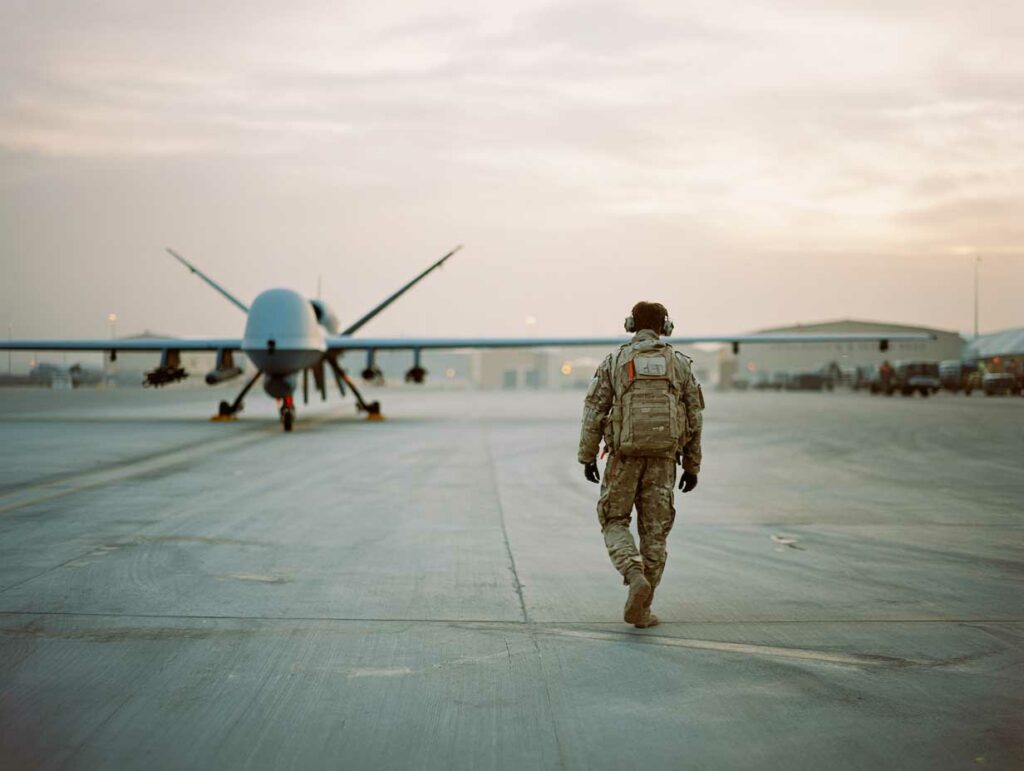
In a MALE drone like the MQ-9 Reaper, the crew remains human. They pilot remotely, manage sensors, and apply the rules of engagement. In more advanced combat drones, autonomy goes further. The system can follow a route, avoid a threat, maintain formation, fuse data, propose a flight path, or execute a defined mission with minimal human intervention. The decision to fire generally remains tightly bound to a human operator, especially in Western militaries.
This distinction is crucial. Autonomy does not eliminate labor; it transforms it. A single pilot or operator can supervise multiple systems. A crew can manage a long surveillance mission without exposing a manned aircraft. A fighter pilot can command accompanying drones. The workload shifts from direct piloting to tactical supervision.
The objective is twofold. First, pilots must be economized. A drone can remain airborne for hours to monitor an area, track a convoy, intercept radar emissions, or provide live video feeds. Second, combat mass must be increased. A country that cannot produce enough pilots can still multiply its sensors, relays, and effectors thanks to unmanned platforms.
However, this transition creates new requirements. It demands operators, intelligence analysts, software engineers, cyber specialists, drone mechanics, mission controllers, and electronic warfare experts. The pilot shortage does not disappear; it transforms into a competition for digital skillsets.
The United States Aims to Rebuild Mass Facing China
The U.S. Air Force represents the most defining case. It is not developing drones simply to save on pilots; it is preparing an aerial warfare architecture to face China. The Indo-Pacific theater imposes immense distances. American bases are remote, and refueling tankers are vulnerable. China possesses a dense air defense network, long-range missiles, and a rapidly modernizing combat air fleet.
In this framework, Collaborative Combat Aircraft, or CCA, have become a top priority. The USAF designated its first two prototypes in 2025: the General Atomics YFQ-42A and the Anduril YFQ-44A. These autonomous combat drones are intended to accompany F-35s, F-22s, and eventually the future F-47. They will be able to carry sensors, jammers, or munitions. They can also serve as decoys or absorb risks in place of a manned aircraft.
The budget demonstrates the program’s seriousness. The USAF requested nearly $1 billion to begin procurement of the first CCAs in the fiscal year 2027 budget, alongside approximately $1.37 billion in additional research and development. The total request for the program neared $2.37 billion. Back in 2023, budget documents already projected around $5.8 billion in development funding over five years.
The logic is clear. An F-35 or a future F-47 is highly expensive and requires a highly trained pilot. A CCA must cost significantly less while adding missiles, sensors, and tactical depth. The USAF has long referenced a baseline goal of around 1,000 CCAs, based on a planning factor of two drones for every 500 advanced fighters. Even if this volume changes, it points the way forward: creating affordable mass.
This approach directly addresses the pilot shortage. It is not about replacing a pilot with a drone. It is about giving a pilot multiple wingmen. A single manned fighter could control or supervise several autonomous platforms. This increases military effect without multiplying the number of exposed crews.
The United Kingdom Uses Drones to Protect Manned Fighters
The United Kingdom is moving forward with a more targeted logic. The Royal Air Force introduced StormShroud in 2025 as the first platform in a new family of Autonomous Collaborative Platforms. The system is based on a Tekever AR3 drone equipped with Leonardo UK’s BriteStorm electronic warfare payload. Its mission is precise: disrupt adversary radars and protect Typhoons and F-35Bs in contested airspace.
This choice is telling. The RAF is not starting with a supersonic combat drone or a fighter equivalent. It is starting with a utility platform that is available and directly integrable. StormShroud does not replace a Typhoon pilot; it reduces the risk hanging over that pilot. It can fly ahead, jam a radar, create confusion within the opposing defense network, and improve the survivability of a strike package.
The budget is modest compared to American programs. Open-source estimates cite an initial fleet of about 24 drones for an investment close to £19 million. This amount is low on the scale of military aviation programs, but it illustrates a change in mindset. Western militaries are no longer pursuing solely rare, perfect platforms. They are also looking for systems that are fast to deploy, useful, and scalable.
The RAF published a dedicated strategy for Autonomous Collaborative Platforms in 2024. It aims to integrate these systems into the frontline force by the end of the decade. The British message is pragmatic: before dreaming of a fully autonomous fighter, air forces must deploy drones that protect existing aircraft. This is a direct response to the scarcity of pilots and combat airframes.
Australia Transforms the MQ-28 Ghost Bat into a Sovereign Tool
Australia offers another important example. The MQ-28A Ghost Bat, developed by Boeing Defence Australia with the Royal Australian Air Force, is one of the most advanced loyal wingman drone programs outside the United States. It is designed to operate with Australian F-35As, F/A-18F Super Hornets, and EA-18G Growlers.
The Ghost Bat responds to a geographical constraint. Australia must monitor and defend an immense territory with a limited population and a restricted pilot base. It cannot simply multiply its fighter squadrons. It must extend the range and mass of its aviation capability with unmanned systems.
The program has received significant budgetary support. In December 2025, the Australian government announced approximately AUD 1.4 billion to advance the MQ-28A toward an operational capability. Boeing also received an AUD 754 million contract to deliver, develop, and support a third batch of seven aircraft. Prior investments already amounted to several hundred million dollars.
The Ghost Bat also crossed a symbolic milestone with an air-to-air live fire trial. The aircraft launched an AIM-120 AMRAAM missile against an aerial target during a test. This type of trial demonstrates that the drone is no longer just a flying sensor; it is becoming a potential effector in air combat.
Australia is not just trying to close a pilot shortage. It wants to create a sovereign industry. The Ghost Bat is billed as the first military aircraft designed and produced in Australia in over 50 years. Military logic and industrial logic converge: reduce dependence on scarce crews, reduce absolute dependence on imports, and create an exportable capability.
Israel Demonstrates Drone Efficiency in Permanent Warfare
Israel is one of the countries that utilizes military drones most intensively. Its air force operates platforms like the Heron TP (called Eitan), the Hermes 450, and the Hermes 900, alongside other smaller systems. Israeli drone use is primarily focused on intelligence, surveillance, target acquisition, and strikes when configurations allow.
The Israeli operational logic is highly concrete. The country must continuously monitor multiple fronts, detect rocket launches, track armed groups, support ground forces, and maintain an uninterrupted operational picture. A drone can loiter over an area for long periods, provide real-time video, and reduce the need to send a manned aircraft on a repetitive or risky mission.
In 2026, Israeli media reported the creation of a new Heron squadron, with aircraft estimated at around $10 million each, excluding specific payloads. Other sources mention around 20 Heron Mk IIs in an agreement aimed at reinforcing capabilities facing Iran. Budgetary details often remain incomplete, but the order of magnitude is telling. For the price of a fraction of a modern fighter, a military can obtain a platform capable of persistent surveillance that relieves manned aviation units.
Israel illustrates a fundamental difference. Drones do not only serve in a high-intensity war between major powers; they also serve in a daily intelligence war. They prevent the exhaustion of pilots and fighter jets on persistent monitoring, observation, and targeting missions.
Turkey Relies on Drones to Bypass Manned Aviation Limits
Turkey has turned drones into a strategic instrument. The TB2 marked conflicts in Ukraine, Libya, Nagorno-Karabakh, and Syria. The Akıncı has moved upmarket with a heavier payload, more powerful sensors, and broader strike capabilities. The Kızılelma program goes even further, aiming for a jet-powered combat drone capable of air-to-air and air-to-ground missions.
Baykar announced a successful air-to-air live fire by the Kızılelma in 2025, using a Gökdoğan missile against an aerial target. The program has also tested autonomous formation flights with multiple prototypes at very close ranges—around 15 to 20 meters according to several open-source analyses. These trials show that Turkey is already working on teaming between unmanned platforms.
The overall Turkish defense and security budget has risen sharply. Open-source estimates for 2026 suggest around TRY 2.15 trillion, or roughly $27 billion, for the combined defense and security sector. Baykar is also investing directly in its critical technologies. In 2024, the company announced a $300 million investment over five years to develop its own engines, notably for the Akıncı and Kızılelma.
Turkey is thus responding to several constraints. It wants to reduce its dependence on foreign suppliers, compensate for the limits of its manned fleet, and expand exports. The drone becomes an operational weapon, an industrial lever, and a diplomatic tool. Here too, manpower plays a role. Training fighter pilots takes time; producing and exporting drones allows air power to expand faster.
India Accelerates Procurement Under Regional Pressure
India illustrates another dynamic. It faces two nuclear-armed adversaries, China and Pakistan, along very different borders. It must monitor the Himalayas, the Indian Ocean, deserts, and high-tension zones. This geography makes drones invaluable.
In June 2026, Reuters reported that India was preparing a defense order worth over $2 billion for military drones from domestic manufacturers. Deliveries could take place within 18 to 24 months under fast-track procurement procedures. This order would follow recent acquisitions totaling around 30 billion rupees, or approximately $313 million, for tactical drones.
India already operates Heron drones of Israeli origin and is developing its own solutions. It is also working on teaming concepts, notably around Hindustan Aeronautics Limited’s Combat Air Teaming System, with the CATS Warrior project. The goal is to accompany future Indian combat aircraft, including the AMCA, with unmanned platforms capable of reconnaissance, jamming, or strikes.
The Indian case demonstrates that drones do not merely respond to a pilot shortage in the strictest sense. They also address a coverage deficit. No country can place manned aircraft everywhere, all the time, along such vast borders. Drones extend the aerial presence without multiplying the number of fighter crews.
France Navigates Between US Reliance and Industrial Catch-Up
France has long maintained excellence in manned combat aviation but fell behind in MALE drones. The procurement of American MQ-9 Reapers in 2013 was intended as a temporary solution, but it turned into a lasting dependence. French Reapers were heavily utilized in the Sahel for surveillance, intelligence, and strikes, saving flight hours on manned aircraft and maintaining a persistent presence over vast areas.
The problem is both industrial and strategic. The Eurodrone program has experienced significant delays, with deliveries now expected around 2030 or 2031 according to open-source records. Faced with this timeline, France launched a low-cost national MALE demonstrator initiative in 2025, allocating less than €10 million in grants to several industrial players, including Turgis Gaillard, Aura Aero, Daher, Fly-R, and SE Aviation. The goal is to move fast, with flight tests expected as early as 2026 for some projects.
This sum is small and will not create a complete industry on its own. However, it marks a shift in culture. France understands that the war in Ukraine has changed the equation. Drones must be more numerous, faster to produce, simpler to upgrade, and less precious than major manned systems.
France is also preparing the FCAS, in which remote carriers are intended to accompany the future combat aircraft. This logic mirrors that of the American CCAs. The pilot will remain at the center, but they will command a network of remote effectors. The challenge will be ensuring they do not arrive too late.
The Real Challenge Becomes Training New Professions
The shift toward drones does not eliminate human needs; it creates an entirely new chain of professions. Militaries will need to train drone operators, autonomy supervisors, imagery analysts, data link specialists, composite airframe mechanics, cyber experts, and planners capable of integrating swarms into an air campaign.
This transformation can relieve the pilot shortage because it reduces the requirement for a certified pilot in every cockpit. However, it can also create a different kind of shortage. Skills in software engineering, cyberdefense, and artificial intelligence are already in high demand in the civilian sector. Militaries will therefore have to attract, train, and retain these profiles.
The issue of trust is also central. A pilot knows what their human wingman is doing; they understand their reactions, training, and limits. With an autonomous drone, that relationship changes. The pilot must understand what the machine sees, what it proposes, and what it fails to comprehend. If the interface is poorly designed, autonomy will add to the cognitive workload. If it is well-designed, it will provide a decisive advantage.
Budgets will also have to keep pace. Buying a drone is only the beginning. It requires ground stations, simulators, communications infrastructure, spare parts, sensors, munitions, software, and regular updates. A military that underfunds these elements will end up with a technological showcase rather than a true combat capability.
Manpower Dictates a New Air Strategy
The pilot shortage is forcing air forces to review their model. For decades, air power relied on ever-higher-performing aircraft flown by highly qualified crews. This model remains indispensable for the most demanding missions, but it is no longer sufficient. Fleets are too expensive, pilots are too scarce, and threats are too numerous.
Drones and AI autonomy provide a credible answer. They make it possible to monitor longer, strike with less human risk, saturate defenses, protect fighters, multiply sensors, and accompany manned aircraft. The United States is betting on CCAs to face China. The United Kingdom is deploying StormShroud to jam adversary radars. Australia is turning the Ghost Bat into a sovereign capability. Israel uses drones as a permanent intelligence tool. Turkey is building an export industry around combat drones. India is accelerating its purchases, and France is attempting to catch up.
The movement is irreversible, but it must be understood without naivety. Drones are not magic. They can be jammed, shot down, hacked, or poorly utilized. They demand robust networks and competent operators. They raise legal and political questions as they move closer to the decision to fire. Yet, they answer a constraint that no one can ignore: no modern air force will have enough pilots for every future scenario.
The future of military aviation will therefore not be pilotless; it will be hybrid. The best pilots will command larger numbers of systems. Drones will take on long, dangerous, or repetitive missions. Artificial intelligence will help sort data and accelerate decisions. Air superiority will belong to the forces capable of combining man, machine, and network without losing political control over the use of force.
War Wings Daily is an independant magazine.