Following the failure of FCAS, Berlin is looking for an alternative between GCAP, the F-35, drones, and limited cooperation with France.
In Summary
The end of the SCAF/FCAS manned fighter does not merely terminate an industrial program. It opens a major reorganization of European air defense. Germany no longer wishes to confine itself to a project it deems unmanageable with Dassault and France. Berlin is now seeking more targeted, more realistic collaborations: data networks, combat cloud, drones, software, air defense, and connected combat architectures. Meanwhile, calls are mounting for Germany to join GCAP/Tempest, the program led by the United Kingdom, Italy, and Japan, with a target date around 2035. This path would offer a more advanced solution than FCAS, but it would force Berlin to accept a role already negotiated by others. Above all, the crisis reveals a structural European weakness: national defense contractors want to cooperate, but rarely want to cede control.
The post-FCAS era forces a brutal return to industrial reality
The post-FCAS era begins with a political correction. For years, the Future Combat Air System was presented as the symbol of European defense. It was supposed to bring together France, Germany, and Spain around a sixth-generation combat aircraft, accompanying drones, and a digital combat network. The program was designed to prepare for the post-Rafale and post-Eurofighter era by 2040.
The breakdown changes the terminology. Berlin no longer speaks of a large, shared aircraft with Paris. Germany now refers to more concrete, faster, and more manageable projects. This shift is significant. It means that the heart of the project, the manned fighter, is considered too conflict-prone. Digital building blocks and unmanned systems remain possible because they are easier to share. They require less political sovereignty than a complete aircraft.
The German message is candid: the companies failed to reach an agreement. Behind this phrasing lies a deep opposition between Dassault Aviation and Airbus Defence and Space. Dassault wanted to retain technical authority over the future fighter. Airbus wanted an industrial distribution corresponding to the financial weight of Germany and Spain. The disagreement centered on work-sharing, intellectual property, aircraft architecture, and certification. These are not details. They are the foundations of a combat program.
The consequence is clear. Europe does not just lack money. It lacks a decision-making mechanism capable of arbitrating between powerful industrial groups and financing states. A combat aircraft cannot be governed like a joint statement. It requires a prime contractor, a technical authority, and an accepted hierarchy.
Franco-German cooperation retreats to the combat cloud
The first official reaction is not a total rupture. Germany and France want to save what can be saved. Friedrich Merz indicated that the defense ministers of the two countries must present, by July, a new project focused on air defense data networks. The objective is to work on the links between aircraft, sensors, drones, and software. This is the domain of the combat cloud.
This concept deserves explanation. The combat cloud is not a simple radio network. It is a digital architecture that allows multiple platforms to share data in real time. One aircraft can detect a threat. Another can fire. A drone can approach the danger zone. A command center can fuse the information. The pilot no longer receives just a radar image; they receive a tactical situation enriched by multiple sensors.
In modern air combat, this capability becomes central. An isolated fighter, no even a high-performance one, loses its value against long-range surface-to-air systems, jammers, satellites, drones, and hypersonic missiles. Air superiority depends increasingly on the quality of the network. This is why Berlin wants to preserve the software portion of FCAS.
This solution is more realistic than the common fighter, but it is also more modest. It allows Franco-German cooperation to be maintained without resolving the question of the future aircraft. It provides work for Thales, Airbus, Hensoldt, Rohde & Schwarz, Indra, and MBDA. It can also support combat drones, missiles, and air defense systems. But it does not give Germany a successor to the Eurofighter, nor does it give France a complete successor to the Rafale.
Drones become the most credible area of cooperation
The drone is the most logical path for the post-FCAS era. The war in Ukraine has shown the value of unmanned systems. It has also shown their economic brutality. A low-cost drone can destroy a radar, saturate a defense, or force the adversary to fire a much more expensive missile. This logic is transforming armaments programs.
Germany has understood this. Berlin has already scaled back certain long-term strike drone acquisition plans but has retained an initial 540 million euro order with Helsing and Stark Defence for loitering munitions. These systems do not replace a fighter. They answer another need: to strike quickly, en masse, with reduced human exposure.
Within the post-FCAS framework, drones can serve as common ground with France. Paris also needs remote carriers to accompany the Rafale and, later, an eventual national fighter. These carriers can jam, detect, designate a target, or attack. Their political advantage is obvious: they do not carry the same sovereignty stakes as a nuclear or naval aircraft.
Yet a combat drone remains complex. It must fly far, survive jamming, communicate with a manned aircraft, manage a degree of autonomy, and respect strict rules of engagement. The real difficulty is not found merely in the airframe. It lies in the software, electronic warfare, onboard artificial intelligence, and cybersecurity. This is where Franco-German cooperation can still make sense.
GCAP/Tempest becomes the most visible European option for Berlin
The most discussed alternative for Germany is the GCAP/Tempest. This program brings together the United Kingdom, Italy, and Japan. It aims for a next-generation combat aircraft around 2035. It relies on BAE Systems, Leonardo, and the Japanese partner JAIEC, with Mitsubishi Heavy Industries as a central player on the Japanese side. Since June 2025, the industrial joint venture has been named Edgewing.
The program has already passed an important milestone. In April 2026, Edgewing received an initial international contract worth 686 million pounds sterling, or approximately 800 million euros depending on the exchange rate at the time. This contract finances design and engineering work. Italy has also approved 8.77 billion euros for the initial phases of the program, with a trajectory that could exceed 18 billion euros over the long term. These figures do not cover the entire final cost. Above all, they show that GCAP is moving forward while FCAS unravels.
For Germany, joining GCAP would have several advantages. Berlin would enter a more advanced program, with a target date closer than that of FCAS. Germany could bring funding, industrial skills, sensors, engines, electronic warfare systems, and a production base. It could also avoid launching a risky national program alone.
But this option comes with a price. GCAP is not a blank slate. The United Kingdom, Italy, and Japan have already distributed responsibilities, created a governance structure, and set a schedule. Germany could not arrive demanding to redesign everything. This is the heart of the problem. Berlin wants to participate, but also to carry weight. Yet the further a program advances, the less a new partner can obtain a central role without delaying the whole project.
The risk of an already tight schedule
The 2035 target is ambitious. Adding Germany could reinforce funding and skills, but it could also slow down the program. Leonardo has already opened the door to Berlin while reminding that the schedule matters. This reservation is logical. Every new partner brings its own military needs, industrial demands, and political red lines.
Germany would undoubtedly want a significant industrial return for Airbus, MTU Aero Engines, Hensoldt, Diehl Defence, and other groups. It would also demand compatibility with its NATO doctrines, its bases, its command systems, and its weapon choices. These demands are normal. But they can become a factor of complexity.
GCAP was precisely designed to avoid getting bogged down. Its governance is clearer than that of FCAS. Its three partners have different needs, but they have accepted a common structure. If Germany joins the program, it will have to choose between influence and discipline. It will not be able to get both without friction.
The F-35 remains a rapid answer, but not a sovereign strategy
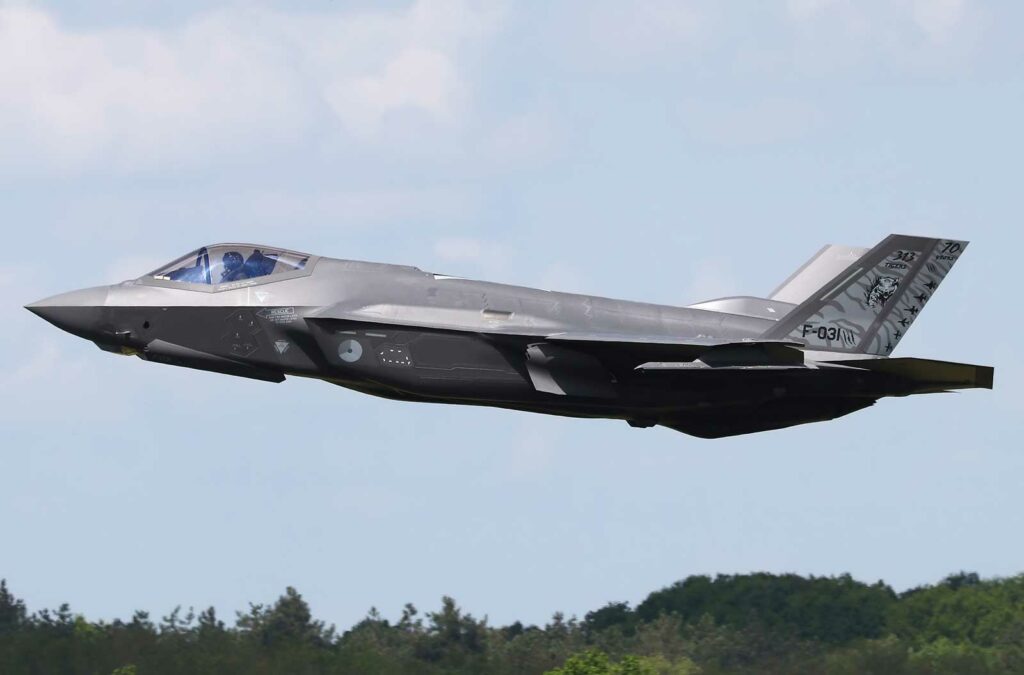
The other German solution is simpler: buy more American F-35As. Berlin has already ordered 35 aircraft to replace the Tornado in NATO’s nuclear sharing mission. The first German planes are to be used for training in the United States before their operational arrival in Europe. Discussions have already taken place regarding additional aircraft, even if Berlin has sometimes denied the existence of a formal decision.
The F-35 has an obvious advantage. It exists. It is in mass production. It is integrated into NATO. It has a global logistics network. It offers useful stealth, powerful sensors, and a data architecture that is already proven. For an air force that must replace aging aircraft, it is a pragmatic solution.
But the F-35 does not solve the European industrial problem. It worsens it. Each additional purchase reinforces German dependence on the United States. Software updates, certain sensitive data, the maintenance ecosystem, and capability evolution remain closely tied to Washington and Lockheed Martin. For Berlin, this may be acceptable. For Paris, it is the opposite of strategic autonomy.
The F-35 is therefore a transitional solution, not a complete post-FCAS response. It fills a capability gap. It does not build a sixth-generation European industry. It does not give Airbus a role as prime contractor. It does not prepare a sovereign successor to the Eurofighter.
The temptation of an autonomous German program remains fragile
Another path is circulating in Berlin: building a German or German-European program around a national consortium. This path could rely on Airbus Defence and Space, MTU Aero Engines, Hensoldt, Diehl Defence, MBDA Deutschland, Rohde & Schwarz, Liebherr, and other groups. It would correspond to Germany’s new ambition to become a more assertive defense industrial power.
On paper, the idea is attractive. Germany has a sharply rising budget. The core defense budget is set to increase from 82.7 billion euros in 2026 to 105.8 billion euros in 2027, while total defense-related spending could reach 144.9 billion euros in 2027 when including special funds and aid to Ukraine. These amounts give Berlin a new weight.
But money does not replace experience. Airbus has major expertise in the Eurofighter, drones, systems, and military transport aircraft. But Germany has not developed a complete combat fighter equivalent to the Rafale, F-35, or the future F-47 on its own. Designing a sixth-generation aircraft requires fine mastery of stealth, engine-airframe integration, data fusion, internal weapon bays, electronic warfare, cooling, software architecture, and industrialization.
An autonomous German program would therefore be long, costly, and risky. It could also recreate the flaws of FCAS if it looks too quickly for partners to share costs. Berlin’s real choice will be brutal: buy American, join an already existing governance structure, or finance a highly uncertain industrial leap.
European defense pays for its national rivalries
The post-FCAS era reveals the recurring obstacles facing European defense. The first is national industrial rivalry. Each country wants to preserve its jobs, its design bureaus, its factories, and its technologies. This is understandable. But this logic becomes destructive when it prevents the appointment of a clear project leader.
The second obstacle is cost. A sixth-generation combat aircraft is not only expensive to develop. It is expensive to maintain, modernize, certify, and produce in sufficient numbers. European volumes are low. France, Germany, Italy, Spain, and the United Kingdom do not buy hundreds of aircraft each. Without consolidation, unit costs skyrocket.
The third obstacle is strategic. Europeans do not all share the same priorities. France thinks of nuclear deterrence, distant projection, and aircraft carriers. Germany thinks of NATO, air defense, American interoperability, and industrial scaling. The United Kingdom thinks of expeditionary air power and cooperation with Japan. Italy seeks a strong industrial role in multiple programs. Spain wants to preserve Indra and its aerospace base. These interests are not illegitimate. They are simply difficult to merge.
Faced with the United States and China, this fragmentation becomes dangerous. The United States has already entrusted Boeing with the development of the F-47, the future sixth-generation fighter for the US Air Force. China, for its part, is revealing advanced prototypes attributed to a new generation of combat aircraft. Meanwhile, Europe is still discussing work-sharing. The contrast is cruel.
France finds itself more isolated, but not necessarily weakened
For Paris, the post-FCAS era is uncomfortable. France loses access to shared funding for the future fighter. It will have to extend the Rafale, accelerate drone development, preserve the future F5 standard, and prepare for longer-term replacement. It will also have to finance deterrence, the next-generation aircraft carrier, surface-to-air defense, ammunition stocks, and space capabilities.
But France gains one thing: freedom of decision. It no longer has to negotiate every critical choice with Berlin. Dassault can champion a more coherent line centered around a French aircraft, a drone system, and a controlled combat architecture. The problem is financial. A complete national program would be heavy for a French budget that is set to reach 76.3 billion euros in 2030, or 2.5% of GDP. France knows how to do it; it will have to prove it can pay.
This situation could also push Paris toward more selective cooperations. Rather than sharing the heart of the fighter, France could share building blocks: drones, missiles, cloud, sensors, electronic warfare, simulation. This method is less spectacular but more realistic. It avoids blocking an entire program over a single governance dispute.
The true European choice will be between integration and dependence
The post-FCAS era does not mark the end of European defense. It marks the end of an illusion: the idea that a large common program is enough to create common sovereignty. Sovereignty is not born from a shared logo. It is born from a clear political decision, an accepted prime contractor, and stable funding.
Germany is looking for more realistic projects with France because it has understood that the large shared aircraft had become ungovernable. The GCAP/Tempest offers a credible alternative, but it is not free. The F-35 offers rapid security but increases American dependence. An autonomous German program would flatter national ambition but would carry a major industrial risk.
European defense is therefore entering a harsher phase. States will have to choose between fewer, better-governed programs, or greater dependence on the United States. They will have to accept that strategic autonomy has a political cost: sometimes giving up a portion of industrial sovereignty to obtain a common capability. Without this discipline, Europe will continue to finance promises, while other powers deploy combat-ready aircraft, drones, and networks.
War Wings Daily is an independant magazine.