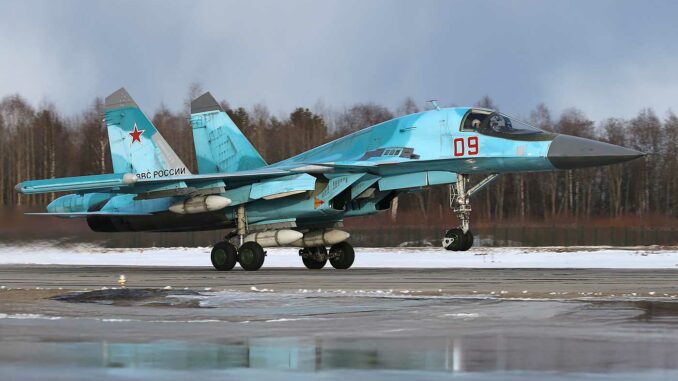
Russia is deploying its Su-34s and glide bombs against drone control posts to break the network rather than targeting individual aircraft.
Summary
Russia is adapting the employment of its Su-34s to the drone warfare in Ukraine. Recent Russian footage and statements report strikes carried out with glide bombs against Ukrainian posts responsible for controlling drones, particularly in the Kupiansk sector. These assertions remain difficult to verify independently. However, the military logic is clear: strike the system rather than the drone. A control post can bring together pilots, antennas, communication terminals, technicians, targeting data, and several aircraft ready for departure. Its destruction can therefore temporarily interrupt numerous missions. FAB-500s equipped with the UMPK module allow Su-34s to remain several dozen kilometers from the front lines. But this method depends on highly recent intelligence. Ukrainian teams are small, mobile, and increasingly dispersed. A heavy bomb can obliterate a fixed site, but it becomes far less effective against a network that moves, camouflages, and reconstitutes itself rapidly.
Russia Claims to Have Struck Operators Rather Than Their Devices
Russian forces recently released footage showing Su-34s dropping guided bombs against what Moscow describes as Ukrainian drone control positions. These strikes reportedly targeted the Kupiansk sector in eastern Ukraine, among other areas.
The available information does not allow for precise verification of the number of sites hit, the units involved, or human casualties. Military videos generally show the aircraft taking off, releasing the weapons, and an explosion observed by a drone. They do not always prove the exact function of the targeted building.
This caveat does not render the information irrelevant. In June 2026, the Institute for the Study of War also noted a possible intensification of Russian strikes against Ukrainian drone operators and logistics assets in the Kupiansk direction.
The trend is consistent with the evolution of the frontline. Ukrainian drones are no longer mere tactical accessories. They detect Russian movements, adjust artillery fire, strike vehicles, drop mines, and monitor logistics routes.
Russia is therefore seeking less to shoot down every small quadcopter than to identify the drone control post that gives it its military value.
This strategy responds to an economic reality. An FPV drone can cost a few hundred or a few thousand euros. Mobilizing an aircraft and a 500 kg bomb to destroy it in flight would make no sense. Conversely, a strike against a team capable of launching several dozen aircraft can produce a significantly greater effect.
The Control Post Constitutes the Brain of a Drone Unit
The term “control post” can evoke the image of a large command center filled with screens. On the Ukrainian front, the reality is often much more scaled down.
A drone team can operate from a house, a basement, a dug-out shelter, a vehicle, or an agricultural building. It generally encompasses several functions. One pilot controls the aircraft. A navigator monitors the map and obstacles. A technician prepares the batteries, radio frequencies, and explosive charges. A commander coordinates targets with the infantry, artillery, or higher command.
The site can also contain directional antennas, video receivers, computers, satellite terminals, radio repeaters, and dozens of drones waiting to be deployed.
The destruction of such an asset does not eliminate just a single aircraft; it can shut down an entire local reconnaissance or strike capability.
FPV missions are often coordinated at the battalion or brigade level. The imagery transmitted by the drones feeds tactical maps. Spotted targets can be handed over to another FPV, a bomber drone, a mortar, or an artillery piece.
The post thus participates in a complete strike chain:
- target detection;
- identification;
- transmission of coordinates;
- engagement decision;
- launch of the effector;
- observation of the result.
Destroying a central element of this chain can slow down all subsequent steps. The intended effect therefore extends far beyond direct material damage.
Qualified Personnel Area Worth More Than Equipment
The loss of a drone can be compensated for in a matter of hours. That of an experienced pilot is much harder to absorb.
A skilled FPV operator must master low-altitude flight, antennas, jamming countermeasures, frequency shifting, and the interpretation of a sometimes degraded video feed. They must also know how to recognize a vehicle, select their angle of attack, and maintain control until impact.
This experience cannot be reproduced on an assembly line. It requires weeks or months of training, followed by actual practice on the front lines.
Russia and Ukraine therefore reciprocally target each other’s drone teams. They seek to spot their antennas, vehicles, transit routes, and radio emissions. Personnel become objectives as critical as the hardware itself.
A successful strike against several operators produces a multiplier effect. It removes expertise, destroys equipment, and disrupts relationships with the supported units.
The Su-34 Offers the Mass Necessary for Long-Range Strikes
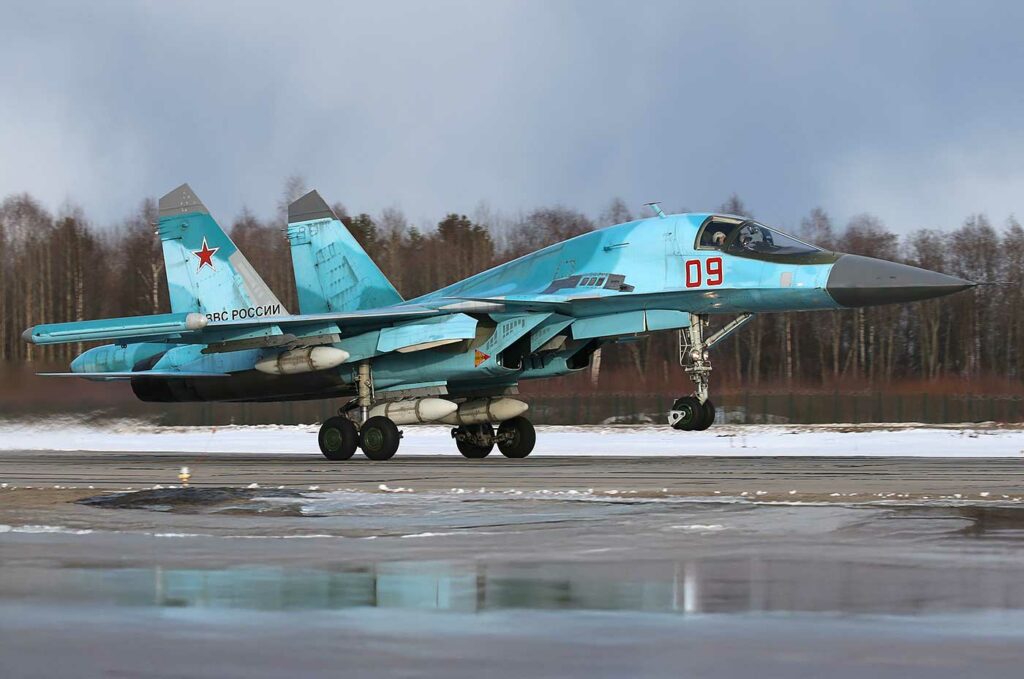
The Su-34 has become the primary Russian platform for glide bomb strikes. This twin-engine aircraft derived from the Su-27 family was designed for long-range ground attack.
Its crew consists of two personnel seated side-by-side. This arrangement facilitates task-sharing during complex missions. One crew member flies the aircraft and manages navigation, while the other can monitor sensors, threats, and weapon preparation.
The Su-34 possesses twelve hardpoints and can carry approximately 8,000 kg of ordnance in certain configurations. It carries bombs, air-to-surface missiles, anti-radiation weapons, and air-to-air missiles intended for self-protection.
For operations in Ukraine, it regularly uses Soviet-era FAB bombs modernized by the addition of a UMPK module. This kit includes deployable wings, a navigation system, and corrective control surfaces.
A bomb that would normally fall almost vertically can thus travel several dozen kilometers. The aircraft converts its altitude and speed into energy for the munition.
The Su-34 can climb, accelerate, release its bombs, and then execute a U-turn before approaching the most dangerous Ukrainian defenses. It nevertheless retains a degree of vulnerability. Patriot batteries, Ukrainian S-300 systems, and fighters equipped with long-range missiles can threaten Russian aircraft when their engagement zones are correctly positioned.
The safety distance is therefore never absolute. It results from a balance between the range of the bomb, the position of the front line, Ukrainian radars, and the protection offered by Russian escort fighters.
The Glide Bomb Transforms an Old Stockpile into a Precision Weapon
The primary weapon employed in this type of mission is the FAB-500 equipped with a UMPK kit. The FAB-500 is a general-purpose 500 kg bomb sourced from considerable Soviet stockpiles.
The module does not transform this weapon into a cruise missile. It adds the functions necessary to glide and correct its trajectory.
A UMPK glide bomb typically combines inertial navigation with GLONASS satellite system signals. Inertial navigation calculates position based on recorded movements, while GLONASS progressively corrects the drift of this calculation.
The range depends on several factors:
- release altitude;
- speed of the Su-34;
- initial trajectory;
- atmospheric conditions;
- mass of the bomb;
- aerodynamic efficiency of the kit.
The standard range of a FAB equipped with a UMPK is frequently estimated between 60 and 70 km. High-altitude launches can go further. The UMPB D-30SN munitions, designed from the outset as gliding weapons, could reach approximately 90 km. Certain newer Russian variants now target distances exceeding 100 km.
A FAB-500 contains approximately 150 to 200 kg of explosive depending on its variant. Such a charge can destroy a house, collapse a light shelter, and damage several nearby buildings.
This destructive power might seem excessive against a few pilots and their computers. It becomes logical when the Russians believe they are targeting a reinforced basement, a brigade post, a drone depot, or a workshop.
The Volume of Launches Reduces the Cost of Uncertainty
In January 2026, the Ukrainian Ministry of Defense tallied more than 5,700 Russian guided aerial bombs. On January 18, 316 were reportedly dropped in a single day.
These data are Ukrainian and must be considered as those of a party to the conflict. They nonetheless demonstrate the order of magnitude reached by the Russian campaign.
At such a cadence, every single target does not need to be treated with absolute certainty. Russia can commit several bombs against an area suspected of sheltering operators, a reserve stockpile, or a communication relay.
This strategy compensates for imperfect accuracy with volume and explosive mass. It also imposes a heavy human cost on localities near the front line. A coordinate error of several dozen meters can destroy an adjacent civilian building.
Intelligence Remains More Important Than the Bomb
A FAB-500 UMPK does not search for a drone post on its own. It steers toward coordinates programmed before release.
The primary challenge therefore consists of discovering where the operators are located and transmitting their position before they move.
Russia can employ several complementary methods.
Reconnaissance drones such as the Orlan-10, ZALA, or SuperCam monitor buildings, vehicles, and personnel movements. A team that regularly returns to the same shelter eventually creates an identifiable pattern.
Electronic intelligence assets spot radio emissions. An FPV post exchanges commands with the aircraft and receives a video feed. These transmissions can reveal a direction, then a probable zone when multiple sensors cross-reference their data.
The antennas themselves constitute a clue. A directional antenna mounted on a roof, in a tree, or at the top of a mast can be observed by an aerial camera.
The Russians can also track the drone back to its starting point. This method requires a surveillance aircraft to be available at the right moment, but it sometimes allows for the direct localization of the team.
Finally, human intelligence, communication intercepts, and the analysis of online publications can complete the system.
The success of the mission then depends on speed. An exact coordinate becomes useless if the team relocates twenty minutes later. The chain between detection, validation, and strike must therefore be short.
Destroying a Node Can Temporarily Open the Front
Drones today form an invisible barrier in front of many Ukrainian positions. They monitor roads, treelines, trenches, and assembly areas.
A Russian unit moving a vehicle out in the open risks detection within minutes. An FPV can then strike it or transmit its position to the artillery.
If the control posts are destroyed, this surveillance can temporarily diminish. The Russians then gain a window to advance infantry, move ammunition, or repair a road.
The strike fits into a form of battlefield interdiction. The objective consists not only of causing casualties but aims to prevent the adversary from using its capabilities at a critical moment.
An attack against a drone node can thus precede:
- an infantry assault;
- a troop rotation;
- the passage of a convoy;
- the installation of an artillery position;
- a medical evacuation;
- the breaching of an obstacle.
The effect will remain limited if ground forces do not exploit it quickly. Another Ukrainian team can retake the area, install a new antenna, and restart operations.
The bomb therefore does not eliminate the threat permanently; it creates a local rupture in the network.
Ukrainian Concentration Creates a Real Vulnerability
Drones are sometimes described as a completely decentralized capability. This is not always true.
Small devices can be distributed among many teams, but certain functions remain concentrated. Units require technicians, spare parts, charged batteries, mapping data, and coordination with command.
A battalion or brigade post can assign drones to priority sectors and transmit intelligence to firing units. A workshop can repair several dozen devices. A relay placed on high ground can extend the radio coverage of multiple teams.
These concentrated points become profitable objectives. Destroying a workshop or a relay can affect more aircraft than striking a single crew.
This centralization improves daily efficiency. In return, it creates a more visible signature. Movements are more numerous, electrical needs increase, and transmissions become more regular.
The Ukrainian challenge therefore consists of maintaining sufficient coordination without creating a headquarters that is too vulnerable.
Ukrainian Defenses Rely on Dispersion and Silence
The best protection against a 500 kg bomb is not always to attempt to intercept it; it often consists of preventing Russia from obtaining an actionable target.
Mobility is the primary response. Operators can change positions frequently, limit missions from a single building, and move their equipment in small vehicles.
Dispersion reduces the value of a strike. Pilots, technicians, drones, and batteries must not all be stored in the same place.
The antennas can be separated from the main post. A cable then connects the operator to a transmitter placed several dozen or hundreds of meters away. A strike against the antenna no longer necessarily kills the team.
The Ukrainians also use repeaters. The pilot works from a more distant shelter, while a relay transmits orders to the drone. This architecture complicates the localization of the actual command post.
Electronic warfare can disrupt the GLONASS guidance of the bombs. When satellite correction disappears, inertial navigation progressively accumulates an error. The munition can miss a point target, especially after a long flight.
Camouflage, decoys, and electromagnetic discipline remain equally important. A fake antenna, an abandoned vehicle, or a transmitter placed far from the team can draw a bomb toward an empty target.
Fiber-Optic Drones Do Not Eliminate the Human Post
Fiber-optic FPV drones resist radio jamming. A very thin cable unspools behind the aircraft, transmitting commands and video.
This technology reduces electromagnetic emissions, making the detection of the pilot via radio direction-finding much more difficult.
However, it does not eliminate the control post. The pilot, the screen, the batteries, and the fiber spool remain somewhere on the ground. The team must still access a launch zone compatible with the length of the cable.
The adversary must then use other clues: optical observation, vehicle tracking, thermal drones, or human intelligence.
Autonomy can further reduce vulnerability. An aircraft capable of recognizing a target or pursuing a mission after losing its link depends less on the operator. But fully autonomous systems remain a minority on the front line.
Russian Limits Reduce the Scope of This Tactic
The strategy appears rational, but it does not guarantee success.
The first difficulty concerns the validation of intelligence. The Russians must distinguish a genuine drone center from a temporarily used house, an abandoned relay, or a decoy.
The second concerns the time lag. A light team can leave a site before the Su-34 arrives or before the bomb travels its trajectory.
The third concerns accuracy. UMPKs can display a circular error probable estimated around 8 to 15 meters under good conditions. Jamming, poor satellite reception, or an imprecise coordinate can heavily increase this deviation.
The fourth limitation is linked to opportunity cost. Every bomb used against a small post is one that does not strike a fortification, a bridge, or a depot. Russia possesses a large stockpile, but its aerial sorties and crews remain limited resources.
Finally, the Su-34 must climb to maximize the range of the munition. This phase can make it more visible to Ukrainian radars. Escort fighters and jamming systems can reduce the danger, without making it disappear.
The Ukrainian Response Must Target the Entire Russian System
Ukraine cannot rely solely on intercepting the bombs. Patriot or NASAMS missiles are too rare and expensive to handle several thousand FABs each month.
The response must rest on a defense in depth.
The first level consists of hiding and moving drone posts. The second aims to jam the guidance of the weapons. The third seeks to detect Su-34s early enough to force their crews to release from further away or to abort.
The fourth level consists of striking the aircraft at their bases. Su-34s stationed on the ground are more vulnerable than in flight. Ukrainian attacks against Russian airfields show that this option is possible, even far from the front line.
Bomb depots, UMPK assembly workshops, and fuel infrastructure also constitute objectives. Destroying the launcher, the munition, or its logistics chain avoids having to intercept every bomb.
This approach inverts the Russian logic. Moscow attacks the brain of the Ukrainian drones; Kyiv seeks to attack the archers launching the glide bombs.
The Battle Shifts from Devices to Networks
Su-34 strikes against control posts show that the drone war has reached a new stage.
The debate no longer centers only on the number of quadcopters available. It concerns the networks that connect them to sensors, commands, and weapons.
An isolated drone possesses limited value. Connected to an experienced team, a tactical map, and an artillery unit, it becomes a central element of combat.
Russia seeks to break these connections through a combination of intelligence, aviation, and glide bombs. Ukraine responds with dispersion, repeaters, fiber optics, jamming, and increasing autonomy.
No single strike will make drones disappear from the battlefield. A destroyed node can be replaced. An experienced operator and a well-organized local network are much less easily replaced.
The confrontation between the Su-34 and Ukrainian teams thus illustrates network-centric warfare. The most visible platform is not always the most critical target. The advantage goes to the one who identifies the essential link, strikes it quickly enough, and reconstitutes their own system before the counterstrike.
War Wings Daily is an independant magazine.