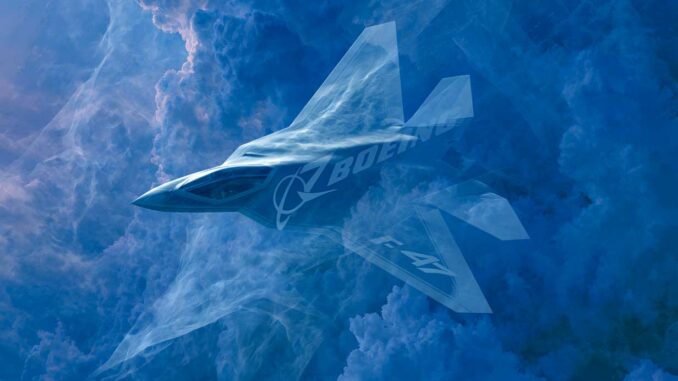
Boeing is developing the manufacturing facilities in St. Louis for the F-47, a sixth-generation fighter designed to replace the F-22 and command drones.
In summary
Boeing is developing a new industrial complex in St. Louis for future US fighter aircraft. The company has not officially confirmed that the site will produce the F-47 exclusively. However, all the evidence suggests it will become the manufacturing hub for the successor to the F-22 Raptor. The expansion covers approximately 102,000 m² and represents an announced investment of 1.8 billion dollars. It comprises a large assembly hall, finishing facilities, a delivery centre and specialised testing facilities. The first aircraft representing the programme is expected to fly in 2028. However, this F-47 should be distinguished from the secret demonstrators that have been undergoing testing since 2020. The US Air Force is planning for at least 185 fighters. It requires a combat radius of over 1,852 kilometres, a speed exceeding Mach 2 and close cooperation with autonomous drones. For Boeing, the programme represents a strategic victory. Its financial return will be considerable, but gradual and heavily dependent on industrial execution.
The new St Louis factory is taking shape ahead of the maiden flight
Boeing began preparing for its industrial expansion in St Louis in 2023. Major construction work followed in 2024, prior to the official award of the Next Generation Air Dominance programme to the company in March 2025.
This timeline is significant. Boeing did not simply win a contract and then decide to build a factory. The company invested before knowing the outcome of the competition. It took an industrial risk worth several billion dollars to convince the US Air Force that it could develop and produce its next-generation air superiority fighter.
The gamble paid off.
The main building, known as the Brownleigh Site, is situated in the immediate vicinity of the historic Boeing Defence, Space & Security campus and St Louis Lambert International Airport. By July 2026, its external structure was well advanced. The roof, façade panels and large hangar doors had been installed.
The entire project is worth approximately $1.8 billion. It is set to almost double Boeing’s regional industrial footprint. The works will be delivered in phases between 2026 and 2030. Some facilities will therefore be able to host operations well before the campus is fully completed.
The expansion is not limited to a single building. It covers approximately 102,000 m² (1.1 million square feet). The project comprises a large assembly hall, technical buildings, post-production facilities and delivery infrastructure.
Environmental documentation published prior to the award of the F-47 contract referred to a main hall of approximately 81,800 m² (880,000 square feet) on the Brownleigh Site.
It also mentioned a hangar of approximately 17,200 m² (185,000 square feet), a radar signature measurement building of 7,430 m² (80,000 square feet), shelters, an engine test facility, a fuel calibration building and various maintenance facilities.
Boeing, however, continues to refer to a facility for ‘advanced combat aircraft’. This caution is understandable. The precise breakdown of the F-47’s activities is classified. The company is also careful not to present the investment as being tied to a single programme. The campus could support other future aircraft, including a potential naval fighter.
The maiden flight in 2028 will not be the first flight of the NGAD programme
The term ‘first prototype’ is misleading.
The US Air Force and the Defence Advanced Research Projects Agency have already flown several experimental demonstrators linked to the NGAD programme. These secret aircraft have logged hundreds of flight hours since 2020. They have been used to test stealth designs, propulsion architectures, sensors, manufacturing methods and concepts for cooperation with autonomous systems.
The flight announced for 2028 will therefore likely involve the first development aircraft representative of the selected design. It will be an F-47 much closer to the production configuration than the previous X-planes.
Boeing indicated as early as the end of 2025 that the first aircraft was already under construction. This announcement suggests that the first components were probably produced at existing secure Phantom Works facilities. The new Brownleigh hangar was not yet sufficiently advanced to handle all the work on its own.
Production ramp-up is therefore expected to take place in several stages. The first development aircraft will be assembled in existing classified facilities. The new factory will then take on an increasing proportion of the test aircraft, initial production and, if the schedule is met, series production.
The target remains a first F-47 in 2028. This timetable is extremely ambitious for a sixth-generation fighter. It relies on a long, secret maturation phase, digital engineering and the use of demonstrators that have already been flight-tested.
This is therefore not a programme created from scratch in 2025. The awarding of the contract marked the start of the visible industrial phase of work that had been underway for several years.
The F-47 requires a factory designed for stealth and data
The manufacture of a stealth aircraft is not like the traditional assembly of a fighter.
On a conventional aircraft, a slight misalignment between two panels may be acceptable from an aerodynamic point of view. On an aircraft with a very low radar signature, that same misalignment can create a detectable electromagnetic reflection. The external shape, joints, hatches, antennas and air intakes must comply with extremely tight tolerances.
Stealth also depends on the continuity of the materials. Some areas use composite structures. Others are fitted with radar-absorbing coatings. Fastenings, panel edges and openings must be checked with a precision that exceeds the requirements of a conventional aircraft.
The new complex will therefore need to incorporate advanced metrology facilities. Laser systems will be able to monitor the geometry of the structures.
Digital tools will constantly compare the actual aircraft with its digital twin. Any deviation must be identified before assembly can proceed.
Assembly will begin with pre-fitted modules
The exact sequence remains classified. The industrial principles are, however, predictable.
The large sections of the fuselage and wings are expected to arrive as highly integrated modules. These assemblies will not be mere empty metal structures. They may already contain pipework, cabling, cooling systems, antennas and certain electronic equipment.
This approach reduces the time spent on the final assembly line. It also allows each module to be tested before installation. On the other hand, it imposes strict discipline on suppliers. A fault discovered at a late stage can hold up an entire assembly.
The main sections will be brought together at specific assembly stations. The engines, landing gear, flight controls and mission systems will then be integrated. Software will need to be loaded and tested in parallel with the physical assembly work.
The F-47 will likely be even more reliant on software than the F-35. Its effectiveness will depend on data fusion, electronic warfare, secure communications and drone management. The factory will therefore have to assemble a physical aircraft whilst simultaneously validating a complex military computer system.
Radar and thermal testing will become part of the production process
The planned inclusion of a radar signature measurement facility is particularly telling.
A stealth aircraft cannot be declared compliant on the basis of a visual inspection alone. It must be placed in an environment where the electromagnetic echoes reflected from various angles can be measured. These tests detect surface defects, misaligned panels and components likely to increase the radar signature.
Thermal management will be just as important. Sensors, computers, jamming systems and data links generate a considerable amount of heat. However, an excessively high external temperature can increase the aircraft’s infrared signature.
The F-47 will therefore need to dissipate thermal energy without becoming easier to detect. This constraint will influence the internal piping, heat exchangers, the fuels used as coolants and the engine integration.
The engine test facility, sometimes known as a ‘hush house’, will allow the engines to be run at high power whilst minimising external noise. Teams will be able to check thrust, vibrations, temperatures and the interaction between the engine and the on-board systems.
Following these tests, the aircraft will undergo fuel system calibration, electrical tests, flight control checks and taxiing tests. The proximity to St Louis Lambert International Airport will then facilitate the first flights and deliveries.
The final assembly line will be unique, but the manufacturing facilities will be spread out
The F-47 will not be built in a single ‘factory’ in the strict sense.
The large hangar at Brownleigh is expected to house advanced or final assembly. The Northern Tract and neighbouring buildings will handle inspections, testing, finishing and preparation for delivery. The historic Phantom Works facilities will likely continue to support development and classified activities.
The engines will not be manufactured on the final assembly line. The Next Generation Adaptive Propulsion programme is funding the work of GE Aerospace and Pratt & Whitney separately. The final selection and organisation of engine production remain sensitive issues.
Sensors, avionics, electronic warfare components, composite materials and hydraulic equipment will also be sourced from a national network of suppliers.
Boeing has not made public the full list of companies or the locations of critical sub-assemblies.
The answer to the question of how many factories there will be is therefore clear: there is expected to be a main assembly centre in St Louis, but production will be spread across several facilities and a supply chain spanning the United States.
This organisation brings specialisation. It also creates dependencies. A single supplier of stealth material, a secure processor or an actuator could slow down the entire chain. The US Air Force will therefore need to monitor industrial capabilities well beyond Boeing’s single site.
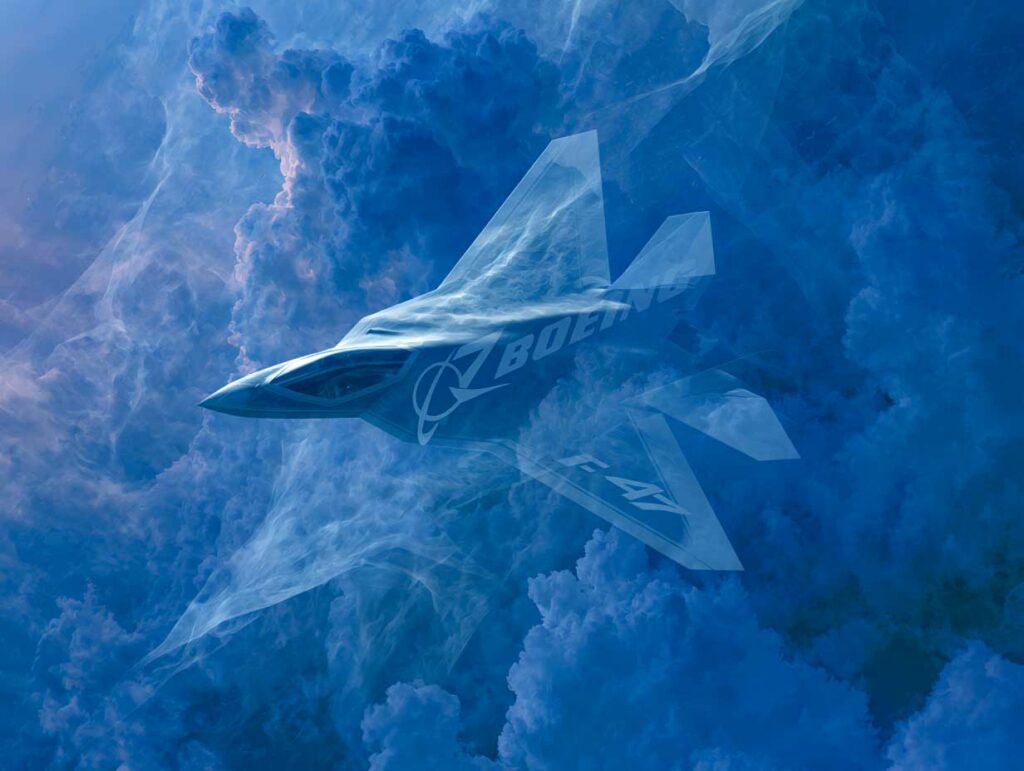
The F-47 will lead an autonomous combat group
Figures published by the US Air Force provide an initial insight into the mission.
The F-47 will need to have a combat radius of more than 1,852 kilometres (1,000 nautical miles). A combat radius is not the same as maximum range. It corresponds to the distance required to reach an area of operations, carry out a mission there and return without refuelling, according to a defined profile.
This requirement is directly tailored to the Indo-Pacific theatre. Bases there are widely dispersed. Aircraft must cover great distances before reaching areas protected by Chinese systems.
The speed must exceed Mach 2. This performance does not necessarily mean that the F-47 will fly at this speed for long periods. It will give it the capability to reposition itself, intercept a threat or quickly leave a dangerous area.
The US Air Force is planning for at least 185 aircraft, a figure comparable to the number of F-22s actually produced for the US forces. This figure may change. It will depend on the unit cost, the performance achieved and the budgetary situation at the start of the next decade.
The main breakthrough, however, will come from the integration of Collaborative Combat Aircraft.
General Atomics’ YFQ-42A and Anduril’s YFQ-44A are being developed separately. They will be able to accompany piloted fighters, carry sensors, jam radars, fire weapons or operate in the most dangerous areas.
The F-47 pilot will not necessarily fly each drone in the same way that an operator controls a remote-controlled aircraft. Instead, the pilot will be required to assign objectives and oversee autonomous behaviour. The drones will then carry out certain tasks with limited human intervention.
This architecture will have a direct impact on production. Boeing will need to validate not only the aircraft itself, but also its data links, software interfaces and its ability to cooperate with platforms manufactured by other companies.
Boeing’s budget is not limited to the announced 20 billion
The contract awarded to Boeing for the Engineering and Manufacturing Development phase exceeds 20 billion dollars. It funds the system’s maturation, integration, testing and the construction of a small number of development aircraft.
It also includes options negotiated for initial low-rate production. This does not mean that Boeing received 20 billion dollars in March 2025. The money will be paid out gradually, depending on the work carried out and Congress’s annual budgetary decisions.
The budget trajectory published by the US Air Force forecasts approximately 3.45 billion dollars for the F-47 during the 2026 financial year.
The figure rises to $5.04 billion for 2027, then to $5.25 billion in 2028. Projections then fall to $4.12 billion in 2029, $3.29 billion in 2030 and $2.95 billion in 2031.
The total amounts to approximately $24.1 billion over six financial years. This amount does not constitute a guaranteed cheque for Boeing. Part of it funds government activities, testing, equipment and suppliers. The figures beyond 2027 remain projections subject to congressional approval.
The engine has a separate budget. Planned expenditure for Next Generation Adaptive Propulsion amounts to approximately 3.2 billion dollars between 2026 and 2031. These should not be added to Boeing’s potential turnover, as they primarily concern engine manufacturers.
Nor does the $730 million budget requested for F-47 infrastructure at Nellis Air Force Base go to the St. Louis assembly line. It will be used for hangars, operational testing and US Air Force support facilities.
Finally, a distinction must be made between public funding and industrial investment. The $1.8 billion committed to St Louis relates to the development of the Boeing campus. The project benefits from local economic incentives, but it does not form part of the EMD contract.
The financial impact will be massive, but it will be gradual
The F-47 is transforming Boeing’s strategic position. It does not immediately transform its financial results.
The Boeing Defence, Space & Security division generated $27.2 billion in revenue in 2025. It still recorded an operating loss of $128 million. The result was nevertheless much better than the $5.4 billion loss incurred in 2024.
In the first quarter of 2026, the division generated $7.6 billion in revenue and an operating profit of $233 million. Its margin stood at 3.1 per cent. The defence division’s order book then stood at around $86 billion.
The F-47 provides visibility over the very long term. It keeps Boeing in the front-line fighter market following the phasing out of the F/A-18E/F Super Hornet. It also supports the transition of St. Louis’s expertise towards stealth technology, autonomous systems and open software architectures.
The impact on turnover will increase in line with development expenditure. It will become more significant once production aircraft are ordered. The total value of the production programme has not been made public. With at least 185 aircraft, airframes, equipment, parts, modifications and support could represent several tens of billions of dollars more over several decades.
Estimates citing hundreds of billions should be treated with caution. They generally include development, future procurement, maintenance and, in some cases, export options. They represent neither a signed contract nor a guaranteed profit.
The contract limits risk without eliminating it
The development phase is structured as a reimbursement cost contract with incentive payments.
This arrangement offers Boeing greater protection than a fixed-price contract. Under a fixed-price contract, the manufacturer must absorb a large proportion of any cost overruns. Boeing has lost billions of dollars on the KC-46A, the T-7A, the MQ-25 and the VC-25B due to this type of commitment.
For the F-47, the government reimburses eligible costs and adds a payment that may vary depending on performance. The financial risk is therefore better shared.
It is not eliminated, however. Boeing may lose part of its remuneration in the event of delays or poor performance. Certain costs may be disallowed. A delay in the schedule may also tie up teams, increase overheads and delay more profitable production contracts.
Furthermore, series production may be negotiated under more restrictive terms. Margins will then depend on the price of the aircraft, the stability of the design, the production rate and the suppliers’ ability to meet their commitments.
The main risk remains industrial execution
The F-47 represents an exceptional opportunity for Boeing. It is also a test of credibility.
The company must simultaneously stabilise its commercial programmes, get several military contracts back on track and launch an extremely complex fighter. It must recruit qualified engineers, retain its skilled workers and integrate a supply chain already stretched thin by missiles, satellites and other Pentagon priority programmes.
The close integration of development and production poses another risk. Building the first aircraft before testing is fully complete saves time. It can also necessitate costly modifications to aircraft that have already been assembled.
Digital engineering reduces this risk, but it does not eliminate it. A computer model never perfectly replicates the thermal, mechanical and electromagnetic stresses encountered in flight.
Boeing will also have to prove that its new factory genuinely improves productivity. A modern facility is no guarantee of either quality or production rate. Performance will depend on work organisation, the maturity of suppliers and configuration discipline.
Finally, the programme remains vulnerable to political decisions. Not all 185 aircraft have been fully funded yet. An excessive rise in unit cost could reduce the fleet size. A major technical difficulty could delay production. A change in strategy could shift budget priorities towards drones, bombers or long-range missiles.
The St. Louis gamble commits Boeing for a generation
Boeing is not just building a hangar. It is seeking to recreate an industrial franchise spanning several decades.
The F-47 provides the group with a response to the gradual phasing out of the Super Hornet. It restores Phantom Works to the centre of US combat aviation. It offers St. Louis a programme around which to organise skills, investments and suppliers right through to the 2050s.
However, the new factory will not single-handedly produce the promised air power. Success will depend on the engine, sensors, drones, software, weapons and the Pentagon’s ability to fund the entire NGAD family.
The 2028 milestone will provide the first visible verdict. A successful flight will demonstrate that the secret demonstrators, digital engineering and forward-looking investments have helped to shorten the development cycle. A significant delay, on the other hand, will serve as a reminder that no factory, however modern, can eliminate the complexity of a sixth-generation fighter.
Sources
U.S. Air Force, ‘Air Force Awards Contract for Next Generation Air Dominance Platform, F-47’, 21 March 2025.
U.S. Air Force, designation of the YFQ-42A and YFQ-44A Collaborative Combat Aircraft, 3 March 2025.
Boeing, ‘Boeing Defence, Space & Security Headquarters Returns to St Louis’, 18 February 2026.
Jacobs, presentation on the 102,000 m² expansion of the Boeing campus in St Louis, 5 June 2025.
St Louis Economic Development Partnership, $1.8 billion investment, jobs and regional benefits.
Air & Space Forces Magazine, budget projections for the F-47 and the NGAP programme for the financial years 2026 to 2031, 4 May 2026.
Boeing, Boeing Defense, Space & Security’s 2025 annual financial results and first-quarter 2026 results.
Reuters, award of the F-47 programme to Boeing and industrial implications for St Louis.
The War Zone, start of production of the first F-47 and target for maiden flight in 2028.
FlightGlobal and public documentation relating to the Brownleigh Site, the Northern Tract and advanced production facilities.
War Wings Daily is an independant magazine.