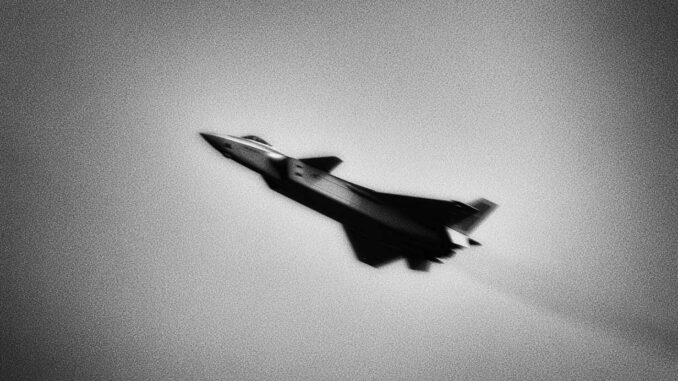
In Chengdu, robots, AI and machine tools are speeding up the production of J-20 components. But the fully autonomous factory remains more of a vision than a reality.
In summary
China has indeed commissioned a ‘dark factory’ linked to the manufacture of the J-20. However, it does not single-handedly produce a complete fighter aircraft in the dark. The site, unveiled in May 2026 by the Aviation Industry Corporation of China, primarily manufactures structural components, described as the ‘skeleton’ of advanced fighter aircraft. Autonomous vehicles transport the materials. Machine tools operate almost continuously. A digital system coordinates the equipment. Artificial intelligence is used for monitoring, measuring and analysing industrial data. According to Chinese figures, manual labour has been reduced by more than 80 per cent, and machine utilisation sometimes exceeds 90 per cent over a 24-hour period. However, there is no reliable public information to confirm that the application of the J-20’s radar-absorbing coating is fully automated. Final assembly, systems integration and stealth validation remain complex operations in which human intervention is still crucial.
China unveils a shadowy factory at the heart of the J-20 programme
The setting had been carefully chosen. In the western suburbs of Chengdu, an industrial hall operates almost without lighting. A few indicator lights pierce the darkness. Automated guided vehicles move between dozens of machine tools. They transport materials and parts without waiting for an operator to clear the way.
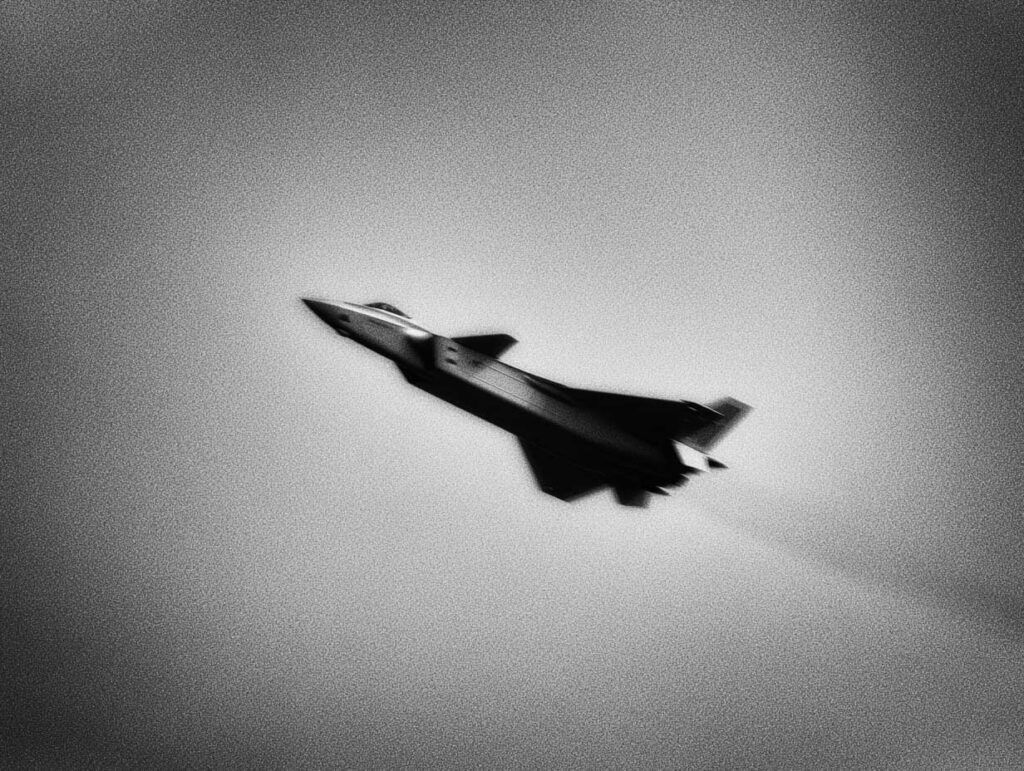
On 7 May 2026, Chinese journalists were allowed to visit this facility belonging to the Chengdu Aircraft Industry Group, or 航空工业成飞. The company is part of the state-owned conglomerate Aviation Industry Corporation of China, better known by the acronym AVIC. Among other things, it designs and manufactures the J-20 威龙 stealth fighter, the ‘Mighty Dragon’.
The report published two days later by Science and Technology Daily directly uses the term ‘shadow factory’. It states that the site produces the structural components for China’s most advanced fighter aircraft, including the J-20.
The term is striking. It must be properly understood.
This facility is not an assembly line where robots feed aluminium ingots in through one door and produce a flight-ready J-20 through another. It is, first and foremost, a structural components factory. It manufactures part of the aircraft’s skeleton: frames, panels, spars, machined parts and complex components that will subsequently be assembled with the engines, flight controls, sensors, wiring and mission equipment.
Darkness is therefore not at the heart of the technology. It is the visible consequence of it. The machines do not require constant lighting. Operators can monitor the work remotely. The automated cells continue their cycles throughout the night.
However, the lights can be switched back on as soon as a technician needs to enter to inspect, adjust, repair or reconfigure equipment. ‘Dark factory’ does not mean ‘a factory without any human beings’. It means that a significant part of production can continue without a constant human presence.
The real breakthrough comes from the connection between the machines
The Chengdu facility does not rely solely on robots. Its most important element is less visible: a shared digital system links the equipment.
In 2014, a machine still had to be monitored by two or three employees taking turns to maintain continuous production. Each piece of equipment had its own software, command language and interfaces. The machines could perform well individually but remained unable to work as a coherent whole.
The engineers in Chengdu developed a common control layer. They worked on the hardware and software interfaces of each piece of equipment. The aim was to enable machine tools, measuring systems, robots and autonomous vehicles to exchange information.
According to the head of the digital manufacturing centre, all the machines can now “speak the same language”. They can be controlled remotely and communicate with one another.
This development is transforming the way work is organised. A machine can signal that it has finished a part. The system then issues a transport order. An autonomous vehicle collects the component and transports it to the next station. Machining data, measurements and any anomalies accompany the part in its digital file.
This does not necessarily involve artificial intelligence at every stage. Much of this process relies on conventional industrial automation, digital programming and production management systems. Artificial intelligence comes into play mainly when data needs to be interpreted, anomalies detected or complex planning optimised.
To describe any automated machine as an ‘AI-managed’ machine would be an exaggeration. The official Chinese wording is more cautious. It refers to a flexible and agile factory assisted by artificial intelligence.
Chinese figures point to a considerable industrial gain
The performance figures announced by the Chengdu Aircraft Industry Group are significant.
The new system is said to have reduced the arduousness or intensity of human labour by more than 80 per cent. This figure does not mean that 80 per cent of staff have been made redundant. It indicates that operators spend far less time directly monitoring the machines and carrying out certain repetitive tasks.
This distinction is important. An automated aerospace factory still requires programmers, process specialists, maintenance technicians, metrologists, quality controllers and production engineers. Not all jobs are disappearing; they are shifting towards more technical roles.
The maximum equipment utilisation rate is said to exceed more than 90 per cent over a twenty-four-hour period. This represents more than 21 hours and 36 minutes of daily operation at full capacity.
However, no machine tool can produce continuously indefinitely. Tools must be changed, work areas cleaned, lubricants checked, swarf removed and maintenance carried out. The figure of 90 per cent is therefore high for aerospace production, which involves small batches and a variety of parts.
The company also reports an improvement in efficiency of nearly 1.5 times. The Chinese wording can be interpreted in two ways. The South China Morning Post translated it as an increase of nearly 150 per cent, which would mean that production had more than doubled. A more conservative interpretation suggests that the new efficiency level is approximately one and a half times its initial level.
This ambiguity calls for caution. The key point remains the same: the improvement relates to a workshop producing structural components. It does not prove that the number of J-20s delivered each year has increased by the same proportion.
An aerospace production line moves at the speed of its slowest bottleneck. Producing twice as many fuselage frames does not mean twice as many aircraft can be delivered if the engines, radars, flight control computers, ejection seats or flight testing cannot keep pace.
Artificial intelligence first checks the quality of parts
The best-documented aspect of the use of artificial intelligence concerns measurement and inspection.
The facility in Chengdu has a cell comprising four structured light scanning systems and industrial robots. Structured light projects a known pattern onto the surface of a part. Cameras monitor any deformation. Software then reconstructs the object’s geometry in three dimensions.
This method allows the actual part to be compared with its digital definition. The system checks for deformations, shape defects and deviations from the specified dimensions.
Technicians can initiate the procedure from an office. The measurement is carried out automatically. A report is generated within a few tens of minutes.
The system can inspect metal parts, composite structures and the compliance of certain cable harnesses. The data is archived. It enables the source of a defect to be identified and the precise conditions under which a part was manufactured to be traced.
This traceability is essential in the aerospace industry. An anomaly detected several months later can be linked to a machine, a tool, a batch of material or a machining programme.
Artificial intelligence can then search for correlations that are difficult to detect manually. A slight temperature drift, a vibration or gradual tool wear may signal a future non-conformity.
The system no longer merely rejects the defective part; it seeks to prevent the next defect from occurring.
Precision does not necessarily mean microscopic measurement
The term ‘microscopic regularity’ is often used to describe this factory. It does not appear in the publicly available technical information.
Structured light can achieve a high degree of precision. However, this depends on the size of the part, the cameras, the optics, the measurement distance and the calibration. No publicly available figures reveal the exact resolution of the system used in Chengdu.
It is therefore reasonable to refer to this as high-precision automated dimensional inspection. It would be unwise to claim that AI guarantees microscopic regularity across the entire surface of the J-20.
The external structure of a stealth aircraft does indeed require strict tolerances. Discontinuities between panels, fastener heads, joints and openings can reflect radar waves. But the final precision depends on the entire production chain, from the manufacture of the parts right through to their assembly on the aircraft.
Stealth is built at every stage. It is not the result of a single machine.
Composites are not simply polymer parts
The reference to ‘polymer parts’ also warrants correction.
Modern fighter aircraft use composite materials. These often consist of carbon fibres embedded in a polymer matrix. Together, they form a material that is much stiffer and stronger than an ordinary polymer.
The term ‘plastic’ would therefore be misleading. An aerospace composite structure can withstand considerable mechanical stress. It can also help to reduce weight and better control certain electromagnetic properties.
The manufacture of these components requires several operations. The fibre layers must be oriented in a specific order. The resin must be polymerised under controlled conditions. The part can then be machined, drilled and inspected.
Internal defects pose a particular problem. A part may appear perfect on the surface whilst containing an area of delamination, an inclusion or porosity.
Structured light is mainly used to check the external geometry. Other processes, such as ultrasound or thermography, are required to examine the interior of the material. Chinese sources do not provide the full details of the inspection procedures applied to the J-20’s components.
Official information confirms the digitisation of composite structure inspection. It does not describe an algorithm that would autonomously adjust all composite components during assembly.
AI does not assemble the aircraft on its own. The Chinese report explicitly refers to in-depth cooperation between humans and machines.
The radar-absorbing coating remains the least well-documented aspect
The exterior paintwork of a stealth aircraft does not merely serve an aesthetic purpose. Certain layers may contain materials that absorb some of the electromagnetic energy. These are often grouped under the term RAM, which stands for Radar-Absorbing Material.
Effectiveness depends on the composition, thickness, adhesion, surface preparation and uniformity of application. A coat that is too thin, too thick or uneven can alter the expected properties.
Automation therefore offers clear advantages. A robot can maintain a more consistent distance, speed and angle than a human operator. Sensors can monitor temperature, humidity and the thickness of the coating applied.
However, this technical possibility does not constitute proof.
The RAM coating is not confirmed in the official presentation of the dark factory. Science and Technology Daily makes no mention of a robotic stealth paint booth, automated coating thickness measurement, or an algorithm for applying the J-20’s absorptive layers.
No reliable public source consulted therefore allows us to confirm that this factory automatically controls the application of RAM to the entire aircraft.
This discretion is logical. The coating’s characteristics, application methods and surface tolerances reveal sensitive information about the fighter’s actual radar signature.
China may well use robots for certain painting or preparation operations. But to turn this plausible hypothesis into an established fact would be a mistake.
Final assembly remains a largely human operation
The J-20 comprises several thousand separate structural components. Two engines, fuel tanks, hydraulic lines, cables, flight controls, computers, a radar, antennas, infrared sensors and electronic warfare equipment must then be integrated.
Not all of these operations lend themselves to full automation.
A robot excels when repeating a task in a stable environment. The assembly of a fighter jet, by contrast, involves numerous variations. Two aircraft from different production batches may be fitted with modified equipment. A pipe may require adjustment. An electrical harness may follow a slightly different route following a configuration change.
Chengdu Aircraft Industry Group claims to have created a flexible production line capable of accommodating multiple models and variants.
When the workload or process changes, the system reorganises resources and adapts the schedule.
This flexibility is probably a more significant advance than the absence of lighting. A rigid production line efficiently produces a single, identical item. A flexible aerospace production line must manage small batches, frequent modifications and high-value components.
However, the company refers to ‘human-machine collaboration’ for assembly, rather than fully autonomous assembly. Sub-assembly, final assembly and testing operations are digitally controlled. Not all of them are carried out by robots.
Humans remain in the loop for tasks requiring judgement, adaptation and formal certification.
Automation does not reveal the actual production rate of the J-20
China does not publish comprehensive official figures on the annual production of the J-20.
A US military study published in May 2025 put the estimate at 40 to 50 aircraft per year. Other open-source assessments suggest higher figures. These estimates are based on observed serial numbers, satellite imagery, movements at airfields and aircraft identified within units.
They remain uncertain.
The US Department of Defence’s 2025 report merely describes the J-20 fleet as growing. It also highlights the general expansion of China’s aviation capabilities, without providing a precise production rate.
In January 2026, however, AVIC released images showing several J-20As in yellow paint schemes during acceptance flights. This announcement confirms that the new variant is undergoing a structured industrial production process. It does not, however, allow us to count the total number of aircraft produced.
The dark factory indicates that China is seeking to remove a bottleneck in the manufacture of airframe structures. It does not provide evidence of an annual production rate of 100, 120 or 200 aircraft.
An increase in capacity only translates into an increase in deliveries when the entire supply chain keeps pace.
Automation brings economic benefits without making the aircraft cheap
A machine operating for more than twenty-one hours a day recoups its cost more quickly. It spreads fixed costs across a greater number of parts. It also reduces the need to field three full shifts to maintain night-time production.
Savings also come from quality. A part rejected after several hours of machining represents a waste of material, time and energy. Early detection of deviations reduces scrap.
Data standardisation simplifies training. It also makes it possible to replicate a production cell more quickly in another hangar.
These advantages do not mean that the J-20 becomes inexpensive. A smart factory requires substantial investment. CNC machines, robots, scanners, industrial servers and software must be purchased, integrated and protected.
The amount invested by AVIC in this facility has not been disclosed.
Maintenance is also demanding. A traditional workshop can continue to operate despite a failure in a local IT system. A highly integrated factory is more dependent on its networks, sensors and coordination software.
The cost savings therefore become apparent above all when production rates are sufficiently high and stable. China appears to be specifically seeking this kind of sustainable production over several years.
The digital supply chain also creates new vulnerabilities
The interconnection between equipment improves productivity. It also concentrates risks.
A fault in shared software can affect several machines. Incorrect calibration data can spread. A network failure can interrupt automated transport systems and disrupt the workshop.
Cybersecurity is becoming an integral part of aerospace production. An attacker does not necessarily need to steal the complete blueprint of the J-20. They may seek to cause shutdowns, discreetly alter parameters or tamper with control data.
Protection must therefore cover networks, control programmes, updates, user identities and measuring equipment.
Automation also reduces certain capacities for improvisation. An experienced technician can recognise an unusual noise, vibration or smell before an alarm is triggered. The digital system must replace this experience with sufficiently reliable sensors and models.
An efficient ‘dark factory’ is therefore not a factory left entirely to the machines. It is a factory where humans monitor the system as a whole rather than each individual operation.
China’s strategy extends far beyond the Chengdu workshop
The transformation of the site is part of a national automation policy.
In 2024, the Chinese authorities reported that they had developed 421 national demonstration factories for smart manufacturing and more than 10,000 digital workshops or smart factories at provincial level.
This civilian base provides robots, sensors, industrial software, private networks and expertise that can then be adapted for the military sector.
China benefits here from the scale of its manufacturing industry. Automation used in the automotive, electronics and battery sectors can feed into the aerospace industry. The constraints of the stealth fighter remain much more severe, but the underlying technologies are shared across sectors.
Development in Chengdu also serves several programmes. The same organisation produces different variants of the J-20 and is working on future airborne systems. A flexible production line makes it possible to introduce modifications without having to completely rebuild the industrial infrastructure.
This is where a strategic industrial advantage lies. China is not merely seeking to manufacture more of the same aircraft. It is seeking to shorten the cycle between design, testing, refinement and production.
The data collected by the factory is fed back to the design offices. A recurring fault may lead to a modification of the part. A design change can be rapidly fed back to the machine in the form of a new programme.
The factory thus becomes part of the development process.
The real battle is as much about production rate as it is about stealth
A fifth-generation fighter is often assessed on the basis of its radar, missiles, engine and electromagnetic signature. This assessment overlooks a more prosaic aspect: the ability to manufacture it consistently.
An extremely high-performance aircraft produced in small numbers offers limited coverage. A larger fleet can distribute its aircraft across several bases, absorb periods of unavailability and generate more sorties.
Production also matters during a protracted crisis. Modern fighters cannot be replaced in a matter of weeks. Specialised components, testing and crew training impose considerable lead times. A stable industrial capacity therefore becomes a deterrent.
The darkened factory in Chengdu does not prove that China can quickly replace J-20s lost in combat. It shows that AVIC is working on one of the most difficult challenges: producing more complex airframes without proportionally increasing staff numbers or lead times.
The United States, France and other powers also use robotics, digital engineering and automated metrology. The technology is not exclusively Chinese. What sets Beijing apart is its stated determination to integrate it on a large scale into sustained military production.
Finally, the public unveiling serves a political purpose. It demonstrates to the Chinese public that the country has mastered advanced technologies. It also sends a message to foreign governments: the J-20 is no longer an experimental programme or a showcase for parades.
The ‘dark factory’ concept must not obscure the industrial reality
The term ‘dark factory’ aptly sums up a transformation. It also risks oversimplifying it.
The Chinese factory does not manufacture complete J-20s on its own. It does not operate without technicians. It does not publicly demonstrate the robotic application of the radar-absorbing coating. Nor does it guarantee perfect quality through the use of artificial intelligence alone.
What has been confirmed is already considerable. Dozens of machines operate under centralised control. Materials are moved automatically. Metal and composite parts are measured by robots. Quality data is fed back to the design team. The daily utilisation rate of the equipment sometimes exceeds 90 per cent.
The real breakthrough, therefore, is not simply that the factory can switch off its lights. It lies in its ability to produce, measure, correct and start again almost without interruption.
For the J-20, this development can reduce lead times and improve consistency. For China’s competitors, it raises a more difficult question than that of flight performance alone: how many aircraft will Beijing be able to build, modify and maintain once the competition in the skies becomes an industrial competition?
War Wings Daily is an independant magazine.