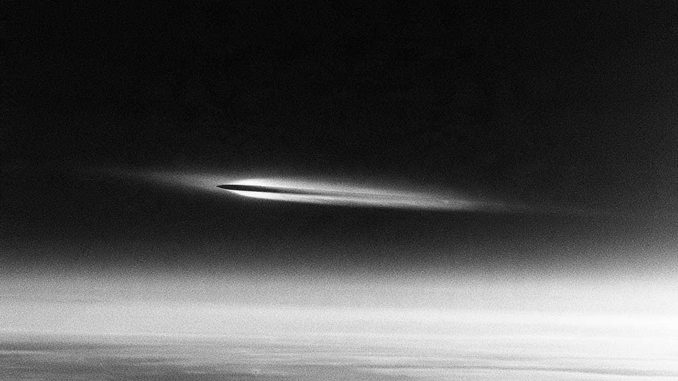
Kinzhal, ARRW, HACM, DF-17, ASN4G: the race for hypersonic missiles is transforming fighter jets into ultra-long-range strike platforms.
In Summary
Hypersonic missiles do not make fighter jets obsolete. They change their function. A fighter or bomber no longer necessarily needs to penetrate deep into air defenses to reach a strategic target. It can become a mobile platform capable of launching, from hundreds or thousands of kilometers away, a weapon flying beyond Mach 5 and leaving the adversary’s defense with very little time. Russia was the first to use a weapon presented as hypersonic in combat with the Kinzhal in Ukraine in March 2022. China has the DF-17. The United States is developing the ARRW and, above all, the HACM. France is preparing the ASN4G for the Rafale F5. But all these weapons are different. Some are ballistic, others use a hypersonic glide vehicle, and still others use a supersonic combustion ramjet (scramjet). Their true value lies less in raw speed than in the combination of range, maneuverability, precision, and the carrier’s mobility.
The hypersonic revolution does not rely solely on speed
The definition seems simple: a hypersonic weapon exceeds Mach 5, or about 6,000 km/h depending on altitude and atmospheric conditions.
But this definition is insufficient. Ballistic missiles have reached hypersonic speeds for decades. An intercontinental ballistic missile far exceeds Mach 5 when it re-enters the atmosphere.
The current breakthrough comes primarily from the combination of speed and maneuverability.
Two major technologies dominate. The Hypersonic Glide Vehicle, or HGV, is first accelerated by a rocket. The glider then separates and continues its course in the upper layers of the atmosphere while maneuvering. The Chinese DF-17 and Russian Avangard use this logic.
The Hypersonic Cruise Missile, on the other hand, remains powered for a significant portion of its flight. It generally uses a scramjet, or supersonic combustion ramjet, capable of burning its fuel in a flow of air that is already supersonic. The Russian Zircon and the future American HACM belong to this family.
The Kinzhal is different. It is essentially an air-launched ballistic missile derived from the Iskander. Calling it hypersonic is technically defensible since it exceeds Mach 5, but it does not have the same flight profile as a true hypersonic cruise missile.
Russia has transformed the MiG-31 into a strategic missile launcher
Russia was the first power to employ a weapon of this category in combat.
On March 19, 2022, Moscow announced it had fired a Kh-47M2 Kinzhal at a Ukrainian ammunition depot near Deliatyn. This was the first known use of the system in a wartime situation.
The Kinzhal measures about 8 meters long and reportedly weighs nearly 4.3 tons. Its range is generally estimated at 1,500 to 2,000 km, with a claimed maximum speed close to Mach 10. This data is difficult to verify independently.
Its value comes mostly from its carrier. The MiG-31K equipped with the Kinzhal missile can rapidly shift its launch point over hundreds of kilometers. The adversary must therefore monitor not only the missile but also the aircraft carrying it.
The price to pay is steep: a MiG-31K carries only one Kinzhal and loses much of its original interceptor function when configured for this mission.
Russia has also used the 3M22 Zircon in Ukraine. Ukrainian experts identified fragments corresponding to the missile after an attack on Kyiv on February 7, 2024. Moscow claims around Mach 9 for this scramjet weapon, but its exact operational performance remains difficult to establish.
China prioritizes the strategic depth of the Pacific
China has followed a different logic. Its best-documented hypersonic system is the DF-17, which entered service around 2019.
The missile uses a DF-ZF glider. Open-source estimates attribute a range of 1,800 to 2,500 km and a speed between Mach 5 and Mach 10 to it. Its lower and more maneuverable trajectory than a traditional ballistic trajectory makes predicting its impact point much harder.
Beijing is simultaneously developing very long-range air-launched weapons for its H-6K and H-6N bombers. The Pentagon’s 2025 report notably attributes to the H-6 and YJ-21/CJ-20 combination an operational range that can reach 4,000 to 5,500 km depending on the configuration. However, the precise characteristics of Chinese systems remain largely classified or disputed.
The objective is particularly suited to the Pacific: threatening bases, warships, and logistical infrastructure without forcing the carrier aircraft to directly penetrate the most heavily defended areas.
The United States wants missiles that are easier to carry
Washington has long dedicated significant resources to experimental hypersonics without having an operational weapon comparable to the Kinzhal or DF-17.
Lockheed Martin’s AGM-183A ARRW represents an initial approach. A booster accelerates a glider to over Mach 5 before separation. Its open-source range is estimated at around 1,600 km (1,000 miles). The B-52 can theoretically carry four ARRWs under its wings. After several failures and successes during testing, the program had been sidelined before the FY2026 budget proposed restarting its production.
But the most interesting weapon for the future of American aviation is likely the HACM, Hypersonic Attack Cruise Missile.
Developed by RTX with Northrop Grumman for propulsion, the HACM uses a scramjet. It must maintain a speed above Mach 5 while following a variable and maneuvering trajectory. The Pentagon plans its integration on the B-52H, then on the future B-52J and B-21. Its more compact format also eventually opens up more integration possibilities on tactical aircraft.
France is preparing the ASN4G for the Rafale F5
France is engaged in a different trajectory because its airborne hypersonic program is directly linked to nuclear deterrence.
In June 2026, the DGA officially ordered the development of the ASN4G from MBDA, intended to replace the upgraded ASMPA around 2035. Its precise characteristics are classified, but the DGA confirms its hypersonic nature and its carrying by the Rafale F5.
The challenge is not to transform the Rafale itself into a hypersonic aircraft. The aircraft must be able to carry the weapon, reach a favorable launch zone, and transmit the necessary data to it while remaining sufficiently far from adversary defenses.
India is also making progress. In November 2024, the DRDO tested a domestic hypersonic missile designed to carry various payloads beyond 1,500 km.
Aircraft are becoming mobile launchers rather than penetrators
This is where hypersonics truly transform the role of fighter jets.
An aircraft provides the missile with three advantages that a ground launcher does not have. It rapidly moves the starting point of the launch. It can alter the axis of attack. Finally, it adds its own combat radius to that of the weapon.
The fighter therefore becomes less of a vehicle tasked with delivering a bomb to the target itself, and more of a mobile element in a stand-off strike chain.
This evolution also favors aircraft capable of receiving information from satellites, drones, airborne radars, or other fighters. A weapon flying at several kilometers per second is worthless if the target’s coordinates are obsolete by the time it arrives.
For mobile targets, especially ships, the quality of intelligence and data links can become more important than a few extra Mach numbers.
Rational use reserves hypersonics for priority targets
Hypersonic missiles will not replace conventional cruise missiles.
They are complex, expensive, and difficult to produce in large quantities. Using a hypersonic weapon against an ordinary building or a lightly defended fixed target would make little sense when much cheaper subsonic weapons can accomplish the same mission.
Their logical domain concerns high-value targets: command centers, advanced anti-aircraft defenses, airbases, mobile missiles, major warships, or facilities that must be struck very quickly.
The Ukrainian experience has also destroyed the myth of invulnerability. Kyiv claims to have intercepted Kinzhals with Patriot systems since May 2023. Even a very fast weapon therefore remains vulnerable under certain conditions.
This reality is detailed in our analysis of the Kinzhal missile and its limitations.
The most capable missile depends on the mission
There is no serious answer today to the question of the “best hypersonic missile” without specifying the mission.
In claimed raw speed, Avangard dominates with announced speeds exceeding Mach 20. But it is a nuclear-capable strategic glider launched by an intercontinental ballistic missile, not a weapon intended for fighter jets.
Among actually employed air-launched weapons, the Kinzhal remains the operational benchmark with its announced range of 1,500 to 2,000 km and its combat experience. However, its architecture remains closer to a modified ballistic missile than to the future hypersonic model.
Zircon technologically represents an additional step forward thanks to its scramjet, but its current use is primarily naval or land-based.
HACM could offer the most interesting compromise for Western aviation: a more compact, maneuverable weapon, powered during flight, and compatible with multiple categories of aircraft. But it has yet to demonstrate its operational capabilities.
This evolution suggests above all that the future fighter jet will not be judged solely on its speed or its ability to penetrate a defense alone. Its value will depend on its capacity to detect a target, receive intelligence, approach close enough to fire, and then entrust the final part of the mission to a weapon capable of traveling hundreds of kilometers in a few minutes.
The hypersonic race thus shifts a part of the combat: the missile penetrates where the aircraft no longer needs to go.