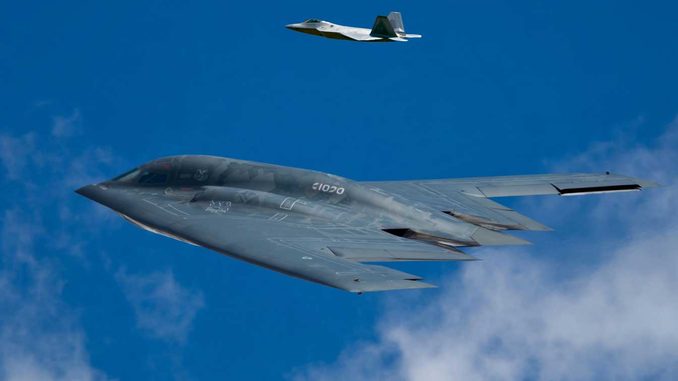
The B-21 Raider has completed its first weapons drop. Amid China’s Red Sword exercise, an analysis of weapons, stealth, and the balance of power around Taiwan.
In Brief
The B-21 Raider has reached a major milestone: in early November 2026, an aircraft dropped a conventional munition during a test flight out of Edwards Air Force Base. The U.S. Air Force confirmed the reliability of its digital models and is entering a weapons integration phase. The nature of the munition and operational performance remain undisclosed. Designed to penetrate modern air defenses, the stealth bomber is slated to arrive at Ellsworth in 2027, ahead of a gradual fleet ramp-up.
Meanwhile, satellite imagery analyzed by the Mitchell Institute reveals roughly 279 Chinese aircraft spread across eleven western bases, in what appears to be the Red Sword exercise. The buildup illustrates Beijing’s ambition: coordinating fighters, bombers, tankers, and command-and-control assets. This progression increases strategic pressure around Taiwan, though it neither proves that an offensive is imminent nor demonstrates that intimidation alone would suffice to force a capitulation.
First Weapons Drop Confirms the Maturity of the U.S. Bomber
On November 13, 2026, the U.S. Air Force announced that a B-21 Raider had conducted its first conventional weapons drop during a test flight from Edwards Air Force Base, California, the previous week. The munition was not identified, and no impact results were released. The test therefore primarily validates weapon separation rather than a fully certified combat capability.
On a stealth bomber, ordnance is carried in internal bays to minimize its radar signature. When the bay doors open, aerodynamic airflow shifts. Engineers verify that the munition separates cleanly without striking the airframe across varying speeds and altitudes. This first drop brings the B-21 into weapons testing; it does not yet make it operational.
The B-21 Program Renews the U.S. Strike Force
The Raider originated from the Long Range Strike Bomber program. Northrop Grumman won the contract in 2015. Unveiled in Palmdale in December 2022, it made its maiden flight on November 10, 2023. A second aircraft joined Edwards in September 2025, and aerial refueling was tested in 2026.
Its flying-wing silhouette recalls the B-2 Spirit, though the program places greater emphasis on higher availability and rapid upgrades. It is slated to gradually replace the B-1B Lancer and B-2 Spirit, operating alongside the modernized B-52. The target is at least 100 aircraft. The U.S. Air Force projects an average procurement cost of $692 million per aircraft, in constant 2022 dollars, including support and equipment.
B-21 production is backed by $4.5 billion in funding aimed at boosting annual manufacturing capacity by 25%. That does not translate into 25% more aircraft delivered today. The first B-21s are expected at Ellsworth Air Force Base, South Dakota, in 2027. Their arrival will not automatically mark a declaration of initial operational capability.
Open Architecture Accelerates Munitions Integration
The aircraft is built around an open architecture and a digital twin. Thousands of hours of simulation made it possible to predict post-release trajectories prior to live testing. This design is intended to streamline upgrades to sensors, communications, and armaments.
It does not, however, eliminate physical testing. Each munition requires compatibility, separation, safety, and guidance verification. The type of bomb tested in November remains unknown: no weapons family can be declared fully qualified on that basis alone.
For nuclear missions, the program plans for gravity bombs and the future AGM-181 Long Range Standoff cruise missile. U.S. law establishes separate certification timelines following initial entry into service. The conventional drop therefore does not constitute nuclear certification.
Stealth Penetration Targets Integrated Air Defenses
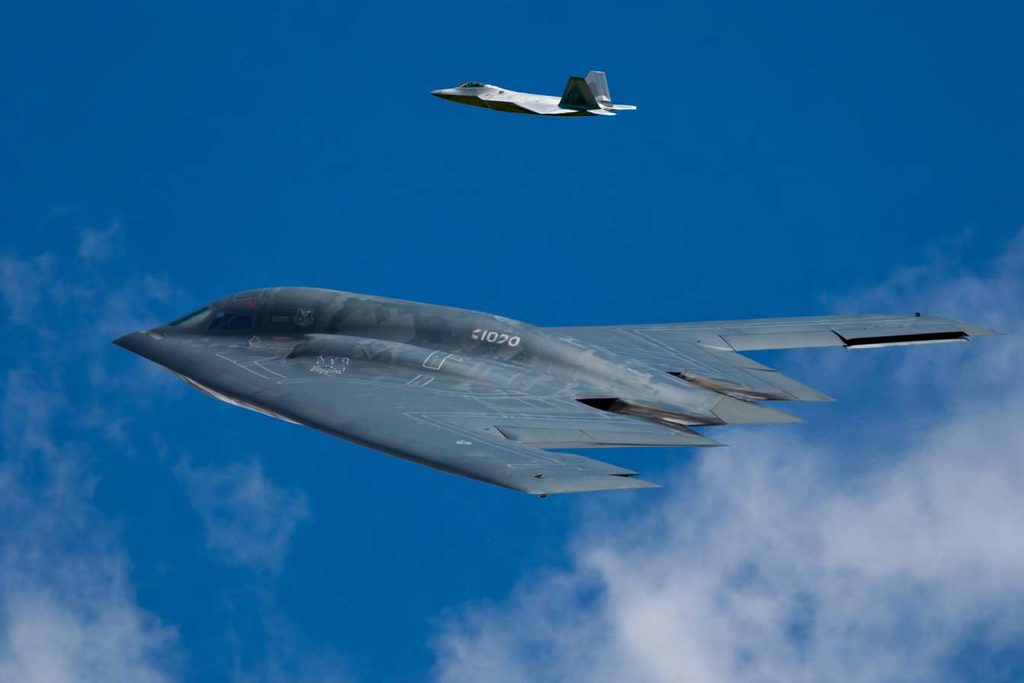
A penetrating strike involves entering hostile airspace to reach heavily defended targets. A modern air defense network combines radars, passive sensors, fighters, surface-to-air missiles, and command centers. The B-21 aims to reduce opportunities for detection, tracking, and engagement.
Its airframe shaping, internal bays, surface treatments, and emissions control all contribute to stealth. Stealth does not render the aircraft invisible. A radar may detect a presence without generating a track precise enough to guide an interception. Survivability also relies on intelligence, electronic warfare, and coordination with other forces.
In the Pacific, its intercontinental range and aerial refueling are designed to reduce reliance on forward bases exposed to Chinese missiles. Envisioned missions include strikes against command centers and hardened military infrastructure. Specific range and payload figures remain classified.
Buildup Attributed to Red Sword Reveals an Exceptional Mobilization
On November 11, the Mitchell Institute for Aerospace Studies presented satellite imagery of China’s western desert. Roughly 279 aircraft were visible across eleven bases, compared to 80 to 100 under normal conditions. Sheltered aircraft could push the total past 300. These are estimates, not figures confirmed by Beijing.
The tally includes approximately 43 stealth J-20s, 43 J-10s, 93 J-11 or J-16 fighters, 20 H-6 bombers, 16 KJ-500 radar aircraft, and 27 Y-20 transport or tanker aircraft. The Red Sword designation remains an analytical interpretation. Simultaneous presence does not prove that all of these aircraft are taking part in the same maneuvers.
Their composition nonetheless points to a large-scale exercise: simulated engagements between opposing forces, bomber escort, suppression of enemy air defenses, electronic warfare, coordinated strikes, and airborne control by KJ-500s. These scenarios are plausible, though satellites cannot confirm that they took place.
Logistics Expose the True Challenge of the Maneuvers
The Y-20s arrived as early as October 17 and 18, ahead of part of the fighter force. Deploying a force also entails transporting mechanics, spare parts, fuel, munitions, and equipment, and then keeping the aircraft mission-capable. Expanding from eight bases during the estimated 2025 exercise to eleven in 2026 multiplies those logistical demands.
For the United States, the core issue is China’s ability to coordinate disparate units, disperse its forces, and sustain operations over several weeks. Imagery captures a concentration of aircraft, not sortie rates or readiness levels. Nor does it prove successful tactical coordination.
Pressure Around Taiwan Guarantees No Capitulation
These western maneuvers coincide with patrols around Taiwan, with no direct operational link established. Taiwan’s Ministry of National Defense recorded 30 Chinese sorties between November 12 and 13, 23 of which crossed the median line of the strait. On November 4, it also reported aircraft and drones operating alongside naval vessels during a joint patrol.
These operations strain Taiwanese defenses, normalize Chinese military presence, and blur the line between routine exercises and offensive preparation. They can support a strategy of coercion or lay the groundwork for a potential blockade. They demonstrate neither that an invasion is imminent nor that Taipei will yield under pressure.
The balance of power will ultimately hinge on endurance. Beijing is showing it can mass hundreds of aircraft; Washington is showing it is bringing its stealth bomber closer to service. The decisive factor will remain the real-world availability of aircraft, crews, munitions, and supply chains, well beyond these high-profile displays.