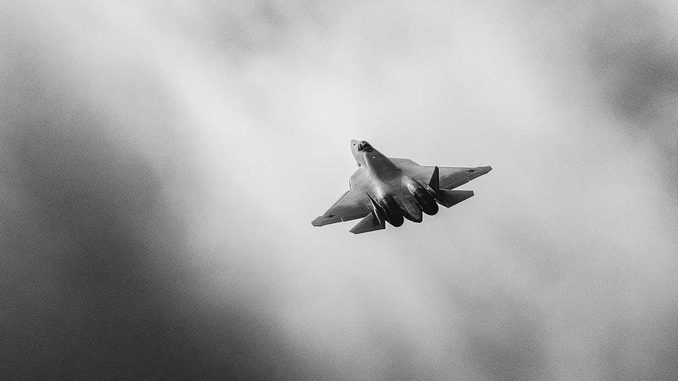
Russia is testing the two-seater Su-57D to command drones and prepare for 6th-generation air combat, despite the war and sanctions.
Summary
The Su-57D marks a major shift in Russian aeronautical strategy. The two-seater prototype made its first flight on May 19, 2026. Sukhoi does not officially present it as a 6th-generation fighter, but as a Su-57 capable of providing training and, above all, commanding a formation that combines crewed aircraft and drones. This function opens a direct path to collaborative combat with platforms like the S-70 Okhotnik. The choice is rational. The Su-75 Checkmate remains delayed and depends heavily on Rostec’s equity, while Russia must simultaneously fund the war in Ukraine, mass production, and its technological modernization. The Su-57D thus makes it possible to test new building blocks at a lower risk: artificial intelligence, drone coordination, data fusion, tactical links, automation, and new propulsion systems. However, turning this architecture into an operational capability remains far more difficult than flying a prototype.
The Su-57D Transforms an Existing Fighter into an Airborne Command Post
The shift is now concrete. United Aircraft Corporation, Sukhoi’s parent company within Rostec, announced on May 19, 2026, the start of flight tests for the Su-57D. The two-seater prototype, bearing number 055, was piloted during its first flight by Sergey Bogdan, chief test pilot at the Sukhoi Design Bureau.
The modification is immediately visible. The Su-57D features an elongated tandem cockpit allowing a second crew member to be seated behind the pilot. But reducing this evolution to a trainer aircraft would be a mistake.
Denis Manturov, Russia’s First Deputy Prime Minister, described the plane as an aircraft possessing both training capabilities and command functions. Rostec goes further. The group explains that the Su-57D must be able to organize and direct the operations of a formation combining crewed and uncrewed aircraft within a single information space.
It is this function that is strategic.
The pilot would retain responsibility for flying, aircraft survival, and essential tactical decisions. The second crew member could manage sensors, communications, weaponry, and especially multiple remotely operated drones.
The Su-57D thus potentially becomes a stealth airborne command post rather than a simple fighter with two seats.
A distinction must nevertheless be made between what is confirmed and what remains projected. Sukhoi has not announced that the second crew member will be exclusively a drone operator. The manufacturer speaks more broadly about commanding crewed and uncrewed air operations.
The idea of controlling multiple S-70 Okhotniks is, however, an old one. As early as 2021, a Russian industry source cited by TASS indicated that a two-seater Su-57 was being studied to command up to four S-70s. This capability has never been officially confirmed as a guaranteed operational feature of the Su-57D.
The Su-75 Checkmate Remains Alive but No Longer Has the Luxury of Being a Priority
The appearance of the Su-57D comes at a time when the situation of the Su-75 Checkmate remains far more uncertain.
It would be an exaggeration to say that the program is officially frozen. Rostec and Sukhoi still maintain that they are pursuing it. But its schedule has collapsed compared to initial ambitions.
When the Checkmate was presented in 2021, its first flight was envisioned for 2023. The deadline then slipped to 2024, then 2025, and finally early 2026. At the Dubai Airshow 2025, Sergey Chemezov claimed that the prototype was approaching flight tests, and Sergey Bogdan was still mentioning a first flight in early 2026. As of August 20, 2026, United Aircraft Corporation has not publicly announced this maiden flight.
The problem is structural.
The Su-75 was designed as a relatively affordable single-engine stealth fighter, primarily intended for export. United Aircraft Corporation claims a maximum payload of 7,400 kg, a range without external tanks of approximately 2,900 km, and a top speed of Mach 1.8.
These figures, however, remain industrial targets. No production aircraft currently exists to confirm them.
Above all, Rostec had acknowledged that development was financed through its own funds and not through a federal program comparable to that of the Su-57. This difference is decisive in times of war.
Russia must already produce Su-34s, Su-35Ss, and Su-57s, replace Western components that have become difficult to access, develop new weapons, maintain its strategic aviation, and fund a war that consumes vast quantities of missiles and drones.
In this context, perfecting an aircraft that is already funded and in production is far more rational than simultaneously launching a second complete combat ecosystem.
The Su-57D does not, therefore, officially replace the Checkmate. It simply responds to a much more immediate priority.
The S-70 Okhotnik Shows Both Russian Ambition and Limits
The natural partner for the Su-57D remains the S-70 Okhotnik.
This heavy combat drone adopts a flying wing configuration in order to reduce its radar cross-section. Rostec indicated a takeoff weight of approximately 20 tons and a speed close to 1,000 km/h in 2022. Its first flight dates back to August 3, 2019. A first joint flight with the Su-57 was carried out as early as September of that same year.
A more advanced version subsequently received a flattened nozzle designed to reduce its radar and infrared signature.
The principle is classic. A circular nozzle exposes more of the engine’s hot parts. A flattened output that is better integrated into the airframe limits certain detection angles and facilitates thermal masking.
On paper, the Okhotnik can play several roles.
It can fly ahead of the fighter to search for radar emissions. It can carry weapons. It can trigger the activation of a surface-to-air defense. It can serve as a communications relay. It can also allow the Su-57 to remain further back while the drone penetrates the most dangerous zone.
This architecture corresponds to the Western concept of manned-unmanned teaming, which is to say collaborative combat between crewed and uncrewed platforms.
However, Russian experience also demonstrates just how difficult this technology is.
On October 5, 2024, an S-70 operating over the Donetsk region was shot down by a Russian aircraft following a probable loss of control. Debris fell in an area held by Ukraine. Elements of a glide bomb were found in the wreckage, suggesting that the drone was participating in an armed operational test and not simply an experimental flight without a military payload.
The incident is particularly instructive.
The most difficult problem with an escort drone is not making it fly. It is maintaining control of it when the electromagnetic spectrum is jammed, satellite links are disrupted, and the aircraft is operating tens or hundreds of kilometers away from its controller.
The Su-57D attempts to address precisely this issue.
6th-Generation Building Blocks Primary Concern Data and Autonomy
The term “6th-generation fighter” remains imperfect because no official international definition exists.
American, European, Chinese, and Russian programs nevertheless converge on several technologies: improved stealth, artificial intelligence, open digital architecture, distributed sensors, escort drones, high-speed communications, and the ability to delegate more tactical decisions to machines.
Under this logic, the Su-57D constitutes less of a 6th-generation fighter and more of a testbed allowing Russia to explore some of these building blocks.
Artificial Intelligence Must Reduce Crew Cognitive Load
The first concerns onboard artificial intelligence.
Rosoboronexport confirmed in 2025 that an assistant using artificial intelligence technology was being integrated into the Su-57. The system is notably meant to assist the pilot with navigation, management of certain systems, and interpretation of tactical situations. Weapon engagement decisions remain assigned to the human pilot.
The value becomes even more obvious on the Su-57D.
A human operator cannot reasonably manually fly four drones while analyzing opposing radars, the air situation, and multiple electro-optical feeds.
The future operator will likely not give a succession of piloting orders. They will assign intent: survey a sector, jam a radar, get into position, track a target, or attack an authorized objective.
The drones will then have to determine part of their trajectory and behavior themselves.
This represents the transition from remote piloting to supervised autonomy.
Tactical Links Become as Important as the Missile
The second building block concerns resilient data links.
Controlling multiple drones requires far more than a standard radio. The Su-57D must be able to exchange positions, radar tracks, imagery, mission orders, and potentially targeting data in real time.
These communications must remain discreet so as not to reveal the group’s position. They must resist jamming. They must also function when certain nodes of the network disappear.
The difficulty is considerable.
A 6th-generation architecture must be able to continue fighting even if it loses its satellite link, its airborne early warning aircraft, or some of its drones.
It is precisely in this domain that the electronic warfare encountered in Ukraine provides Russia with particularly valuable operational experience.
Sensor Fusion Must Produce a Single Tactical Picture
The third building block is sensor fusion.
The Su-57 already possesses an unusual sensor architecture. Its N036 Byelka suite combines several X-band AESA radar arrays and L-band arrays, while the L402 Himalayas complex handles electronic warfare functions.
The challenge is not simply to install many sensors. It consists of fusing their information with that received from other aircraft and drones to create a single picture of the battle.
With an S-70 positioned 100 km ahead of it, for example, the Su-57D could theoretically exploit information collected by the drone without using its own radar as intensively.
The drone then becomes an offboard sensor.
This is a fundamental characteristic of future air combat: the missile no longer necessarily needs to be guided exclusively by the platform that launched it.
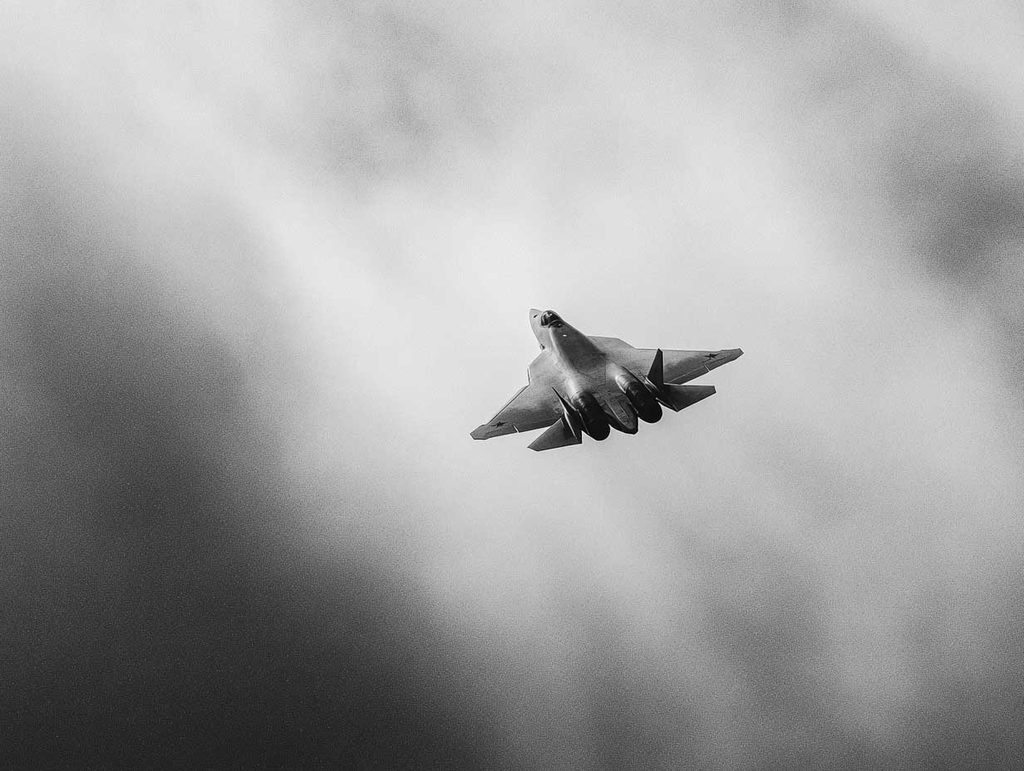
The New Engine Strengthens the Platform Without Representing a Revolution
Propulsion represents another major development.
Rostec has begun flight testing the new “Product 177” (изделие 177) engine on the Su-57. The engine manufacturer claims approximately 157 kN of thrust with afterburner, or 16,000 kgf, alongside reduced consumption and an increased service life.
This engine can improve range, performance, and the Su-57’s capacity to operate with new electrical and electronic loads.
However, it should not be portrayed as a 6th-generation engine.
Future combat systems will demand enormous amounts of electricity to power computers, AESA radars, jammers, and cooling systems. Certain foreign programs are also exploring adaptive-cycle engines capable of modifying their operation depending on thrust or endurance requirements.
No comparable capability has been publicly demonstrated on the Su-57D.
Product 177 therefore constitutes a major improvement to the existing platform, not a technological breakthrough comparable to what some future Western programs are seeking.
War Makes the Su-57D Both More Relevant and Harder to Achieve
The Russian paradox here is particularly interesting.
The war in Ukraine increases the relevance of the Su-57D. It demonstrates daily the importance of drones, electronic warfare, long-range strikes, and the rapid flow of information.
Yet it simultaneously reduces the resources available to develop these technologies long-term.
SIPRI estimates Russian military spending planned for 2026 at approximately 14.9 trillion rubles, or nearly 6.3% of gross domestic product. It had reached roughly 16 trillion rubles in 2025.
These amounts are immense. They do not mean that Sukhoi has tens of billions freely available for its future programs.
The priority remains the immediate war effort.
Rostec illustrates this tension. The group indicated that its revenue had grown by 25% in 2025, driven notably by military orders. But its net profit fell by 42%, to 76.4 billion rubles. Sergey Chemezov acknowledged in July 2026 that the group now had little equity left to launch new investment projects.
This situation explains why the Su-57D is industrially relevant.
Creating an entirely new fighter forces the funding of a new airframe, new aerodynamic testing, a new industrial assembly line, and years of qualification.
Modifying an existing Su-57 allows the reuse of engines, flight controls, radars, weapons, software, test infrastructure, and supply chains.
In a period of constraint, this is a much more realistic approach.
The Su-57D Remains a Long Way from a True 6th-Generation System
Russian communications risk masking a fundamental difference between experimenting with a technology and deploying it at scale.
Russia has already experienced this issue with the Okhotnik.
Rostec announced in 2022 the start of serial production for the S-70 in 2023. Three years later, public information still does not establish the existence of a significant operational fleet. The loss of the prototype in Ukraine in 2024 furthermore showed that mastery of control functions remained imperfect.
The same principle applies to artificial intelligence.
Having an assistant capable of advising a pilot is one thing. Allowing four aircraft to automatically decide their trajectories, allocate sectors among themselves, avoid defenses, and continue the mission after communications are cut is another.
There is currently no public evidence that Russia has mastered this degree of operational autonomy.
Industrial capacity constitutes another limitation. The Su-57 itself continues to be produced in modest quantities compared to the large fleets of Su-30s, Su-34s, and Su-35s. United Aircraft Corporation delivered another batch of modernized aircraft in 2026, which demonstrates that production continues, but Moscow no longer systematically discloses the number of aircraft in each batch.
It would therefore be premature to view the Su-57D as the start of a 6th-generation Russian fleet.
It should rather be considered an operational laboratory.
Russia’s Gamble Lies in Evolving the Su-57 Rather Than Starting from Scratch
Sukhoi’s strategy ultimately follows a fairly clear logic.
In the current context, Russia likely has little interest in multiplying entirely new combat aircraft programs. It already possesses a stealth airframe—the Su-57—a production line, a new engine under development, and a heavy drone designed to operate alongside it.
The Su-57D makes it possible to bring these elements together.
The second seat does not serve merely to train pilots. It allows for testing a new division of labor between human and machine. The pilot flies the plane. The second crew member progressively commands the system around the plane.
This is likely the most important transformation.
Next-generation air combat will no longer rely solely on a comparison between two individual fighters. A Su-57D accompanied by multiple drones could distribute its sensors, jammers, and weapons across several platforms spaced dozens of kilometers apart. Destroying one element would no longer necessarily destroy the whole system.
This logic explains why the Su-57D is strategically much more interesting than its appearance as a simple two-seater suggests.
However, it remains a fifth-generation Su-57, not a sixth-generation fighter in disguise. The most difficult technologies—advanced autonomy, resilient communications, large-scale distributed combat, and real cooperation among multiple drones in a heavily jammed environment—remain precisely the ones Moscow has yet to demonstrate.
The Su-75 promised Russia a new aircraft. The Su-57D pursues a potentially larger ambition: learning how to turn an aircraft into the brain of an entire formation.
If Sukhoi succeeds, Russia will have a credible bridge to its next generation of air combat without waiting for a new aircraft designed from a blank sheet of paper. If it fails, the Su-57D will remain an excellent indicator of the industrial limits of a power attempting to simultaneously sustain a high-intensity war and prepare the aviation of the 2040s.
War Wings Daily is an independant magazine.
Sources
United Aircraft Corporation, press release on the first flight of the two-seater Su-57 prototype, May 19, 2026.
Rostec, press release on the first flight of the Su-57D and its command functions for a crewed and uncrewed formation, May 19, 2026.
Janes, analysis of the two-seater Su-57D and its airborne command functions, 2026.
TASS, information on the two-seater Su-57 project designed to control multiple S-70 Okhotnik drones, July 27, 2021.
Aviation Week, status of the Su-75 Checkmate program and prototype preparation for flight testing, November 2025.
United Aircraft Corporation, stated industrial characteristics of the Su-75 Checkmate.
Rostec, official data on the S-70 Okhotnik, its first flight, weight, and development.
Rostec, presentation of the S-70 Okhotnik featuring a flattened, reduced-signature nozzle, December 2021.
Janes, analysis of the loss of an S-70 Okhotnik over Ukraine, October 2024.
Air & Space Forces Magazine, analysis of the destruction of the S-70 and recovery of its wreckage in Ukraine, October 2024.
Janes, information on the integration of an artificial intelligence-based assistant system on the Su-57, May 2025.
TASS, information on testing control, navigation, and weapon systems intended for future Russian air combat systems.
Rostec and United Engine Corporation, tests of the Product 177 engine and thrust characteristics.
SIPRI, A Budget for a Fifth Year of War: Military Spending in Russia’s Budget for 2026, March 2026.
Rostec, deliveries of modernized Su-57s to Russian forces in 2026.
The Moscow Times, Rostec 2025 financial results and statements by Sergey Chemezov on investment constraints, July 2026.