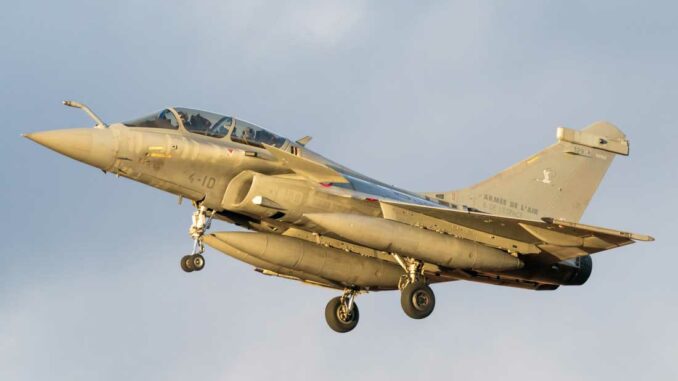
The Rafale is not a pure stealth aircraft. It combines design, materials, passive sensors, and electronic warfare to reduce its detectability.
In Summary
The Rafale was never designed as a fifth-generation stealth aircraft in the sense of the F-35 or F-22. Its philosophy is different. Dassault Aviation sought controlled low observability, compatible with a versatile, carrier-based, robust, heavily armed, and exportable aircraft. This stealth relies on several factors: adapted shapes, composite materials, surface treatments, reduction of certain radar reflections, passive sensors, SPECTRA electronic warfare, and low-altitude penetration tactics. The result is not invisibility. It is a reduced radar signature, difficult to exploit under certain conditions, especially when combined with jamming, data fusion, and long-range missiles. The Rafale therefore remains a 4.5-generation fighter. But it belongs to a specific category: that of fighters capable of surviving not through stealth alone, but through a coherent combination of concealment, detection, self-protection, and maneuverability.
The Rafale’s low-observability concept is based on a deliberate compromise
The question “Is the Rafale stealthy?” calls for a frank answer: no, not in the strict sense. The Rafale is not an aircraft designed around a large internal weapons bay, a geometry entirely optimized for radar wave deflection, or an architecture comparable to that of the F-35. It often carries its missiles, fuel tanks, and pods under its wings. These external loads mechanically increase its radar signature. This is a physical limitation, not a hidden weakness.
But reducing the Rafale to a non-stealth fighter would be just as inaccurate. Dassault Aviation describes it as a “discreet” aircraft, with a significantly reduced radar signature thanks to its shape and materials. The logic is that of low observability. It does not promise invisibility. It aims to make detection more difficult, to shorten the effective range of enemy radars, and to give the pilot a few seconds or tens of seconds’ head start in a engagement.
This approach aligns with French doctrine. The Rafale was intended to replace several types of aircraft: the Mirage 2000, Super Étendard, Jaguar, Mirage F1, and Crusader. It was intended for air defense, ground attack, reconnaissance, nuclear strike, naval support, and operations from aircraft carriers. Extreme stealth would have imposed significant constraints on internal volume, maintenance, weight, cost, and weapons payload.
The French choice was therefore more pragmatic. The Rafale is a compact aircraft, 15.30 meters long, with a wingspan of 10.90 meters, an empty weight in the 10-ton range, and a maximum takeoff weight of 24.5 tons. It can carry up to 9.5 tons of external payload across 14 hardpoints. These figures explain the trade-off: the aircraft must remain versatile and heavily armed, while being less detectable than a conventional fighter from the previous generation.
Radar signature is reduced by shapes and materials
The first aspect of the Rafale’s stealth capabilities concerns the Rafale radar signature, i.e., the radar cross-section.
Put simply, this value measures an object’s ability to reflect radar energy back to the transmitter. The lower this signature, the more difficult detection becomes at long range.
The exact radar cross-section figures for the Rafale have not been published by Dassault Aviation. Estimates circulating in the specialized press or on forums should not be treated as official data. They vary too much depending on the angle, radar frequency, load configuration, surface condition, and mission. A smooth Rafale with few external loads does not have the same signature as a Rafale loaded with fuel tanks, missiles, a TALIOS pod, or air-to-ground weapons.
What can be cautiously stated is that the Rafale employs several conventional low-observability techniques. The overall shape reduces certain frontal reflections. The air intakes, wing joints, trailing edges, and movable surfaces are designed to prevent overly distinct radar reflections. Dassault Aviation explicitly mentions the serrated patterns visible on the trailing edges of the wings and canard surfaces. These sawtooth cuts serve to break up direct reflections and disperse some of the radar energy.
Composite materials also play a role. Dassault states that composites account for 70% of the aircraft’s wetted surface area. This figure is significant. The wetted surface refers to all external surfaces exposed to airflow. The use of composites does not automatically make an aircraft stealthy, but it allows for the adjustment of certain electromagnetic properties, the reduction of certain metallic discontinuities, and the integration of specific treatments.
The Rafale likely uses radar-absorbing materials in certain areas, but their exact nature remains confidential. This is to be expected. Coatings, seals, leading-edge treatments, and manufacturing details are among the most closely guarded industrial and military secrets. In the realm of stealth, detail often matters more than the overall silhouette.
The Rafale is not optimized for absolute stealth
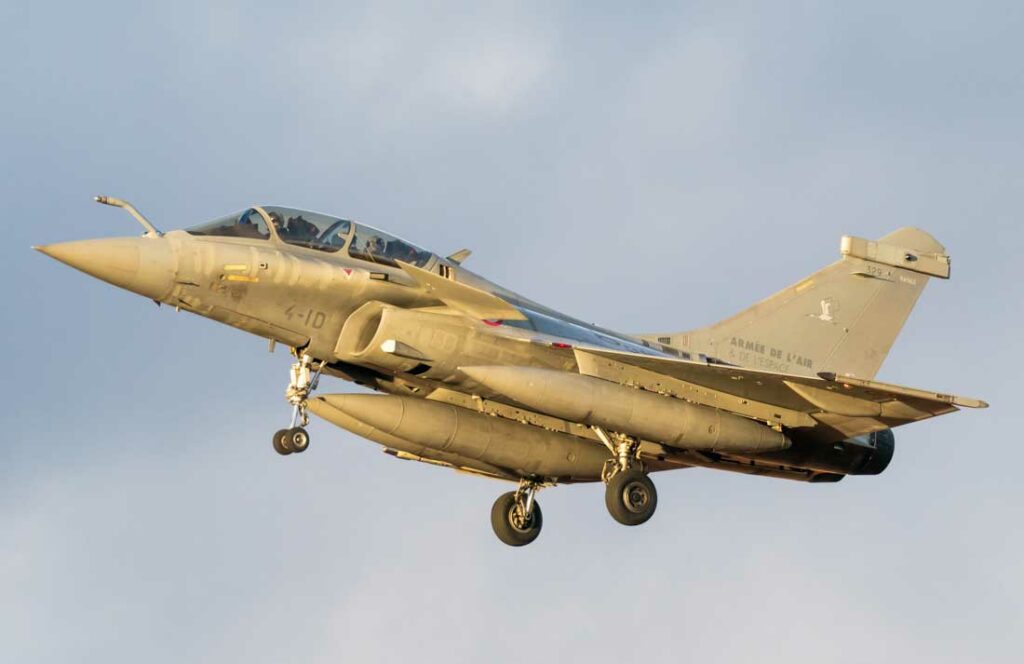
The Rafale’s low observability has a clear limitation: the aircraft carries its weapons externally. A Meteor missile, a MICA, an AASM bomb, a 2,000-liter fuel tank, or a laser designation pod create angles, pylons, and discontinuities. These elements reflect radar waves. They increase the overall signature.
This is where the difference with an F-35 becomes structural. The F-35 stores part of its armament in an internal bay to preserve its radar signature at the start of the mission. The Rafale, on the other hand, prioritizes modularity. It accepts a loss of stealth when it needs to maximize payload. This is a coherent operational choice, but it must be stated clearly: the Rafale cannot maintain a low signature in all its configurations.
This limitation does not doom the aircraft. It dictates a doctrine of use. A Rafale engaged in a penetration mission can fly with a more streamlined configuration, use its passive sensors, remain electromagnetically silent, and employ electronic warfare. A Rafale engaged in a heavy strike mission will have a higher signature, but it can rely on escort, jamming, saturation, cruise missiles, or very low-altitude flight.
The Rafale’s stealth is therefore not a fixed property.
It is a tactical variable. It depends on the mission, payload, altitude, the enemy’s radar environment, and the level of cooperation with other air assets.
The SPECTRA system transforms stealth into survivability
The core of the Rafale’s survivability is not just its shape. It is SPECTRA, its internal electronic warfare system. It was developed in collaboration with Thales and MBDA. This is a key factor, as the Rafale does not rely solely on a low passive signature. It combines this stealth capability with threat detection, localization, jamming, decoys, and automatic or semi-automatic response.
SPECTRA operates across multiple domains: electromagnetic, laser, and infrared. It includes radar warning receivers, laser warning receivers, missile launch detectors, active antenna jammers, and decoy dispensers. MBDA states that its role notably includes the DDM-NG missile detector, a threat level management unit, and multi-role decoy dispensers.
The principle is simple to explain. When an enemy radar locks onto the Rafale, SPECTRA can detect the signal, identify it, compare it to a threat database, estimate its position, and propose a response. This response may be an evasive maneuver, jamming, the release of electromagnetic or infrared decoys, or a combination of these actions.
SPECTRA’s effectiveness relies on two elements. The first is data fusion. An isolated signal can be ambiguous. Multiple cross-referenced signals become actionable. The second is the threat database. The more precise and up-to-date it is, the faster the aircraft can react. Dassault emphasizes that users can define and update this database with a high degree of autonomy. This is an advantage in environments where ground-to-air systems are evolving rapidly.
The operational impact is significant. The Rafale’s low observability reduces the probability of detection or lock-on. SPECTRA then aims to prevent the threat from completing the chain: detection, tracking, acquisition, firing, guidance, impact. Survivability therefore does not stem from a single technology. It stems from a comprehensive defensive chain.
Passive sensors allow you to see without revealing yourself
Low observability isn’t just about what the enemy sees. It’s also about what the aircraft emits. A powerful onboard radar allows for long-range detection, but it can also reveal the aircraft’s presence. That’s why passive sensors are essential.
The Rafale uses the OSF, or Frontal Sector Optronics, supplied by Thales. This system enables the detection, identification, and tracking of targets in the visible and infrared spectrum. It operates without emitting radar waves. It is therefore discreet. Dassault states that the OSF enables the detection and tracking of stealth targets, and their identification at a distance when rules of engagement require visual identification.
This is a major factor in modern air combat. A pilot cannot always fire based solely on a radar track. In many scenarios, he must identify the target. The OSF gives the Rafale passive observation capability, useful against aircraft, drones, refueling aircraft, command aircraft, or naval targets.
The RBE2 AESA radar, also supplied by Thales, remains indispensable. It offers long-range detection, multi-target tracking, ground mapping, and compatibility with the Meteor missile.
But in a low-observable strategy, the pilot can choose not to use it continuously. He can receive data from other aircraft, an AWACS, a ship, or an allied patrol via data link. He can also alternate between short bursts, stealth modes, and passive sensors.
This combination is more subtle than pure stealth. It does not make the aircraft invisible. It allows the pilot to manage its electromagnetic signature. In an airspace saturated with radars, long-range missiles, and mobile ground-to-air systems, this approach to emissions can be just as important as the aircraft’s shape.
The infrared signature remains a physical constraint
Stealth is not limited to radar. An aircraft can be detected by infrared, acoustic means, optical surveillance, or sensor fusion. The Rafale must therefore also manage its infrared signature.
Its two M88 engines are designed and manufactured by Safran Aircraft Engines. The current M88 delivers approximately 7.5 metric tons of thrust with afterburner per engine, or about 16,500 pounds. Safran reports that over 600 engines have been delivered and that the fleet has logged more than one million flight hours. The engine uses advanced technologies, including monobloc bladed discs, powder metallurgy discs, single-crystal turbine blades with ceramic coatings, and thermostructural composites.
These technologies primarily serve performance, reliability, and maintainability. They can also contribute to better thermal management. But we must not exaggerate. A twin-engine afterburner-equipped fighter jet generates significant heat. When it accelerates rapidly or climbs in altitude with the afterburner engaged, its infrared signature increases.
The Rafale compensates for this through its tactics, its missile warning system, its infrared decoys, and its ability to operate at various flight profiles. The DDM-NG integrated into SPECTRA is specifically designed to detect missile threats, particularly in the infrared spectrum. Here again, the goal is not to make the aircraft completely invisible. It is to reduce risk, detect threats earlier, and react faster.
The suppliers involved form a cohesive French supply chain
The Rafale’s low observability is not the product of a single manufacturer. It is based on an integrated French architecture. Dassault Aviation is the aircraft’s architect. It designs the airframe, aerodynamics, systems integration, and the overall coherence of the platform.
Thales plays a central role in sensors and electronics. The group supplies, in particular, the RBE2 AESA radar, the OSF, components of SPECTRA, communication, navigation, and identification systems, as well as a large part of the cockpit interface. This expertise in sensors is essential, as modern low observability depends as much on stealth as on tactical situational awareness.
MBDA is involved in SPECTRA, particularly in missile warning, threat assessment, and intelligent decoy deployment functions. MBDA is also a major player in the Rafale’s armament suite, supplying Meteor, MICA, SCALP, and other systems depending on the configuration. The effectiveness of a stealth aircraft also depends on its ability to strike before being engaged.
Safran Aircraft Engines supplies the M88. Its role is less prominent in discussions about radar stealth, but it remains crucial for thermal signature, operational availability, and flight performance. In 2025, Safran also unveiled the M88 T-REX, designed for future Rafale standards, with thrust increased to 9 tons with afterburner and approximately 20% additional thrust. This upgrade is primarily aimed at meeting the future needs of the Rafale F5.
This industrial supply chain gives the Rafale a strategic advantage: the main critical components are produced in France or Europe. For a customer nation, this reduces dependence on an American supplier. For France, this protects operational sovereignty, particularly in nuclear missions, exports, and electronic warfare upgrades.
Operational uses prioritize penetration, escort, and first strike
The Rafale’s low-observable characteristics are useful in several types of missions. The first is penetration into contested airspace. Dassault highlights automatic terrain following and AGCAS, which enable flight at very low altitude, day or night and in bad weather. Low-altitude flight reduces exposure to certain radars by exploiting terrain and the curvature of the Earth. It also increases piloting constraints, hence the value of automation.
The second use is air superiority. With the RBE2 AESA, OSF, SPECTRA, and Meteor, the Rafale can detect, identify, and engage targets at long range. Its low observability can delay enemy detection. Its passive sensors can limit its own emissions. Its long-range missile can create a threat before close combat.
The third use is air-to-ground strikes. A Rafale loaded with guided munitions is not stealthy in the strict sense, but it can approach under electronic protection, fly low, use weapons from a safe distance, and rely on coordination with other platforms. The TALIOS pod provides laser designation and day-night identification. Stealth is then just one element of a broader system.
The fourth use concerns French nuclear deterrence. The Rafale B and Rafale M can carry the upgraded ASMPA missile. In this role, survivability matters above all else. The Rafale must penetrate, survive defenses, and fire from a distance. Low observability, SPECTRA, low-altitude flight, and mission planning then become complementary.
Actual effectiveness depends on the adversary and the scenario
The effectiveness of the Rafale’s stealth cannot be summed up by a single number. Against an older radar, a poorly coordinated defense, or limited surveillance, its low signature and electronic warfare capabilities may be enough to create a clear advantage. Against a modern network combining low-frequency radars, AESA radars, infrared sensors, surveillance aircraft, long-range missiles, and data fusion, the equation becomes more challenging.
We must be realistic. A Rafale does not have the same initial penetration capability as an F-35 configured in stealth mode. It does not play in the same league when it comes to passive stealth. But it can offer another form of effectiveness: that of a more versatile, better-armed aircraft capable of very different missions, with highly integrated electronic warfare and progressive upgrades via standards.
The Rafale’s low observability is therefore credible, but relative. It is strong against medium-level threats. It is useful against high-level threats. It is not sufficient on its own against the densest defenses. In such environments, intelligence, jamming, decoys, cruise missiles, drones, coordinated attacks, and information superiority are required.
This is precisely the direction of the Rafale F4 and then the Rafale F5. The aircraft is evolving toward greater connectivity, data fusion, electronic warfare, collaborative combat, and likely integration with drones. The stealth of the future will not be solely a matter of the airframe. It will also be a matter of the network.
The Rafale illustrates another definition of modern stealth
The Rafale is not a pure “stealth fighter.” It is a low-observable multi-role fighter, designed to survive through a balance of stealth, electronic warfare, passive sensors, radar power, long-range weaponry, and flight tactics. This distinction is essential.
Its stealth is neither a myth nor a revolution comparable to the F-35. It is a serious optimization, but one constrained by versatility. The shapes, composites, serrated edges, OSF, RBE2 AESA, SPECTRA, and upgrades to the M88 engine form a coherent whole. The aircraft reduces its detectability when its configuration allows it. It jams, deceives, detects, and maneuvers as the threat approaches.
The Rafale’s true strength is not in being invisible. It lies in never relying on a single attribute. In modern air warfare, this approach makes sense. Passive stealth can be circumvented over time. Radars evolve. Infrared sensors advance. Networks fuse their data. An aircraft that stakes everything on a minimal signature also takes a doctrinal risk.
The Rafale takes a different path: remaining discreet enough to complicate the enemy’s task, connected enough to exploit allied intelligence, armed enough to strike hard, and adaptable enough to integrate new standards. It is less spectacular than a discourse on invisibility. It is probably closer to operational reality.
War Wings Daily is an independant magazine.