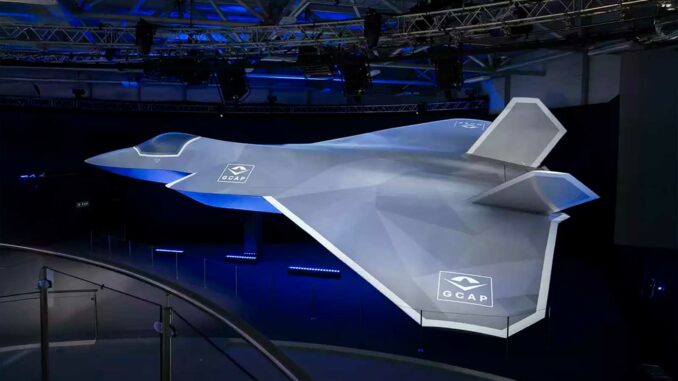
The American F-47, Chinese J-36/J-50 prototypes, and the European GCAP: the race for sixth-generation fighters reveals a profound strategic shift.
Summary
The race for sixth-generation fighter jets is no longer a distant projection. It now pits three visible blocs against each other: the United States with Boeing’s F-47, China with prototypes frequently designated J-36 and J-50, and the GCAP led by the United Kingdom, Italy, and Japan. The F-47 holds the budgetary and institutional advantage. China displays a spectacular lead in visible trials, with two tailless stealth airframes observed since December 2024. GCAP is progressing but remains further from entering service, which is announced for 2035. Meanwhile, the French-German-Spanish FCAS remains hampered by industrial conflicts between Dassault Aviation and Airbus. The stakes extend far beyond technology; they encompass air superiority, combat drones, the Indo-Pacific, and the capacity of major powers to dictate the strategic tempo.
The new air superiority triangle takes shape
The race for sixth-generation fighters has long been described as an abstract rivalry. This is no longer the case. Programs are funded, contracts exist, prototypes are flying, and armed forces are beginning to build their doctrines around a common principle: the manned fighter will no longer be alone in combat.
The balance of power is currently concentrated around three axes. The first is American, featuring Boeing’s F-47, selected in March 2025 to carry the Next Generation Air Dominance program, or NGAD. The second is Chinese, with two tailless stealth aircraft observed in flight since late 2024, often designated J-36 and J-50 by analysts. The third is Euro-Asian, with the GCAP, a joint program between the United Kingdom, Italy, and Japan.
This triangulation is significant. It demonstrates that the sixth generation is no longer limited to a duel between Washington and Beijing. Japan is directly involved in GCAP. The United Kingdom seeks to preserve its status as a military aviation power. Italy is investing heavily to remain at the industrial core of future aerial combat. Continental Europe, conversely, appears divided between a progressing GCAP and a stalling FCAS.
The matter is therefore military, industrial, and political. Whoever succeeds in mastering the sixth generation will not just produce a new aircraft; they will control the architecture of aerial warfare for the 2030s and 2040s.
The American F-47 advances with a funding advantage
The F-47 is currently the most robust program from a budgetary standpoint. The US Air Force awarded Boeing the Engineering and Manufacturing Development contract in March 2025. This contract paves the way for detailed design, testing, initial test aircraft, and potential low-rate initial production.
Budgets confirm this acceleration. American documents mention approximately $3.5 billion in FY2026, over $5 billion in FY2027, and nearly $5.3 billion in FY2028 for the research, development, test, and evaluation of the F-47. This pace is far from mere study funding; it corresponds to a program undergoing industrialization.
The first flight is targeted for around 2028. The US Air Force speaks of a combat radius exceeding 1,852 kilometers (1,000 nautical miles) and speeds above Mach 2. It also projects a fleet of at least 185 aircraft, an order of magnitude close to the current F-22 fleet. The message is clear: the United States does not just want to demonstrate a technology; they want to field a combat capability.
The F-47 is intended to replace the F-22 in the air superiority mission. It will not directly replace the F-35, which remains a multirole aircraft that is exported and widely deployed. The F-47 will be more specialized. It must penetrate the most contested airspaces, detect from afar, strike quickly, survive, and coordinate combat drones.
This choice reflects a strategic reality. The US Air Force knows that the F-22 remains exceptional but rare. It also knows that the F-35 was not designed to single-handedly cover the immense distances of the Indo-Pacific. Against China, range becomes just as critical as stealth.
American technology bets on the system, not just the aircraft
The F-47 is not merely a faster stealth fighter. It is conceived as the heart of a family of systems. This expression is essential. It means that the manned aircraft will be linked to drones, sensors, satellites, surveillance aircraft, cyber assets, and long-range weapons.
Stealth remains central. However, it is no longer just about radar; it must also encompass infrared signatures, electronic emissions, data links, and the ability to remain discreet while receiving or sharing information. Modern aerial warfare is no longer just about not being seen; it is about seeing without speaking too loudly.
Supercruise is equally important. It allows for supersonic flight without afterburners, which reduces fuel consumption and limits thermal signatures. In the Pacific, where distances are considerable, this capability provides a tactical advantage. It allows the aircraft to reach the missile launch zone faster, impart more energy to the missiles, and exit before the adversary organizes a counter-response.
Adaptive propulsion is set to play a major role. A next-generation engine can alternate between fuel economy, high thrust, and thermal management. This final point is often underestimated. Sensors, processors, electronic warfare systems, and data links generate significant heat. In a stealth aircraft, dissipating this heat becomes a problem of survivability.
CCA drones redefine the fighter itself
The F-47 will be judged as much by its drones as by its own performance. The US Air Force is developing Collaborative Combat Aircraft, or CCAs. The two prototypes officially designated are the YFQ-42A from General Atomics and the YFQ-44A from Anduril. The choice of the letter F is symbolic: the United States now recognizes certain drones as combat aircraft, rather than mere auxiliaries.
The ultimate American goal exceeds 1,000 CCAs. These drones are meant to accompany F-47s, F-35s, and other manned platforms. They will be able to detect, jam, draw fire, carry missiles, strike radars, or act as communication relays. Some will be recoverable. Others could be accepted as tactical losses if their unit cost permits.
This is a major doctrinal shift. An F-47 pilot will not just be an aviator; they will become the manager of a group of systems. Human decision-making will remain central, but software autonomy will take up more space. Aerial combat will no longer be an addition of isolated planes; it will become a mobile, distributed, and partially autonomous network.
The core challenge will be trust. A drone can fly on its own. But can it make decisions in a jammed environment? Can it continue its mission without GPS? Can it distinguish a real target from a decoy? Can it receive a simple command and adapt it to a fluid situation? This is where the sixth generation will truly be won or lost—not just in the shape of the wing.
Chinese prototypes show a visible and unsettling advance
China captured international attention on December 26, 2024. Images revealed two unknown military aircraft featuring highly pronounced stealth geometries and no tailplanes. Reuters confirmed a video of the larger aircraft by cross-referencing it with buildings and satellite imagery, though it could not independently verify the date. While the designations J-36 and J-50 remain unofficial, they have become established in public debate.
The larger aircraft, frequently referred to as the J-36, presents a diamond shape, a highly blended wing-body design, and an unusual configuration with three air intakes. Some analysts view it as a long-range platform, potentially destined for air superiority, maritime strike, drone command, or deep-penetration missions. The smaller one, often called the J-50, appears closer to a maneuverable stealth fighter, potentially linked to Shenyang.
Prudence is required. The engines are unknown. The sensors are unknown. The actual level of stealth is unknown, as is the maturity of the software. Seeing a prototype fly does not mean a military possesses an operational aircraft. However, it would be equally incorrect to minimize the event.
China is demonstrating a capacity for rapid experimentation. It is flying multiple configurations. It is embracing audacious designs. It is testing publicly—or at least visibly—shapes that the West did not expect to see so early. This is an industrial signal as much as a military one.
The most unsettling point for Washington is not that China has already won the race; that remains unproven. The troubling aspect is that Beijing is moving fast, utilizing a multi-prototype logic, whereas Western programs are frequently slowed by budgetary arbitrations, administrative requirements, and industrial compromises.
GCAP progresses, but with a more distant timeline
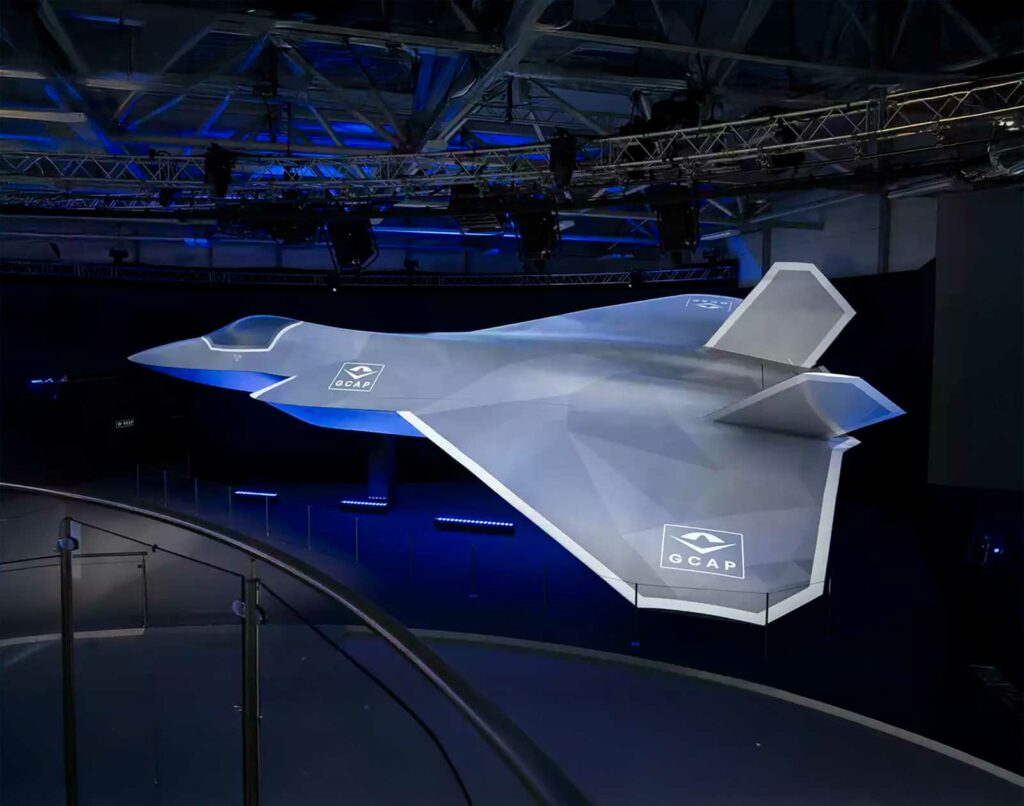
The UK-Italy-Japan GCAP is the most politically coherent non-American program. Launched in December 2022, it targets a next-generation combat aircraft by 2035. It brings together BAE Systems, Leonardo, and Japan Aircraft Industrial Enhancement, supported by Mitsubishi Heavy Industries. The joint industrial structure operates under the name Edgewing.
A recent 686-million-pound contract is set to fund design and engineering activities. Running until June 2026, it maintains momentum ahead of more comprehensive long-term commitments. While this amount is lower than the American budgets for the F-47, it holds significant value: it transforms the GCAP cooperation into concrete industrial work.
Italy approved 8.77 billion euros for the initial phases of the program, to be spent through 2037. Estimates for these early phases have also risen sharply to 18.6 billion euros, compared to approximately 6 billion euros at 2021 prices. This inflation is not unusual for a program of this complexity; it reflects technological maturity, trials, sensors, software, propulsion, and drone systems.
GCAP bets on a manned fighter connected to unmanned platforms, advanced sensors, and a combat network. Its interest is geopolitical. Japan brings the direct operational pressure of the Indo-Pacific. The United Kingdom brings Tempest experience and a solid industrial heritage. Italy brings Leonardo, electronics, sensors, and a major industrial base.
GCAP is not ahead of the F-47, nor is it as visible as the Chinese prototypes. However, it possesses a clearer governance structure than FCAS. That alone is a major asset.
The European FCAS illustrates the cost of industrial gridlocks
The European FCAS (SCAF) was intended to embody the continent’s strategic autonomy. It was meant to unite France, Germany, and Spain around a next-generation fighter, drones, a combat cloud, and connected armaments. On paper, the ambition is strong. In reality, the program is blocked by deep-seated tensions between Dassault Aviation and Airbus.
The core of the conflict is straightforward. Dassault wants clear leadership over the development of the fighter. The company believes it possesses unique experience from the Rafale, discrete stealth, flight controls, weapons integration, and sovereign French combat aviation. Airbus, representing Germany and Spain in this pillar, wants a more balanced industrial distribution.
The disagreement centers on three topics: intellectual property, the division of responsibilities, and certification. These words may sound technical, but they are deeply political. Intellectual property determines who owns the know-how. The industrial workshare decides where jobs and skills will go. Certification determines who bears the technical and legal risk.
Tensions have become public. Dassault has raised the possibility of developing a separate aircraft for under 50 billion euros. Airbus speaks of progress on systems but acknowledges the gridlock surrounding the fighter. Some European officials are considering salvaging the drones and the combat cloud while abandoning the idea of a single, joint aircraft.
This is a serious situation. FCAS does not lack engineers; it lacks decisions. It does not lack expertise; it lacks clear industrial command.
The European delay stems from a divergence of sovereignties
The delay of FCAS is not merely the product of a clash between two industrial giants. It stems from a deeper strategic divergence. France wants an aircraft capable of carrying its nuclear deterrent, supporting its expeditionary model, and preserving Dassault’s independence. Germany reasons more in terms of industrial workshare, economic return, European cooperation, and NATO integration. Spain seeks to preserve its position in sensors and systems.
These priorities are not absurd; they are simply difficult to merge into a single aircraft. A sixth-generation fighter cannot be shared like a commercial train or a satellite. The architecture must be coherent, and the prime contractor must make the final decisions. Perpetual compromises risk creating an aircraft that is too heavy, too expensive, too late, and less performant.
European history illustrates this. The Eurofighter Typhoon is an excellent aircraft, but its development was lengthy and its architecture reflected national compromises. The Rafale, developed independently by France, was less consensual initially but industrially more coherent. FCAS is reactivating this old fracture.
The contrast with the United States and China is brutal. Washington can decide; Beijing can impose. Europe must negotiate. In a rapid technological race, this weakness becomes strategic.
Indo-Pacific stakes structure the entire race
The Indo-Pacific is the theater that explains the urgency. Taiwan, the South China Sea, the Japanese islands, Guam, the Philippines, and maritime shipping lanes are becoming the primary friction points. Distances are enormous. Bases are vulnerable. Tankers are threatened. Chinese anti-aircraft and anti-ship missiles create anti-access/area-denial (A2/AD) bubbles.
In this context, a sixth-generation fighter must achieve three goals: go far, survive, and command remote effectors. Combat radius becomes just as decisive as maneuverability. Stealth becomes a prerequisite for entry. Drones become a way to generate mass without exposing too many pilots.
Japan understands this problem better than many Europeans. Its participation in GCAP is not symbolic; it responds directly to rising Chinese power and the geographical proximity of risk. For Tokyo, the sixth generation is not an abstract industrial ambition; it is a strategic insurance policy.
The United States reasons along the same lines. The F-47 is not designed to bomb armed groups in a permissive environment. It is engineered to confront a power equipped with radars, missiles, satellites, cyber capabilities, stealth fighters, and an immense industrial depth. That power is China.
The United States retains the systemic lead, China dictates the tempo
The most difficult question is that of actual leadership. Who is ahead? The answer depends on the criteria used.
The United States retains the systemic advantage. They possess the highest funding, a long history of operational stealth, advanced engines, proven sensors, networked warfare doctrines, and a unique capacity to integrate aircraft, satellites, drones, missiles, and command elements. The F-47 also benefits from classified trials conducted with X-planes over several years.
China dictates the advantage of visibility and speed. It is showing prototypes. It is testing multiple airframes. It appears to embrace a logic of rapid iteration. Its weakness lies elsewhere: the actual maturity of its engines, sensors, software, weapons, and integration with combat drones remains unknown. A futuristic aircraft that flies is not yet a complete system of warfare.
GCAP possesses a clear strategic logic, but its timeline places it behind. An entry into service in 2035 allows for time, but it also introduces risk. If the F-47 flies in 2028 and Chinese prototypes continue their trials, GCAP will arrive in a competition already structured by others.
FCAS remains the major loser of the moment—not because it is technologically inferior, but because it is failing to translate its expertise into a firm industrial decision.
The next frontier will be production, not the prototype
The sixth generation will not be won with a mock-up, an announcement, or even a maiden flight. It will be won through production, maintenance, software, associated drones, engines, and the ability to update systems every two or three years.
This is where the race becomes harder. The United States has the money, but their programs risk becoming too expensive. China has the tempo but must prove quality and reliability. GCAP has political coherence but must accelerate without letting costs explode. FCAS must decide whether it still wants to produce a joint aircraft or merely salvage the technological building blocks of the system.
The sixth-generation fighter will not just be a stealthier plane. It will be a flying command node, linked to drones, long-range weapons, distributed sensors, and combat networks. Its value will depend less on an isolated performance and more on its capacity to orchestrate a battle.
The race is well underway. The F-47 leads through funding and structure. China impresses with its prototypes. GCAP is advancing with caution. FCAS is paying the price for European ambiguity. In the skies of the 2030s, the advantage will go to the side that knows how to unite three things: technology, mass, and political decision-making.
War Wings Daily is an independant magazine.