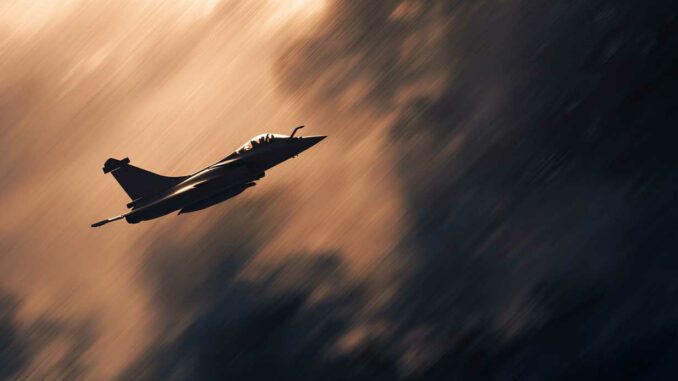
How fighter jets gain speed through engines, aerodynamics, materials, and in-flight measurement systems.
The evolution of fighter jet speed tells an essential part of military aviation history. From the piston-engine fighters of World War II to today’s supersonic aircraft, each generation has sought to fly faster, higher, longer, and with greater precision. Speed is not just a spectacular statistic. It dictates interception, survival against missiles, the ability to reach an operational area, and the capability to rapidly exit threatened airspace. However, it depends on several factors: propulsion, aerodynamics, altitude, aircraft mass, weapon payload, fuel consumption, and even radar signature.
From piston engines to supersonic jets
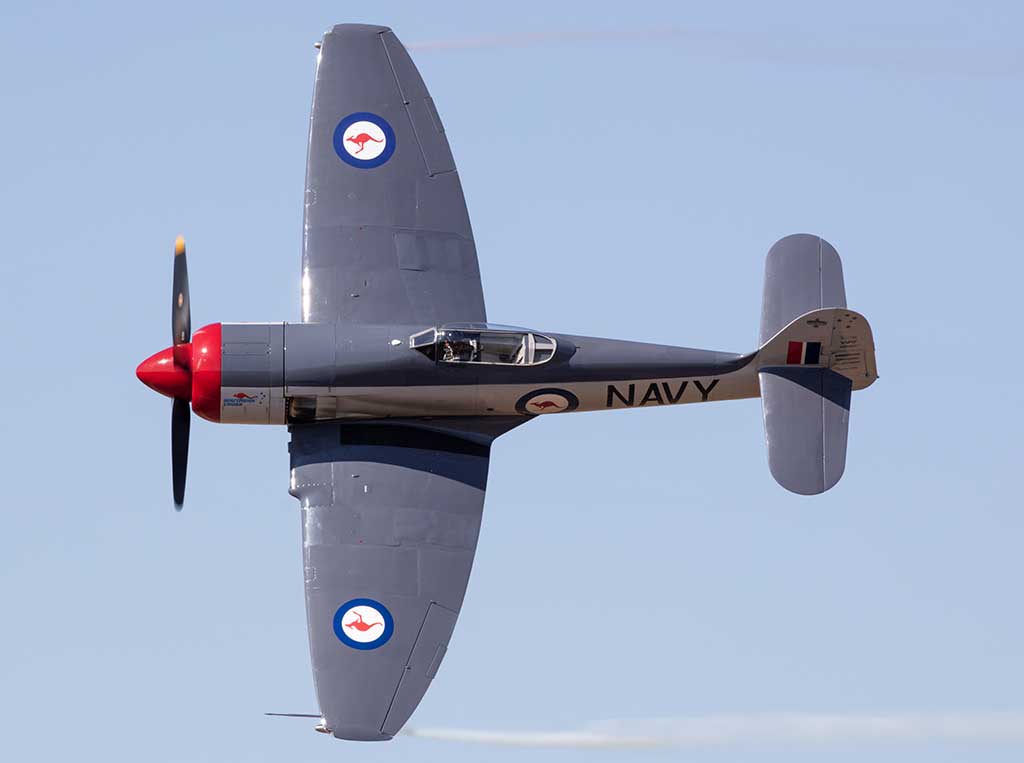
The first fast fighter jets relied on piston engines. These engines, paired with a propeller, allowed for major advancements before and during World War II. The Supermarine Spitfire is a prime example. Equipped with a Rolls-Royce Merlin engine, it could reach approximately 590 km/h depending on the version. At the time, this performance was remarkable. It allowed for the interception of bombers, maneuvering in close-quarters dogfights, and maintaining the upper hand against slower aircraft.
But the piston engine had a physical limitation. As speed increased, the propeller became less efficient. The tips of the blades could approach the speed of sound, creating compressibility phenomena, vibrations, and a loss of efficiency. At high altitudes, the drop in air density also reduced engine performance, even though superchargers and turbochargers helped delay this issue.
The arrival of the jet engine therefore marked a breakthrough. The Messerschmitt Me 262, the first operational jet fighter, surpassed the performance of propeller fighters by reaching around 870 km/h. This shift transformed aerial combat. A faster aircraft could choose when to engage, attack, and then break away before the opponent could react. Speed became a tactical tool.
After 1945, progress was rapid. Jet engines became more powerful, more reliable, and better suited for high-altitude flight. Cold War aircraft, such as the MiG-21, the Mirage III, the F-104 Starfighter, or the F-4 Phantom II, brought fighter aviation into the era of supersonic flight. The Mach 2 barrier became a technological symbol, even though few aircraft could sustain this speed for long in operational situations.
Why Mach matters more than kilometers per hour
The speed of a military aircraft is often expressed in Mach. The Mach number represents the ratio between the speed of the aircraft and the speed of sound in the surrounding air. However, the speed of sound varies with temperature, and therefore with altitude. This is why Mach 1 does not correspond to the exact same speed in kilometers per hour at sea level as it does at 12,000 meters.
This distinction is important. An aircraft can display an impressive speed in km/h at low altitude but experience very high drag. At high altitudes, the air is less dense. Drag decreases, which facilitates high speeds. On the other hand, lift also drops. To stay airborne, the aircraft must fly faster or use an adapted lifting surface.
This is one of the reasons why maximum speeds advertised by manufacturers must be read with caution. They often correspond to a precise configuration: optimal altitude, lightly loaded aircraft, absence of external fuel tanks, limited weaponry, and controlled atmospheric conditions. A fighter on a real mission, with missiles, drop tanks, and fuel, often flies much slower than its theoretical maximum speed.
Aerodynamics, key to the transition to supersonic
Propulsion alone is not enough. To fly fast, an aircraft must also cut through the air with the least possible resistance. Aerodynamic drag increases sharply with speed. As Mach 1 approaches, shockwaves appear on certain parts of the aircraft. They cause a sudden surge in drag, known as wave drag.
To reduce this effect, engineers developed swept wings, and later delta wings. These shapes allow for better management of airflow at high speeds. The MiG-21, with its delta wing, illustrates this logic. Its simple, compact design, highly oriented toward speed, allowed it to reach Mach 2 under certain conditions.
Modern aircraft go further. Their fuselage, air intakes, tail assemblies, and control surfaces are designed to balance speed, maneuverability, stealth, and range. The F-35, for example, is not the fastest fighter jet of its generation. Its maximum speed is lower than that of some older aircraft. But its design prioritizes stealth, data fusion, internal weapons carriage, and the ability to operate in an environment saturated with radars and missiles.
The pursuit of pure speed is therefore no longer the sole priority. An aircraft that is too fast but highly visible can become vulnerable. Conversely, a slower aircraft capable of detecting, striking, and disappearing more effectively can offer a superior operational advantage.
Materials, heat, and physical limits
At very high speeds, the air heats the aircraft’s surfaces through friction and compression. This phenomenon becomes critical beyond Mach 2, and extreme beyond Mach 3. The SR-71 Blackbird, designed for strategic reconnaissance, is the most famous example. It could exceed Mach 3 at altitudes of over 24,000 meters. To withstand these conditions, it made extensive use of titanium and a design adapted to thermal expansion.
This constraint explains why not all fighter jets attempt to reach Mach 3. Such a speed mandates expensive materials, complex maintenance, very high fuel consumption, and significant stress on the airframe. For a multirole fighter, it is often more useful to have good acceleration, high maneuverability, a strong radar, and sufficient range rather than a maximum speed that is rarely exploitable.
Composite materials have also changed the design of recent aircraft. They help reduce weight, reinforce certain structures, and improve radar discretion. They do not only serve to fly faster. They contribute to better overall efficiency: less weight, more available fuel, better endurance, and finer integration of stealth shapes.
The role of altitude in performance
The relationship between speed and altitude is central. At low altitudes, dense air heavily increases resistance. An aircraft must consume more fuel to maintain a high speed. Turbulence, terrain, and structural constraints also make fast flight more difficult. This is why maximum speeds at low altitude are often lower than those achieved at high altitude.
The A-10 Thunderbolt II illustrates a different design choice. It was not thought out for pure speed, but for close air support. Its maximum speed, around 700 km/h, remains modest for a military aircraft. In contrast, it can fly slowly, loiter over the battlefield for long periods, take damage, and use its cannon with precision against ground targets.
At high altitude, the situation changes. The lower density reduces drag. Reconnaissance or interception aircraft can exploit much higher speeds there. The SR-71, but also certain Cold War interceptors like the MiG-25 and MiG-31, were designed to take advantage of this environment. Their mission was less about turning dogfights and more about rapid interception or high-speed reconnaissance.
How is the speed of a fighter jet measured?
Measuring speed in flight is more complex than a simple speedometer reading. The pilot utilizes several pieces of information. The indicated airspeed depends on the dynamic pressure measured by the pitot-static system. This system compares total pressure, captured by the pitot tube, to the static pressure of the ambient air. It allows for an estimation of the aircraft’s speed relative to the air mass.
But this indicated airspeed is not always enough. Pilots and engineers also use true airspeed, ground speed, and the Mach number. True airspeed accounts for altitude and air density. Ground speed depends on the actual movement relative to the ground, and therefore on the wind. The Machmeter, meanwhile, becomes indispensable for fast aircraft, as it indicates proximity to transonic and supersonic regimes.
Before being validated, an aircraft’s performance is studied in a wind tunnel, and then in flight testing. Wind tunnel tests allow for the measurement of lift, drag, shockwave effects, and the behavior of air intakes. Flight tests then verify the data under real conditions. This phase is long, expensive, and essential to guarantee the safety of the aircraft.
Speed, aerial combat, and operational reality
In modern aerial combat, speed remains important, but it never acts alone. A fast aircraft can reach a zone quicker, launch a missile with more kinetic energy, and disengage faster. But it must also detect before being detected, communicate with other platforms, and survive against opposing radars.
Modern air-to-air missiles have changed the logic of combat. The speed of the launch platform can improve the initial range of the missile, but the quality of the radar, infrared sensors, data links, and electronic warfare becomes just as decisive. Maneuverability remains useful, but close-range dogfighting is no longer the dominant scenario in modern doctrines.
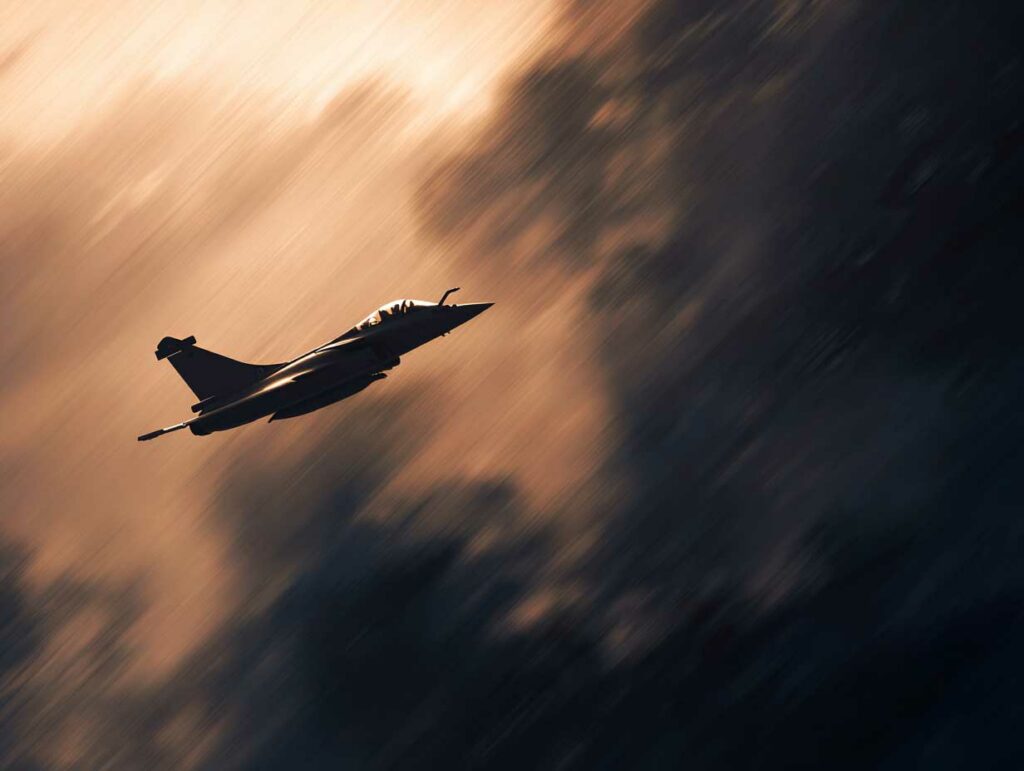
This is why current aircraft seek a balance. The Rafale, Eurofighter Typhoon, F-22, F-35, or Gripen do not respond to the exact same priorities. Some prioritize supercruise, others stealth, versatility, operating costs, or connectivity. Speed is one part of the equation, not the entire equation.
What is the future for military speed?
The future could bring speed back to the center of the debate with hypersonic propulsion. Hypersonic missiles already exist in military doctrines, but applying this type of performance to a manned or reusable aircraft remains very difficult. Thermal constraints, materials, cost, consumption, and safety heavily complicate scaling up.
Future combat aircraft are more likely to combine several qualities: sufficient speed, radar discretion, advanced sensors, artificial intelligence for decision support, wingman drones, and long-range weaponry. Hypersonic propulsion might affect certain specialized missiles or drones before it transforms manned fighters.
The speed of fighter jets therefore remains an essential indicator, but it must be placed back into context. Flying fast is no longer enough. One must fly fast at the right time, at the right altitude, with the right payload, while retaining enough fuel, discretion, and combat capability. It is this combination of engine, aerodynamics, sensors, and tactics that defines true military aircraft performance today.
War Wings Daily is an independant magazine.