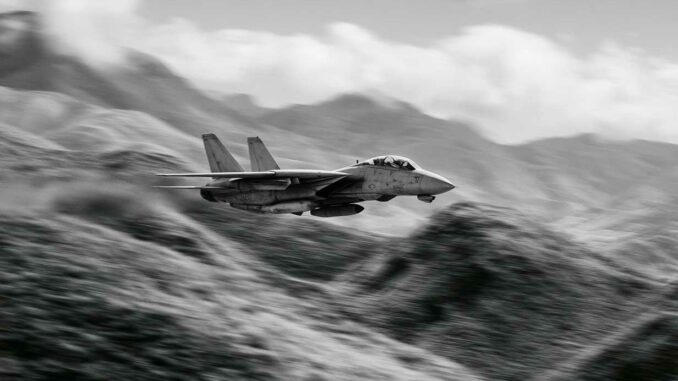
In the F-14 Tomcat, Goose was not a co-pilot. Without a stick or throttles, the RIO directed the radar, weapons, and interception.
Summary
The F-14 Tomcat possessed two seats, but only one pilot. In the forward cockpit, the pilot controlled the stick, the two jet engines, and the flight surfaces. In the rear, the Radar Intercept Officer, or RIO, had no flight stick, throttles, or rudder pedals usable for flying the aircraft. His mission was completely different. He operated the AN/AWG-9 radar, organized interceptions, classified threats, and prepared the deployment of AIM-54 Phoenix missiles. This system could track 24 targets and guide six missiles toward six distinct objectives. The rear seat therefore resembled a combat information center more than a backup cockpit. If the pilot lost consciousness, the RIO could transmit a message, adjust certain systems, and trigger ejection. He could not, however, fly the Tomcat back to an aircraft carrier. Goose was not Maverick’s second pilot; he was the other half of a weapon system designed to defend an entire fleet.
The Second Seat Did Not Signify a Second Pilot
The presence of two people in a military aircraft creates immediate confusion. The public naturally imagines a pilot and a co-pilot, as found in a transport aircraft. The F-14 Tomcat did not function this way.
The crew member installed in the front was the sole pilot of the aircraft. He possessed the stick, the two throttles, the rudder pedals, the wing sweep controls, and the instruments necessary for flight. He handled takeoff, dogfighting, aerial refueling, approach, and landing.
The officer positioned in the rear was a Radar Intercept Officer, generally designated by the acronym RIO. He belonged to the Naval Flight Officer community. His training focused on navigation, radars, interception, communications, weapons, and tactical mission management.
The RIO was therefore neither a passenger nor an administrative assistant. Nor did he serve as a backup pilot. He performed a completely distinct job.
This organization stemmed directly from the mission assigned to the Tomcat. The F-14 was designed to protect American carrier strike groups against Soviet bombers and their anti-ship missiles. It had to detect multiple aircraft at long range, identify them, establish their threat level, and engage several targets almost simultaneously.
A single man could hardly pilot a heavy fighter from an aircraft carrier while operating a complex radar, monitoring multiple tracks, and preparing missile launches at distances exceeding 100 kilometers. Grumman and the U.S. Navy therefore divided the workload between two specialists.
The F-14 counted two aviators, but only one pilot.
The Rear Cockpit Hid No Backup Flight Controls
The difference was immediately apparent in the layout of the two cockpits.
In the front, the pilot found a central flight stick, the two engine throttles on his left, and rudder pedals at his feet. These controls acted on the flight surfaces, engine thrust, and the movement of the aircraft around its three axes.
The rear cockpit did not replicate this installation. It possessed no stick connected to the flight controls. It had no throttles to control the engines. It featured no rudder pedals to direct the vertical stabilizers.
Photographs of the rear seat nevertheless show several handles that can resemble flight controls. This resemblance feeds part of the myth.
The primary handle installed in front of the RIO was a radar control stick, not a flight stick. It was used to move cursors, select tracks, and control certain functions of the weapon system.
On Tomcats later adapted for strike missions, another controller allowed the RIO to manipulate the LANTIRN targeting pod. There again, it directed a sensor and its laser. It controlled neither roll, nor pitch, nor the flight path of the aircraft.
This absence of controls was not a matter of improvised cost-cutting. The rear cockpit had been designed from the outset as a specialized station. Installing full flight controls would have required more mechanisms, wiring, volume, and mass. It would have also reduced the space available for the screens and panels of the weapon system.
Safety did not rely on the possibility of the RIO taking over the aircraft. It relied on system reliability, crew procedures, and the two ejection seats.
The AWG-9 Radar Imposed a Full-Time Specialist
The heart of the F-14 was not merely its variable-geometry wing. It was the AN/AWG-9 radar designed by Hughes.
This pulse-Doppler radar was developed at a time when onboard computers remained bulky, slow, and poorly automated. The crew had to understand system behavior, select its modes, and interpret displays that demanded genuine expertise.
The AWG-9 could search for targets at high or low altitudes. Its look-down capability allowed it to spot an aircraft flying beneath the Tomcat, despite the radar clutter returned by the sea or the ground. This capability was essential for detecting a bomber or a cruise missile operating at low altitude.
The radar could track up to 24 targets and prepare the engagement of six of them. This capability far exceeded that of many contemporary fighters.
The RIO worked primarily with two large displays.
The Detail Data Display presented raw radar information and specific parameters of a target. The Tactical Information Display offered a more synthesized representation of the situation. It showed tracks, their relative positions, interception paths, and information received via data link.
The RIO had to distinguish a real target from parasitic clutter. He controlled the orientation and search volume of the radar. He selected the appropriate modes. He classified tracks based on their speed, altitude, and direction.
He also had to prevent the crew from fixating on the wrong threat. A lone bomber could serve as a diversion while another group approached at low altitude. A fast contact could be a fighter, a missile, or an poorly established track.
The pilot retained certain simplified radar functions for close combat. In a short-range engagement, he could use rapid acquisition modes without waiting for complex manipulation from the RIO. However, long-range surveillance and multi-target interception remained the exclusive domain of the rear seat.
The Phoenix Transformed the RIO into an Air Battle Manager
The AIM-54 Phoenix missile gave full meaning to this organization.
The weapon measured approximately 3.9 meters (13 feet). Its mass exceeded 460 kg (1,024 pounds) in certain versions. It carried a warhead close to 61 kg and could exceed 4,800 km/h.
The range published by the U.S. Navy exceeded 184 km (100 nautical miles). Actual performance depended on altitude, the speed of the Tomcat, the trajectory of the target, and the version of the missile.
The F-14 could carry up to six Phoenix missiles. On November 21, 1973, a Tomcat launched six missiles in 38 seconds against six distinct targets located roughly 80 km (50 miles) away. Four direct impacts were recorded, with the other two launches evaluated under the specific parameters of the test.
This capability was not a matter of simply pressing a button six times. The crew had to construct the engagement.
The RIO tracked the targets, evaluated their danger, and prepared their assignment. He monitored the quality of the radar tracks. He verified whether the objectives fell within the firing envelope. He informed the pilot of necessary heading or altitude changes to improve launch conditions.
The pilot brought the aircraft to the correct position and executed the launch. The AWG-9 system then transmitted guidance corrections to the missiles during the first part of their flight. As they neared the target, the active radar of the Phoenix took over.
This division of labor demanded total trust. A piloting error could degrade the geometry of the shot. A poor interpretation of the radar could lead the crew to engage too early, too late, or against an incorrectly identified track.
The RIO thus managed far more than a screen. He controlled the tactical coherence of the interception.
The RIO Constructed the Situation the Pilot Could Not See
In an air-to-air combat scenario beyond visual range, the pilot often sees nothing of the target. He perceives the sky, his instruments, and the indications transmitted by his wingman.
The RIO then formed a mental image of the battle from multiple sources. He used the F-14’s radar, radio communications, data link, and information transmitted by airborne early warning aircraft like the E-2 Hawkeye.
He calculated the interception and announced heading changes. He helped determine whether a contact was approaching or separating. He monitored other aircraft to prevent a fixation on a single target from leaving the crew vulnerable.
At close range, he also scanned the sky around the aircraft. The Tomcat’s canopy offered good visibility, but the pilot could not permanently monitor his rear. The RIO therefore participated in the visual search and called out the position of an adversary.
Instructions could become very direct: turn right, maintain altitude, accelerate, watch a threat, or abort the engagement.
These exchanges sometimes give the impression that the RIO directed the pilot. In reality, each possessed technical authority over his domain. The pilot remained responsible for the aircraft’s flight. The RIO possessed a more complete vision of the sensors and the tactical situation.
An effective crew did not function as a leader and his assistant. They functioned as two interdependent specialists.
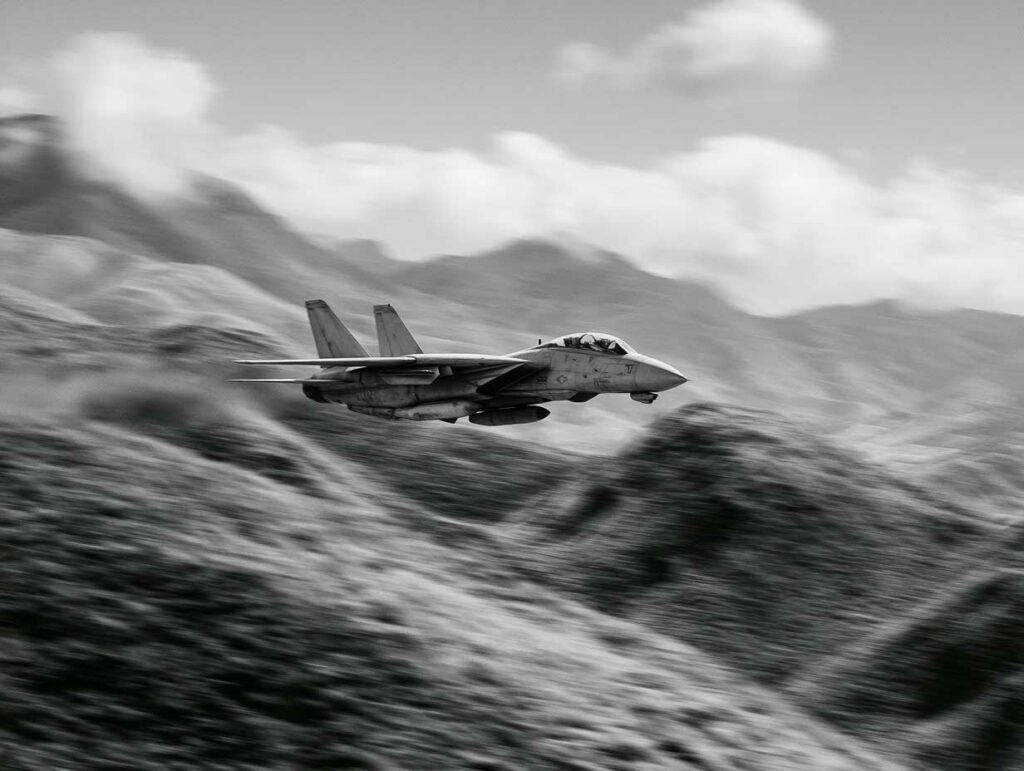
Pilot Incapacitation Transformed the Tomcat into a Lost Aircraft
The consequence of this architecture was brutal. If the pilot lost consciousness or became physically incapable of acting, the RIO could not regain control.
He could not grasp a non-existent stick. He could not pull back on throttles that weren’t there to slow down. He could not correct a bank angle, extend the landing gear, or execute a carrier landing.
In a stable situation, he could attempt to revive the pilot, contact another aircraft, and transmit the Tomcat’s position. He could also use certain communication, navigation, or identification equipment placed at his station.
This did not transform the rear seat into a cockpit. Even if the aircraft found itself momentarily stabilized, the RIO possessed no control interfaces allowing him to steer it toward a base.
A carrier landing rendered any improvised solution even more unrealistic. Landing an F-14 on an aircraft carrier demanded precise control over speed, angle of attack, descent rate, and alignment. Merely maintaining altitude would have served no purpose.
The RIO then had to consider the only action giving him immediate control over his own fate: triggering the ejection.
The phrase suggesting he could only control altitude by pulling the ejection handle is intentionally provocative. It nevertheless describes reality quite accurately. The RIO could not bring the aircraft down safely. He could only leave it before it became unrecoverable.
The Ejection System Gave the RIO a Vital Decision
The F-14 featured two Martin-Baker ejection seats. The rear cockpit included an ejection command selector.
The system’s logic depended on its position. When the selector sat in the PILOT position, an ejection triggered by the pilot initiated the departure of both crew members. An ejection triggered from the rear, however, only launched the RIO.
In the MCO mode—standing for Manual Command Override—the RIO’s action could trigger the ejection of both crew members.
This difference was significant. An unqualified passenger or a RIO reacting to a local emergency should not necessarily expel the pilot without justification. Conversely, in a critical situation, the crew could select a configuration allowing the RIO to command a general abandonment.
The F-14 emergency procedures explicitly assigned the RIO the responsibility to command ejection in certain cases, notably during a confirmed flat spin.
The rear cockpit was therefore not passive. The RIO possessed essential authority over the survival of the crew. This authority remained entirely distinct from piloting.
If the pilot was unconscious and the Tomcat was descending toward the ground, the RIO did not have to attempt an impossible recovery. He had to evaluate the remaining time and decide whether to abandon the aircraft.
The rear seat could save Maverick. It could not save his aircraft.
The Spin in the Film Correctly Illustrates the Separation of Roles
The most famous scene in Top Gun shows Maverick and Goose’s F-14 entering a flat spin after crossing through the jet wash of another aircraft.
In this situation, flight controls can become ineffective. The engines risk stalling. The Tomcat rotates around a near-vertical axis while losing altitude rapidly.
The pilot attempts to recover the aircraft using the stick, rudder pedals, and engines. The RIO monitors parameters and participates in the procedure. When recovery becomes impossible, ejection remains the only solution.
The scene dramatizes the events, but it respects a fundamental principle: Goose could not take over the flying. His role was to help diagnose the situation and then execute the abandonment procedure.
The F-14 emergency manual precisely dictated an ejection commanded by the RIO in the event of a persistent flat spin. This responsibility did not make him a co-pilot; it made him the officer responsible for a specific step in the procedure.
Popular fiction, however, produced the opposite effect. By constantly showing Goose participating in decisions, talking about the flight path, and manipulating controls, it reinforced the idea that he could fly the aircraft.
He worked on the aircraft. He did not pilot it.
The RIO Became Even More Important in Strike Missions
The role of the rear seat evolved with the career of the Tomcat.
Designed as a fleet defense interceptor, the F-14 progressively became a strike aircraft. It participated in reconnaissance, precision strike, and close air support missions.
The integration of the LANTIRN pod gave the RIO a new function. He could use a dedicated controller to orient the infrared camera, search for a target, and designate it with a laser.
The pilot brought the aircraft toward the engagement zone and dropped the bombs. The RIO identified the objective, tracked its movement, and maintained the laser illumination necessary for guidance.
Late-generation versions received upgraded displays, including the Programmable Tactical Information Display. This equipment facilitated the exploitation of targeting pod imagery and tactical data.
The RIO thus became a radar operator, tactical navigator, intercept coordinator, and target designation specialist all at once.
This evolution confirms that the absence of flight controls did not reduce his importance. It freed the rear seat for a specialized mission that grew increasingly broad.
The Comparison with Bob Requires an Additional Correction
Associating Goose and Bob is understandable from a cinematic perspective. Both characters occupy the rear seat of a naval fighter aircraft. Their technical situation, however, is not identical.
Goose is a RIO in an F-14A. Bob is a Weapon Systems Officer (WSO) in a F/A-18F Super Hornet. Both manage sensors, navigation, and weapons. The Super Hornet, however, belongs to a newer generation and exists in multiple rear cockpit configurations.
Certain F/A-18F aircraft configured for training receive a stick, throttles, and rudder pedals in the rear seat. A qualified instructor can then take over the flying.
Aircraft configured for operational missions may employ a rear station more heavily focused on sensors and weapons. The presence of two seats does not, by itself, indicate whether the rear occupant can fly the aircraft.
Bob is not simply a modern version of Goose. He works within a more digital architecture, where the distribution of functions can vary depending on the configuration.
For the Tomcat, the answer remains much clearer: the RIO did not pilot.
Grumman’s Choice Prioritized the Mission Over Redundancy
The absence of dual controls might seem strange on an aircraft so costly and complex. Yet it responded directly to the doctrine of the era.
The primary risk was not considered to be sudden pilot incapacitation. The priority consisted of intercepting Soviet bombers before they could launch their missiles against an aircraft carrier.
Every kilogram, every screen, and every inch of cockpit space had to serve this mission. A complete radar station brought more military value than a second set of flight controls that would rarely be used.
The RIO’s training followed the same logic. The U.S. Navy did not seek to create a replacement pilot. It trained an officer specialized in the employment of the weapon system.
This specialization came at a price. The aircraft could not accomplish its mission properly without both crew members. A pilot alone could theoretically fly the Tomcat, but he could not normally exploit all the capabilities of the radar and the Phoenix.
A RIO alone could analyze the situation, but could not keep the aircraft in the air.
The F-14 was therefore not an aircraft with a pilot and his deputy. It was a system divided between two people. Removing one of them left part of the machine functioning, not the whole.
The Rear Seat Was the Combat Center, Not the Backup Seat
Cinema gave the RIO a sympathetic, sometimes comical, and often secondary image. Technology tells a different story.
The pilot controlled the machine. The RIO controlled a large part of the invisible battle unfolding beyond the canopy.
He searched for threats, interpreted the radar, organized tracks, and prepared the employment of missiles weighing nearly half a ton. He linked the Tomcat to other actors within the carrier strike group. He monitored the sky that the pilot could not see.
But the boundary between the two jobs remained absolute. No screen, no radar handle, and no tactical skill allowed the RIO to move a flight surface.
If Maverick had truly lost consciousness, Goose could have called for help, attempted to wake him, and prepared for ejection. He could not have seized a stick and brought the F-14 back to the USS Enterprise.
This limitation does not diminish his role; it explains it. Goose was not installed in the back to replace Maverick. He was there to allow the Tomcat to fight like no single-seat fighter of its era could.
War Wings Daily is an independant magazine.