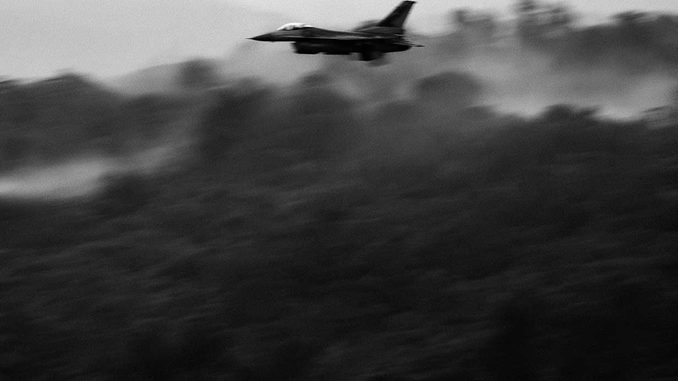
The U.S. Air Force is launching initial production of the AN/ALQ-257 IVEWS, an electronic warfare suite designed to enhance the F-16’s survivability.
In Summary
The U.S. Air Force has reached a major industrial milestone in the electronic modernization of its F-16 fleet. A $87.4 million contract modification is funding the low-rate initial production of the AN/ALQ-257 Integrated Viper Electronic Warfare Suite, or IVEWS, developed by Northrop Grumman. The system replaces a self-protection model largely reliant on external pods with an integrated suite capable of detecting adversary radar emissions, identifying their type, estimating their location, and deploying electronic countermeasures. Its key advantage lies in its coordinated operation with the AN/APG-83 SABR AESA radar: both systems can operate simultaneously without blinding each other. The immediate priority involves 72 F-16 Block 50 aircraft tied to an urgent operational requirement. The currently published FY2027 budget plan subsequently projects 206 operational aircraft equipped by 2031, although earlier ambitions targeted several hundred fighters.
$87.4 Million Contract Launches Production
The U.S. contract announcement on September 24, 2026, involves a $87.417 million modification awarded to Northrop Grumman. It funds the low-rate initial production (LRIP) phase of the AN/ALQ-257 IVEWS. The work will be performed in Rolling Meadows, Illinois, with completion expected by December 31, 2029.
LRIP represents the initial low-volume production phase. It serves to manufacture operational-configuration hardware, stabilize the manufacturing baseline, and prepare for rate production. Of the $87.4 million, $79.37 million is obligated immediately—$11 million in research and development funds and $68.37 million in aircraft procurement funds.
The cumulative value of contract FA8615-17-C-6047 now stands at $1.921 billion. However, this figure requires context: the same contract has also funded AN/APG-83 AESA radar procurement for the F-16 for several years. The $1.921 billion figure therefore reflects the cumulative value of the overarching support contract, rather than the cost of the IVEWS suite alone.
IVEWS Transforms F-16 Self-Protection
IVEWS is an electronic warfare suite fully integrated into the aircraft. It aims to protect the F-16 Fighting Falcon against radiofrequency threats, including surveillance radars, tracking radars, fire-control systems, and radar-guided weapons.
Its digital radar warning receiver monitors the electromagnetic environment. In particular, it analyzes pulse structure, frequency, and angle of arrival to identify the threat type and assess its risk level. This data is checked against an onboard threat library.
The system adds a geolocation capability. While specific methods remain classified, they rely notably on digital signal processing and direction-of-arrival calculations. The goal is to provide the pilot with an actionable threat position rather than a simple warning.
IVEWS can then deploy active jamming. High-power transmitters and tailored modulations attempt to disrupt an opposing radar’s ability to accurately measure a target’s range, angle, or velocity, preventing a stable track.
Northrop Grumman also highlights an ultra-wideband architecture capable of addressing agile radars, including systems operating in millimeter-wave bands. This expanded coverage is vital against modern threats that utilize higher frequencies, complex waveforms, and brief emission times.
To understand the role of these technologies in a modern combat system, see also our coverage on electronic warfare.
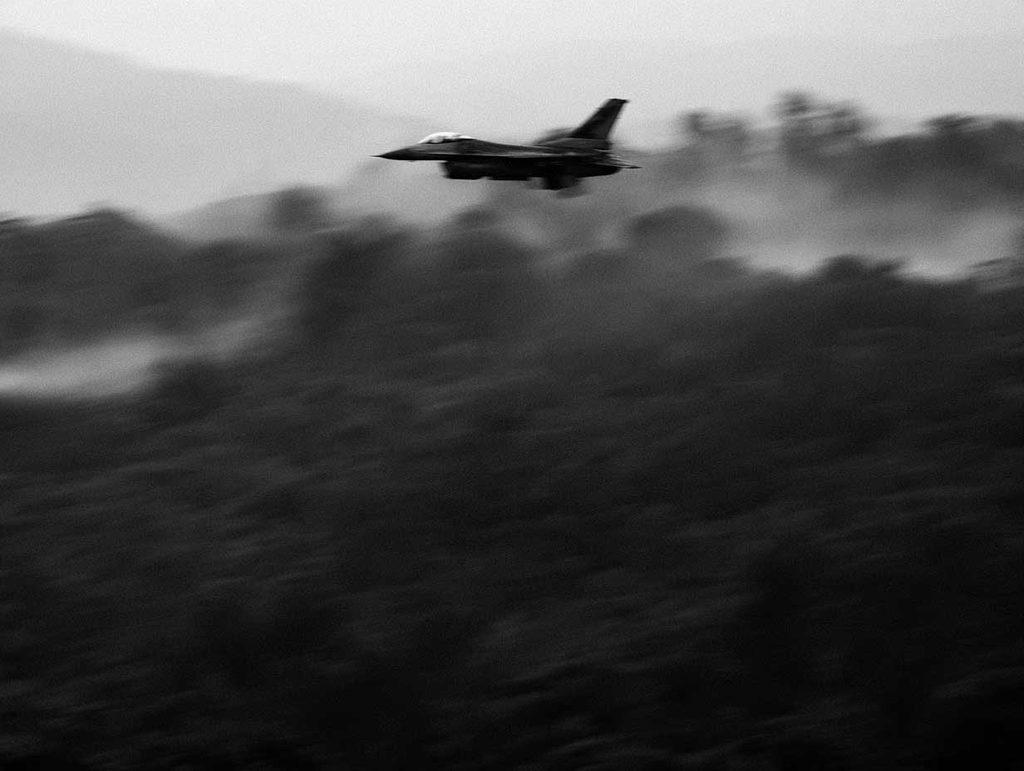
The APG-83 Radar and IVEWS Work Without Mutual Interference
One of the major technical advances involves integration with the AN/APG-83 SABR, the AESA radar fitted to many modernized F-16s.
A radar and a high-power jammer both operate within the radiofrequency spectrum. On legacy architectures, they often have to alternate their activity over split-second intervals to prevent mutual interference—a concept known as “blanking.”
By contrast, IVEWS and SABR are engineered for pulse-to-pulse interoperability. The two systems coordinate operations down to individual pulses. According to Northrop Grumman, the radar can continue detecting and tracking targets while the electronic warfare suite simultaneously monitors and jammers threats.
The operational stakes are high: a pilot gains little from a powerful jammer if using it degrades radar performance precisely when the threat environment is most hazardous.
System Also Frees Up a Hardpoint
Because IVEWS is installed internally, it assumes the functions previously handled by legacy external electronic warfare pods like the AN/ALQ-131 and AN/ALQ-184 carried under the fuselage.
The operational benefit is tangible: the centerline station can now carry a 300-gallon (approx. 1,136-liter) fuel tank or another compatible store. The F-16 thus gains greater mission flexibility across fuel, ordnance, and sensor payloads.
This upgrade fits into the broader modernization of the F-16 fleet, which encompasses AESA radars, digital mission computers, refreshed avionics, and upgraded electronic warfare suites. The F-16V Viper follows a similar technological path, though specific electronic warfare configurations vary by customer and variant.
First Priority Targets 72 Block 50 F-16s
IVEWS has progressed beyond the demonstration phase. Northrop Grumman states that the system has logged over 500 flight hours and completed more than 300 test sorties. The defense contractor also cites a system availability rate exceeding 99% across hundreds of test hours.
The initial operational priority focuses on 72 Block 50 F-16s, driven by an urgent operational need for units deployed to the Middle East. These aircraft frequently perform Suppression of Enemy Air Defenses (SEAD) missions, where radar warnings and countermeasures directly determine an aircraft’s ability to penetrate defended airspace.
However, the final procurement count should be viewed cautiously. Earlier plans mentioned up to 450 U.S. F-16s. The FY2027 budget request outlines a more defined path: $438 million requested to equip 48 aircraft in 2027, within a program targeting 206 operational aircraft through FY2031, alongside four development installations.
F-16 Buys Crucial Time Against Modern Defenses
IVEWS does not make the F-16 stealthy, nor does it convert an airframe designed in the 1970s into a true fifth-generation fighter. Its contribution is different: it lowers vulnerability in an environment where hostile radars rapidly shift frequencies, employ agile waveforms, and operate within complex integrated air defense networks.
Its digital, open, and reprogrammable architecture is designed to simplify the addition of new threat libraries and jamming techniques. The U.S. Air Force also anticipates future upgrade paths toward adaptive or cognitive processing and additional self-protection capabilities.
Consequently, the September contract is more significant than its dollar figure suggests. It marks the transition from a thoroughly tested prototype to operational equipment heading to front-line squadrons. For an F-16 platform expected to remain in service for years to come, electronic warfare is a fundamental requirement for survival.