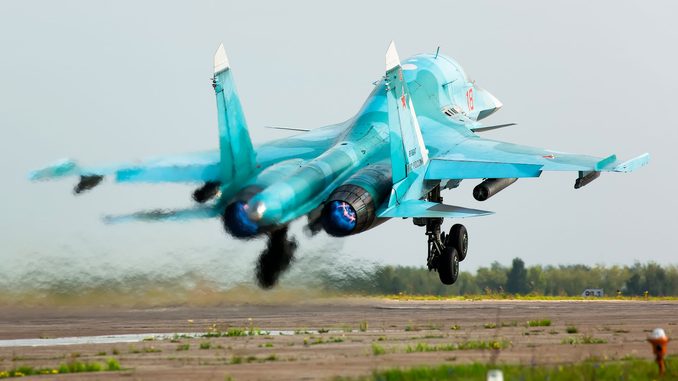
Russia delivers new Su-34s despite sanctions. How Moscow produces its combat aircraft and still procures foreign components.
In Brief
On November 17, 2026, the United Aircraft Corporation (UAC), a subsidiary of the state-owned Rostec group, announced the delivery of a new batch of Su-34 fighter-bombers to the Russian Aerospace Forces. This is the third officially announced delivery this year, following those in July and October. The exact number of aircraft remains confidential.
This announcement confirms that Russia retains a military aerospace production capacity despite the Western sanctions imposed since 2022.
However, this industrial continuity relies on a paradox. Moscow manufactures its own airframes, engines, and weaponry while remaining dependent on foreign electronic components and industrial equipment.
Investigations published in 2025 identified hundreds of western components in the Su-34 and Su-35S. Circuits manufactured by Analog Devices, Texas Instruments, Intel, and Murata continue to reach the Russian industry through indirect commercial channels. Sanctions have complicated supply chains without managing to interrupt them completely.
Russia Announces a Third Su-34 Delivery in 2026
On November 17, 2026, Rostec confirmed the handover of a new batch of Su-34 fighter-bombers to the Russian Ministry of Defense. According to the industrial group, the aircraft completed all ground and flight tests before joining their operational units.
This delivery follows those announced on July 9 and October 7, 2026.
UAC did not communicate the number of aircraft involved, their serial numbers, or their future home bases. It is therefore impossible to establish annual production precisely from these announcements.
The aircraft are assembled at the Novosibirsk Aircraft Production Association at the Chkalov industrial site in Siberia.
According to a study published by the Center for European Policy Analysis in November 2026, Russia reportedly delivered approximately 18 to 20 Su-34s in 2025. This is an estimate based on open sources rather than an official industrial balance sheet.
Vadim Badekha, CEO of UAC, asserts that production is continuing at a high pace and that the modifications made to the aircraft take into account the lessons learned from the war in Ukraine.
The Su-34 Remains Essential to Russian Airstrikes
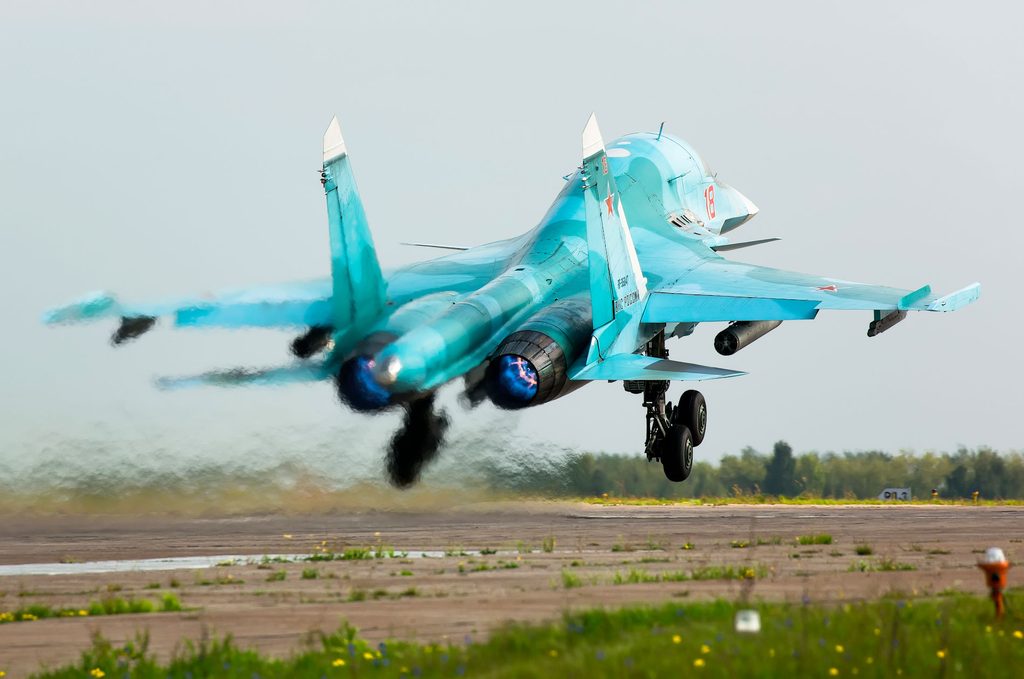
Developed from the Su-27, the Sukhoi Su-34 Fullback is a two-seat fighter-bomber primarily intended for ground attack.
Measuring 23.3 meters in length, it features two turbofan engines and can carry approximately 8 tons of armament. Its ferry range can reach 4,000 kilometers, depending on the configurations.
In Ukraine, it is notably used to drop FAB bombs equipped with UMPK modules. These kits combine lifting surfaces with a guidance system to transform conventional bombs into glide munitions.
This technology makes it possible to attack certain targets several dozen kilometers away without necessarily overflying adversary positions.
The Su-34 regularly operates under the protection of Su-35S fighters, which are tasked with contributing to air cover.
Replacing destroyed or damaged aircraft therefore constitutes a Russian industrial priority.
Russia Manufactures Its Aircraft but Still Depends on Foreign Technologies
The construction of an Su-34 relies essentially on a Russian industrial chain.
The airframes are manufactured in Novosibirsk. The engines of the AL-31 family are produced by the national industry. Russia also has specialized manufacturers for radars, flight controls, communications, and electronic warfare systems.
However, manufacturing an aircraft does not mean producing every component nationally.
The onboard equipment utilizes microprocessors, memories, signal converters, capacitors, and integrated circuits, certain references of which remain difficult to replace.
These components notably ensure radar signal processing, navigation, communications, and the electronic management of onboard systems.
An investigation published in July 2025 by the International Partnership for Human Rights (IPHR), NAKO, and Hunterbrook identified 227 verified electronic components out of 228 references studied in the Su-34.
These items originated from 59 manufacturers spread across eight countries. Among the identified references, 66% belonged to categories deemed particularly high priority in export controls.
These findings concern the studied equipment, not all the parts making up an Su-34.
American and Japanese Manufacturers Remain Present in Russian Electronics
The investigation identifies several foreign groups whose components were found in the Russian aircraft.
Analog Devices, an American company, appears notably through analog-to-digital converters, clock generators, and signal processing circuits.
Intel figures among the manufacturers of field-programmable gate array (FPGA) logic circuits. These components make it possible to perform specialized calculations and reconfigure certain electronic functions.
Murata, a Japanese group, supplies the global industry with ceramic capacitors and various passive components. References from this brand were identified in Russian electronics.
Other components come from Texas Instruments, AMD, Micron, Cypress, NXP, Marvell, Qorvo, and Infineon.
This does not mean these manufacturers are willingly supplying the Russian military.
Several groups have officially halted their sales in Russia. Texas Instruments and Analog Devices have also condemned the unauthorized diversion of their products.
The parts may originate from old stocks, independent distributors, or transactions carried out without the initial manufacturer’s consent.
No public investigation makes it possible to affirm that the Su-34s delivered on November 17, 2026, contain the exact same references as the previously analyzed aircraft.
China and Commercial Intermediaries Maintain Supply Chains
Russia uses several mechanisms to maintain access to imported technologies.
Parallel imports allow the purchase of authentic products outside the commercial networks authorized by their manufacturers. Distributors established in third countries can also resell components initially intended for the civil market.
Investigations notably identify flows transiting through China, Hong Kong, Turkey, the United Arab Emirates, Kazakhstan, and Kyrgyzstan.
In May 2024, Radio Free Europe/Radio Liberty revealed that Noratec Holdings, registered in Cyprus, and Matrix Metal Group, established in Hungary, had shipped foreign electronic components to Russian companies linked to the aerospace industry between 2021 and 2023.
These historical observations do not prove that the two companies are continuing their activities today.
The 2025 IPHR-NAKO study also examined more than 180,000 shipments of high-priority microelectronic products in 2023, representing $805.6 million.
This figure concerns a much broader import market than the sole manufacturing of Su-34s. Therefore, it does not correspond to the amount of components integrated into these aircraft.
Sanctions Have Not Eliminated Industrial Dependencies
A study published in November 2025 by the Royal United Services Institute (RUSI) provides additional elements.
According to its researchers, Russian importers supplying twelve major Sukhoi avionics providers received over $25 million in integrated circuits and capacitors in 2024, notably from the Texas Instruments and Murata brands.
The circuits concerned feed industrial chains linked to communication systems, flight controls, and electronic equipment.
The dependence goes beyond chips alone.
Russian industrialists also use foreign machine tools, measuring instruments, and laboratory equipment. RUSI notably documented imports of devices manufactured by Keysight, despite this company’s official withdrawal from the Russian market.
This equipment is necessary to check the precision of parts and test the performance of electronic systems.
Substitution with Chinese or Russian components remains possible in certain applications. It becomes more delicate for equipment subjected to extreme temperatures, vibrations, and high reliability requirements.
Su-34 Production Demonstrates Industrial Resilience Under Constraint
The new deliveries confirm that Russia retains an industry capable of assembling modern combat aircraft and maintaining priority programs.
However, they prove neither its technological autonomy nor its capacity to sustainably increase production rates.
The proliferation of suppliers and intermediaries can drive up the cost of components, lengthen lead times, and complicate their traceability.
Moscow must also finance the maintenance of its fleet, train technicians, and replace aircraft lost in combat.
To understand the evolution of this industry, Su-34s must be placed within the broader context of Russian fighter aircraft programs, notably the Su-30SM2, Su-35S, and Su-57.
The true indicator will be less the number of press releases published by Rostec than the quantity of aircraft actually delivered, their operational availability, and the ability of factories to maintain their supply chains.
Sanctions have not stopped Russian production. Above all, they have transformed its functioning and shifted part of its technological dependence toward less transparent commercial networks.