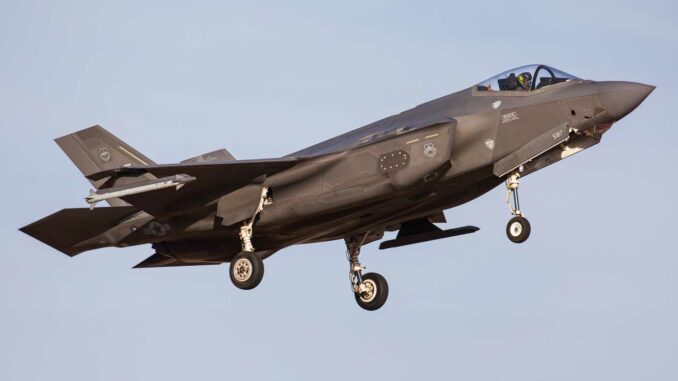
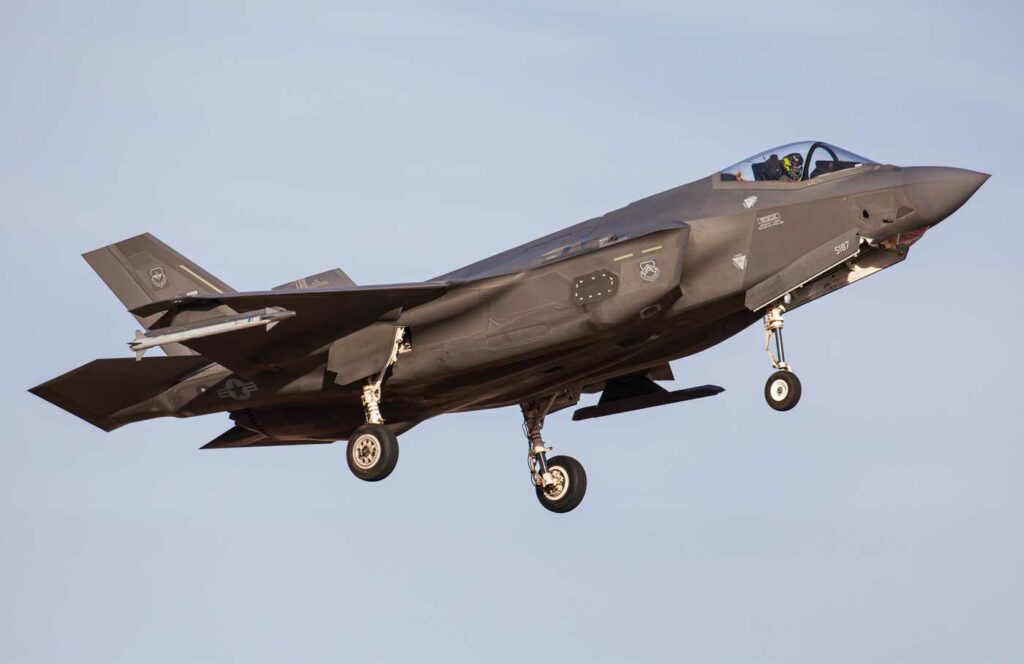
The 2026 GAO report reveals a critical availability status for the F-35. An industrial, military, and commercial alert for Lockheed Martin.
In Summary
The latest report from the U.S. Government Accountability Office places the F-35 Lightning II in front of a major contradiction. The aircraft remains the benchmark Western stealth fighter. It still dominates the export market for fifth-generation combat aircraft. Yet, its operational availability is collapsing. In fiscal year 2025, the mission capable rate of the American fleet fell to 44%. The full mission capable rate dropped to 25%. This means that only one in four F-35s can perform all of its planned missions at any given time. The problem is not primarily aerodynamic or tactical. It is logistical, industrial, software-related, and financial. Insufficient spare parts, excessively slow maintenance, reliance on contractors, corrosion, software delays, and the complexity of versions weigh heavily on the system. The Pentagon is preparing a $13.7 billion fix. But the signal sent to export customers is clear: buying the F-35 also means buying its sustainment ecosystem.
The GAO Report Facing the F-35 with Its Own Limits
The F-35 Lightning II is no ordinary aircraft. It is the core of American air power and that of numerous allies. It replaces entire fleets of F-16s, AV-8B Harriers, F/A-18 Hornets, and older attack aircraft. It combines stealth, advanced sensors, data fusion, electronic warfare, ground attack, air superiority, and networked information sharing. On paper, it is less a simple fighter jet than a flying node for collaborative combat.
It is precisely for this reason that report GAO-26-108113, published on June 11, 2026, is important. It does not just challenge a technical indicator. It questions the actual capability of the program to transform an operational promise into available power.
According to the GAO, the mission capable rate of the U.S. F-35 fleet dropped from 67% in fiscal year 2021 to 44% in fiscal year 2025. The full mission capable rate went from 38% to 25% over the same period. The distinction is essential. A mission capable aircraft can perform at least one of its assigned missions. A full mission capable aircraft can accomplish all of its planned missions. In the case of the F-35, this can include air defense, ground attack, suppression of enemy air defenses, intelligence, electronic warfare, and data sharing.
The figure of 25% is therefore brutal. It does not mean that three out of four F-35s are grounded. It means that three out of four do not possess the full suite of their planned capabilities at a given moment. For an aircraft sold as an advanced multi-role system, this nuance is severe. The F-35 is not just judged on its ability to take off. It is judged on its ability to deliver the entire technological package that justifies its cost.
Actual Availability Becomes the True Criterion of Power
Operational availability is often less spectacular than speed, stealth, or weapon payload. Yet, it determines the actual mass available in the event of a crisis. A country can buy 100 aircraft. If only 44 can accomplish at least one given mission, and only 25 can fulfill the entire intended spectrum, the displayed power and the usable power are no longer the same.
In detail, the figures by variant show a contrasted situation. The U.S. Air Force’s F-35A, the conventional version intended for standard runways, posted a full mission capable rate of 28.5% in 2025. This is the best result among the three main American families, but it remains far below objectives. The U.S. Marine Corps’ F-35B, capable of short takeoff and vertical landing, falls to around 16.2%. The F-35Cs intended for carrier-based operations also show low levels, with approximately 22% for Marine Corps aircraft and 15.3% for those of the U.S. Navy.
The mission capable rate gives a different picture. In 2025, the F-35A is at 38.6%. The F-35B is at 53.9%. The Marine Corps’ F-35C reaches 64.2%. The U.S. Navy’s reaches 54.2%. This shows that some aircraft can still fly and perform a limited mission, but not the full expected spectrum. The problem is therefore not solely immobilization. It is also the loss of versatility.
The comparison with the rest of the U.S. Air Force adds perspective. The mission capable average for all USAF fleets was 67.15% in fiscal year 2024, according to Air & Space Forces Magazine. The F-22 Raptor had itself fallen to 40.19% mission capable in 2024. One must remain precise: this public figure concerns mission capable, not necessarily full mission capable. But it shows a broader reality. Highly advanced stealth aircraft impose a heavy sustainment burden. The F-35 is not alone in this difficulty. It merely becomes its most visible example, as it is produced on a large scale and exported massively.
The Support System Can No Longer Keep Pace with Fleet Growth
The GAO identifies a central cause: the program has long prioritized aircraft production over maintenance in operational condition. This criticism is blunt. The United States and its partners bought fast, delivered fast, and integrated fast. But parts inventories, repair capacities, technical data, tooling, and maintenance personnel did not keep pace at the same rate.
The result is an industrial imbalance. The F-35 has become a global fleet of more than 800 American aircraft, with approximately 1,700 additional aircraft planned by U.S. forces by the mid-2040s. On a global scale, Lockheed Martin mentioned in early 2026 nearly 1,300 F-35s in service across 12 operator countries. The size of the program is therefore immense. But a large fleet is not enough. It requires a support network capable of absorbing breakdowns, inspections, component repairs, and software evolutions.
The GAO cites several concrete problems. Spare parts and consumables are insufficient. Depot repairs are too slow. Industrial capacity remains constrained for certain components. Maintenance is not sufficiently optimized to reduce downtime. The fleet features several technical configurations, which complicates maintenance practices and supply. Corrosion also requires specific inspections and corrections.
This last point is often underestimated. A stealth aircraft is not just a fuselage and an engine. Its performance also depends on its coatings, its surfaces, its sensors, its internal bays, its seals, and its low-observability treatments. Each inspection can take longer. Each repair can demand rare skills. Each part delay can immobilize a highly expensive aircraft.
The $13.7 Billion Bill Reveals the Hidden Price of the F-35
The Joint Program Office’s response is called the Global Support Solution Reset. Its objective is ambitious: to reach 80% mission capable and 65% full mission capable by 2030. To achieve this, the program estimates it needs an additional $13.7 billion on top of the spending already planned through 2031.
This amount tells a simple reality. The purchase price of the F-35 is no longer the only issue. The cost of sustainment is becoming the strategic element. According to the GAO, approximately $7.3 billion must go toward purchasing additional parts and equipment inventories needed for depot repairs. About $3.1 billion must be dedicated to repair capacity and depot activations. Approximately $3.3 billion concerns operations and maintenance, including fuel, aircraft interventions, and depot-level maintenance.
The GAO also points out that the sustainment costs of the F-35 for the United States alone are estimated at $1.6 trillion over the life of the program, through 2088. This figure goes beyond the traditional debate over unit price. It places the F-35 in a category of its own. It is a multi-decade military system, with a continuous dependence on software, parts, engines, updates, and the support chain.
The situation is all the more sensitive because the GAO criticizes the contractual incentive mechanisms. The Department of Defense has reportedly paid hundreds of millions of dollars in incentives since 2020 without obtaining the expected availability results. The report recommends reviewing incentive thresholds, better aligning contracts with the needs of the forces, and even considering penalties in cases of poor performance. This is a tough signal for Lockheed Martin and the industrial ecosystem. The question is no longer just about producing. It is about guaranteeing measurable availability.
Software Delay Weighs on Operational Credibility
F-35 availability is also affected by software evolutions. The Technology Refresh 3 program, or TR-3, was intended to provide more computing power and memory to prepare for Block 4 capabilities. These evolutions are indispensable for integrating new sensors, new weapons, and more advanced electronic warfare functions. But they have led to delays and temporary limitations.
The GAO indicates that the acceptance of new aircraft that are not fully mission capable, due to software delays, contributed to the 2025 decline. This is an important point. The program continues to deliver aircraft, but some arrive in units with incomplete capabilities. This creates a statistical illusion. The fleet grows, but actual availability does not progress at the same pace.
This phenomenon is dangerous for air forces. A modern aircraft is no longer frozen at the time of its delivery. It evolves through software blocks, updates, patches, weapon integrations, and sensor adjustments. If the software chain slows down, the fleet can find itself with several standards in service. This complicates training, maintenance, mission planning, and interoperability.
For export customers, this topic is central. Buying the F-35 means accepting a dependence on American updates. This dependence can be an advantage if the system works quickly. It becomes a weakness if delays accumulate or if political constraints interfere. European countries purchasing the F-35 are not just taking delivery of an aircraft. They are joining a technical and political architecture driven from the United States.
The Export Market Remains Solid but More Nervous
It would be false to write that the GAO report will cause the F-35 export market to collapse. The reality is more nuanced. The F-35 retains advantages that its Western competitors cannot always offer in the same package: operational stealth, data fusion, NATO interoperability, presence within U.S. forces, global feedback, and access to the U.S. mission network.
Demand remains strong. Romania became the program’s twentieth global customer in 2024 with a planned order of 32 aircraft. Lots 18 and 19 cover up to 296 F-35s, with deliveries starting from 2026 for U.S. forces, international partners, and Foreign Military Sales customers. In Europe, Poland, Finland, Germany, Switzerland, Belgium, Denmark, the Netherlands, Norway, Italy, and the United Kingdom illustrate the scale of the footprint. The F-35 has become a de facto standard throughout much of NATO.
But the GAO report changes the commercial discussion. Buyers will no longer look solely at the acquisition price, industrial offsets, stealth, or deliveries. They will demand guarantees on parts, repair turnaround times, national stocks, technical data sovereignty, maintenance costs, availability in a crisis, and the priority given to their fleets in the event of major tension.
This is where the export market could move. The F-35 is not losing its status. But it becomes more vulnerable in tenders where industrial sovereignty, national control of support, or daily availability matter as much as stealth. The Rafale, the Eurofighter Typhoon, the Gripen E/F, or the KF-21 Boramae can exploit this terrain. They do not all possess the same stealth. But they can defend other arguments: autonomy, technology transfer, more predictable costs, and maintenance less dependent on a global American architecture.
Allies Must Measure Logistical Dependence
The F-35 relies on a logic of global pooling. Customers share stocks, repair lines, data, and cost rules. In theory, this architecture allows for economies of scale. In practice, it also creates a common dependence on a complex system. If parts are lacking in the United States, they may be lacking elsewhere. If certain components are constrained by the industrial base, the waiting line becomes international.
For an export country, the question becomes simple: who has priority in a crisis? U.S. forces? Countries deployed in an active theater? Customers most exposed to Russia or China? Historic partners? The GAO report does not directly answer this question. But it makes it more legitimate. A national fleet of F-35s is not totally independent if its support depends on a global network under heavy strain.
The consequence is commercial. Future buyers will demand larger national stocks. They will ask for regional depots, turnaround guarantees, technical data access rights, local repair capabilities, and better transparency on costs. Some states will accept these constraints because the military value of the F-35 remains high. Others might hesitate, especially if their needs relate more to air policing, regional air defense, or daily sovereignty missions.
Political Risk Adds to Industrial Risk
The export debate is not limited to maintenance. It also touches politics. The F-35 is an instrument of alliance. It brings air forces closer to Washington. It facilitates NATO integration. It gives access to an American operational culture. But it also creates a technological and strategic dependence.
In Europe, this dependence is already under discussion. It becomes more sensitive when availability drops. A country may accept political dependence if the delivered system is highly performing and highly available. It accepts it less easily if the fleet requires heavy additional investments, a strained logistics system, and delayed updates.
This is an important point for Dassault Aviation, Airbus Defence and Space, Saab, BAE Systems, Leonardo, and South Korean industrialists. The GAO report gives them a commercial angle. They can say to customers: American stealth is powerful, but support sovereignty matters too. This line will not always be enough to beat the F-35. But it can carry weight in countries that want to preserve a national industrial base or avoid complete dependence on the United States.
The Paradox of an Indispensable but Under-Available Aircraft
The F-35 is not an operational failure. That would be too simple a reading. The aircraft has genuine qualities. Its sensors, its stealth, and its ability to distribute information change the way combat is conducted. When properly supported, it can offer a major tactical advantage. The problem lies elsewhere. A technologically superior aircraft that is too often partially available produces inconsistent power.
The GAO report therefore shows a paradox. The F-35 is probably one of the most important combat aircraft in the Western world. It is also one of the most difficult to support on a large scale. This contradiction becomes strategic as fleets increase. The more the F-35 spreads, the more its maintenance system must hold up. If it does not hold up, the mass advantage turns into a risk of logistical saturation.
For the United States, the stake is direct. A high-intensity confrontation against a power like China would demand high availability, rapid repairs, deep stocks, and an ability to maintain aircraft in operation despite losses, damage, and base dispersal. At 25% full mission capable, the signal is bad. Even if the rate can improve in priority deployments, it remains insufficient for a fleet meant to form the backbone of American air power.
For the export market, the message is just as clear. The F-35 will remain attractive. It will remain chosen by many countries. But its sales pitch will have to change. Lockheed Martin and the Pentagon will no longer be able to sell just stealth, data fusion, and interoperability. They will have to sell availability, logistical depth, and cost control. It is less spectacular. Yet it is what decides whether a fighter jet truly exists on the day it must be engaged.
War Wings Daily is an independant magazine.