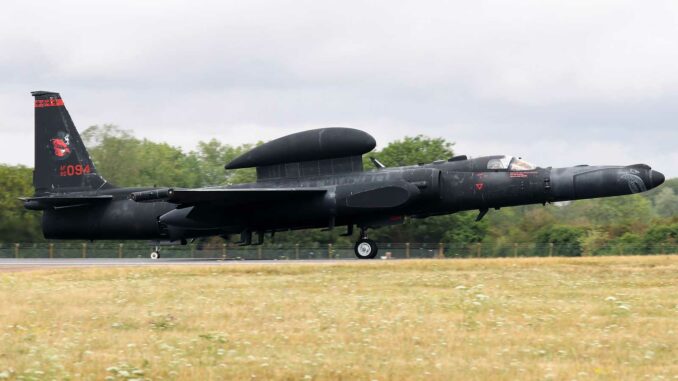
The U.S. Congress wants to restore four U-2S aircraft while the Air Force aims to retire the fleet. A revealing choice for the future of ISR.
In Summary
The latest budget proposal from the House of Representatives revives an old debate: should the U-2S Dragon Lady still be funded, or should the U.S. Air Force permanently close down this Cold War-born reconnaissance fleet? The text presented in June 2026 allocates $81 million to restore four aircraft through heavy programmed depot maintenance. It also limits the retirement to just two planes for fiscal year 2027. This decision directly contradicts the request of the Air Force, which wants to retire the 23 U-2S and TU-2S aircraft still in its inventory. The issue goes beyond aviation nostalgia. It touches on ISR intelligence, satellites, stealth drones, the E-7 Wedgetail, the F-47, and the American capacity to rapidly monitor a crisis. Congress is not just saving an old aircraft. It is refusing to eliminate a capability before its replacements are credible.
The Restoration Project Blocking the U-2S Retirement
The latest U.S. budget cycle says a lot about the actual state of military modernization. On one hand, the U.S. Air Force wants to retire its entire fleet of U-2S Dragon Lady aircraft in fiscal year 2027. On the other, the House of Representatives wants to fund the refurbishment of four planes and prevent the service from discarding this capability too quickly.
The defense appropriations bill for 2027, presented by the House Appropriations Committee, provides $81 million for the programmed depot maintenance of the U-2. The text indicates that this amount is intended to “fully restore four aircraft.” It also prohibits the retirement of more than two U-2s during the fiscal year concerned. This is a very clear political signal. Congress is not merely slowing down the closure of the program. It wants to restore operational availability to a portion of the fleet.
The difference from a simple administrative delay is significant. Restoring aircraft through heavy maintenance means grounding the airframes, opening up structures, inspecting for corrosion, treating coatings, reworking systems, integrating fixes, and making the aircraft fit to fly for the long term. This is not about keeping planes on paper. It is about preserving flight hours, crews, mechanics, sensors, procedures, and a support chain.
This decision contradicts the trajectory of the Air Force. In its Force Structure Changes Exhibit for 2027, the Pentagon plans the retirement of 23 Dragon Lady U-2S aircraft over fiscal year 2027. The document justifies this choice by pointing out the low viability of the platform in future high-intensity conflicts. It also cites safety risks, logistical constraints, and financial costs deemed too high. The retirement would save approximately $189.2 million over the 2027-2031 budget period. The $81 million funding proposed by the House would therefore absorb more than 44% of this expected saving. This is no small detail. It is a head-on budget clash.
The Strategic Reason Behind Congressional Resistance
The central question is not whether the U-2 is old. It is. The first U-2 flew in 1955. Current aircraft have been profoundly remanufactured and modernized, but the fleet still stems from an architecture designed to fly very high, very long, with a pilot in a pressurized suit. The aircraft operates above 21,300 meters (70,000 feet), in an area close to space, with high endurance and a significant payload capacity for sensors.
The question is simpler: what does the U.S. Air Force lose if it retires this aircraft too quickly? The answer is awkward. The U-2S remains an ISR intelligence platform capable of carrying a combination of electro-optical, infrared, synthetic aperture radar, signals intelligence, and MASINT sensors. It can transmit a large portion of this data in near-real-time via air-to-ground or satellite links. It also offers a mission flexibility that is not always available with a drone or a satellite.
A satellite follows an orbit. It passes over according to a predictable schedule, unless dealing with a highly dense constellation. A high-altitude drone can stay airborne for a long time, but it depends on communications, bases, authorizations, and a mission profile that is sometimes less flexible. A manned aircraft can be redirected, reconfigured, and operated with a different operational culture. This flexibility explains why Congress hesitates to cut the fleet as long as replacements are not clearly ready.
Congressional resistance also reflects mistrust toward the promises of transition. The United States has already tried to replace the U-2 with the RQ-4 Global Hawk. The result is paradoxical. The drone that was supposed to take over part of the Dragon Lady’s succession is itself targeted for retirement. The Air Force is now banking on a mix of satellites, unmanned systems, classified capabilities, and next-generation platforms. This logic may be coherent in the long term. It is more fragile in the short term.
Heavy Maintenance Revealing the Real State of the Fleet
The term Programmed Depot Maintenance might sound administrative. Yet, it is at the heart of the matter. For an aircraft as unique as the U-2S, heavy maintenance in a depot does not resemble a routine checkup. It consists of restoring the aircraft to a structural, technical, and operational state compatible with several years of service. Inspections focus on the airframe, electrical systems, mission equipment, landing gear, surfaces, wiring, exterior treatments, and elements related to survivability.
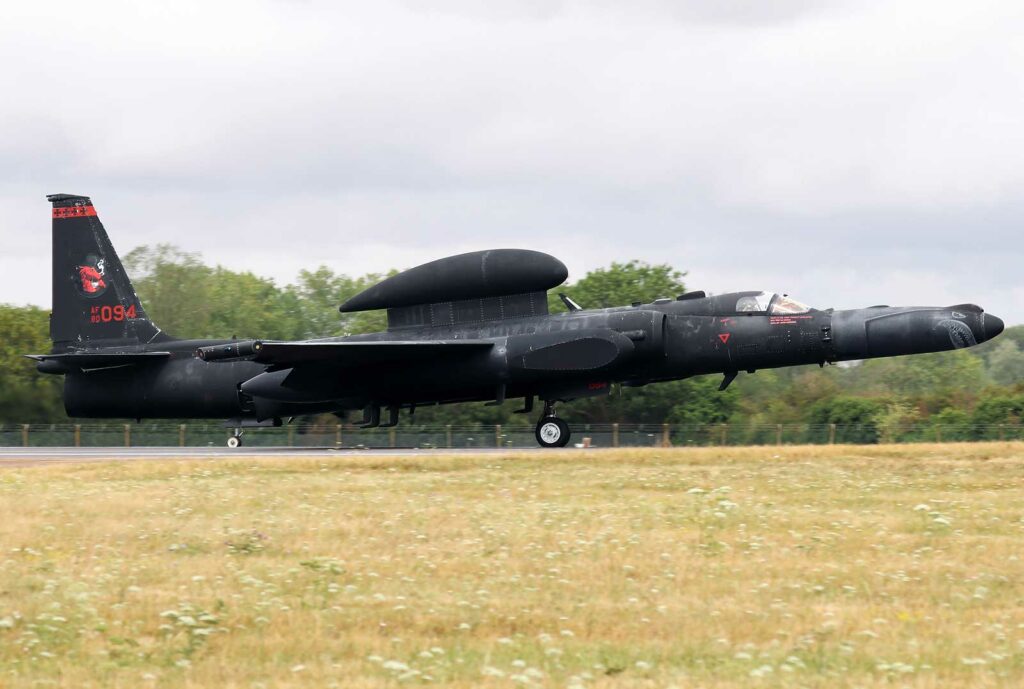
The U-2S is a demanding aircraft. Its long, narrow wings give it characteristics close to a glider. They allow it to climb to exceptional altitudes with a heavy payload of sensors. But they also impose strict piloting and maintenance constraints. Landing requires the assistance of a second pilot in a pursuit car, who guides the aircraft via radio. The bicycle-type landing gear, limited forward visibility, and aerodynamic finesse of the aircraft make every recovery delicate.
Fleet availability has already declined. According to data published in 2025, the mission capable rate of the single-seat U-2 fell from 76% to 61.9% between fiscal years 2023 and 2024. That of the two-seat TU-2S trainer dropped from 81% to 59.2%. These figures remain higher than those of several more modern fleets, but their trend is poor. They confirm the problem highlighted by the Air Force: age, parts, repairs, and industrial sourcing are becoming heavy burdens.
Congress responds with an inverse logic. If availability drops, the most useful aircraft must be restored, not retired all at once. This approach is pragmatic. It recognizes that the fleet cannot last forever. But it refuses to create a capability gap risk in aerial intelligence.
Sensors That Still Make the Dragon Lady Valuable
The U-2S remains useful because it carries highly specialized sensors. The Air Force describes the platform as capable of producing electro-optical, infrared, multispectral, radar imagery, and signals intelligence. At very high altitudes, the aircraft can cover vast areas with wide observation angles. It can also collect from international airspace without necessarily penetrating a defended zone.
This capability matters in crises. The U-2S can monitor a border, track military activity, map radar emissions, observe infrastructure, support a deployed force, or document the movements of an adversary. It can also serve as a flying testbed. Its open architecture and high electrical capacity have allowed for experimentation with advanced payloads, data processing, and digital functions.
The aircraft is not stealthy. That is its clearest limitation. Faced with a modern, integrated, mobile, and connected air defense system, it can no longer fly freely over a major adversary as it did in the 1950s. Its survivability should therefore not be exaggerated. The U-2S is not a magic solution against China or Russia. But it remains relevant in peripheral spaces, gray zones, theaters where the surface-to-air threat is managed, and standoff intelligence missions.
The modernization of its defensive system confirms this logic. In March 2026, BAE Systems announced a contract with Robins Air Force Base to support and modernize the AN/ALQ-221 Advanced Defensive System. This system provides radar warning, electronic countermeasures, long-range sensors, and onboard processing. It allows the pilot to better understand the electromagnetic environment and react to new threats. This contract only makes sense if the aircraft retains operational utility. No one seriously modernizes an electronic warfare system for a fleet that is already dead.
Current Programs Being Disrupted by the U-2S
The debate over the U-2S directly touches current Air Force programs. The 2027 budget highlights very different priorities: the F-47, Collaborative Combat Aircraft, the B-21 Raider, the E-7 Wedgetail, space capabilities, missiles, missile defense, and command architecture. The House proposes $5 billion for the F-47, $977 million for Collaborative Combat Aircraft, $2.2 billion for the B-21 Raider, and $1.55 billion for the E-7 Wedgetail.
These figures show the general direction. Washington is preparing an air force based on stealth penetration, combat drones, distributed sensors, satellites, and networked command. In this architecture, the U-2S seems to belong to another era. But age is not enough to judge a capability. An older platform can remain useful if it performs a mission better, cheaper, or faster than a newer, still immature system.
The case of the E-7 Wedgetail is instructive. This program is not a direct replacement for the U-2. It concerns airborne control, surveillance, and air battle management. Yet, its budgetary restoration by Congress shows the same concern: lawmakers refuse to eliminate proven assets before alternatives are available in sufficient numbers and in working order. The same reasoning applies to the U-2S.
The CCA program is also affected. Collaborative Combat Aircraft are intended to accompany manned aircraft, expand mass, carry sensors or weapons, and reduce risks for pilots. But they will not immediately replace a strategic ISR platform capable of flying at 21,300 meters (70,000 feet) with heavy sensors. CCAs relate primarily to collaborative combat. The U-2S relates to strategic and operational surveillance. The two worlds meet through data, but they are not interchangeable.
Probable Roles If the Restoration Is Adopted
If the funding is adopted in its current version, the U-2S will not become a central fleet for the next twenty years. That is not the most realistic scenario. The restoration of four aircraft aims instead to preserve a core capability. This core can serve in three types of missions.
The first role concerns rapid crises. Tensions in the Indo-Pacific, the Middle East, Eastern Europe, or around a sensitive maritime zone may require sensors that are available quickly. The U-2S can provide broad, persistent, and flexible coverage. Its value is even stronger when satellites are saturated, unavailable, hindered by weather, or constrained by their orbits.
The second role concerns experimentation. The Dragon Lady is a useful testbed platform for sensors, onboard software, data fusion, and communication systems. It can fly high, long, and with a significant payload. It can also integrate different mission systems. At a time when the Air Force seeks to accelerate digital cycles, an airborne testbed remains precious.
The third role concerns training and resilience. Exercise Dragon Shield, conducted at Beale Air Force Base in January 2026, tested the capability to maintain and launch U-2s in a simulated contested environment. Mechanics worked with protective gear and under austere conditions. The message is clear: even an old reconnaissance aircraft must be capable of operating from a base threatened by drones, indirect attacks, or disruptions. The U-2S also serves to train an ISR chain under stress.
The Political Limit of a Temporary Rescue
The proposed restoration does not solve the fundamental problem. The U-2S will not last forever. Its industrial support will become more difficult. Its crews are rare. Its training is demanding. Its parts are not always simple to produce. Its survivability against modern air defenses remains limited. The Air Force is therefore right to prepare its succession.
But the Air Force is wrong if it thinks it can retire a strategic capability without proving that the follow-on system is ready. Satellites are essential, but they do not do everything. Drones are indispensable, but they are not always available or survivable. Classified systems may exist, but Congress must fund a real force, not a promise covered by secrecy.
This is the true meaning of the U-2S aircraft restoration plan. It is not a romantic return to the Cold War. It is a partial vote of no confidence toward a transition judged to be too rapid. Lawmakers are telling the Pentagon: show us the replacement, prove its availability, and then retire the old asset.
The U-2S therefore remains a useful symbol. It shows that military modernization is not just about funding new programs. It is also about managing overlaps. An air force can lose power if it retires its old tools too early and receives its future tools too late.
The Dragon Lady as a Warning for American ISR
The debate over the U-2S retirement is a broader warning. The United States wants to shift toward an architecture based on satellites and stealth drones. This ambition is logical. Modern conflicts demand distributed, resilient sensors that are difficult to target and capable of rapidly feeding decision chains. But this architecture is not yet fully transparent. A portion is classified. Another depends on space constellations, communications, algorithms, ground stations, and unstable budgets.
In this context, the Dragon Lady becomes an insurance policy. It is not the solution for the future. It is a transition capability. It prevents too brutal a break between the old world of manned aerial intelligence and the future world of distributed ISR. This transition may last longer than expected, as is often the case in military programs.
The Pentagon will therefore have to answer a simple question: what system, available in 2027, can replace the missions still performed by the U-2S? If the answer remains vague, Congress will continue to block the retirement. If the answer becomes credible, the Dragon Lady will leave service with less resistance. At this stage, the budget debate shows above all that trust is not complete.
The U-2S has survived satellites, the Global Hawk, budget cuts, and several retirement attempts. Its new restoration does not mean it has won the war against time. It means the Air Force has not yet convinced Congress that the time of the U-2 is truly over.
War Wings Daily is an independant magazine.