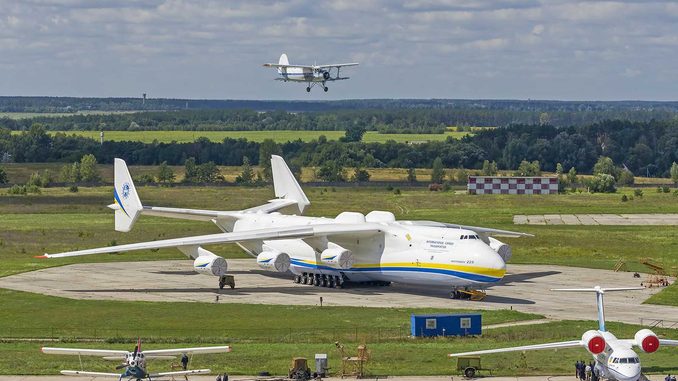
Destroyed at Hostomel in 2022, the An-225 could be reborn thanks to an unfinished second airframe. However, the industrial challenge is colossal.
Summary
Rebuilding the Antonov An-225 Mriya would not simply mean reproducing the aircraft destroyed at Hostomel in February 2022. A second An-225 had indeed been launched into production during the Soviet era, but it was never completed. This incomplete airframe could serve as the starting point for a new aircraft, completed by recoverable components from the destroyed Mriya alongside brand-new equipment. The issue is that the An-225 belongs to an industrial supply chain that no longer exists in its original form. Its six engines, systems, avionics, equipment, and even certain manufacturing processes would need to be located, adapted, or replaced. Antonov initiated preliminary studies and component recovery, but work was subsequently suspended. As of September 2026, no new An-225 is currently anywhere near flying. The project remains possible, but it resembles the development of a new hybrid aircraft far more than a conventional restoration.
The Second An-225 Turns the Reconstruction Into a Giant Puzzle
The Antonov An-225 Mriya was destroyed on the ground on February 27, 2022, during fighting around Hostomel Airport near Kyiv. The image of its charred forward section quickly circulated around the world.
Yet, the story of the An-225 does not necessarily end with that aircraft.
Antonov confirms that a second unit had entered production. Only one An-225 was completed and flown. However, major components of the second aircraft had been built before the program was halted following the collapse of the Soviet Union.
This is what makes the prospect of a reconstruction technically fascinating.
It would not be a matter of repairing the destroyed Mriya. The damage sustained at Hostomel is far too extensive. The new aircraft would instead have to be assembled around the unfinished airframe of the second An-225, potentially using certain parts from the first aircraft and manufacturing or adapting whatever is missing.
The term “reconstruction” is therefore almost misleading.
A future Mriya would be simultaneously an old aircraft, a new aircraft, and likely a modernized version of the original An-225.
The Mriya Was Already an Extraordinarily Atypical Aircraft
To understand the complexity of the project, one must return to the original reason why the An-225 existed.
Antonov did not initially design it as a commercial freighter. The program met the needs of the Soviet Energiya-Buran space program.
The Mriya’s maiden flight took place on December 21, 1988. The aircraft was intended notably to transport the Buran shuttle and components of the Energiya launch vehicle.
Antonov started from the An-124 Ruslan, but the modifications were substantial.
The fuselage was lengthened. The wing area was enlarged. Two additional engines were added. The Mriya thus utilized six Progress D-18T turbofans, compared to four on the An-124.
Each D-18T delivers approximately 229.5 kN of thrust, or roughly 51,600 pounds-force. Together, the six engines provided nearly 1,380 kN.
The empennage constitutes another striking difference. The An-225 features twin vertical stabilizers positioned at the tips of a massive horizontal stabilizer. This design choice notably preserved effective aerodynamic control when a bulky external load, such as Buran, was mounted on top of the fuselage and disrupted airflow behind the body of the aircraft.
The Gigantism of the Aircraft Imposes Its Own Constraints
The Mriya measures 84 meters in length, with a wingspan of 88.4 meters and a height of 18.2 meters.
Its wing area reaches 905 m².
Following the reinforcement of certain structural elements in the early 2000s, its maximum takeoff weight reached 640 metric tons, or approximately 1.41 million pounds.
Its cargo hold could accommodate up to 1,200 m³. It measured roughly 43.3 meters in length, 6.4 meters in width, and 4.4 meters in height.
The maximum commercial payload was rated at 250 metric tons.
The An-225 also featured an onboard cargo handling system capable of lifting 30 metric tons. Like the An-124, its nose gear could kneel to reduce the ramp angle and facilitate loading.
These characteristics explain why the aircraft accumulated more than 240 aviation records. The exact figure varies depending on Antonov publications and the categories cited. Antonov Airlines’ commercial brochure listed 242, while some subsequent communications referred to over 250 records.
On March 22, 1989, a single flight allowed it to set 110 world records for speed, altitude, and payload. In September 2001, Antonov claimed a record total payload of 253.8 metric tons. In 2009, the Mriya also transported a 187.6-metric-ton generator, recognized by Guinness World Records as the heaviest single piece of cargo ever transported by air.
The Second An-225 Exists, But Its Completion Level Causes Confusion
This is perhaps the most critical point regarding the potential rebirth of the Mriya.
For years, it has been reported that the second An-225 was 60% or even 70% complete. Taken literally, this figure creates the impression that it would suffice to complete the remaining 30%.
That would be a mistake.
An airframe that is 70% structurally complete is not an aircraft that is 70% complete.
An airframe may possess a large portion of its fuselage, wing, or empennage while remaining extremely far from operational status. Miles of wiring, hydraulic lines, flight controls, electrical systems, avionics, fuel systems, landing gear, cabin equipment, and, naturally, the engines still need to be installed.
Everything must then be thoroughly tested.
In November 2022, Antonov notably used a much more cautious metric. The manufacturer estimated that it possessed roughly 30% of the components usable to build the second aircraft.
The two percentages do not measure the same thing.
One roughly describes the historical physical state of the unfinished structure. The other evaluates the proportion of components deemed usable in an actual reconstruction program.
This distinction completely alters the perspective of the project.
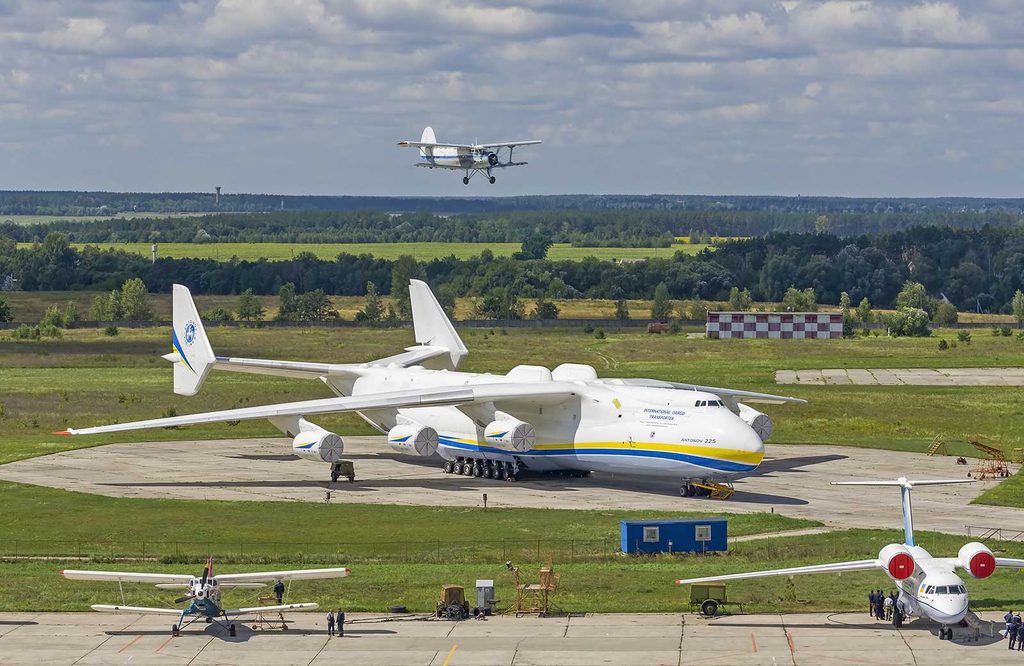
Parts From the Destroyed Mriya Cannot Simply Be Reinstalled
Another idea appears appealing: recover components from the first An-225 that visually appear intact and install them onto the second.
In aviation reality, the process is far more complex.
Following a fire, an explosion, or violent impacts, the external appearance of a component is insufficient. A metal part can look intact while having experienced temperatures high enough to alter its mechanical properties.
Spars, fittings, landing gear assemblies, and other critical structural elements must undergo rigorous inspection. Engineers must utilize ultrasonic testing, eddy current testing, X-ray inspection, or other non-destructive testing techniques to detect invisible cracks and structural damage.
The complete history of each part must also be verified.
Antonov therefore conducted a defectation assessment—that is, a detailed technical expertise of surviving components from the destroyed Mriya. The objective was to identify and preserve whatever might potentially be used at a later stage.
By September 2024, sources within Antonov indicated that this urgent phase had been completed.
This is very different from an aircraft already undergoing assembly.
The Collapse of the Soviet Industrial Base Complicates Everything
The most profound issue is likely not even the airframe itself.
The An-225 is the product of a massive Soviet industrial ecosystem.
Antonov notes that while the fuselage and empennage were assembled in Kyiv, the center wing section and outer wing panels originated from the Valerii Chkalov Aviation Plant in Tashkent, in present-day Uzbekistan. These components were subsequently transported to Kyiv aboard an Antonov An-22.
That supply chain no longer exists.
Certain suppliers have disappeared. Others are now located in different countries. Tooling has been dismantled or repurposed. Technologies dating back to the 1980s no longer necessarily align with equipment available today.
Rebuilding an An-225 therefore requires determining, part by part, what can still be manufactured according to original blueprints and what must be redesigned.
It is an exercise in industrial reverse engineering as much as an aircraft manufacturing program.
The Six Engines Represent a Central Challenge
Propulsion provides a clear illustration of this difficulty.
The An-225 utilized six D-18T engines, which are also employed on the An-124.
The D-18T belongs to a generation of turbofans designed in the 1970s and 1980s. Documentation from manufacturer Ivchenko-Progress lists approximately 23,430 kgf of takeoff thrust for certain series, or roughly 230 kN.
Replacing these engines with modern Western propulsion appears attractive on paper. Fuel consumption could decrease, and parts availability could improve.
However, re-engining an aircraft is not merely a matter of swapping six metal cylinders under a wing.
It would require redesigning pylons, structural interfaces, electrical generation, hydraulic and pneumatic systems, engine controls, fire protection, and likely portions of the aerodynamics.
The new thrust parameters would also alter the loads applied to the wing structure.
A radical re-engining would transform the reconstruction program into a brand-new aircraft development effort.
Antonov has not released a definitive configuration for a future An-225. Any claim that the aircraft will receive a specific modern engine type remains speculative.
The Cockpit of the New An-225 Could Hardly Remain in 1988
The same issue applies to the avionics suite.
Rebuilding an exact replica of a cockpit designed in the 1980s would make little sense. Certain flight instruments are no longer manufactured. Some computers are obsolete. Navigation, surveillance, and communication standards used in international air transport have evolved.
Antonov is already addressing this exact issue with the An-124.
The manufacturer launched a modernization program designed notably to integrate new flight management systems, satellite navigation, and electronic flight displays on the Ruslan.
A future An-225 would logically benefit from a similar technical philosophy.
However, the more systems are modified, the more extensive testing becomes.
Every new piece of equipment must interface properly with circuitry designed several decades ago. Issues regarding power supply, electromagnetic compatibility, data transmission, and redundancy quickly become complex.
Certification Would Be Nearly a Program in Its Own Right
Even if Antonov were to gather all necessary parts tomorrow, the Mriya could not simply take off as soon as assembly is complete.
Compliance and airworthiness would have to be demonstrated.
The task would be particularly delicate if the new aircraft combined a legacy airframe, recovered components, newly manufactured structures, and modern avionics.
Engineers would need to document every modification, recalculate certain load limits, verify structural fatigue, and perform extensive ground testing.
Hydraulics would have to be tested. Flight controls would require validation. Engine and fuel system operations would need verification. Electrical architectures would undergo comprehensive testing.
Taxi tests and subsequent flight test campaigns would be mandatory.
In other words, getting the aircraft airborne is merely the final step.
The true challenge consists of demonstrating that it can fly safely and repeatedly with a technical configuration that has never existed before.
The Price of Reconstruction Remains Impossible to Estimate Accurately
Financial estimates have varied wildly since 2022.
In the days following the destruction of the aircraft, Ukroboronprom cited figures up to $3 billion and at least five years of work.
A few months later, Antonov cited a minimum of 500 million euros, while emphasizing that it was far too early to establish a definitive figure.
That caution remains warranted.
The final cost will depend on the number of recoverable components, the condition of the second airframe, the selected propulsion system, the level of avionics modernization, and the amount of tooling that must be recreated.
Internal sources cited in 2024 even mentioned the possibility of using certain grounded An-124s as component donors should those aircraft become legally available.
Yet this illustrates the core issue: the budget still depends on technical, industrial, and legal decisions that have not been finalized.
Publishing a definitive price tag for the new An-225 today would be artificial.
The Project Is Being Prepared, But Active Construction Is Not Underway
Here, one must separate media communications surrounding Mriya from industrial reality.
Antonov did indeed announce the launch of reconstruction preparations after 2022. The manufacturer evaluated recoverable components, worked on concept design, and preserved key parts.
An international fund dedicated to the reconstruction was also established.
However, this does not mean that a new An-225 is currently progressing down an assembly line.
By September 2024, Antonov had completed urgent diagnostic and preservation tasks and refocused its resources on more immediate priorities. Resuming the project was deferred until after the war.
In 2026, there are no credible public announcements from Antonov indicating that industrial assembly of a new aircraft has actively resumed. Recent publications continue to describe the program as a long-term project with no announced date for a maiden flight.
Mriya is therefore not on the verge of returning to the skies.
The Real Question Now Goes Beyond a Single Aircraft
Technically, making an An-225 fly again appears possible. Antonov possesses the engineering plans, unique experience with the aircraft, an unfinished airframe, and certain components from the original airplane.
However, “possible” does not mean “simple,” and even less so “economically rational.”
The real question will be one of purpose.
If the new An-225 is intended to be a profitable commercial asset, its operating costs, six engines, maintenance footprint, and the actual frequency of missions requiring a 250-metric-ton payload will need to be evaluated dispassionately.
If the project also aims to restore an iconic symbol of Ukrainian aerospace capability, the logic becomes different.
The Mriya was never just another cargo plane. Its value derived precisely from its ability to accomplish missions that no other aircraft could easily undertake.
This also explains why it remains so prominent in aviation memory four years after its destruction.
The second An-225 provides a physical foundation for that ambition. However, it is not a half-finished airplane waiting simply to be rolled out of a hangar.
It represents instead the first piece of a vast industrial puzzle. Around that piece, available propulsion, modern electronics, a supply chain, production methods, certification, and a viable economic model must all be reconstructed.
If a Mriya takes to the skies again one day, it will externally resemble the giant of 1988. Industrially, however, it will be a 21st-century aircraft built from the fragments of two distinct eras.