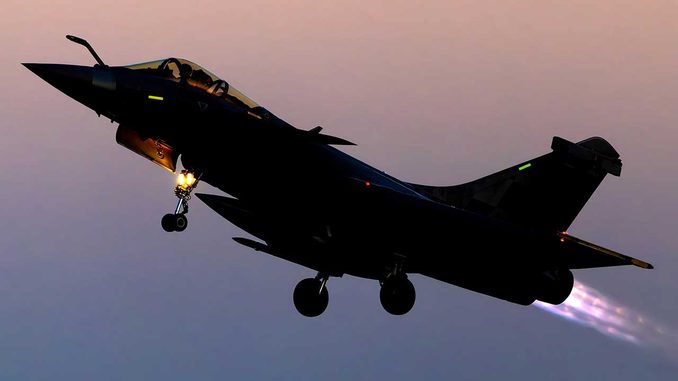
The Rafale remains highly capable, but high-intensity warfare exposes French vulnerabilities: missile stocks, maintenance, production rates, and fleet depth.
In summary
The French challenge is not the quality of the Rafale. It is knowing how long the Air and Space Force could sustain a high-intensity air campaign. An IFRI study published in 2025 estimated that the available air-to-air missile stocks in 2024, after reserving munitions for permanent standing missions, corresponded to about three days of high-intensity combat, and just a single day for the Meteor missile. These figures are estimates, not official stock levels, which remain classified. Since then, France has responded vigorously. The updated Military Programming Law (LPM) of August 2026 adds €8.5 billion for ammunition and plans a significant increase in deliveries of AASM, MICA, Meteor, and SCALP munitions. But the other constraint is availability: Rafale fighters are currently overused by about 15%. In high-intensity conflict, an aircraft’s technical performance matters less than the ability to re-fly, rearm, and repair it over several weeks.
High-intensity conflict transforms availability into a strategic weapon
The Dassault Rafale features a particularly complete combination of sensors, electronic warfare suite, and weaponry. However, this tactical quality solves only part of the equation.
High-intensity warfare demands repeated sorties, rapid turnarounds, high consumption of spare parts, engines, and munitions, as well as sufficient maintenance mechanics, mission support equipment, and aircrews. An aircraft grounded for inspection generates the exact same number of combat sorties as a destroyed one: zero.
The clearest signal came in May 2026 from General Jérôme Bellanger, Chief of Staff of the Air and Space Force. Testifying before the Senate, he confirmed a 15% overutilization of the Rafale fleet. During an operational peak a few weeks prior, nearly 80% of France’s fighter aviation was deployed simultaneously in the air across all mission types. He noted that “versatility does not equal ubiquity.”
This operational strain highlights the debate surrounding Rafale standards: enhancing future capabilities does not automatically resolve immediate fleet depth shortages.
Missile stocks represent the most visible bottleneck
This is the most worrying figure, yet it must be handled with precision.
The IFRI study The Future of Air Superiority, published in January 2025, compared consumption rates observed during exercises and simulations against estimated stock levels available in 2024. After setting aside the munitions required for national airspace protection and the airborne nuclear deterrent, it concluded that France held roughly three days of air-to-air missiles in high-intensity combat. For the Meteor missile, it estimated endurance at just one day.
This is not an official disclosure of military inventories. The actual number of MICA, Meteor, AASM, or SCALP missiles in stock remains classified. Nevertheless, the Senate officially cited this three-day estimate in late 2025 to illustrate the lack of French operational depth.
The distinction is important. Basic air-to-ground munitions face fewer constraints. The bottleneck primarily affects complex, high-value munitions: air-to-air missiles, deep-strike weapons, and specialized effectors.
Maintenance becomes critical as sorties pile up
Since 2019, the Rafale fleet has benefited from the RAVEL contract, awarded to Dassault Aviation for ten years. It consolidates most of the fleet’s logistics and maintenance—excluding engines and ejection seats—with an industrial commitment focused on aircraft availability. Engine support is handled under the BOLERO contract.
While this model functions well in peacetime, Rafale maintenance in high-intensity combat operates under different rules. Aircraft fly more hours, reach technical inspection thresholds faster, and consume spare parts at a higher rate. Technicians must simultaneously maintain available jets, repair battle damage, and restore airframes returning from missions back to flight status.
Detailed availability rates are protected under national defense secrecy. It would therefore be unfounded to publicly state that French workshops would “saturate after three days.” No official figures support such a claim. However, General Bellanger explicitly called in 2026 for a shift from contractual maintenance to a “combat MCO” (Maintenance in Operational Condition), tailored for far higher activity levels.
The core issue is less an inevitable failure than an overly narrow safety margin.
France is now investing heavily in ammunition
The budgetary response changed significantly in 2026. The law of August 16 updating the 2024–2030 Military Programming Law (LPM) added €36 billion to defense spending between 2026 and 2030. Ammunition, operational readiness, and combat aviation were explicitly placed among the top priorities.
The envelope dedicated to munitions now reaches €26.3 billion over the 2024–2030 period, representing an additional €8.5 billion compared to the previous plan for 2026–2030. This marks a 53% increase.
Even more revealing are the additional delivery volumes included in the updated LPM. Compared to initial targets, deliveries of AASM precision-guided bombs are scheduled to increase by 240% by 2030, air-to-air missiles (MICA, Meteor, and Comète) by 55%, and SCALP / MdCN cruise missiles by 85%. These percentages reflect planned delivery increases rather than immediate stock expansions.
This ramp-up complements the modernization of French military aviation, primarily aiming to provide existing platforms with greater operational endurance.
Industry is accelerating but cannot recreate stocks overnight
France retains a major advantage: a domestic defense industry capable of manufacturing most of the Rafale’s munitions.
Safran reported quadrupling its production of AASM Hammer guidance kits between 2021 and 2025. For its part, MBDA doubled its overall missile production between 2023 and late 2025, with an additional 40% increase projected for 2026. The missile manufacturer plans €5 billion in European investments over the 2026–2030 period.
Yet scaling up industrial output is not the same as filling ammunition depots instantly. Modern missiles rely on radar seekers, microelectronics, rocket motors, warheads, and specialized materials with long supply chains.
High-intensity warfare demands a clear departure from past expeditionary operations: nations must acquire in advance what defense contractors cannot manufacture during the opening weeks of a conflict.
Sustainability becomes the true test for the Rafale
The Rafale can win a tactical engagement. The strategic question is whether it can repeat the performance the next day, and then ten or twenty days later.
France has clearly identified the issue, and the decisions made since 2025 have altered the scale: massive ammunition orders, industrial acceleration, adapted maintenance frameworks, and preparation for high-end conflict. Exercises such as ORION 2026 and Ramstein Flag 2026 reflect this ongoing shift.
However, industrial lead times remain uncompressible. The French high-intensity challenge is no longer merely a matter of deploying a world-class fighter jet. It requires building the support structure around the Rafale that three decades of limited expeditionary operations demanded far less: deep stockpiles, spare parts, ground technicians, plentiful effectors, and an industrial base capable of swiftly replacing what is consumed or lost.
That is where French air power will ultimately be measured: not by the number of sorties flown on day one, but by how many it can still generate on day thirty.