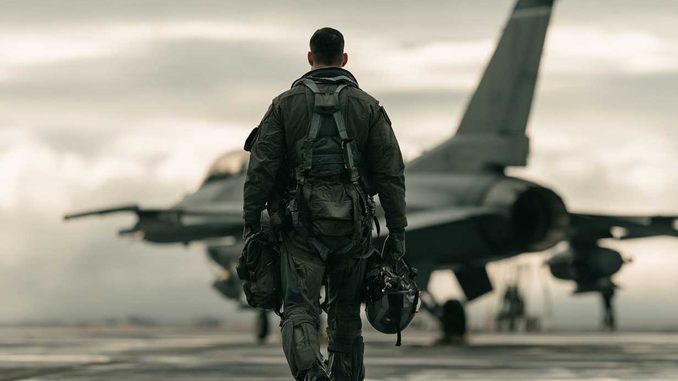
GCAP remains crewed, but AI, autonomy, and budget constraints are already laying the groundwork for aerial combat where the cockpit could disappear.
In Summary
The fighter pilot is not going to disappear in 2035. The British, Italian, and Japanese GCAP is still designed around a crewed aircraft featuring a highly sophisticated digital cockpit. FCAS’s New Generation Fighter relied on the same principle prior to the halt of the joint Franco-German aircraft project in June 2026. However, technology is already preparing the next step. Artificial intelligence can fly an F-16 in dogfights, manage flight paths, fuse data from multiple sensors, and coordinate autonomous systems at speeds unreachable by humans. At the same time, military budgets are pushing toward architectures combining a few high-performance aircraft with numerous less expensive combat drones. The pilot is progressively becoming a mission commander rather than an aircraft driver. Eventually, if autonomy becomes sufficiently reliable, the question will no longer be whether a machine can fly a fighter, but why a human should still be placed on board.
GCAP Retains a Pilot but Is Already Removing Part of the Flying Duties
We must start with a fact. The sixth-generation fighter is not yet an uncrewed aircraft.
The United Kingdom still describes Tempest—the British core of the Global Combat Air Programme—as a crewed stealth fighter scheduled to enter service starting in 2035. In July 2026, the three partner nations signed a £4.6 billion development contract with Edgewing. Concurrently, London plans to invest £8.6 billion in GCAP over the next four years.
Yet the future cockpit already shows the direction being taken.
BAE Systems is working on information projected directly into the helmet, eye-tracking, and physiological monitoring of the pilot. Eye position, heart rate, respiration, or cognitive load can be analyzed so that artificial intelligence can detect overload and take over certain tasks.
The radar envisioned for Tempest is expected to generate up to 10,000 times more data than current systems. No pilot can directly process such a flow.
AI thus becomes essential to sort, fuse, and prioritize information before presenting it to the human operator.
To explore this transformation further: anatomy of the 6th-generation fighter jet.
Artificial Intelligence Is Already Mastering Part of Aerial Combat
Today, the role of a pilot combines several functions. One must control the aircraft, manage fuel and systems, monitor threats, communicate, interpret sensor data, identify targets, and employ weapons.
The sixth generation adds drone control, electronic warfare, and a gigantic volume of data to this list.
These are precisely the tasks in which machines are making rapid progress.
An AI can continuously compare thousands of parameters, recalculate a flight path, fuse radar and infrared tracks, maintain formation, or adapt its positioning relative to multiple opponents. It does not fatigue and can react in a few milliseconds.
DARPA’s Air Combat Evolution program provided a dramatic demonstration of this capability. The X-62A VISTA, derived from the F-16, was flown by artificial intelligence agents in close-range dogfights against a human-piloted F-16. Trials began as early as 2023.
In 2026, DARPA and the U.S. Air Force took another step forward with VENOM by integrating this autonomy into F-16s that are closer to operational aircraft.
Tactically flying a fighter is therefore no longer an exclusively human function.
See also: AI already pilots a fighter in autonomous interception.
The Pilot Is Transforming into a Commander of an Autonomous Fleet
Paradoxically, the eventual disappearance of the pilot begins with a transformation of their job.
DARPA envisions a clear division of labor. The human retains higher-level functions: mission understanding, priority setting, overall strategy, target selection, and control over the use of force.
The machine handles local tasks: flight paths, positioning, obstacle avoidance, formation flying, and specific aerial tactics.
The pilot then becomes a mission commander.
This architecture corresponds to the American Collaborative Combat Aircraft initiative. Multiple drones can accompany an F-35 or the future F-47. Some carry missiles; others deploy sensors forward, jam enemy defenses, or take up positions in zones deemed too dangerous for a crewed aircraft.
FCAS was built around a similar philosophy with its Remote Carriers. Even after the termination of the joint Franco-German single-aircraft project in June 2026, Paris and Berlin decided to pursue the development of a European collaborative combat architecture linking fighters, drones, and offboard effectors.
Eliminating the Cockpit Would Profoundly Change the Aircraft
Removing the pilot does not simply mean removing their seat.
A crewed aircraft must incorporate a canopy, an ejection seat, pressurization, an oxygen supply, flight interfaces, survival gear, and protective measures.
All of these elements consume volume and add weight.
An autonomous aircraft can use a portion of this space to carry more fuel, install sensors, improve cooling for electronic systems, or carry additional weapons.
Its airframe can also be designed with fewer constraints imposed by pilot visibility or human physiology.
G-forces remain limited by the structure, weapons, and equipment, of course. But human tolerance to load factors disappears from the equation.
The other disruption involves risk. Losing an autonomous aircraft remains costly, but it no longer means losing or capturing a pilot whose training requires several years.
This alters what a commander can accept during a Suppression of Enemy Air Defenses (SEAD) or deep-penetration mission.
Budgets Are Pushing Toward Fewer Aircraft and More Drones
However, the sixth generation faces an economic contradiction.
The more stealthy, connected, and sensor-rich an aircraft becomes—and the more capable it is of surviving in highly contested airspace—the more expensive its development becomes.
The United Kingdom is committing £8.6 billion over four years to GCAP. Yet its 2026 Defence Investment Plan also sets aside £300 million for Collaborative Combat Aircraft and £5 billion for drones and autonomous systems more broadly.
This dual investment is revealing.
The United States is following the exact same logic. The U.S. Air Force initially aimed to cap the cost of a Collaborative Combat Aircraft at roughly one-third that of an F-35. By March 2026, program officials stated they had surpassed that cost-reduction goal.
This does not mean a sophisticated autonomous fighter will be cheap. Stealth, engines, AESA radars, secure communications, and electronic warfare are costly whether a pilot is present or not.
The economic gain stems primarily from a different doctrine: no longer expecting the same aircraft to do everything.
A few highly sophisticated platforms can command a larger fleet of specialized, lower-cost drones.
Also read: the collaborative drone CCA enters the industrial phase.
Autonomy Becomes Essential When Communications Are Jammed
The future autonomous aircraft cannot simply be remote-controlled.
In a high-intensity conflict, data links will be jammed, intercepted, or temporarily severed. An operator located hundreds of miles away will not be able to dictate every heading change.
The aircraft will have to press on alone.
Navigation, collision avoidance, formation keeping, sensor management, threat searching, and flight path adaptation will all need to function locally.
This is one of the primary technological challenges. AI excels when rapidly analyzing a situation for which it has been trained. War, by contrast, produces ambiguous, incomplete, and sometimes intentionally deceptive scenarios.
Here, humans retain a crucial advantage. They possess a better understanding of context, intent, diplomatic ramifications, and situations that fall entirely outside the expected script.
The Disappearance of the Pilot Will Be an Evolution Rather Than a Revolution
The GCAP planned for 2035 is still expected to carry a pilot. France is likewise developing the Rafale F5 around a human crew working alongside a stealth combat drone.
Thus, the sixth generation does not signal the immediate death of the cockpit.
Nonetheless, it is putting in place nearly all the technologies required to eventually do without one: autonomous flight, tactical artificial intelligence, automated data fusion, software-assisted electronic warfare, collaborative drones, and command by intent.
The most plausible scenario is therefore a gradual transition. Humans will retain missions requiring judgment, political understanding, and accountability. Machines will absorb dangerous, repetitive, and extremely fast-paced missions.
Then, the division of labor may evolve further still.
The paradox is that the greatest innovation of 6th-generation fighter jets may not be their futuristic cockpits. It may be making those cockpits unnecessary.